Winter Hydroponics With Minimal Heat: How to Keep Kratky, DWC and Small Indoor Systems Productive When Temperatures Drop
Common Winter Hydroponics Mistakes (And What They Cost You)
“Cold roots are fine. Hydroponics has tons of oxygen, so plants will still grow.”
That belief is why so many winter Kratky buckets and DWC tubs look healthy on top but barely move for weeks. The roots are sitting in 5–10 °C solution, metabolism is crawling, and every adjustment at the nutrient bottle or pH pen feels useless.
In 2026, a lot of balcony and spare-room growers are running straight into this wall. Reddit threads are full of stalled lettuce, rotten-smelling Kratky tubs and plug-and-play systems that produced great in summer and then crashed once night temps dropped into single digits (example discussion). At the same time, small-space case studies are showing that with smart insulation, crop choice and a bit of passive heat capture, you can still pull steady salads indoors with minimal power use as noted in this guide.
This article is about that gap: why winter conditions wreck small Kratky, DWC and plug-and-play systems, and how to reconfigure them so you keep harvesting even when your water wants to sit at fridge temperatures.
Mistake 1: Treating “Room Feels Cool” As a Root-Zone Measurement
Growers often assume that if the room is 15–18 °C, the reservoir must be similar. In reality, small plastic tubs sitting on cold concrete, near glass, or in a draft can sit 3–8 °C colder than the air.
Below about 12–14 °C, most leafy greens and herbs dramatically slow root activity. Nutrient uptake drops, pH drift slows, and EC creeps up because the plant is not pulling dissolved salts out of solution. The result is what you see reported so often in winter Kratky threads: “The plants look fine, but they just stopped.”
Mistake 2: Running Summer EC, pH and Crop Choices in Winter
Another pattern across winter failure reports is copying summer recipes: same nutrient brand, same dosage, same basil-heavy crop mix. But winter hydroponics is a different environment:
- Shorter days and lower leaf temperatures reduce photosynthesis.
- Cooler roots drink less and eat less.
- Crops like basil, tomatoes and cucumbers want 18–22 °C nutrient solution and strong light. Put them in a 10 °C tote and they stall or rot from the crown down.
Trying to push warm-season crops in cold solution forces you into chasing problems with additives and frequent reservoir changes instead of fixing the core issue: wrong plant for the climate.
Mistake 3: Ignoring Insulation Because “It’s Indoors”
Even indoors, hydro systems often sit in the coldest micro-climates:
- On tiled floors that stay near outside ground temperature.
- Right against single-pane windows or balcony doors.
- In unheated spare rooms where the thermostat never measures.
In the Reddit Kratky-in-winter discussion, people reported 5–10 °C solution in buckets placed near glass while the rest of the apartment was “comfortable.” That is enough to stall lettuce, let alone basil. Without insulation under and around the reservoir, you are effectively coupling your nutrient solution to the outdoors.
Mistake 4: Assuming More Air, More Bubbles Or More Nutrients Will Fix Cold Roots
Deep Water Culture growers hit a similar wall. The instinctive move when plants stall is to increase airflow, add another stone, bump EC, or switch nutrient brands. But cold water already holds plenty of oxygen. The limiting factor is biochemical speed, not dissolved O₂.
At 5–10 °C, roots are “awake enough” to respire but too cold to drive strong growth. You can bubble all you like; the plants will sit still until the root zone warms up. Meanwhile, feeding them summer-strength nutrients in that state is a good way to accumulate salts and invite tip burn once temperatures rise.

Why Winter Wrecks Small Kratky, DWC & Plug-and-Play Systems
Cold Water, Slow Plants, Weird Chemistry
Hydroponic textbooks and extension publications typically recommend 18–22 °C solution temperature for most leafy crops because that is the sweet spot where roots have enough oxygen, enzymes run efficiently, and nutrient uptake is balanced. Below that window:
- Enzyme activity in roots slows, especially for phosphorus and micronutrient uptake.
- Membranes become less fluid, so ions move more slowly into cells.
- Roots become brittle, with short new tips and poor branching.
So even if EC and pH are “perfect,” plants can still show deficiency-like symptoms or just sit there. Cold does not show up on your EC meter, but you see it in growth rates and root structure.
Temperature vs EC vs Oxygen: The Trade-Off in Winter
Colder water holds more dissolved oxygen, which is good for root health, but you pay for it in speed. In very warm weather, we fight low dissolved oxygen and root disease. In winter, we usually have the opposite curve:
- At 18–20 °C: high oxygen, good growth, stable pH drift, and moderate EC consumption.
- At 12–15 °C: very high oxygen, slower growth, slight reduction in nutrient uptake.
- At 5–10 °C: plenty of oxygen, but plants are idling and may barely consume nutrients at all.
This is why winter systems so often show EC creeping up or staying flat while water levels fall slowly; you are losing water to evaporation and transpiration, but the plant is not taking up salts at the same rate.
Why Small Systems Suffer More Than Big Ones
On balconies, windowsills and in small tents, reservoirs are usually:
- Low volume (5–20 L), so they change temperature quickly.
- Thin plastic with lots of exposed surface area to radiate heat away.
- Placed on cold substrates like tile, metal shelves or concrete.
Compared to a 100 L insulated reservoir, a 10 L Kratky tote on a tiled floor will track every night-time temperature swing. If outside air drops from 10 °C to 2 °C overnight, that little tote can easily end up near 5 °C by morning.
Method-Specific Winter Weak Points
- Kratky: No active circulation, no pump warmth, and no inline heater options out of the box. Whatever temperature the solution drifts to is what the roots get. The upside is that static water loses heat a bit more slowly than actively bubbled water, and it is easy to wrap and insulate a sealed tote.
- DWC: Continuous aeration keeps oxygen levels high, but bubbling can increase convective heat loss. If the air pump is drawing very cold air from a garage or outside, it can actively chill the solution. The big advantage is that DWC usually has a central reservoir where an aquarium heater or insulated sump can be added.
- Plug-and-play countertop systems: These usually sit in the warmest part of the house and have integrated lights that add a little heat, which is why they tend to keep producing. Their weak point is shallow, poorly insulated reservoirs and lids that bleed heat and allow light into the nutrient solution.
Recognizing where your particular system is bleeding heat is the first step to fixing winter performance without throwing a lot of watts at the problem.
How To Fix Winter Problems: Kratky, DWC & Countertop Systems
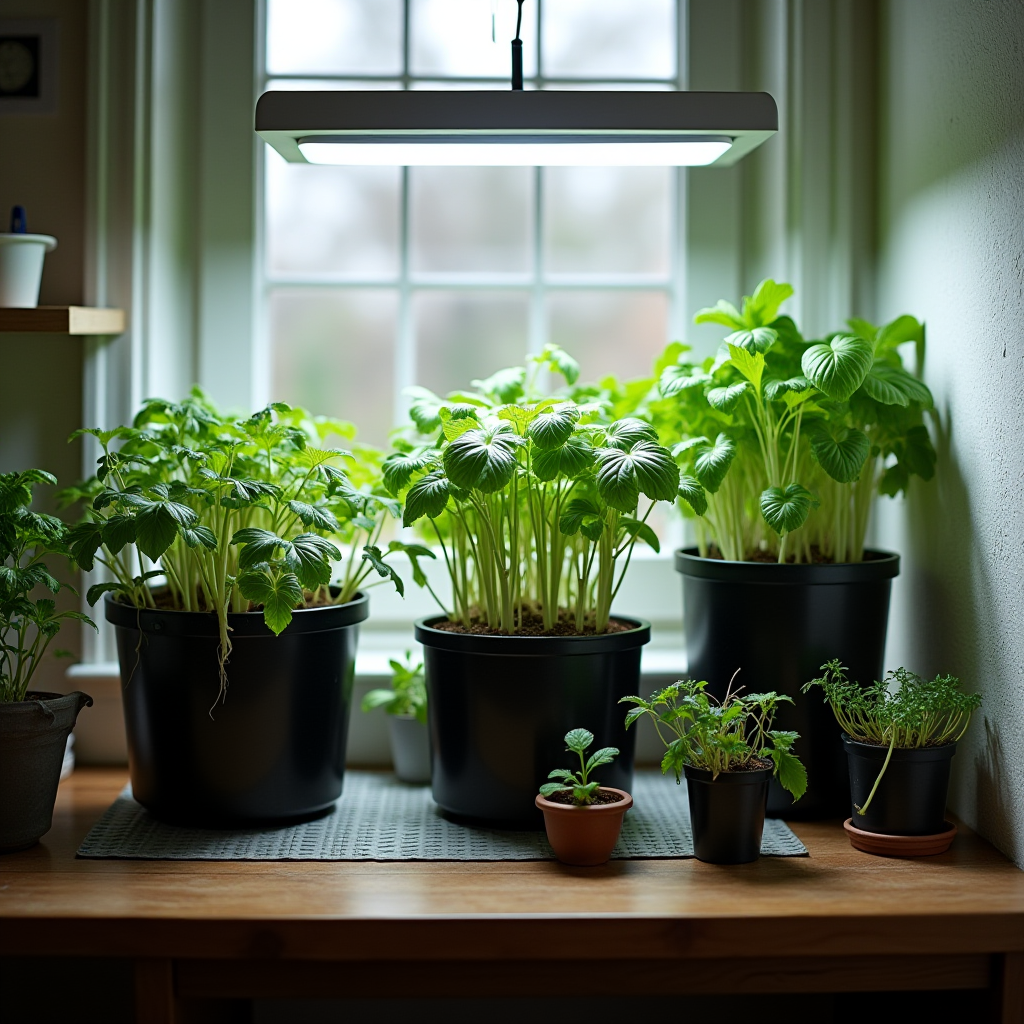
1. Move The System Into The Warmest Micro-Climate You Have
You do not need a dedicated grow room. You do need to stop treating your hydro system like an unheated storage box.
- Prefer interior walls over exterior walls.
- Avoid placing reservoirs directly against glass, balcony doors or cold brick.
- Get systems off the floor. Even a simple layer of cardboard, wood or foam under your tote or bucket can save 1–3 °C in root-zone temperature.
- For balconies, consider bringing the reservoir just inside the door and running lines or plant trays to the window area, as suggested for small-space layouts in this Grozine article.
2. Insulate The Reservoirs Like You Mean It
Think of your nutrient solution as a low-grade battery of heat. Your job is to stop it leaking to the coldest things around it.
- Choose better containers: Thick-walled, opaque totes or buckets are superior to thin, clear storage tubs. Dark plastic also cuts out light leaks that drive algae and biofilm.
- Wrap the sides: Use reflective insulation (Reflectix-style), yoga mats, camping foam, or rigid foam board. Tape or strap it around the reservoir. Don’t forget the lid.
- Double-container trick: Put a smaller reservoir into a larger tote, fill the gap with crumpled cardboard, foam pieces, or even old towels. Air plus insulation around the inner tank dramatically slows heat loss.
- Bundle small systems together: Several buckets or Kratky totes touching each other and sharing a single insulated box ride out temperature swings more smoothly than a lone bucket surrounded by cold air.
3. Use Light And Schedule As Passive Heating
LEDs are efficient, but at typical home-growing power densities (25–40 W over a small Kratky tote or countertop garden), they still add a couple of degrees to the local air and sometimes the reservoir.
- Run your main photoperiod through the coldest hours of the night and early morning. If your room is coldest between 2 a.m. and 7 a.m., schedule lights from midnight to 2 p.m. rather than 8 a.m. to 10 p.m.
- Keep enough clearance to avoid heat stress on foliage, but do not waste the gentle ambient temperature rise the fixture provides.
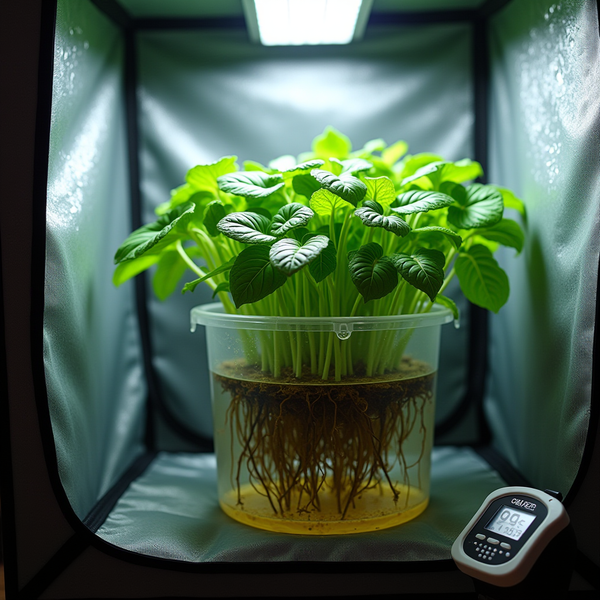
- For enclosed cabinets or tents, a solid LED fixture plus good insulation can keep the air a few degrees warmer than the rest of the room, which in turn protects the solution.
4. Add Low-Wattage Heat Only Where It Matters
If you are willing to spend a little power, target it at the root zone, not the whole room.
- Central heated reservoir for DWC: Tie buckets or grow sites into a single reservoir and add one small, adjustable aquarium heater. Set it at 18–19 °C, not 24–26 °C. You want “cool but active,” not tropical.
- Heated sump cabinet: Place your reservoir in a small, insulated cabinet or box. Use a low-wattage heat mat under the reservoir or a tiny heater controlled by a thermostat. Keep cabinet air just above your desired water temperature to avoid overshooting.
- Seedling mats under small Kratky totes: For 10–20 L containers, a seedling heat mat on a thermostat is often enough to keep the solution above 15–16 °C even in cooler rooms. Always monitor with an aquarium thermometer while you dial it in.
- Control air pump intake: For DWC, make sure your air pump is drawing from the warmest part of the room, not from a drafty window or unheated hallway. Cold intake air will cool the solution faster.
5. Choose Crops That Actually Want Your Winter Temperatures
Trying to grow warm-season fruiting crops in a cold, minimally heated system is like asking a tomato to behave like a cabbage. Match crops to the environment and life gets easier.
Good winter hydroponic candidates (Kratky or DWC):
- Lettuce (butterhead, romaine, loose-leaf types)
- Spinach
- Kale and other brassica greens (mustard, mizuna, tatsoi, komatsuna)
- Swiss chard
- Arugula (rocket)
- Asian greens like pak choi and small bok choy
- Parsley, cilantro, chives, green onions
- Mint (if light is decent)
High-frustration crops in low-heat winter rigs:
- Tomatoes, cucumbers, peppers, eggplant
- Most basil-heavy mixes in rooms that sit below 18 °C
- Large, long-season fruiting plants unless you have intentional heating and strong lighting
On balconies or very cool rooms, rotate your mindset: winter is for leaf and stem crops. Save the fruiting plants for warmer months or for actively heated, high-light spaces.
6. Adjust EC And pH For Winter Metabolism
Because plants grow slower in the cold, you generally want slightly lighter nutrient strength than in summer, and you want to watch pH range more closely to avoid micronutrient lockout.
- Leafy greens (Kratky or DWC): 0.8–1.2 mS/cm (800–1200 µS/cm) is a good winter starting point in cool rooms.
- Herbs: 1.0–1.6 mS/cm depending on species and vigor. Mint and chives tolerate higher EC than delicate cilantro in cool conditions.
- pH target: 5.8–6.2, with acceptable drift between 5.5 and 6.5. Above 6.5 in cold solution, iron and other micros become less available, and you will see yellowing even if EC looks ok.
Check EC and pH at least twice a week. In Kratky, you will see slower changes than in recirculating systems; in winter that is partly because uptake is slower. Resist the urge to “fix” a stable EC by throwing in stronger nutrients. Instead, ask whether the plants are simply cold and slow.

What To Watch Long-Term: Benchmarks, Tweaks And When To Change Methods
Benchmark 1: Solution Temperature Ranges
Pick a simple, realistic target window and manage toward it:
- Ideal for winter leafy greens: 18–20 °C solution.
- Acceptable with slower growth: 14–17 °C.
- Stunting and headaches: below ~12–14 °C for more than a day or two.
Use inexpensive aquarium thermometers or digital probes and actually log your minimum and maximum temperatures for a week. If your nightly minimum is consistently in the “stunting” band, focus on insulation and micro-climate changes before you tweak nutrients.
Benchmark 2: Growth Speed vs. EC & pH Drift
Once you have the root zone roughly in range, use EC and pH behavior as diagnostics:
- If plants look healthy but growth is slow and EC barely budges over several days, roots are probably still too cold or light is weak.
- If EC drops steadily and pH drifts slowly upward (for most leafy mixes), the system is in the zone: plants are feeding and growing.
- If EC creeps up while leaves pale or show interveinal chlorosis, pH may be too high for cold conditions or the nutrient ratio may not suit slow growth.
Benchmark 3: Root Appearance
Healthy winter hydroponic roots in cool conditions should still be mostly white to cream-colored, with active new tips. Watch for:
- Very fine, glassy roots with almost no branching: usually prolonged cold, not infection.
- Brown, slimy roots with rotten smell: typically more of a warm-water plus low-oxygen problem, but can appear after temperature swings combined with organic contamination.
- Roots constantly glued to the container walls above the water line (Kratky): often a sign that the air gap is bigger than needed because you under-filled to “avoid drowning,” and the cold liquid zone is not attractive to the plant.
In Kratky, you can often rescue a cold, under-performing tub by slightly raising the solution level (temporarily shrinking the air gap) once the root mat is established. This gives more root mass access to whatever warmth remains in the main reservoir volume.
When To Switch Methods (Or Combine Them)
Some winter setups are fighting physics harder than they need to. It can make sense to pivot methods as seasons change:
- Garage or balcony under 10 °C at night: Drop attempts at DWC or large Kratky totes out there unless you are ready to insulate aggressively and add heat. Move to a small, well-insulated indoor Kratky or a countertop system instead.
- Cool but stable spare room (15–18 °C): Perfect for insulated Kratky salad totes or a cluster of DWC buckets tied to a small heated reservoir.
- Limited power budget: Run a mostly passive Kratky setup indoors and reserve power for lights. Save DWC and more heat-hungry crops for spring and summer.
- Mixed strategy: Keep a high-control, heated DWC or tower system for the crops you care most about, and a lower-energy Kratky bank for backup greens.
Winter-Specific Maintenance Routines
Finally, tighten up your winter operating habits:
- Wipe lids, collars and exposed container surfaces more often. Cold, slow systems accumulate biofilms and algae quietly.
- Calibrate pH meters more frequently; cold rooms and condensation are rough on probes.
- Use top-ups with slightly warmer water (not hot) to keep solution from drifting too low, especially in very small systems.
- Plan reservoir changes around temperature. If tap water is very cold, mix nutrients and let the solution warm indoors before swapping.
Winter hydroponics without big heaters is absolutely viable. But you have to treat temperature, crop choice and insulation as primary design variables, not afterthoughts.

As an Amazon Associate, I earn from qualifying purchases.