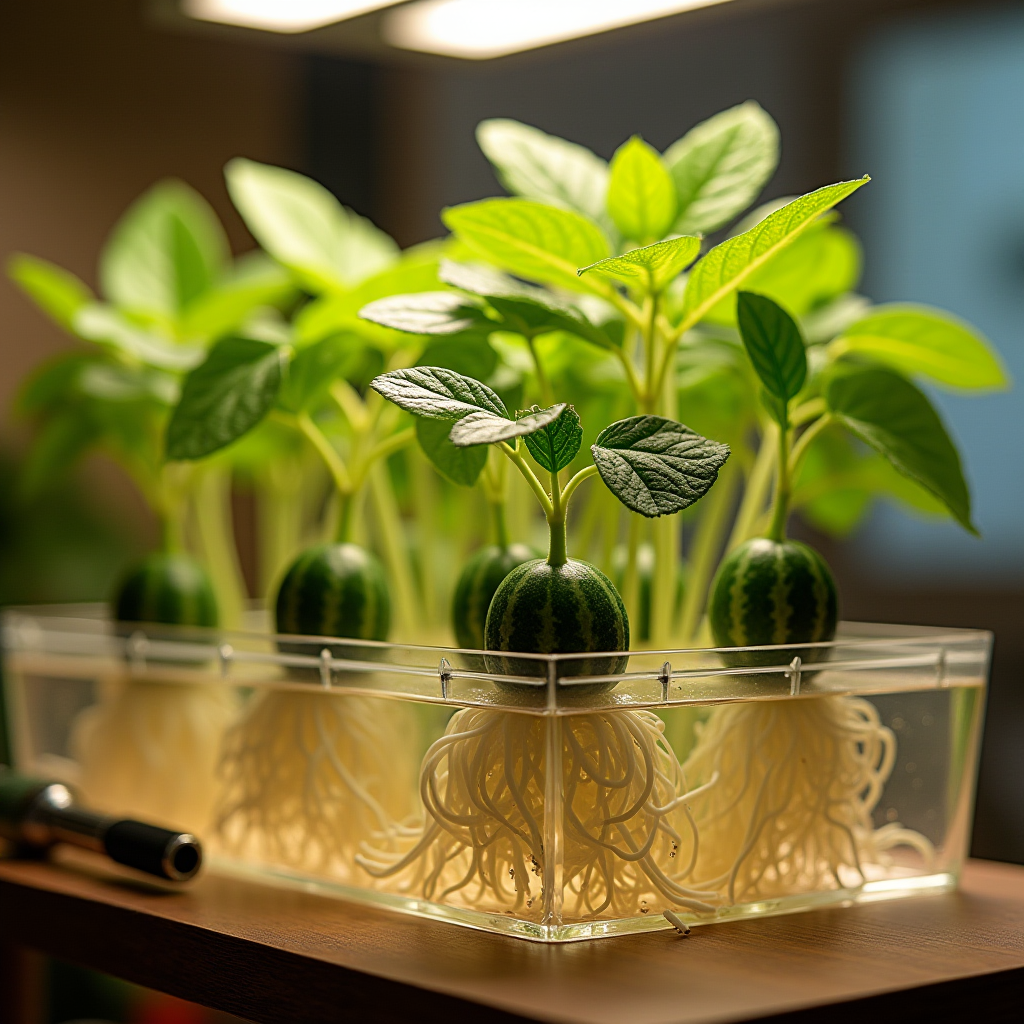
Miniature Hydroponic Watermelon Breeding: How Tiny, High-Brix Varieties Could Change Indoor Fruit Growing
The Common Mistakes Indoor Growers Make With Fruiting Crops
Most indoor growers assume that if they throw enough watts, EC and trellis clips at a standard watermelon, they can tame it into a 2×4 tent. That belief is exactly why so many “indoor fruit” projects stall at lanky vines, aborted flowers and half-sweet fruit.
Meanwhile, a pair of amateur breeders in Japan quietly pulled off something very different: a watermelon line that tops out at roughly chicken-egg size, with dense flesh and surprisingly high sweetness, as covered in this report. Instead of fighting the plant, they changed the genetics.
That is the pivot most indoor hydroponic growers have not made yet. We keep engineering systems for full-size field cultivars, instead of choosing or breeding genetics that actually fit the tent, the balcony rail, or the NFT rail under an LED bar.
This piece will walk through where most indoor fruit projects go wrong, what traits actually matter in tiny-space watermelons, and how to treat variety choice and breeding as seriously as your pH pen.

Why Full-Size Genetics Fail Under LEDs And In Small Systems
Mistake 1: Treating plant size as a training problem, not a genetics problem
Watermelons were bred to sprawl across warm, high-light fields. A typical field cultivar will happily throw 3–5 m (10–16 ft) of vine and several square metres of leaf area per plant. In a 120 cm-wide tent, that alone is a mismatch.
Under LEDs, you are also dealing with a fixed light footprint. Pushing a field-type vine into a tent means:
- Excess leaf area sitting outside the 500–900 µmol/m²/s zone.
- Shaded fruiting nodes that never hit the carbohydrate threshold to hold fruit.
- Very high transpiration demand on a relatively small DWC bucket or NFT channel.
The result is exactly what many growers report: lush early growth, then stalled fruiting or bland fruit, even at sensible EC and pH. The plant architecture never matched the light and volume envelope.
Mistake 2: Ignoring internode length and leaf angle
Internode length – the distance between nodes on the vine – is not just a breeding curiosity. It dictates how many leaves and flowering sites you can stack inside a given vertical and horizontal space.
- Long internodes + horizontal training = massive lateral spread and wasted light.
- Short internodes + semi-erect habit = more nodes per linear metre of trellis, more efficient use of photon budget.
Dwarfing genes in cucurbits reduce internode length and change leaf angle, producing semi-bush or bush types with inherently compact canopies, as discussed in many breeding guides for cucurbits such as those summarized by seed companies and extension resources profiling mini and dwarf watermelons.
Mistake 3: Running fruiting EC and light for “field yield” in a micro-root volume
Indoor growers often copy nutrient and light “recipes” from high-volume greenhouse or field setups into a 20–40 L DWC bucket or a slim NFT channel.
The problem is simple physics:
- Root volume and dissolved oxygen (DO) buffer are far smaller in hobby hydro systems.
- Evapotranspiration spikes faster in hot, small tents than in ventilated greenhouses.
- Any misstep in EC or temperature hits the plant harder and faster.
Running 2.4–2.8 mS/cm in a small DWC bucket with 800–900 µmol/m²/s light is asking for tip burn and calcium transport issues once fruit load comes on, particularly in warm, low-oxygen nutrient solution. Field cultivars tolerate that outdoors because they have deep, cool soil and thousands of litres of water buffering them. Your bucket does not.
Mistake 4: Assuming any “mini watermelon” is automatically compact
Retail seed descriptions often label varieties as “mini watermelons” when only the fruit is small. The vines are still 2–3 m long.
Growers then discover that a “mini” variety tangles an entire 4×4 tent because they never checked habit descriptors like “bush”, “semi-bush”, “dwarf vine”, or actual vine length. As noted in summaries of compact cultivars such as Mini Love and Golden Midget in this overview, fruit size and plant size are separate variables.
Why These Mistakes Happen: Genetics, Constraints, And Indoor Reality
The field-to-tent mindset lag
Hydroponics has largely solved leafy greens indoors because the crops are naturally compact and fast. We can hit commercial lettuce numbers in a 60 L NFT loop because the genetics and the system constraints align.
Fruit crops never enjoyed that advantage. Tomatoes, cucumbers and melons were improved for open-field or high tunnel use first. Breeding programmes only recently started selecting for controlled environment agriculture and container performance, as highlighted in several seed and breeding notes around greenhouse and container watermelons documented here.
The result: a lag between LED / DWC tech and the plant material we stuff into it. Many growers are engineering around genetic mismatches rather than starting with genetics designed for tight spaces.
What the egg-sized watermelon story teaches us
The Japanese mini watermelon line that hit the news is a clear demonstration of what happens when you flip the priorities. Instead of asking “how do we squeeze a 5 kg fruit onto a balcony?”, the breeders asked “what if the fruit is 50–150 g, but still high-brix and deeply colored?”
According to their account, they selected over multiple generations for:
- Very small fruit size (roughly chicken-egg scale).
- Dense, pigmented flesh rather than hollow, watery interiors.
- Acceptable sweetness, measured as Brix.
They effectively redefined “acceptable” for a watermelon in the context of cramped urban balconies and limited container volume. That is exactly the mindset indoor hydro growers need if we want serious fruit production rather than occasional novelty.
Indoor constraints that must be baked into breeding goals
If you want to breed or select watermelons for miniature hydroponic setups, the constraints are non-negotiable:
- Light footprint: Most hobby lights deliver 400–800 µmol/m²/s over 0.8–1.2 m², not a whole field.
- Root volume: Typical DWC buckets are 20–40 L; balcony reservoirs might be 40–80 L total.
- Headroom: 120–200 cm in most tents; even less under shelves or window rigs.
- Heat and humidity: Small volumes make VPD and reservoir temperature swing fast.
Any breeding goal that ignores those numbers will produce plants the average indoor grower cannot realistically support. The plant must be built for LEDs and plastic reservoirs, not sun and soil.

How To Fix It: Choosing And Breeding Miniature Hydro Watermelons
Step 1: Start with truly compact, hydro-suitable varieties
Based on container and compact-field trials summarized in resources like Epic Gardening’s mini-variety guide here, the following seed lines make far more sense in a tent than standard field cultivars:
- Mini Love – Semi-bush habit, roughly 1–1.2 m (3–4 ft) vines, 1.5–3 kg fruits, ~70 days. Good candidate for single-plant DWC in 20–30 L with a single trellis panel.
- Golden Midget – Dwarf vines, 1–2 m (3–6 ft), 1.5–2.5 kg fruits with a golden rind at ripeness, ~70 days. Easy to read ripeness visually; ideal for first-timers.
- Triple Treat – Dwarf, vining plant with 3–4 ft vines and 1.5–2.5 kg fruits; typically three or more fruits per plant in 75 days.
- Mini-Me – Semi-bush, 1.5–1.8 m (5–6 ft) vines, 1.5–2.5 kg fruits, thin edible rind and low seed count.
- Treasure Chest – Compact semi-bush, 2–2.5 m (6–8 ft) vines, 1.5–2.5 kg fruits, bred specifically for high yield in small spaces.
All of these were selected for smaller plant habit and earlier maturity than standard watermelons. They are not yet “egg-sized” like the Japanese novelty line, but they are realistic starting points for indoor hydro projects.
Step 2: Match system type to crop load
For miniature hydroponic watermelon, the system choice is not academic. It directly controls how much fruit your plant can carry without crashing the reservoir.
Kratky for experimental single fruits
Kratky can work if you treat it as a low-input demonstration, not a production engine:
- Use at least 27–32 gallon (100–120 L) food-grade totes or barrels per plant.
- Start with EC around 1.2–1.4 mS/cm and let it creep up as the level falls.
- Plan for one, maybe two fruits per plant, and accept that you are running on a thin oxygen margin once roots fill the reservoir.
A safer twist is what many growers call “semi-Kratky”: you start static, then add air stones or a small recirculation loop once the root mass is heavy and solution volume has dropped to one-third or half.
DWC / RDWC for repeatable fruiting
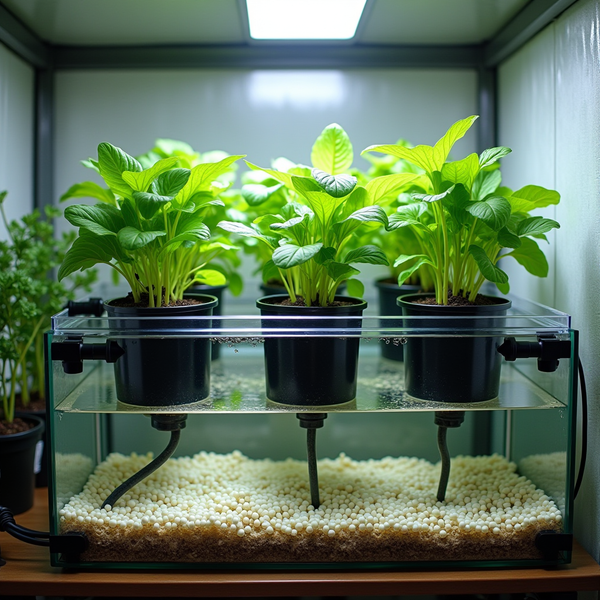
If you want consistent yields, DWC or recirculating DWC is a better fit:
- Dedicate 20–40 L of solution per plant, with strong aeration.
- Target 18–21 °C nutrient temperatures using insulation or a chiller where needed.
- Run weekly full changes once plants are flowering to reset EC balance and remove exudates.
RDWC lets you centralize monitoring and adjustment. One control bucket with a pH/EC probe saves you chasing numbers across multiple solo buckets.
Step 3: Dial nutrient and environmental targets for compact vines
For miniature hydroponic watermelons under LED, the following working ranges are a solid starting point (adapted from cucurbit hydroponic recommendations in general hydroponic production guides such as those discussed by extension sources here):
- pH: 5.6–5.8 in early vegetative, allowing rise to 5.8–6.2 from flowering through ripening.
- EC:
- Seedlings / early veg: 0.8–1.2 mS/cm.
- Vine build (pre-flower): 1.6–2.0 mS/cm.
- Flowering / early fruit set: 1.8–2.1 mS/cm.
- Fruit bulking: 2.0–2.3 mS/cm if leaves remain healthy and dark.
- Air temperature: 24–28 °C lights on; avoid drops below 18 °C.
- RH: 60–70 % in veg; 50–60 % in fruiting to limit disease and stabilize transpiration.
- PPFD: ~500–700 µmol/m²/s in veg; 700–900 µmol/m²/s from early flowering onward.
Use a cal-mag supplement if your base water is very soft, and monitor new growth for marginal necrosis or blossom-end rot-like lesions on fruit as early warning of calcium issues.
Step 4: Train to a framework that fits your light
Compact vines still need structure. A simple, repeatable training plan looks like this:
- Single main leader up a vertical trellis on one side of the tent, tied with soft clips.
- Keep 2–4 laterals at intervals where they can occupy unused light zones; remove others early.
- Limit fruit per plant to match your light and reservoir – for example:
- Mini Love / Golden Midget in 20–30 L DWC under ~300–400 W LED in a 2×4 tent: aim for 2–3 fruits.
- Triple Treat / Treasure Chest in a 4×4 with ~500–600 W LED and 40 L root volume: 3–4 fruits.
- Support fruit with slings tied back to the trellis to prevent stem damage.
This is the same logic greenhouse cucumber growers use, but scaled to a smaller, less forgiving environment.

What To Watch Long-Term: High-Brix, Micro-Fruit Watermelons For Hydro
Key breeding and selection traits for indoor hydro lines
If you are serious about breeding or at least selecting toward hydro-optimized watermelons, stack these traits:
- Short internodes / semi-bush habit: Look for lines described as bush, semi-bush, or dwarf vine. These typically carry dwarfing genes that suppress vine length and alter leaf angle.
- Early maturity (≤80 days): Every extra week under LEDs costs power and raises risk of system failure. Favour lines that set and ripen fruit quickly, such as Mini Love, Golden Midget and Blacktail Mountain, all reported around the 70–80 day mark in compact trials like these.
- Small fruit footprint: For hardcore micro-hydro projects, target sub-1 kg fruit and eventually down toward the chicken-egg scale demonstrated by the Japanese breeders.
- High Brix and dense flesh: Indoors you control light, so you can push sugar content, but only if the genetics are capable. Use a handheld refractometer to measure Brix of each candidate fruit and save seed from the superior ones.
- Resistance to cracking and physiological disorders: Indoor hydro is prone to EC swings and irregular watering; lines that hold flesh integrity under these conditions are worth keeping.
- Low leaf area per fruit: Aim for lines that maintain good fruit size and Brix with less foliage. This makes them more compatible with limited LEDs.
A simple home-breeding workflow for tent growers
You do not need a full breeding programme to improve your own planting stock. A practical workflow looks like this:
- Pick 2–3 compact varieties – for example Mini Love, Golden Midget and Triple Treat.
- Grow them under your actual conditions – same tent, LEDs, DWC buckets or NFT you intend to use long-term.
- Record key metrics for each plant:
- Days from sowing to first flower and to first ripe fruit.
- Maximum vine length inside the trellis.
- Number of fruits held without nutrient issues.
- Brix readings for each harvested fruit.
- Save seed from your best-performing plants – especially those that stayed compact, set fruit easily with hand pollination, and delivered high Brix without tip burn or nutrient drama at your standard EC.
- Repeat over 3–5 generations, always growing under LEDs and hydroponic conditions. You are selecting not only for genetics but for compatibility with a particular system design and management style.
Over time, you will nudge the population toward plants that treat 2×4 or 3×3 tents as their native environment, not a compromise.
Integrating micro-melons into vertical and balcony rigs
Once you have compact lines, you can plug them into systems that previously only made sense for herbs and leafy greens:
- Balcony Kratky barrels: One dwarf vine per barrel, trellised up a simple frame; fruit slings tied back to railings.
- Multi-level racks: Short-internode vines trained along horizontal wires, with each level only 50–60 cm high, as long as you keep fruit size small.
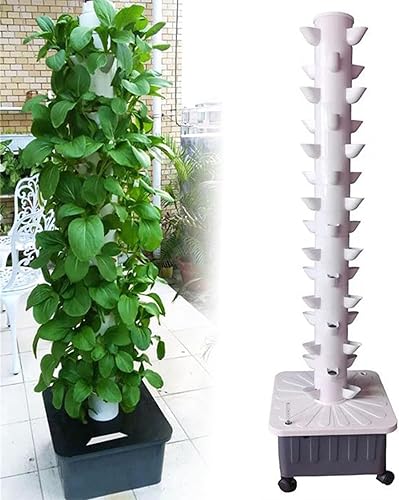
- Aeroponic towers: Carefully pruned vines can occupy the bottom tiers while upper tiers carry greens and herbs, but this only works if fruit size and vine load stay modest.
The Japanese egg-sized watermelon shows that if you deliberately compress fruit size, you can realistically treat watermelons like a speciality berry crop in small spaces. That opens doors for mixed plantings in towers and racks that would be unthinkable with conventional cultivars.
Evidence that this direction works
We already have three independent streams of evidence pointing the same way:
- Mini and dwarf cultivars like Mini Love, Golden Midget, Triple Treat and similar lines selected for containers and short seasons perform more predictably in confined spaces than field types, as catalogued in compact variety guides such as this one.
- The Japanese egg-sized line demonstrates that extreme miniaturisation with acceptable sweetness is possible through persistent amateur selection, as reported in this feature.
- Hydroponic cucurbit production research shows that cucurbits respond well to tightly managed EC, pH and DO in recirculating systems, provided canopy size and fruit load match the system’s capacity, as outlined in hydroponic vegetable production fact sheets like this one.
Pulling those together, the path forward for indoor watermelon is clear: move more of the work into the seed, so your LEDs, buckets and towers are not constantly fighting the plant.
Bottom line: Build the watermelon for the tent, not the tent for the watermelon
If you want miniature watermelon hydroponic growing indoors to be more than a one-off project, stop trying to “scale down” field genetics. Start with compact, early, high-brix lines. Select and breed for short internodes, modest fruit size and compatibility with DWC, NFT and Kratky systems.
When you do that, you stop asking whether a watermelon belongs in a tent. You start asking how many small, dense, high-brix fruits you can realistically ripen per square metre without breaking your EC, pH or LED budget.
As an Amazon Associate, I earn from qualifying purchases.
Names and numbers can make a football shirt feel linked to a particular player. Supporters interested in historic designs may consider Real Madrid jersey(camiseta del Real Madrid) while comparing different eras. Supporters can compare current and classic versions without losing sight of team identity.