Year-Round Aeroponic Tower Farming in Small Spaces: What TikTok Doesn’t Show You About Nutrients, Roots and System Design
1. Common Mistakes: What TikTok Doesn’t Show You
Most vertical aeroponic towers look flawless in a 30-second clip. Dense greens, spotless plastic, zero wires. What you never see is the reality two weeks later: browned roots, half-clogged misters, and a pump that sounds like it is chewing gravel.
Year-round aeroponic tower farming in small indoor spaces is absolutely possible. The problem is that social content rarely explains the unglamorous parts: droplet size, nutrient stability, filtration, root mass management, and what happens when your pump or power cuts out at 2 a.m.
The Agrotonomy vertical farming videos are a good example of the trend: you see highly productive towers running year-round, but not the detailed breakdown of how the system is kept clean, how the feeding schedule is managed, or how failures are handled behind the scenes in real farm environments, as you can see in this Agrotonomy clip.
This guide focuses on the unsexy but critical side of a year round aeroponic tower system for small indoor spaces: how to design hardware that resists clogging, how to keep roots happy, how to spec pumps and nozzles, and how to keep the system alive during outages in an apartment or garage.
Mistake 1: Designing For Aesthetics, Not Reliability
Most social-first towers are built to look minimal: tiny base, skinny white column, hidden pump, and a nest of roots packed into a narrow tube. That works for a short shoot. It is a nightmare for long-term, real-world use.
Common symptoms:
- Reservoir is too small, so pH and EC swing wildly in 24–48 hours.
- No easy access to misters or manifold, so cleaning requires a full teardown.
- Roots choke the column because there is nowhere for them to hang and dry between mist cycles.
For a reliable indoor vertical aeroponics setup for apartments, the system has to behave like an appliance: easy to open, easy to clean, and tolerant of user error.
Mistake 2: Treating Aeroponics Like DWC Or Kratky
If you come from deep water culture (DWC) or Kratky, it is tempting to pour the same nutrients into a misting tower and expect better growth. Instead, you hit new problems:
- Nutrients formulated for buckets build biofilm in mist lines.
- Organic or “thick” blends leave solids that become sludge in nozzles.
- High EC levels that are fine in DWC burn fine, misted roots.
DWC has large reservoirs and constant aeration. Kratky relies on a stable, mostly still volume. Aeroponics is different: thin films of nutrient on roots, high oxygen, small-bore plumbing, and pumps cycling on and off for hundreds of times per day. The margin for error is smaller, so nutrient and hardware choices matter more.
Mistake 3: Ignoring Droplet Size And Misting Pattern
Every aeroponic tower lives or dies in the root chamber. What matters there is not just “getting them wet”, but how they are wetted:
- Fine high-pressure mist (50–80 micron droplets) can deliver great oxygenation but clogs easily, especially in small indoor towers.
- Low-pressure spray or coarse droplets are more forgiving and still provide excellent growth when roots are well exposed to air between cycles.
- Dead zones in the tower where spray does not reach cause local root death and plant stress.
If you copy high-pressure agriculture-style misters into a 20–30 liter apartment system without matching filtration, pressure, and nutrient purity, you are signing up for constant clog hunts.
Mistake 4: No Backup Plan For Pump Or Power Failure
A well-aerated DWC bucket can coast through a short outage. A Kratky tub is basically unaffected. An aeroponic tower with bare roots can go from “healthy” to “crispy” in an hour under bright LEDs if the pump fails and mist cycles stop.
Most home towers have exactly one pump, one timer, and no fallback. In a small indoor vertical aeroponics setup for apartments, you cannot count on being home every time something fails. You need passive time buffers and simple backup strategies, which we will cover later.

2. Why These Problems Happen In Small Aeroponic Towers
Once you understand the physics and chemistry inside a vertical tower, the common aeroponic tower farming nutrient and clogging problems become predictable instead of mysterious.
Root Zone Physics: Why Space And Air Matter
Aeroponics works because roots sit in a high-oxygen environment and receive brief, frequent nutrient sprays. The roots are supposed to be mostly in air, not soaking in solution.
In small towers:
- Columns are narrow, so roots quickly fill the whole volume.
- Once roots form a dense curtain, inner roots stay saturated and oxygen drops.
- If misting cycles are too long or too frequent, roots never dry slightly, and you get the same low-oxygen problems as in poorly-aerated DWC.
That is why a year round aeroponic tower system for small indoor spaces must be designed with extra root space and aggressive pruning in mind. Give the roots room and keep them periodically exposed to air.
Droplet Size, Pressure, And Clogging
High-pressure aeroponics (HPA) uses tiny droplets (often 50–80 microns) created by specialized nozzles and pumps running 60 psi or more. This can create a very efficient root environment, but it is unforgiving.
Low-pressure aeroponics (LPA) uses standard submersible pumps at 2–5 psi with larger-orifice sprayers or drilled holes. Droplets are larger, and roots often get sprayed and splashed rather than perfectly misted. For indoor vertical towers, LPA is usually the smarter trade-off.
In a compact apartment tower, most “mister problems” are not magic:
- Precipitated nutrient salts forming crystals on nozzle outlets.
- Fine organic particles or algae accumulating in lines.
- Hard water scaling (calcium carbonate) from high-alkalinity tap water.
Research on recirculating aeroponics and NFT systems has consistently shown that organic nutrients and high-carbon loads greatly increase biofilm and clogging risk in emitters, especially under warm conditions, as summarised in this review of soilless culture systems. In small towers, the impact is magnified because you have less plumbing volume and more frequent cycling.
Nutrient Chemistry: Why “Clean” Formulas Matter
The more complex the nutrient, the more likely you are to create deposits in a misting system. Thick organic blends, fish emulsions, or compost teas include colloids and solids that do not stay dissolved in a small, warm reservoir.
In contrast, hydroponic-grade mineral nutrients are engineered to stay in solution when mixed correctly at recommended ratios and pH. Studies on hydroponic solution management highlight how improper mixing order or extreme pH can cause certain ions (especially calcium and phosphate) to fall out of solution as scale or sludge, which then ends up in your emitters, as discussed in this Haifa nutrient solubility guide.
This is why you cannot treat a vertical aeroponic system like a soil plant you feed occasionally. The entire tower is a closed hydronic circuit. Any solids you pour in will eventually end up in a nozzle, filter, or root mass.
Small-Volume Reservoir Dynamics
Most social-media-ready towers have tiny bases to look sleek. That means:
- Fast pH drift as plants selectively uptake ions.
- Rapid EC changes as plants drink and evaporative losses mount.
- Big temperature swings because a small water mass heats and cools quickly next to lights.
All of this stresses roots and makes clogging worse. Warm, nutrient-rich solution with high organic load is ideal for biofilm-forming microbes that glue solids to surfaces inside pipes and nozzles.
Why Aeroponics Is Less Forgiving Than DWC Or Kratky
In Kratky or DWC, roots are buffered by a large volume of water. Conditions can wander a bit without instant damage. In aeroponics, the root surface is directly exposed to air, droplets, and whatever is stuck to those droplets.
That means:
- EC that is too high will burn the finest root hairs very quickly.
- pH extremes hit the absorption surfaces directly with little dilution.
- Lapses in misting cause roots to dry and die fast under indoor lights.
The payoff is faster growth and higher oxygenation when you get it right, which is why commercial vertical growers still use aeroponic and mist-based systems despite the added complexity, as highlighted by groups like Agrotonomy in their vertical farming showcases.
3. How To Design A Reliable Indoor Aeroponic Vertical Garden
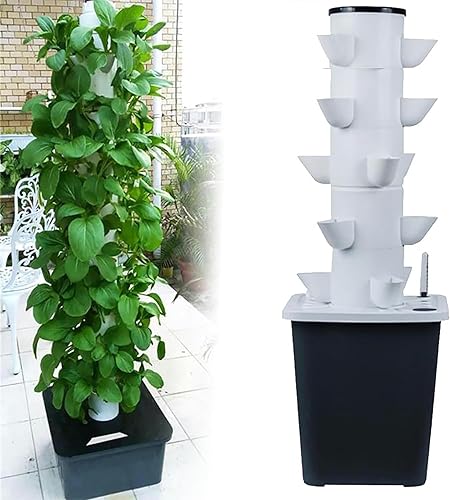
Now we translate those failure modes into concrete design choices. This is how to design a reliable indoor aeroponic vertical garden that fits in a real apartment, garage, or spare room and runs year-round.
Step 1: Choose Low-Pressure Aeroponics (LPA) For Small Spaces
For a compact, year-round system, start with low-pressure aeroponics:
- Pump: 400–800 L/h (100–200 GPH) submersible pump with at least 2–2.5 m head height.
- Pressure: 2–5 psi in the main line using standard pond or fountain pump style plumbing.
- Nozzles: Larger-orifice sprayers (0.8–1.0 mm or bigger) or simple drilled spray rails inside the tower.
This keeps the system in the “forgiving” zone. Droplets are larger, but roots still get plenty of oxygen because they live in air between cycles, not a bath. You gain huge reliability by giving up the ultra-fine, ultra-cloggy high-pressure mist.
Step 2: Spec The Tower Around The Reservoir, Not The Other Way Around
For a year round aeroponic tower system for small indoor spaces, start by choosing a reasonable reservoir volume and then design the tower above it:
- Reservoir: 20–40 liters for 16–24 leafy green sites, opaque, food-safe, with a tight lid.
- Footprint: 30–40 cm diameter so it fits in corners but has enough base mass.
- Height: 1.4–1.8 meters to stay below typical ceilings with room for lights.
Larger reservoirs buffer pH and EC swings and keep solution temperatures more stable, which directly reduces stress on roots and cuts down on biofilm growth.
Step 3: Design The Internal Manifold For Redundancy And Easy Cleaning
Inside the tower, you want a manifold that you can remove, inspect, and clean without cutting anything.
Practical pattern for small towers:
- A central PVC spine (13–20 mm) running vertically, fed by the pump line at the bottom or mid-point.
- Drilled 2–3 mm holes or snap-in low-pressure sprayers positioned to hit the main root zone area.
- Unions or quick-connect fittings at the base so you can pull the whole manifold out for service.
Some growers find that drilled holes in PVC are more reliable than small screw-in nozzles, because they are hard to clog and easy to ream with a toothpick or small drill bit. If you want more even coverage, a ring manifold at one or two levels can work well.
Step 4: Filter Everything Upstream
Install a filter directly after the pump before the riser goes up the tower. A 100–200 micron screen filter is sufficient for most low-pressure aeroponics. Clean it weekly.
If your tap water is high in sediment or iron, consider a small pre-filter on your fill water as well. The goal is simple: nothing granular should ever enter your recirculating loop.
Step 5: Dial In Pump Cycles For Your Environment
There is no single perfect mist cycle, but you can use a solid starting point:
- Leafy greens, moderate room humidity: 2–3 minutes ON, 10–12 minutes OFF.
- Seedlings or very dry rooms: 2–3 minutes ON, 7–10 minutes OFF.
- Night cycles: Stretch OFF times to 15–20 minutes if roots stay moist.
Then watch your roots:
- Healthy roots: white to cream, firm, no foul smell.
- Too dry: tips brown and crisp, roots feel papery.
- Too wet/low oxygen: roots beige/tan with slime or off-smells.
Adjust timing before you chase nutrients. Root feel and color are your primary diagnostics in an aeroponic tower.
Step 6: Choose Nutrients Built For Recirculating Systems
To prevent clogged misters in small aeroponic tower systems, your nutrient choice is as important as your hardware:
- Use a clean, mineral-based hydroponic nutrient labeled for recirculating systems.
- A 2-part (A/B) or 3-part line is ideal because you can control ratios across plant stages.
- Avoid organic or “thick” bottled fertilizers in recirculating aeroponics.
Mixing protocol:
- Fill the reservoir with water first.
- Add Part A, stir until fully dissolved.
- Add Part B (and Part C if applicable), stir thoroughly.
- Measure EC, adjust concentration if needed.
- Adjust pH last, after all nutrients are mixed and stable.
This mirrors standard hydroponic nutrient management best practices, as discussed in this Oklahoma State hydroponics guide. It is even more important in aeroponics because any precipitate ends up in your plumbing.
Step 7: Set Realistic EC And pH Targets
For most small indoor towers packed with greens and herbs:
- EC: 1.0–1.6 mS/cm for leafy greens and herbs, stay closer to 1.2–1.4 for mixed plantings.
- pH: 5.5–6.0, with 5.8 as a good central target.
Fruit crops like peppers and dwarf tomatoes can handle 1.8–2.2 mS/cm, but in a shared tower environment they can tip the balance. If you are just starting out, keep fruiting crops in their own system or in DWC, and use your aeroponic tower as a leafy green and herb workhorse.
Step 8: Design For Maintenance From Day One
Before you build or buy, ask three questions:
- Can I pull the manifold and pump without unplanting the whole tower?
- Can I fully drain the reservoir without moving the system?
- Can I visually inspect roots and spray pattern without major disassembly?
If the answer to any of those is “no”, you are adopting a maintenance nightmare. Good systems make it trivial to flush, clean, and service hardware. That is how commercial farms keep year-round aeroponic towers running, even when they are stacked in dense rows.
4. What To Watch Long-Term: Roots, Outages And Apartment Realities
You can get an aeroponic tower running in a weekend. Keeping it stable for 6–12 months in a small indoor space is a different challenge. Here is how to think about long-term reliability.
Root Management: Pruning, Volume, And Oxygen
Left alone, roots from a full tower of lettuce and herbs will form one giant, tangled curtain down the column. That looks impressive, but it is not ideal for oxygenation or flow.
Good root management in towers means:
- Regular pruning: Once roots from different plants meet and knot, trim them back lightly so each plant keeps its own main root mass.
- Dedicated root channels: If you are building from scratch, consider internal root baffles or channels that keep main root bundles from blocking the entire spray zone.
- Oxygen checks: Look and smell. Healthy roots are clean and neutral in smell. If you see slime or smell rot, shorten mist cycles, drop reservoir temperature if it is high, and clean aggressively.
Handling Pump And Power Outages
This is the part almost no TikTok video mentions, but it is where most small towers are lost.
Plan for three layers of protection:
- Passive buffer: Let the lowest few centimeters of root mass dip into a shallow nutrient pool in the base. Even in an “aeroponic” tower, this acts like an NFT/DWC safety net if misting stops for a short period.
- UPS or battery backup: A small uninterruptible power supply can keep a low-wattage pump and timer going for an hour or two during short outages.
- Sensor or smart plug alerts: Run the pump through a smart plug and let it notify you if it goes offline unexpectedly. This is not perfect, but it buys you awareness.
If an outage extends beyond your buffer, treat the system like a DWC emergency:
- Manually pour nutrient solution over the root zone every 20–30 minutes.
- If possible, temporarily lower some net cups into the reservoir to keep critical plants alive.
Once power returns, inspect roots. Trim any obviously dead or mushy sections to prevent them from decomposing in the tower.
Apartment Constraints: Noise, Heat, And Space
Indoor vertical aeroponics setup for apartments adds three constraints that farms do not worry about as much:
- Noise: Choose quiet pumps, isolate them on foam or rubber in the reservoir, and use flexible tubing to avoid vibration transferring to floors or walls.
- Heat load: LED lights and pumps can warm your solution. Use white or reflective tower surfaces, insulate the reservoir, and provide airflow. If the reservoir consistently exceeds 24–25 °C, growth and root health will drop.
- Space and access: Place the tower where you can reach all sides and get a bucket or hose to the reservoir. Back-of-closet installs are asking for neglect.
Lighting Strategy For Vertical Towers
Most “Instagram tower” lighting is either too weak or badly positioned. For real production:
- Use one or two full-spectrum LED bar lights vertically, or a panel at 30–45 degrees facing the tower.
- Aim for 14–16 hours of light per day for greens. Use a timer. Stability matters more than the perfect schedule.
- Keep leaves within the recommended distance of the light (often 20–40 cm for modern LED bars) to avoid stretching or bleaching.
Balanced lighting helps plants use the nutrients and oxygen you are working hard to deliver, and keeps growth even top-to-bottom rather than only on the brightest side.
Pairing Aeroponic Towers With Simpler Systems
A smart way to harden your home food production is to pair an aeroponic tower with simpler systems:
- Use the tower for fast, high-density greens and herbs.
- Run a Kratky tote or two on a shelf for backup lettuce and herbs with no moving parts.
- Keep fruiting crops in a separate DWC or media-based setup with more rooting volume per plant.
This spreads risk: if your tower needs a deep clean or a part fails, you are not starting from zero.
Routine Maintenance Checklist (Long-Term)
To keep a year-round system stable, follow a simple cadence:
- Every 1–2 days: Check water level, quick visual on roots and mist, confirm pump cycles.
- Weekly: Measure and adjust pH and EC, clean the inline filter, wipe the exterior.
- Every 2–4 weeks: Full reservoir change, quick internal rinse, inspect manifold.
- Every crop cycle or 1–3 months: Disassemble and soak nozzles/manifold in warm water with vinegar or citric acid, then flush.
This sounds like a lot, but once you are set up it is a 5–10 minute routine most days, plus a slightly longer session every few weeks.

5. Turning Social-Media Towers Into Real Year-Round Systems
It is easy to get discouraged when your first tower does not match the perfectly curated clips online. The truth is that most of those systems are staged, heavily edited, or shot in the first 2–3 weeks of growth before the hard maintenance work starts.
If you want a true year round aeroponic tower system for small indoor spaces, treat your build like a piece of equipment, not decor:
- Prioritize root-zone access, filtration, and maintenance paths.
- Choose low-pressure, coarse-droplet spray over fragile micro-misting.
- Run clean, mineral hydroponic nutrients with conservative EC and tight pH control.
- Give roots volume, prune them, and watch them as closely as you watch leaves.
- Build in simple backup and outage strategies before you need them.
Do that, and your tower will look good on TikTok and still be running when the trend cycles to the next thing.

As an Amazon Associate, I earn from qualifying purchases.