Passive vs Active Apartment Hydroponics in 2026: How to Design Low‑Maintenance Systems Without Falling for Kratky Hype
The Kratky Promise vs Apartment Reality
“Set it and forget it” Kratky is having a moment. Reddit logs show jars parked on windowsills for months, YouTube thumbnails scream “no pumps, no power”, and short reels show roots dangling in still water like it is a cheat code for indoor growing. The myth: if you skip air pumps and circulation, you get a truly low-maintenance system. The reality: most apartment grows fail for boring engineering reasons long before nutrients run out.
In real apartments, you are fighting three constraints at once: limited space, limited time, and limited tolerance for noise and leaks. That means the question is not “Kratky or DWC?” anymore. The real question is: how do you design passive and semi-passive systems that can run for 4–10 weeks with minimal intervention, in a small, warm room, without quietly drifting into root rot, wild pH swings, or nutrient lockout?
This article is not another beginner method comparison. You already know the basics of Kratky, DWC and maybe an NFT rail. Here we will zoom in on the engineering: buffer volume, container geometry, oxygen strategy, EC and pH drift, crop selection, and how to hybridize passive and active approaches so you can run multi-month grows in a real apartment with low noise and low electricity.
1. Common Design Mistakes In “Lazy” Apartment Hydroponics
Mistake 1: Treating Kratky as magic instead of a finite buffer
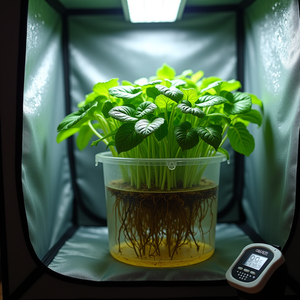
The core Kratky idea is simple: you start with a fixed volume of nutrient solution, plant at the right stage, and let the water level drop as the plant drinks, exposing an air gap for oxygen. On paper it is beautifully passive. In practice, many apartment growers stretch it way past its design envelope.
- They run huge, high-demand plants (full-size tomatoes, peppers, heavy basil) in small, low-volume containers.
- They expect “2–3 months no top-ups” when the container only holds enough water for 2–3 weeks of transpiration at summer indoor temps.
- They ignore EC drift as water disappears and assume nutrients are “fine” until leaves burn.
In a recent Reddit comparison of 2‑month vs 3‑month Kratky runs, the longer grow only worked because the grower used larger containers and more conservative plant density, accepting slower growth for stability over time rather than trying to push maximum yield per liter.[1]
Mistake 2: Undersized reservoirs in active systems
Active systems like DWC buckets or compact NFT racks in apartments often fail for the exact opposite reason: the mechanics are there, but the reservoir is too small. A 10 L tote under a balcony rail NFT sounds space-efficient, but with 8–12 heads of lettuce under modern LEDs, that reservoir can swing:
- EC up by 40–70% as water is consumed faster than nutrients.
- pH down by 0.5–1.0 units in a day as roots exude acids.
- Temperature up above 24–26 °C in a warm room, choking dissolved oxygen.
Once you cross those thresholds, you are not “low maintenance” anymore. You are in “daily babysitting” territory.
Mistake 3: Ignoring oxygen strategy in passive builds
Passive growers often assume that if there is an air gap, oxygen is solved. It is not that simple. You still need:
- Enough surface area relative to plant size.
- Root structure that actually occupies that air gap instead of matting at the bottom.
- Reasonable water temperature and no thick biofilm choking the surface.
Atlas Scientific’s Kratky explanation stresses that the air gap and the upper “air roots” become the plant’s oxygen source once the solution drops.[2] But if your container is too tall and narrow, or your plant is oversized, roots can stay submerged and never develop that fuzzy oxygen-taking layer, especially in cool or very humid rooms.
Mistake 4: Overstuffed containers and wrong crop choices
Highly viral reels often show crowded jars of leafy greens that were filmed during a narrow 7–10 day “perfect” window.[3] What you do not see are the next 3–4 weeks when EC spikes, roots brown, and growth stalls.
Common problems:
- Planting multiple heavy feeders in one small passive reservoir.
- Trying “multi-month” Kratky with crops that are actually fast turnover (like baby lettuce) or absolutely not suited to static water (big fruiting varieties).
- Ignoring root volume and container geometry until it is too late.
Mistake 5: “Silent” systems that are actually unstable
Apartment growers rightly want low noise and low electricity. So pumps get unplugged, air stones are removed, and flow is minimized or turned off overnight. The problem: oxygen demand does not take a break when the pump does. Warm, nutrient-rich water with dense roots will crash overnight faster than you think, especially in DWC. UrbanHydroSpace’s comparison of DWC and Kratky in apartments shows that air-pump-free setups work, but only within carefully defined crop, volume and runtime limits.[4]

2. Why These Problems Show Up In Real Apartments
The physics: buffer volume beats clever tricks
Every hydro system is a balancing act between plant demand and reservoir capacity. In small apartments, we are tempted to compress everything: shorter totes, smaller buckets, tiny jars. That reduces our “buffer volume” so that any change in plant uptake, room temperature, or nutrient ratio shows up faster as EC and pH swings.
In practice, this means:
- Kratky jars with 2–3 L of solution and a full head of lettuce might give you a 10–14 day stable window.
- A 20–30 L tote with the same plant can stretch that to 3–5 weeks before things get dicey.
- Active DWC with 30–40 L and a modest air pump can stay rock solid with weekly checks, even under strong LED lighting.
A recent Kratky explainer from Atlas Scientific emphasizes that the method is “low maintenance, not no maintenance” and that solution strength and volume must match both plant size and run length expectations.[2]
The chemistry: EC and pH drift are amplified in small systems
In passive systems, water leaves faster than nutrients, so EC climbs. In active recirculating systems, the same thing happens, you just notice it more because you are already looking at the numbers. In a small reservoir, these swings become extreme much faster.
Common patterns in apartments:
- Running “just follow the bottle” nutrient doses in small reservoirs, which start too strong and end up scorching roots as water volume drops.
- Not using a pH pen because “Kratky does not need it,” then being surprised by yellowing or burnt tips around week 3–4.
- Trying to correct big pH swings with large pH up/down doses, overcorrecting, and stressing plants further.
Good nutrient management is still essential, passive or active. The difference is that passive systems hide the issue until you see plant damage, while active systems encourage measurement and early correction.
The biology: oxygen, temperature and biofilm
Warm indoor air plus enclosed containers equals ideal conditions for biofilm and algae if any light hits the solution. Biofilm coats roots and walls, consuming oxygen and creating micro pockets of low pH and low oxygen. In DWC, an airstone can partly compensate, but in Kratky the only oxygen movement is through the air gap and surface.
On top of that:
- Apartment temperatures of 22–27 °C push nutrient temperature into a zone where dissolved oxygen drops sharply.
- LEDs close to the reservoir heat the solution further, especially in small, shallow containers.
- Static water with dense roots and no agitation forms stratified layers: poorly mixed, with different EC and pH at top vs bottom.
These factors explain why DWC with a small pump and limited noise can actually be more forgiving long-term than pure Kratky in a tiny jar, even if the jar looks simpler on day one.
The human factor: “I don’t want to babysit this”
Your time constraint is real. Most apartment growers are working around jobs, family and small windows for maintenance. So the system has to be designed around realistic touchpoints:
- You can check once per week, not twice per day.
- You can live with a quiet pump, but not with a loud air compressor humming in the bedroom.
- You may be away for 5–10 days and need the system to coast without dying.
The most successful 2026 “lazy hydroponics” setups are not pure Kratky jars. They are hybrid or buffered systems: bigger reservoirs, simple automation, and crops chosen to match the system’s natural stability window.
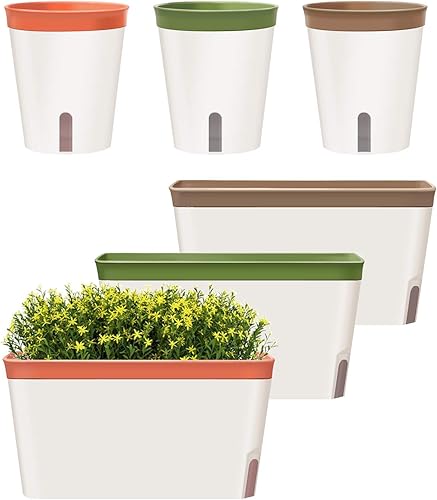
3. How To Design Low‑Maintenance Passive & Semi‑Passive Systems That Actually Work
Step 1: Decide your maintenance interval first
Design backwards from how often you are willing to interact with the system. Be honest. Examples:
- Weekly check-in (7 days): realistic for most people. Allows DWC with small reservoir and quiet air pump or a well-sized hybrid Kratky tote with occasional top-up.
- Fortnightly check-in (14 days): requires larger reservoirs, conservative EC, and crops with modest demand like lettuce or herbs.
- Monthly+ check-in (30 days): only realistic with large passive reservoirs, cool environment, and low-demand crops, or a small active system with auto top-up from a secondary tank.
Once you know your interval, you can size your reservoir and choose your method.
Step 2: Use buffer volume as your main “stability knob”
For multi-week stability in small spaces, buffer volume beats fancy gadgets. Here is a practical rule of thumb for leafy greens and herbs in an apartment at 22–26 °C with moderate light:
- Passive Kratky jars: 2–3 L per plant for 2–3 weeks of growth from transplant to harvest (baby greens, small basil).
- Semi-passive Kratky tote: 8–12 L per plant site for 4–6 weeks, with a large shared reservoir kept mostly opaque to light.
- DWC buckets: 15–20 L per plant for 4–8 weeks, assuming a constant air source and moderate EC.
For fruiting plants in an apartment (cherry tomatoes, peppers), double those volumes or accept that you will need to check and top up more often.
Step 3: Engineer oxygen without turning your living room into a pump room
There are three good oxygen strategies that stay apartment-friendly:
- Classic Kratky air gap: Works best with shallow, wide containers that create a broad evaporation surface. Ensure at least 3–5 cm of space between the net pot base and solution once roots are established.
- Low-noise DWC: Use a quality, quiet air pump with one airstone per bucket or two per tote. Many modern pumps are near-silent if decoupled from hard surfaces.
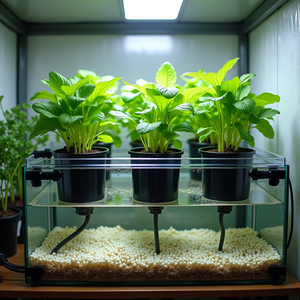
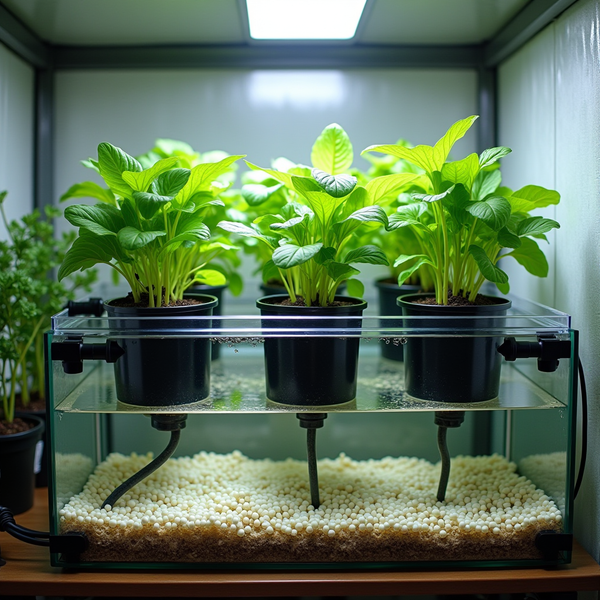
- Slow circulation hybrid: A tiny submersible pump running a gentle recirculation loop in a tote or NFT rail. Short duty cycles (e.g. 15 minutes on, 45 off) maintain oxygenation without continuous noise.
Hybridization is where 2026 content is heading. In one popular build video, the creator combines a Kratky-style deep reservoir with intermittent circulation to keep nutrients mixed and oxygenated while still relying on a generous air gap and large buffer volume.[5] This middle ground avoids both constant bubbling and the stagnation of pure static water.
Step 4: Match crop selection to your system’s “stable window”
Design what you grow around how long your system stays stable without intervention.
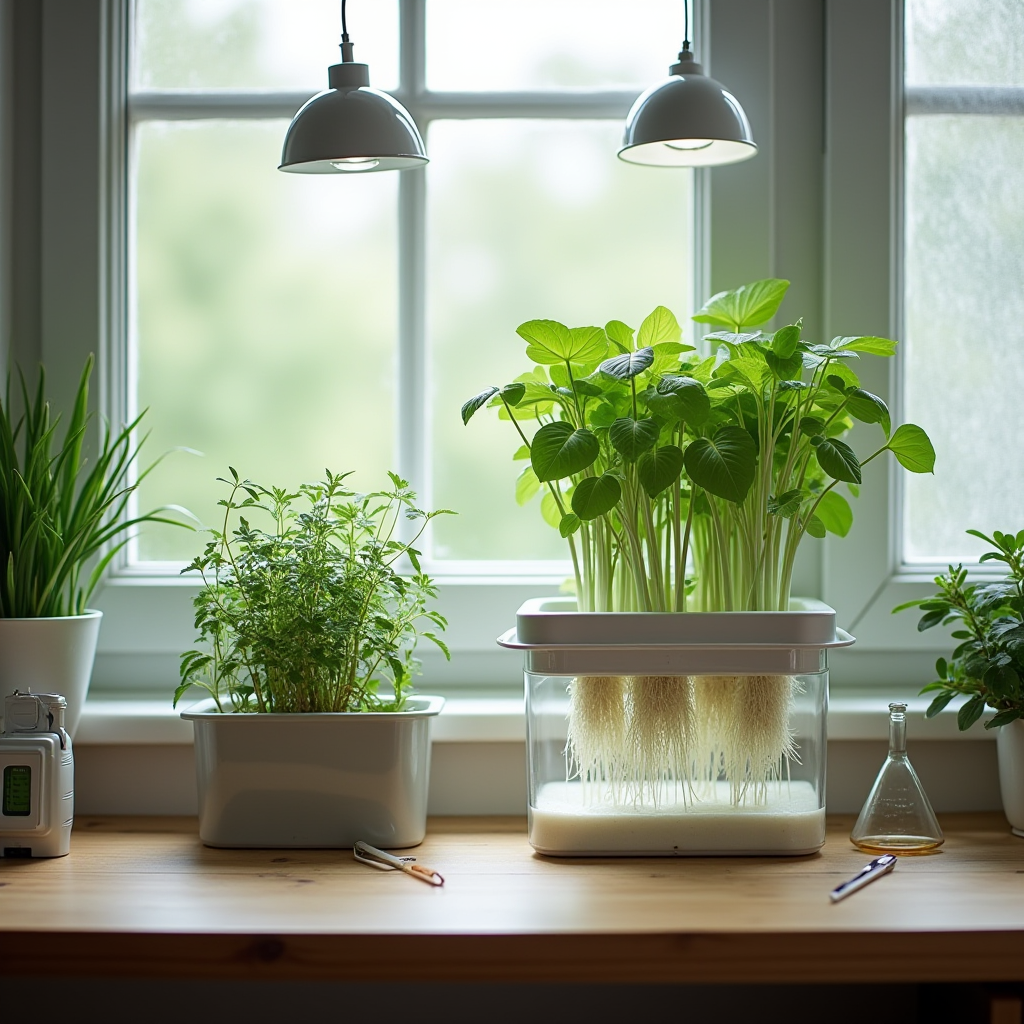
- Short-window systems (10–20 days): ideal for baby lettuce, microgreens, small herb starts. Perfect for desktop or windowsill Kratky jars and wicking planters.
- Medium-window systems (3–6 weeks): compact DWC or semi-passive totes with 20–40 L reservoirs. Great for full heads of lettuce, basil, cilantro, chives, and pak choi.
- Long-window systems (6–12+ weeks): require either high-volume passive reservoirs or active systems with auto top-up. Suitable for bushy herbs, dwarf tomatoes, peppers, and strawberries.
If you insist on running a long-lived, thirsty crop in a tiny reservoir, you will pay for it in maintenance and risk. If you match crop and volume, you can automate away most of the workload.
Step 5: Container geometry and light placement
Geometry matters as much as volume:
- Wide and shallow beats tall and narrow for passive systems. You get a larger surface area for oxygen exchange and slower, more even lowering of the water level.
- Opaque walls are non-negotiable. Any light leak into the reservoir will feed algae and biofilm. Paint clear containers or wrap them in foil or reflective film.
- Headroom for roots is crucial. Expect root masses to reach at least as deep as the foliage is tall in vigorous leafy crops.
For indoor lighting, aim to keep your light 20–35 cm above the canopy for most compact fixtures, adjusting as plants grow. Avoid placing the LED too close to the reservoir, or shield the lid to prevent radiant heating of the solution.
Step 6: Keep nutrient management boring and consistent
For low-maintenance hydro, the goal is not to chase perfect numbers. It is to keep everything in a stable, safe band.
- EC: Run leafy greens in the 0.8–1.4 mS/cm range, herbs around 1.0–1.8, and most fruiting plants 1.8–2.4, using the low end if your reservoir is small or passive.
- pH: Keep it between 5.6 and 6.4. Accept gentle drift within this band and correct only if it goes outside.
- Top-ups: For partial-passive systems, top up with plain water to your original level, then recheck EC. Add nutrients only when EC has dropped clearly below target.
A simple weekly routine for a semi-passive apartment system:
- Check water level, top up with plain water.
- Measure EC and pH. If EC is low, add a small dose of nutrients and stir or circulate. If pH is outside 5.6–6.4, adjust gently.
- Quick visual inspection of roots for browning or slime.
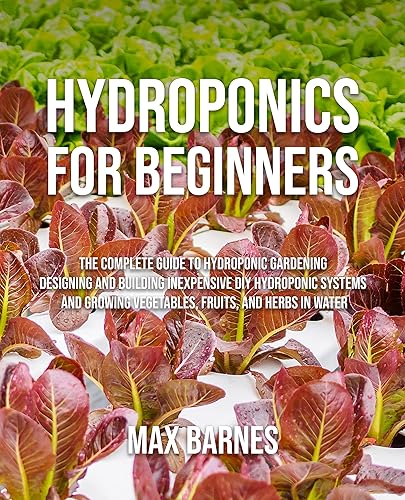
4. What To Watch Long‑Term: Running Multi‑Month Passive & Semi‑Passive Grows
Benchmark 1: EC and pH stability over weeks
Once your system is running, stability trends matter more than single readings. Track EC and pH weekly and look for patterns:
- EC slightly rising over time: plants are drinking more water than nutrients. Top up mostly with plain water and consider starting at a slightly lower EC next cycle.
- EC falling: plants are actively feeding. Top up with mild nutrient solution rather than pure water.
- pH drifting slowly downward: common as roots acidify the solution. Adjust gently, avoid big swings.
If EC and pH stay within a tight band week after week, you have a stable design. If you see wild swings after every top-up, your buffer volume is too small or your nutrient concentration is too high for the plant load.
Benchmark 2: Root zone health and oxygen limits
Set a repeating “inspection day” every 1–2 weeks:
- Lift lids or net pots and look at roots. You want off-white to light tan, with fine fuzzy root hairs.
- Smell the reservoir. It should smell earthy or neutral, never sour or rotten.
- Check for slime or thick film on roots or container walls.
In passive systems, if roots are thick mats with no visible air roots in the gap, your air zone is too small or too humid. Either extend the air gap, thin plants, or add intermittent circulation.
Benchmark 3: Container “end-of-cycle” behavior
Do not judge a system only by how good it looks at peak. Pay attention to how it behaves in the last quarter of the grow:
- Does growth stall or tip burn show up near the end?
- Does the solution level drop so low that roots dry out between top-ups?
- Does algae or biofilm explode late in the cycle?
This end-of-cycle behavior tells you whether your reservoir and crop choice are matched. If everything falls apart in the last week, the fix is usually to either harvest a bit earlier or redesign for slightly more volume or fewer plants per container.
Benchmark 4: Noise, power and “life integration”
A system that annoys you will get neglected. For apartment setups, track:
- Noise level: Can you sleep with it running in the next room? If not, look at better pumps, vibration isolation, or hybrid designs where pumps run in short cycles.
- Power draw: LEDs are the main consumer. A small, efficient LED panel and a 5–10 W air or water pump will barely touch your bill compared to a large, old fixture.
- Leak risk: Elevate reservoirs in trays, use grommets and bulkheads for any plumbing, and pressure-test before putting systems over hardwood floors.
Done right, a semi-passive system with a modest LED and tiny pump can run quietly in a studio apartment, cost only a few dollars a month, and still deliver reliable herbs and greens.
Benchmark 5: Repeatability across seasons
Your first successful run is a data point, not a pattern. Apartment conditions change with seasons: winter brings cooler rooms and possibly drier air; summer brings heat and higher solution temperatures.
Keep notes on:
- Room and reservoir temperatures at different times of year.
- How often you needed to top up in each season.
- Any recurring disease or algae issues tied to seasonal light or humidity changes.
Passively cooled systems that work perfectly near a cool window in winter might struggle in a sunny, unventilated corner during summer. Be ready to adjust reservoir size, shading, or crop choice by season.

Bringing It All Together: Passive vs Active Without the Hype
Passive systems like Kratky are powerful tools, especially for short, fast crops and growers who truly need silence and simplicity. Active systems like DWC or slow-flow NFT shine when you want higher throughput or multi-month runs. The best apartment setups in 2026 are not locked into one camp. They mix ideas:
- Kratky-style deep reservoirs with generous air gaps and opaque walls.
- Low-noise air or water pumps on timers to gently stabilize oxygen and mixing.
- Reservoir volumes sized for your actual maintenance interval, not for aesthetics.
- Crops chosen to match the system’s natural stability window.
If you design your system around buffer volume, oxygen strategy and realistic check-ins, Kratky hype stops being a trap and becomes one ingredient in a robust, low-maintenance apartment hydroponic setup. Your goal is not to avoid pumps at all costs; it is to avoid systems that demand your attention every day just to stay alive.
As an Amazon Associate, I earn from qualifying purchases.