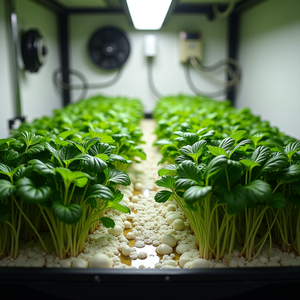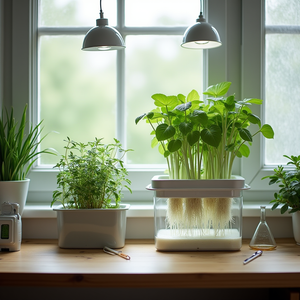
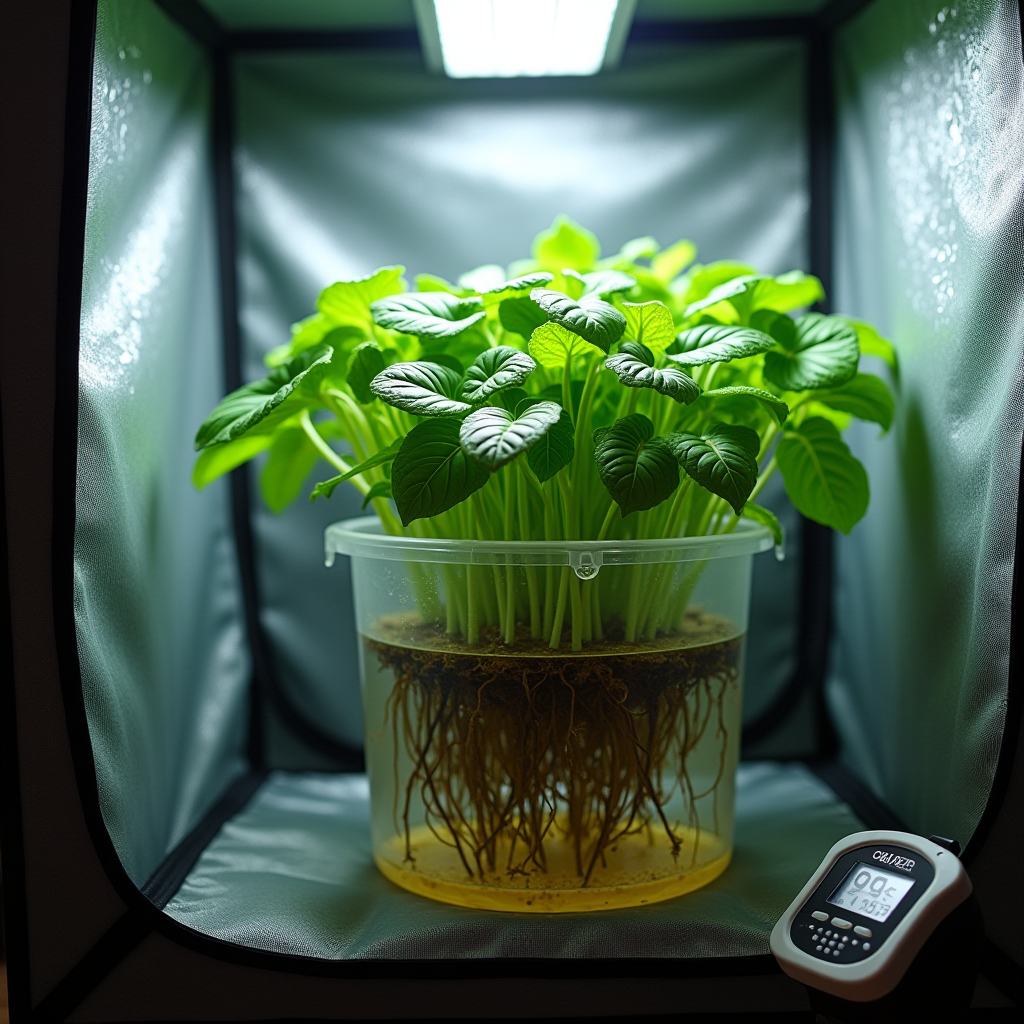
Myth: “If the roots are oxygenated, plants will power through any heatwave.”
In 2026’s tropical and coastal summers, that belief is costing growers whole tents.
Reservoirs are perfectly chilled and oxygenated. EC and pH look fine. Yet in a single sticky week, DWC lettuce shows crispy tips, basil leaves bubble with edema, NFT channels grow slime, and coco dries strangely uneven. The missing piece is not in the water. It is in the air: VPD, humidity, airflow and how they control transpiration.
This article is the air-side sequel to our heatwave reservoir guide. We are going to keep your small tents, closets and spare-room setups drinking, feeding and resisting pathogens when outside feels like a steam bath.
No fluff, just the real failure modes and how to fix them for DWC, NFT, Kratky, coco and aeroponics.
1. Common mistakes growers make in humid heatwaves
Mistake 1: Treating “humidity” as a single number instead of VPD
Most small-grow guides still say things like “keep RH around 60 %.” That is halfway useful at best.
Vapor pressure deficit (VPD) is what matters. It is the difference between how much moisture the air could hold at saturation and how much it actually holds. It tells you how hard the air pulls water out of the leaves, and it is central to indoor crops, as outlined in this overview and this grower guide.
In a heatwave, your tent might sit at 29 °C and 80 % RH. A casual glance says “nice and humid, plants will not dry out.” In reality, VPD is extremely low. Transpiration stalls. Calcium transport slows. Edema and fungal pressure spike even while leaves look lush and green.
Mistake 2: “Just add more fans”
The classic heatwave reaction is to throw more clip fans at the problem. That can help, or it can make things worse.
- If fans only blast the tops of plants and never move air out of the tent, you are just recirculating hot, wet air.
- If fans point straight at reservoirs, you ramp up evaporation and push RH even higher.
- If you add big fans but still run a tiny exhaust, you create strong local airflow with no actual air exchange. Leaves move but VPD barely changes.
Proper airflow design uses exhaust, intake and gentle circulation working together, as explained in modern ventilation breakdowns like this guide.
Mistake 3: Ignoring how VPD and EC interact
When air is very humid (low VPD), plants drink less. If you keep EC at your usual summer level, ions accumulate in leaf tissue and tip burn appears even though your meter shows “normal.” When air is unusually dry (high VPD), plants drink fast and drag more ions with that water. The same EC number becomes effectively hotter.
Growers who do not adjust EC for VPD are the ones who see edema and nutrient burn in the same plant in the same week.
Mistake 4: Sizing dehumidifiers by tent volume instead of moisture load
A 2×4 tent full of DWC buckets evaporates a lot more water than a 2×4 soil tent. Yet many people buy “closet dehumidifiers” rated for a few hundred ml per day and expect them to hold 65 % RH.
Current grow-tent dehumidifier guides show that even small hydro tents often need 30–50 pint/day units to keep RH in range, especially in sticky climates, as seen in this dehumidifier sizing article and this 2×4 sizing breakdown.
Mistake 5: Treating DWC, NFT, coco and Kratky as if they respond the same way
In a humid heatwave:
- DWC pushes huge evapotranspiration and raises RH fast.
- NFT creates long, warm film surfaces that off-gas moisture into channels and tent air.
- Coco holds water in the root zone and responds to low VPD by staying wet, courting root disease.
- Kratky has large still-water surfaces; foliage relies heavily on air movement because there is no pump to mix solution and break surface humidity.
Designing airflow and dehumidification without considering these differences is another common way to lose control.

2. Why these mistakes happen (and what is really going on)
VPD 101 for lettuce and herbs
VPD is defined in kPa and describes the gap between saturated vapour pressure and actual vapour pressure, as described in this technical definition. For indoor crops, most horticultural sources now converge on 0.8–1.2 kPa as a solid general range for vegging plants, with species-specific tweaks, as laid out in this guide and this grower chart.
For hydroponic lettuce, which prefers cooler air and moderate transpiration, you will usually aim a bit lower, around 0.6–1.0 kPa. For basil and common herbs, which like slightly warmer, more active conditions, 0.8–1.2 kPa works well, as summarized in crop-based VPD calculators such as this leafy greens tool and modern hydroponic crop guides like this hydroponic reference collection.
When humidity spikes during a heatwave, VPD can fall off a cliff even though the room is hot. That is when you see:
- Edema: swollen, blistered leaves as water uptake outpaces transpiration.
- Calcium issues: tip burn in lettuce and young basil growth.
- Soft, disease-prone tissues: ideal for Botrytis and downy mildew.
How humid air + high root activity cause edema
Edema is not a pathogen. It is a physiological response: roots keep absorbing water, leaves cannot push it out, cells burst, and you get corky or glassy patches. Case reports from hydro growers, such as this basil edema thread, almost always resolve when VPD and airflow are corrected.
In DWC under humid heatwaves, four drivers stack up:
- Warm air + very high RH push VPD low.
- Cool, well-oxygenated solution keeps roots highly active.
- Still air at the leaf surface traps a thin layer of near-saturated air.
- Sudden swings between air-conditioned rooms and outdoor air shock the plant.
Why “perfect EC” still burns tips at bad VPD
Leafy crops have published EC ranges. For lettuce, many guides and charts converge around 0.8–1.2 mS/cm for seedlings and 1.2–1.6 mS/cm for mature plants, with pH roughly 5.5–6.5, as summarised in resources like this lettuce EC/pH guide and this pH/EC chart. Basil and many herbs sit around EC 1.0–1.6 mS/cm, pH 5.5–6.5, as collated in herb-specific charts such as this herb nutrient reference.
Those numbers assume transpiration is in a healthy band. When VPD is very low, less water flows through the plant, so ions accumulate faster in tissues and tips burn even at mid-range EC. When VPD is very high, water flow is intense, and salts can damage root membranes as they rush in.
So during heatwaves, “running chart EC” without watching VPD is a recipe for inconsistent results.
Why small tents are uniquely vulnerable
In a 2×4 or 3×3 tent you have:
- High planting density, often with multiple reservoirs.
- Thin plastic walls that track ambient room conditions.
- Limited fan positions and short duct runs.
- Household dehumidifiers that were never sized for constant evaporative loads.
That combination makes microclimates. One corner sits at 30 °C and 90 % RH around the NFT return. Another sits at 27 °C and 60 % RH near the intake. Plants in different corners experience completely different VPD and respond with mixed symptoms, which can fool you into blaming nutrients or genetics instead of air.

3. How to fix humidity-driven stress in small hydro rooms
Step 1: Set clear VPD targets for your crops
Instead of chasing “60 % RH,” aim for VPD with temperature taken into account. Use an interactive chart such as this VPD calculator or this VPD app.
- Pick an air temperature you can realistically maintain.
- Dial RH to land in a safe VPD band.
For a mixed lettuce/herb tent:
- Air temp: 20–22 °C (you can let basil ride slightly warmer if VPD remains in range).
- VPD: 0.6–1.0 kPa for lettuce, 0.8–1.2 kPa for herbs.
- Typical RH at 22 °C: around 60–70 % gets you close to those numbers. Confirm with a chart.
Step 2: Design airflow, do not just add fans
In a 2×4 tent, a clean airflow layout looks like this, matching best practices from ventilation guides like this step-by-step setup and fan-position articles such as this fan placement guide:
- Exhaust fan mounted high, pulling air out through a short duct run.
- Passive intake through the lowest vents, or a small intake fan if the ambient room is not much drier than the tent.
- Two oscillating clip fans where possible:
- One at or just above canopy height, blowing diagonally across the plants.
- One lower, pushing air along the system hardware (NFT channels, buckets, or coco pots) back toward the intake side.
- Airflow path: intake → across reservoirs and stems → through canopy → up and out via exhaust.
Leaves should gently move everywhere. If some sections are still, reposition fans until every plant sways slightly.
Step 3: Size and place your dehumidifier correctly
For a tent that contains open-water systems (DWC, NFT, Kratky), base dehumidifier size on the moisture you expect, not just volume.
- For a 2×4 tent with 2–4 buckets or channels, aim for a 30–50 pint/day unit, as recommended by modern tent-specific dehumidifier reviews like this guide and this 2×4-focused analysis.
- Ignore “1–2 L/day mini dehumidifiers” unless you are running only a couple of small Kratky jars.
Placement tips:
- In very humid climates, you can place the dehumidifier inside the tent with a continuous drain line. Direct oscillating fans so moist air flows into the intake and dry exhaust mixes into the top of the tent rather than blasting one corner.
- Alternatively, place the dehumidifier just outside the tent and run the tent exhaust into the same room, so you constantly dry the air feeding the intake.
- Use a plug-in humidity controller (Inkbird-style) to cycle the dehumidifier between, for example, 60 % and 65 % RH.
Step 4: Link EC to the environment
During humid heatwaves, do not run your “normal” EC by habit. Use the lower half of recommended ranges and adjust with your VPD:
- Lettuce: 1.0–1.4 mS/cm, pH 5.8–6.2.
- Basil/herbs: 1.0–1.4 mS/cm, pH 5.8–6.2.
This overlaps the safe, evidence-based ranges reported across modern hydroponic lettuce and basil guides like this lettuce EC/pH chart and this basil environment guide.
General rule:
- If VPD is trending low for several days (humid), trim EC down by 0.1–0.2 mS/cm.
- If VPD is trending high (air drier than target), stay near the lower edge of the band and watch tips carefully before raising strength.
Step 5: Build system-specific air strategies
DWC:
- Keep solution at 18–22 °C to avoid overspeeding root uptake in humid air, per lettuce and basil temperature data in references like this lettuce guide.
- Ensure air stones break the surface to speed off-gassing and help equalize humidity within the bucket area, but counter that with strong tent-level dehumidification.
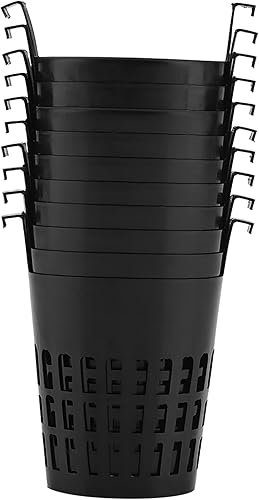
- Use lids that minimize open water around net pots to cut evaporative load.
NFT:
- Enclose channels where possible and seal gaps to prevent warm humid air from looping through them.
- Run a gentle internal fan along the channel run to prevent stagnant, saturated air under foliage.
- Place the nutrient return into a lidded reservoir, not an open tub.
Kratky:
- Use tight, light-proof lids (foam board or fitted plastic) with only enough hole size for net pots, as recommended in non-circulating designs such as this Kratky method paper.
- Add at least one oscillating fan aimed across the foliage. Kratky leaves are especially prone to edema in still, humid air, as growers note in discussions like this airflow thread.
- In extremely humid climates, consider switching your “prime” crop buckets to gentle DWC during peak summer just to improve root oxygenation while you learn the VPD behaviour of your space.
Coco / inert media:
- Shorten irrigation events when VPD is low so the media spends some time in the “moist but aerated” range instead of waterlogged.
- Use more frequent, smaller pulses when VPD is high to keep EC stable in the root zone.
- Make sure fans reach the lower canopy; coco foliage sitting above a damp, still floor is a mold magnet.
4. What to watch long-term (benchmarks, tweaks and early warnings)
Benchmarks for a stable small tent in humid climates
If you tune your system well, your logs should start to look boring, in a good way.
- VPD: stays mostly between 0.6 and 1.0 kPa for lettuce, rarely dipping below 0.5 kPa or above 1.2 kPa for more than an hour.
- RH: typically 55–70 % at 20–24 °C, depending on the time of day and whether lights are on.
- EC drift: daily changes within ±0.1–0.2 mS/cm once plants are established.
- pH drift: slow, predictable movement over several days inside the 5.5–6.5 band.
- Leaf quality: no new edema blisters, minimal fresh tip burn, and crisp but not brittle leaves.
Early warning signs that air, not nutrients, is the problem
Watch for these patterns:
- New leaves show water-soaked, blister-like spots after a stretch of hot, cloudy, humid weather, while solution conditions are unchanged.
- Coco or slabs stay wet for too long, yet leaf edges still burn.
- Powdery or downy mildew starts at lower leaves even though your system is clean and nutrients are fresh.
- Different corners of the tent show different symptoms on the same cultivar.
In those cases, look at VPD history before blaming the nutrient bottle.
Routine adjustments through a heatwave
As outside humidity changes, adjust your routine:
- On very humid days (RH outside > 80 %):
- Run dehumidifier harder and increase exhaust fan speed within reason.
- Drop EC slightly and avoid big nutrient concentration changes.
- Check that every plant has some breeze; add a temporary extra fan if needed.
- On unusually dry days (RH outside < 40 %):
- Slow the exhaust slightly to avoid overshooting VPD into the high-stress zone.
- Top up reservoirs more often; plants will drink faster.
- Keep EC conservative rather than chasing growth with strong feed.
Pathogen and foliar management in steamy conditions
High humidity plus low airflow is a pathogen invitation. Once you stabilise VPD and airflow, finish the job by tightening your foliar practices:
- Avoid heavy foliar feeds or sprays late in the light cycle; leaves should be dry by “lights off.”
- Prefer root-applied treatments unless a foliar route is essential.
- Space plants so foliage does not mash together; crowded leaves trap humidity.
- Prune lower, shaded leaves that never fully dry.
These steps align with standard controlled-environment hygiene practices outlined in many modern hydroponic disease-prevention guides, such as this sensor-based management overview.
Data logging: the quiet superpower
If you are running anything more complex than a single Kratky tote on a balcony, start logging:
- Air temperature and RH (preferably VPD directly) at canopy level.
- EC and pH of each reservoir.
- Notes on symptoms and visual plant status.
Even cheap Bluetooth loggers plus a spreadsheet can reveal patterns: for example, tip burn appearing two days after midday VPD spikes, or edema flaring when overnight VPD sits near zero for hours.

Bringing it all together
Oxygenated, cool reservoirs are only half the heatwave story. If the air-side is wrong, lettuce and herbs will still stall, burn, or rot. By treating VPD, humidity, airflow and EC as one linked system, you can keep small hydro rooms in coastal, tropical and monsoon climates running almost as smoothly in August as they do in May.
Anchor your setup with clear VPD targets, a correctly sized dehumidifier, deliberate fan placement and conservative EC. Once those are in place, most “mystery” heatwave problems stop being mysterious, and your DWC, NFT, Kratky, coco or aero system goes back to doing what it should: turning water, salts and light into dense, clean harvests.
As an Amazon Associate, I earn from qualifying purchases.
Club colours help connect shirt design with supporter identity. For supporters planning a gift, Juventus football jerseys(camisetas de la Juventus) gives a precise starting point for the intended team. Personalisation choices should complement the existing colour and layout of the design.