When Your Top Shelf Looks Like a Different Climate Zone
If your top-tier lettuce is tip-burned, your middle tier is perfect, and your bottom tier is a moldy jungle, you don’t have a nutrient problem - you have a climate control problem hiding in your vertical rack.
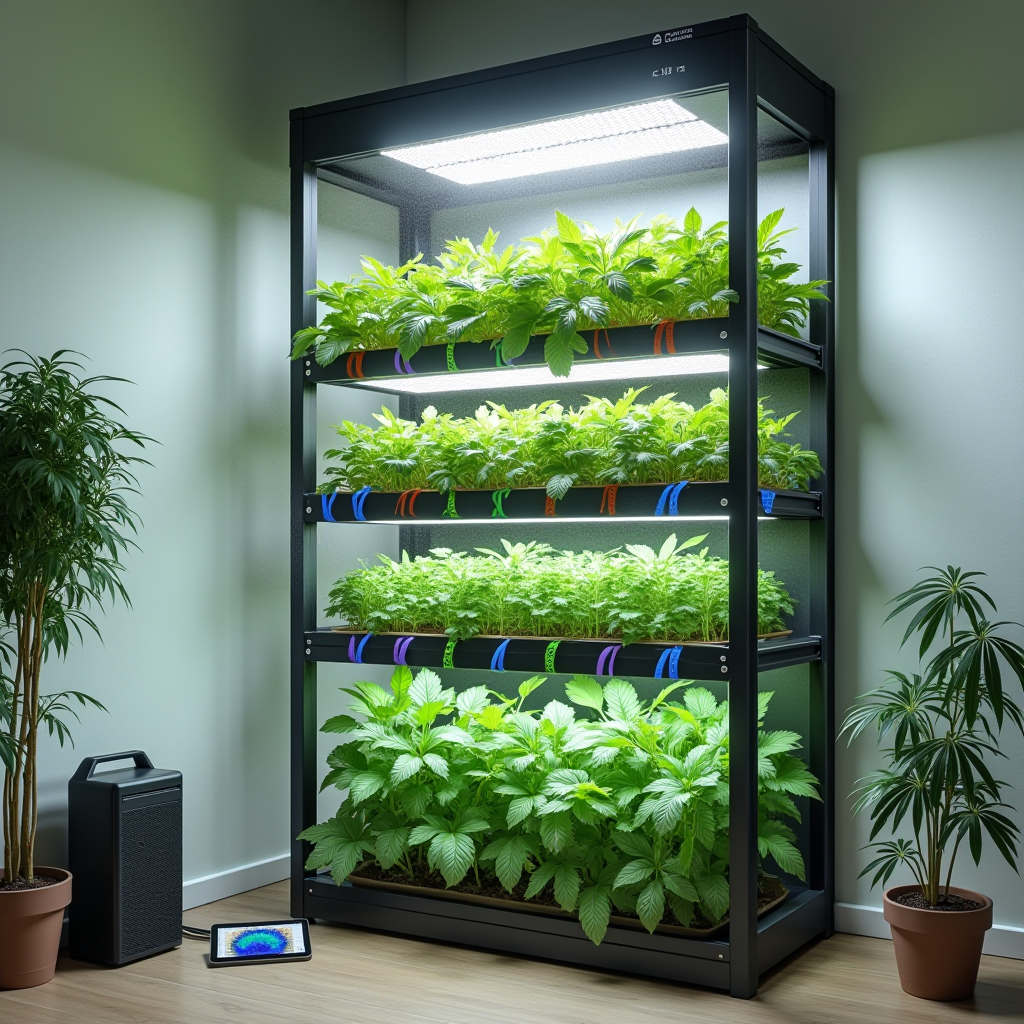
Vertical farming is exploding, from commercial facilities testing humanoid harvest robots to home growers stacking 3- to 5-tier racks in spare rooms and balconies. But here is the ugly truth: most multi-tier hydro setups are basically three different grow rooms stacked on top of each other, each with its own temperature, humidity, and VPD. Upper shelves cook, bottoms stay clammy, and your yields tell the story.
This guide is about fixing that. We are going to:
- Design airflow paths that actually move air through every tier
- Map VPD across the rack so you can see the real problem, not guess
- Size and place dehumidifiers so you are not paying for oversized HVAC you do not need
- Apply this to Kratky, DWC, and NFT-style vertical racks without rebuilding your whole setup
Let us turn your “random climate tower” into a controlled, even environment where every shelf grows like the middle shelf.
The Problem: Tier-to-Tier Climate Drift Is Wrecking Your Rack
In a multi-tier rack, climate drift is what happens when each level ends up with its own microclimate. You will recognize it instantly:
- Top tiers: hotter, drier, and often showing tip burn, especially in fast-growing lettuce and basil. Leaf edges crisp, calcium issues, and plants transpire like crazy.
- Middle tiers: usually “Goldilocks” - good growth, consistent color, and predictable harvest times.
- Bottom tiers: cooler, more humid, and prone to powdery mildew, botrytis, slimy NFT channels, and slow growth.
This hits both commercial and home/small-scale growers:
- Commercial vertical farms: racks are packed tight, lights increase heat, and air handlers often treat the room, not each tier. You get uneven yields and unpredictable quality per shelf, which makes repeatable production a nightmare.
- Home and balcony racks: one clip fan and a dehumidifier in the corner, lights at different heights, and reservoirs or channels evaporating into a relatively small room. Top plants look “sun-stressed”; bottom plants look like they live in a terrarium.
Once climate drift sets in, you start chasing symptoms instead of causes:
- Cranking nutrients to “fix” weak growth on a humid bottom tier (which makes tip burn worse up top).
- Dropping light intensity on the top shelf to relieve heat stress, sacrificing potential yield.
- Overwatering or under-watering to compensate for different transpiration rates tier to tier.
It is not a recipe, strain, or nutrient brand issue. It is air, water vapor, and heat moving in ways you are not controlling.

The Cause: Heat, Humidity, And VPD Stack Differently Than Your Racks
Vertical hydroponic racks do not just stack plants; they stack heat sources and humidity sources in a tall column. If you do not manage air movement with intent, you end up with a stratified room.
1. Hot air and lights climb, humidity hugs the lower tiers
Most indoor grow spaces are classic physics in action:
- Heat from LEDs and drivers rises and pools near the ceiling and upper tiers.
- Evaporation and transpiration from NFT channels, DWC reservoirs, or Kratky totes load the air with moisture, which tends to stay around the plant canopy if air is not actively mixed.
So while your top-tier might read 26-28 °C with 55-60% RH, your bottom tier can be 21-23 °C with 70-80% RH. On paper, “room” conditions look fine. Inside the rack, plants are living in two different climates.
Guides on vertical systems repeatedly stress the importance of active air mixing to avoid microclimate pockets inside racks, not just in the room itself, as noted in this airflow optimization guide and this airflow design overview.
2. VPD: the real reason your top and bottom tiers act so differently
Vapor Pressure Deficit (VPD) is simply how “thirsty” the air is for water. It is driven by both temperature and humidity. Two tiers with the same RH but different temps do not share the same VPD.
For leafy greens, you generally want:
- VPD around 0.8 - 1.2 kPa during most of the growth phase.
- Higher VPD (drier air) increases transpiration and can drag calcium quickly through the plant, but too high triggers stress and tip burn.
- Lower VPD (humid air) slows transpiration, invites mildew, and makes nutrient uptake sluggish.
If your upper tier is sitting at 27 °C and 55% RH, your VPD might be around 1.2 kPa. Your lower tier at 22 °C and 75% RH could be closer to 0.5 kPa or less. Same room, wildly different plant behavior.
Research and grower best practices in vertical systems target tight, consistent VPD ranges across all levels to stabilize growth and reduce disease pressure, as summarized in this vertical farming guide.
3. Hydro system type amplifies the climate problem
Your choice of hydroponic method influences how much moisture and temperature drift you have to manage:
- DWC systems have large open reservoirs. Warmer top-tier water can spike root zone temps and add more humidity. Air pumps and bubbling also increase evaporation.
- NFT channels can act like long, humid radiators. Warm return lines running low in the rack dump moisture and heat into the lower tiers.
- Kratky totes are often uninsulated and exposed to room air. As solution warms, evaporation increases, and the water surface becomes a significant humidity source near whichever tier it sits on.
In short: the system type plus rack layout decides where the humid zones form. Without deliberate airflow and dehumidification, your environment will be uneven by default.
4. Dehumidifiers and fans placed for the room, not the racks
Most growers drop a dehumidifier “somewhere in the room” and add one or two clip fans. That is fine for single-level grows, but in multi-tier racks, this usually results in:
- Dehumidifiers pulling air mostly from the middle/top of the room, leaving the lower rack humid.
- Fans blowing across the front of the rack, creating nice breeze on the first row of plants and dead zones behind and below.
- HVAC thermostats and humidistats mounted at human height, not plant height.
So the control system is making decisions based on the easiest place to measure, not the most important place to measure.

The Solution: Smart Airflow, VPD Mapping, And Dehumidifiers Sized For Your Plants (Not The Brochure)
Now for the fun part: turning your vertical rack into one consistent climate from floor to top shelf. We will stay focused on actionable moves you can make today, not exotic HVAC redesigns.
Step 1: Map your rack’s microclimates with a simple VPD survey
You cannot fix what you do not measure. Do a quick “VPD map” across tiers:
- Grab a few sensors: Ideally 3-4 temp/RH sensors you can move around or log from. Even budget units are fine if you use the same ones across tiers.
- Measure at canopy height on each tier, not at the wall or ceiling.
- Take readings at lights-on steady state (after at least 1-2 hours of lights on), and again just before lights off.
- Calculate VPD with any of the common VPD calculators or apps.
Write it down. You are looking for patterns like:
- Top: 26 °C, 55% RH, VPD ~1.2 kPa
- Middle: 24 °C, 60% RH, VPD ~1.0 kPa
- Bottom: 22 °C, 75% RH, VPD ~0.5 kPa
Now you have proof that your “one grow room” is actually three different environments. This mapping method aligns with the multi-point monitoring recommended in vertical farm best practice overviews like this guide to vertical hydroponic farming.
Step 2: Design an actual airflow path, not just a fan collection
You want air to move in a predictable loop through and around your rack, not just bounce around randomly.
For small/home multi-tier racks
- Front-to-back or bottom-to-top pattern:
- Use one oscillating fan low, aimed slightly upward at the underside of the lowest tier, to push cool, humid air up through the rack.
- Use another fan higher up aiming across the top tier toward the room exhaust or dehumidifier intake.
- Avoid only blowing at plant faces: Aim to move air through the rack structure, across channels and reservoirs, then out.
- Keep clear air channels: Do not block the rear or sides of the rack with storage. Air needs somewhere to go.
For commercial or walk-in vertical rooms
- Use push-pull corridors: Treat aisles as “ducts.” Supply air enters one side of the aisle at the bottom, flows under and through racks, and is pulled out near the top on the opposite side.
- Tier-level mixing fans: Mount small horizontal fans between tiers to mix air along the length of each shelf.
- Coordinate with HVAC: Place supply diffusers so they do not blast just the top tier. Distribute supply air down the height of the room, as recommended in airflow design resources like this CEA airflow guide.
Step 3: Balance system layout to reduce humidity hotspots
You can cheat the environment in your favor by how you place your hydro gear:
- Keep big reservoirs outside the rack where possible, or at least on the side with strongest airflow and closest to dehumidifier intake.
- Insulate DWC totes and NFT return lines on upper tiers to reduce water warming and evaporation.
- Do not stack “wettest” hardware all on the bottom (e.g., nutrient mixing tank, main DWC reservoir, and seedling trays sitting right under the lowest tier). Spread moisture sources so one tier is not drowned in humidity.
Step 4: Size your dehumidifier based on plant load, not room size
Hydroponic grow rooms, especially vertical ones, have far more moisture production than a normal room. A basic rule-of-thumb way to estimate dehumidification needs:
- Estimate transpiration per square meter: Leafy greens at full canopy in hydro often transpire roughly equal to their irrigation input. If you are feeding 3-5 L/m²/day, a big chunk of that ends up in the air.
- Add open water surfaces: DWC and open channels add more evaporation. For a dense rack, it is reasonable to add 20-30% on top of plant transpiration as a working estimate.
- Total it up and match to dehumidifier capacity: Dehumidifier capacities are usually rated in L/day (or pints/day). If your 3-tier rack is evaporating 15 L/day and your dehumidifier pulls 10 L/day at your room conditions, you are under-sized.
More detailed approaches like those used in commercial vertical farms balance transpiration, evaporation, and air exchange when sizing equipment, similar to the humidity considerations discussed in this vertical farming efficiency guide.
Placement tips that actually matter
- Put the dehumidifier where the wettest air is. That is usually near the racks, not by the door. You want the intake facing the aisle or side of the rack where air exits your fan loop.
- Do not blow the warm, dry air straight at one tier. Diffuse it by pointing the outlet into an aisle or toward a wall so other fans mix it into the whole room.
- Consider two smaller units instead of one big one in longer rooms, to avoid over-drying one end and ignoring the other.
Step 5: Tune climate targets for DWC, NFT, and Kratky on vertical racks
Once airflow and dehumidification are under control, you can tighten your climate targets:
- Leafy greens (DWC/NFT/Kratky) general targets:
- Air temperature: 20-24 °C lights on, 18-22 °C lights off.
- RH: 55-70%, but always check VPD. Aim for 0.8-1.1 kPa across tiers.
- Solution temperature: 18-21 °C for DWC/NFT to avoid root rot and oxygen loss.
- Kratky-specific tweaks:
- Because solution is static, keep Kratky totes away from the hottest upper tiers where water can warm fast.
- Use lids and light-proof containers to reduce algae and evaporation.
- DWC-specific tweaks:
- Warm upper tiers can overheat reservoirs. Use insulated lids and consider remote reservoirs with lines feeding each tier.
- Avoid putting all air pumps on the hottest top shelf; heat shortens pump life and warms air going into reservoirs.
Step 6: Verify the fix with a second VPD map
After you have:
- Re-aimed and repositioned fans,
- Adjusted dehumidifier placement or capacity,
- Relocated major reservoirs or channels where possible,
run the same VPD mapping routine as in Step 1. Your goal is to bring the tiers within about:
- 1-2 °C of each other, and
- 0.2-0.3 kPa VPD difference max.
When you hit that, symptoms start disappearing: tip burn fades, mildew pressure drops, and crop timing across tiers tightens. You are finally running one grow room, not three arguing with each other.
Step 7: Automate only what needs automating
You do not need a full building management system to make this work, especially at home scale. Useful automation tiers:
- Entry level: Plug dehumidifiers and some fans into simple humidity or temperature controllers.
- Intermediate: Use WiFi temp/RH sensors and smart plugs to schedule or trigger airflow at specific conditions.
- Advanced/commercial: Networked sensors at multiple heights feeding a central controller that modulates fans, dampers, and dehumidifiers as recommended in pro CEA environments like those discussed in this HVACD-focused guide.
The key is feedback: if you can see tier-level data and make hardware respond, you can keep VPD tight without throwing money into oversized HVAC.
Dial in airflow paths, do one honest VPD mapping session, and size your dehumidification to your plant load instead of the room label. Once you do, your vertical rack stops being a stack of microclimates and starts behaving like the high-density, predictable production system it was supposed to be.