Vertical Farm Humanoid Robots Are Here: Make Your NFT & Aeroponic Hydro Systems Robot-Operable Without Costly Retrofits
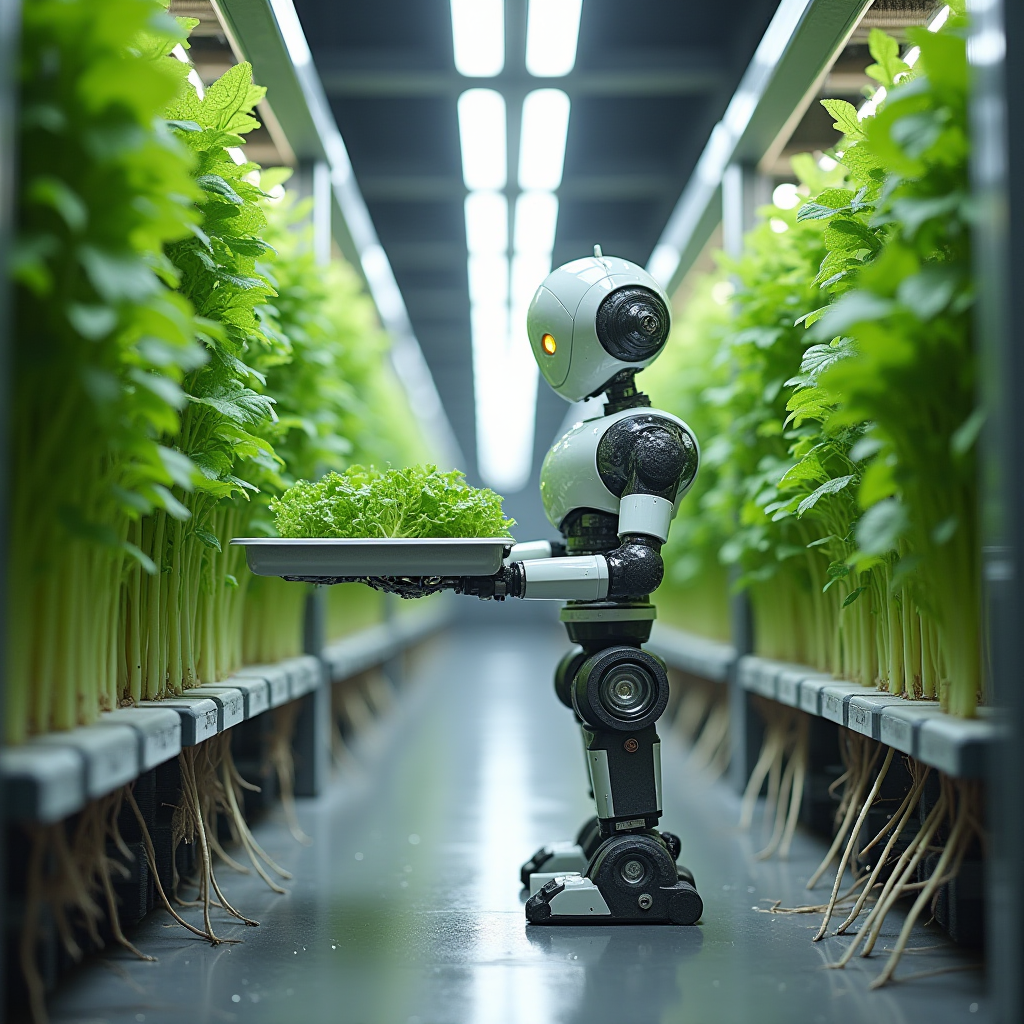
If you think humanoid robots in vertical farms are a “someday” problem, you are already behind. With players like Agroz AgTech and UBTech pushing robotics into controlled environment agriculture (CEA), the smart move - even for a small indoor grower - is to design systems today that robots and humans can both work in tomorrow.
This is not about buying a robot. It is about building NFT and aeroponic layouts that do not need to be ripped apart when robots start handling your trays, channels, and harvest.
We are going to stay brutally practical: standard tray and rack sizes, aisle widths that work for humanoids and carts, lighting that cooperates with machine vision, safe load limits on racks, and cleaning workflows that a robot can actually follow.
The Problem: Beautiful Tech, Awful Layouts
Most small NFT and aeroponic setups are built for one user: you, with your specific reach, habits, and shortcuts. That works right up until you want help - whether that is a part-time worker, a cart-based robot, or, very soon, a humanoid platform like UBTech’s working in your aisles.
The result in many indoor farms looks like this:
- NFT channels at random heights and odd spacing, so only the person who built it can actually work comfortably.
- Homemade aeroponic buckets shoved under benches, with tangle-prone lines and no clear path for a robot or cart to approach them.
- Aisles that are “fine for now” at 40-45 cm wide, which is basically a no-go zone for any humanoid or mobile platform.
- Racks overloaded with reservoirs, pumps, and trays that flex or sway, murdering the precision robots rely on.
- Lighting that is brilliant for plants but brutal for cameras - glare, hotspots, and harsh color skew that confuse machine vision.
- Cleaning workflows that assume a flexible human with two good knees and a mop, not a robot following a repeatable sanitation routine.
What this adds up to is friction. Robots and even semi-automated platforms thrive on repeatability and clear structure. Many vertical farms already lean heavily on automation for monitoring and dosing, but it is the physical layout where things still look like a DIY science project. Reviews of vertical farm automation repeatedly highlight that labor-intensive tasks - transplanting, inspection, harvest - are the bottleneck robots are now targeting as discussed here.
So the risk is simple: you keep building perfectly functional NFT and aeroponics rigs… that will need expensive retrofits the moment humanoid robots are affordable.

The Cause: Systems Built For Hands, Not Robots
Robots need structure. Hydroponics, especially NFT and aeroponics, already gives you a controlled environment, which is exactly why vertical farming and robotics are converging fast as noted in this review. The friction comes from the physical details.
1. Non-standard trays and channels
Most small growers mix and match trays, channels, and reservoirs from whatever is available. Robots do not love surprises. Slight differences in tray lip height or width can throw off a gripper designed for a “standard” profile.
For NFT and aeroponics, the main physical interface a robot will touch is:
- Seedling trays and plug trays
- NFT channels and lids
- Aeroponic chambers, lids, and collars
When these are not standardized, you either need complex sensing and adaptive grippers (expensive) or a painful retrofit later.
2. Aisles too narrow and heights all over the place
Research on automated vertical racks and robotic platforms consistently assumes predictable aisle widths and clear floor paths for robots to navigate and align with racks as shown in this IoT-based vertical farm automation study. In human terms:
- Aisle too narrow: You twist sideways to get through. A humanoid or wheeled base simply cannot pass without risk.
- Heights inconsistent: Some channels are at knee height, others at eye level. Great for using vertical space, terrible for repeatable robot motions.
3. Lighting that fights machine vision
LEDs designed only around plant PPFD sometimes ignore the cameras that will eventually do inspection. Strong glare off white channels, mixed color spikes, or pulsed lighting can confuse vision systems. Modern vertical farms using robotics lean on consistent spectrum and minimal flicker for reliable imaging as highlighted in automation guides.
4. Racks and loads that are “safe enough” for humans, not robots
Humans unconsciously compensate for a wobbly tray or flexing rack. Robots do not. Overloaded shelves, sagging channels, or makeshift mounting brackets cause misalignment for grippers and make precise positioning unreliable.
5. Sanitation designed around improvisation
Hydroponic sanitation is usually a mix of “drain, scrub, rinse, refill” - efficient for a person who can see biofilm, pull fittings, and scrub corners. Robots need:
- Defined positions a robot can access with sprayers or tools
- Drain points they can trigger or that are valved in a consistent way
- Surfaces and joints designed to shed biofilm under sprayed disinfectant, not hand scrubbing
In short, the cause of robot-unfriendly farms is not the technology. It is layouts that were never drawn with robotics in mind.

The Solution: Design NFT & Aeroponics For Robots Now
Here is how to build or tweak your NFT and aeroponic systems so they are “robot-ready” without sacrificing your current workflow.
1. Standardize trays, channels, and spacing
Pick one tray footprint and stick to it. For seedling trays and grow trays, choose a common size (for example, 10 x 20 inch / 25 x 50 cm) and keep it consistent across the system. For NFT:
- Use channels with uniform width and lip height.
- Keep plant-hole spacing consistent on every channel length (for example, 20 or 25 cm centers).
- Use identical lids wherever possible.
For aeroponics:
- Use consistent collar sizes (for example, 1.625 inch neoprene collars across all lids).
- Standardize chamber dimensions where robots will handle lids, collars, or baskets.
That means a robot only needs to learn a handful of geometries. Even if the first “robot” is just a human with a cart today, you are paving the way.
2. Design aisle widths and rack geometry for humanoids
Humanoid robots and mobile bases are typically comfortable in aisle widths that also feel good for a human with a full cart. Use these practical targets:
- Minimum aisle width: 80 cm for small rooms; 90-100 cm if you can spare it. This gives space for a humanoid robot shoulders and arm swing without clipping channels.
- Maximum rack depth (per side): 45-60 cm so both humans and robots can reach the back of trays without overextension.
- Working height range: Keep key tasks (seeding, transplant, harvest) between 70 and 150 cm from the floor. Put purely plumbing/storage lower or higher.
In multi-tier racks, reserve the “robot tiers” for the heights easiest to reach. That is where you want your NFT channels and aeroponic collars sitting.
3. Choose lighting that plants and cameras both love
You do not need special “robot lights”, just fixtures that are predictable:
- Full-spectrum white LEDs (4000-5000 K) with a good red/blue mix are easier for cameras to interpret than heavily skewed purple.
- Continuous drivers rather than aggressively PWM-dimmed lights reduce flicker artifacts in machine vision.
- Diffuse light with lenses or covers to reduce glare off white NFT channels and wet aeroponic roots.
From the plant side, you still hit the standard ranges: leafy greens thriving around 150-250 µmol/m²/s and 14-18 hours per day in NFT or aeroponics, fruiting crops higher, as summarized across multiple vertical farming guides like this one.
4. Respect safe load limits and rigidity
Robot-friendly racks are stiff, not heroic. Key points:
- Know the rated load of your rack per shelf and do not exceed 70-80% of it. Water is heavy: 1 L = 1 kg.
- Minimize point loads by using full support beneath NFT channels and aeroponic reservoirs.
- Cross-brace tall racks to cut sway. If the rack wobbles when you tug a top channel, a robot will see position drift.
In practice, a 1.2 m wide rack with three tiers of NFT channels might be carrying 60-100 kg of solution and hardware. Design it as if a robot is going to push, tap, and manipulate those trays daily.
5. Build robot-friendly sanitation workflows
Whether it is you, a humanoid, or both doing the cleaning, a robot-ready sanitation loop looks like:
- Centralized drains: Collect NFT returns and aeroponic waste into known drain points that can be valved or actuated.
- Quick-disconnect manifolds: Avoid dozens of unique fittings. Use standardized unions for channels and aeroponic misters so a robot (or you) can disconnect and clean sections in a repeatable motion.
- Smooth, non-porous surfaces: Channels, chambers, and collars that clean with sprayed disinfectant and a rinse, not hand-scrubbing textured plastic.
- Defined CIP (clean-in-place) paths: Design manifolds so you can run a cleaning solution (for example, dilute hydrogen peroxide or peracetic acid where appropriate) through NFT lines and aeroponic nozzles without disassembling everything.
Automation studies on vertical farms repeatedly emphasize that sanitation and biofilm control are critical for stable, low-labor systems as highlighted in this overview of vertical farming innovations. Getting this right now means your future robot can follow the same routine you do - just more consistently.
6. Keep control systems robot-readable
Last piece: your automation and monitoring. Even if you are running a fairly simple controller today:
- Label reservoirs, manifolds, and valves clearly and consistently.
- Log pH, EC, temperature and solution levels. Most leafy NFT and aeroponic crops will sit happily in pH 5.5-6.5 and EC 1.2-2.0 mS/cm ranges, which is consistent with controlled-environment hydroponic recommendations like these.
- Use simple, consistent naming in any digital system (Rack1_Tier2_ChannelA instead of “left lettuce line”).
That way, when a robot ties into your system, it will have a clean map of where everything is.
Putting it together for small growers
You do not need humanoid robots to benefit from this mindset. If you:
- Standardize trays and collars,
- Keep aisles 80 cm+ with predictable working heights,
- Use plant- and camera-friendly lighting,
- Respect rigid, well-braced rack loads, and
- Design sanitation and plumbing for repeatable cycles,
you will have a system that is easier for humans today and trivial to hand off to robots tomorrow, whether that is a cart-based transplanter, an inspection bot, or a humanoid from a company like UBTech working side-by-side with you.
That is what “future-proof” really means in hydroponics: not waiting for the robot revolution, but quietly building an NFT and aeroponic farm that is boringly easy for any worker - human or robot - to run.