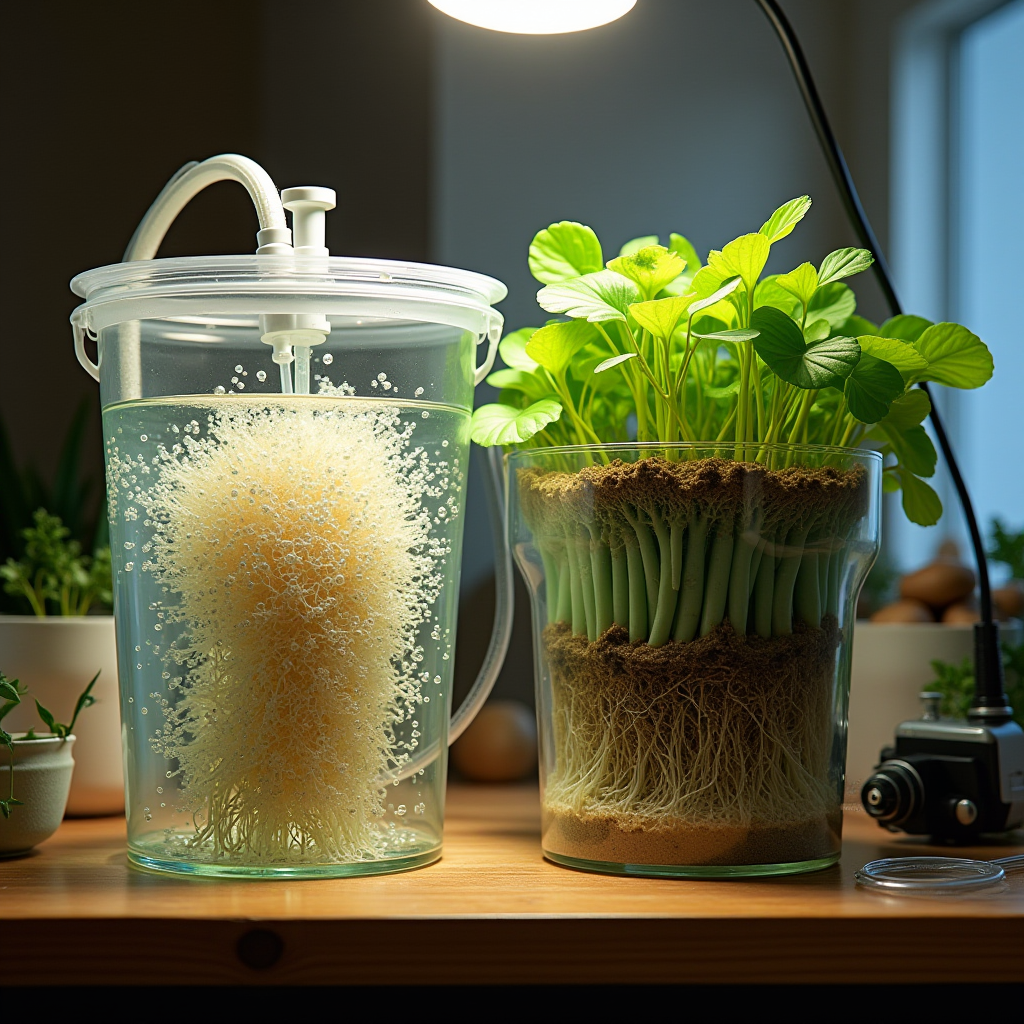
Stop Root Rot with Oxygen: Exact DO mg/L Targets and Aeration Design for DWC & Raft Hydroponics (2026 Guide)
Common Mistakes: When Low Oxygen Pretends To Be “Nutrient Problems”
“Pythium” gets blamed for a lot of what is really oxygen starvation.
Roots look a little beige, growth plateaus, EC seems fine, and you start chasing nutrient tweaks. Meanwhile, your dissolved oxygen has been under 5 mg/L for days.
That disconnect is exactly what sits behind splashy headlines like a desktop system that grows plants “in midair without water or soil” in the new Izestee aeroponic ecosystem, highlighted in this piece. And it is also quietly underpinning the yields claimed by high-output vertical farms, like the Chengdu project pushing 50 tons from 100 m² reported in this Grozine article. Both extremes are fundamentally about ruthless control of the root zone, including oxygen.
In deep water culture (DWC) buckets and raft beds, most growers under-aerate. They rely on “a couple of air stones” without knowing what DO the crop actually needs, or how much oxygen the pump can really supply.
Let’s fix that. We are going to treat oxygen like nutrients: with clear targets, numbers, and a system you can design and verify.
Why These Mistakes Happen: Oxygen Is Invisible And Under-specified
Growers Work With Bottles And EC, Not mg/L Of Oxygen
Most of us were taught to dial in EC and pH. Few of us were given a clean, crop-specific dissolved oxygen target in mg/L, or any idea how to size aeration to hit that number in a loaded system.
Plant physiology research is clear: roots are not just straws for water and nutrients. They are metabolically active tissues that need oxygen for respiration and ion transport, especially under high light and fast growth rates, as summarized in root respiration work across leafy crops in plant physiology studies. If you starve the roots of O2, no amount of extra nitrate or calcium fixes the bottleneck.
Headlines Around Aeroponics Hide The Real Constraint
The “grow in midair” desktop systems and high-density towers look magical because roots are bathed in oxygen-rich air or mist. But the common thread is not the mist itself. It is the extremely oxygenated root zone.
In a DWC tote or raft channel, you are fighting the opposite condition: a warm, nutrient-rich soup with limited gas exchange. That environment hits three problems at once:
- Lower DO solubility as temperature rises - warmer water holds less oxygen.
- Higher oxygen demand as plants and microbes ramp up metabolism.
- Pathogens favored when oxygen drops and organic matter accumulates.
That is how you get a “mystery Pythium outbreak” right when your crop is bulking up.
Manufacturers Rarely Publish Usable SOTR Numbers
In wastewater aeration, blowers and diffusers come with SOTR (Standard Oxygen Transfer Rate) data. In hobby and small farm hydroponics, most pumps come with nothing but “L/min of air” and a watt rating. You are left guessing how many stones you need and hoping for the best.
Indoor agriculture coverage in outlets like Greenhouse Grower and sustainability-focused reporting on ScienceDaily keep pointing to the same thing: high-yield systems are increasingly engineered, not improvised. Oxygen is one of those parameters that has to move from “rough guess” to “designed and measured.”

How To Fix It: DO Targets, Aeration Design, And Reliable Measurement
1. Set Real DO Targets By Crop And Stage
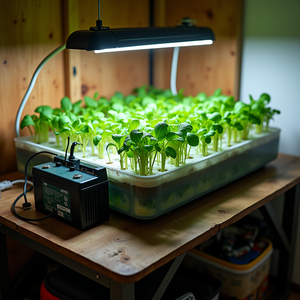
Lettuce & Leafy Greens In Raft / DWC
For indoor lettuce rafts and DWC totes, you can treat these as hard operating numbers:
- Root-zone temperature: 18 to 22 °C is the sweet spot for most lettuces.
- DO saturation at those temps: roughly 9.5 to 10 mg/L at 18 °C and around 8 to 8.5 mg/L at 24 °C in fresh water.
Putting that together, practical targets:
- Safe minimum: 5 to 6 mg/L (below this, stress and disease risk rise fast).
- Working minimum: keep the system above 7 mg/L at all times under load.
- Preferred range: 7 to 9 mg/L for vigorous growth and disease resistance.
This aligns well with experimental ranges seen in controlled environment research summarized across leafy crops in the plant physiology literature on Nature: roots function normally at DO near saturation and begin to switch to less efficient metabolism as DO drops toward 4 mg/L.
Seedlings, Herbs, And Heavy Feeders
- Seedlings/propagation (any crop): aim for the upper end, 8 to 9 mg/L, because young roots are delicate and disease-prone.
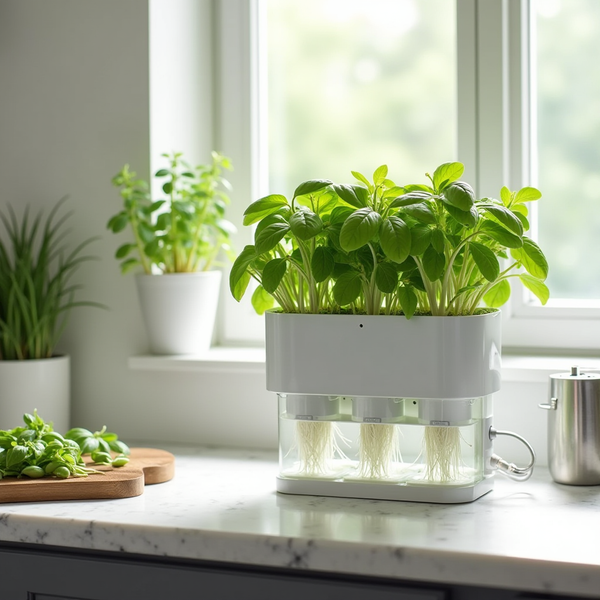
- Basil and leafy herbs in DWC: handle similar DO to lettuce but tend to be more sensitive to warm, low-oxygen conditions. Keep DO > 7.5 mg/L and temperatures on the cooler side if possible.
- Fruit crops in DWC buckets (tomato, cucumber): workable at 6 to 8 mg/L if temperature is controlled, but you will see stronger root systems and resilience closer to 8 to 9 mg/L.
2. Design Aeration: From Air Pump To DO mg/L
Key Concepts: SOTR, FOTR, And Oxygen Demand
To stop guessing, you want to think like this:
Field oxygen transfer rate (FOTR) ≥ Total oxygen uptake rate (OUR) at your DO setpoint.
Definitions in plain language:
- SOTR (Standard Oxygen Transfer Rate): how much O2 a pump + diffuser can move into clean water at 20 °C with zero DO.
- FOTR (Field Oxygen Transfer Rate): what you actually get in your nutrient solution at your real temperature and DO.
- OUR (Oxygen Uptake Rate): how much O2 your plants plus microbes are using per hour.
You rarely get formal SOTR data for hobby air pumps, but you can still design intelligently and then verify with a DO meter.
Quick Rules Of Thumb For DWC & Rafts
- Air volume: start with about 0.5 to 1.0 L/min of air per 10 L of nutrient solution.
- Diffuser type: fine-bubble diffusers (small-pore stones or discs) are more efficient than large, coarse bubbles because they provide more surface area.
- Layout: distribute diffusers down the length of each raft channel or DWC tote rather than one big stone at the sump only.
- Recirculation: maintain a steady turnover rate in raft systems so fresh, aerated solution reaches every plant. You want good mixing, not just bubbles under the inlet.
A Simple Oxygen Demand Check For Lettuce Rafts
Say you have a 1000 L raft channel with 200 mature lettuce plants.
- Rough combined oxygen use for plants plus microbes: about 0.3 to 0.8 g O2/plant/day in dense, high-light conditions. A mid-range assumption is 0.5 g.
- That is 200 × 0.5 = 100 g O2/day.
- Per hour, that is roughly 4.2 g O2/h.
Your aeration and circulation need to transfer at least that much, with a safety factor of 30 to 50%. So, design for roughly 5.5 to 6 g O2/h transfer capacity while maintaining DO above 7 mg/L.
In practice, you will:
- Select an air pump sized to deliver the airflow above.
- Install fine-bubble diffusers along the channel and in the sump.
- Run the system at full plant load and measure DO at the inlet, middle, and outlet during the warmest part of the day.
- If DO stays above 7 mg/L everywhere, your real FOTR is covering the load. If DO drops toward 5 to 6 mg/L at the outlet, add aeration or cooling.
3. Place Diffusers And Build In Turbulence
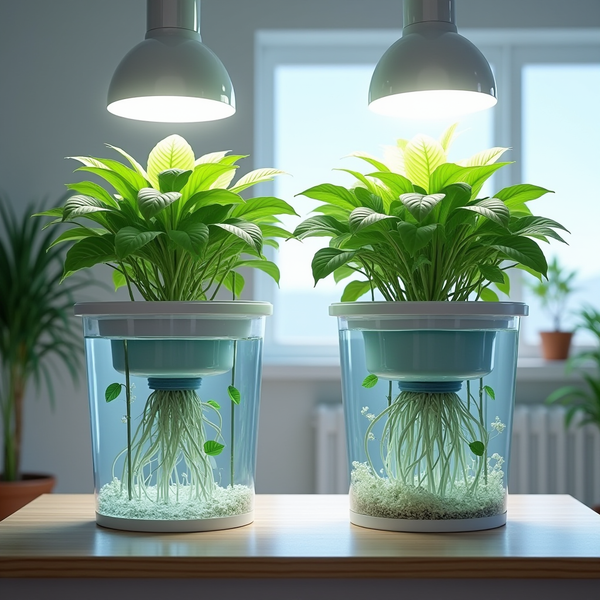
For DWC Buckets
- Use at least one good fine-bubble stone per bucket, placed central, not jammed under the side wall.
- Keep the water level high enough that bubbles actually pass through most of the root mass.
- Consider a small circulator pump in multi-bucket systems to avoid stagnant zones.
For Raft Channels
- Drop an airstone or diffuser every 1 to 1.5 m of channel length, or every 6 to 8 plants, depending on spacing.
- Place some aeration at the return or collection sump to re-oxygenate before the pump sends solution back to the inlets.
- Use the plumbing to help: let inlets enter slightly below the water surface, angled to create a gentle circular flow. That extra turbulence improves gas exchange.
4. Use An Optical DO Sensor And Calibrate It Properly
Without a reliable DO meter, everything above is guesswork. Optical (luminescent) DO sensors are well suited to nutrient solutions because they do not consume oxygen and are less sensitive to flow than galvanic probes.
Calibration Workflow
- Clean the sensor: rinse with clean water and gently wipe. Avoid abrasives or harsh solvents on the optical cap.
- Set the saturation point:
- Aerate a container of clean water for 20 to 30 minutes.
- Enter the water temperature (and barometric pressure if your meter asks for it).
- Place the probe in the container, wait for the reading to stabilize, and calibrate to 100% saturation.
- Set the zero point (for two-point calibration):
- Make a 2% sodium sulfite solution in deionized water.
- Immerse the sensor and wait until the reading approaches zero.
- Confirm the zero calibration per your meter’s instructions.
- Mount in the system: place the probe in a well-mixed point in the main reservoir or a bypass loop. Do not mount directly over a diffuser.
Re-check calibration weekly or at least once per crop cycle. A drifting DO meter is worse than no DO meter.
5. Contrast: Aeroponic “Mist” vs. Recirculating Systems
Aeroponics often gets presented as “better hydroponics” without explanation. In reality, it trades one set of problems for another.
Oxygenation In Aeroponics
- Roots are suspended in air with intermittent misting of nutrients.
- Between mist cycles, the root zone is in contact with oxygen-rich air at almost 21% O2.
- Because the film of water on roots is thin, oxygen diffusion into that film is extremely fast.
That is why compact systems like the Izestee desktop unit can support visible roots “in midair” for small, ornamental, or herb plants. The basic principle is simple: there is so much oxygen that root respiration is never limited, as long as misting is reliable.
Oxygenation In DWC & Raft Hydroponics
- Roots are submerged in a relatively deep nutrient solution.
- Oxygen can only enter by diffusion at the surface and by bubbles from aeration equipment.
- As temperature rises and biomass increases, demand outpaces passive diffusion very quickly.
This is why you cannot apply aeroponic expectations to a simple tub with an air pump. DWC and rafts are more forgiving with regard to mist nozzle clogs and pump cycling, but they demand serious attention to DO mg/L, pump sizing, and water temperature.
6. Integrate Oxygen With Temperature, pH, And EC
Oxygen management is not isolated from the rest of your controls. It sits right alongside temperature, pH, and EC as part of a coherent recipe.
For Indoor Lettuce Rafts, A Practical Recipe Looks Like:
- DO: 7 to 9 mg/L through the full channel length.
- Temperature: 18 to 22 °C in solution.
- pH: 5.8 to 6.2 (with 5.5 to 6.5 as the acceptable band).
- EC: 0.8 to 1.2 mS/cm for seedlings and 1.2 to 2.0 mS/cm for mature heads.
Tracking all four parameters gives you clean diagnostics. If the crop slows down and DO is solid but EC is dropping, you know it is nutrient-limited. If EC and pH are on point but DO is hovering at 4.5 mg/L in the back of the channel, you know the true bottleneck.

What To Watch Long-Term: Benchmarks, Red Flags, And Oxygen Safety Margins
1. DO Benchmarks For Indoor Lettuce Rafts
Use these as quick checks in your logbook or controller dashboard:
- Inlet DO: ≥ 8 mg/L in the afternoon at mature crop.
- Mid-channel DO: ≥ 7 mg/L, with less than 1 mg/L drop from inlet.
- Outlet DO: ≥ 6.5 to 7 mg/L. A drop larger than 1 to 2 mg/L suggests undersized aeration or flow.
If those numbers slip, you may not see symptoms immediately. But it is only a matter of time before roots start browning, especially if temperatures creep up.
2. Visual Root Diagnostics
DO meters are great, but roots tell the truth too. Watch for:
- Healthy roots: white or cream, firm, with fine lateral hairs and no strong smell.
- Early oxygen stress: slightly tan roots, reduced fine hairs, and slower overall growth even when tops still look okay.
- Advanced problems: brown, slimy roots, smell of fermentation, and rapid wilting after minor stress.
At the first sign of early stress, treat DO as your first suspect. Confirm with the meter before you start chasing exotic pathogens or obscure nutrient issues.
3. System Design Red Flags
- Single-point-of-failure aeration: one pump, one circuit, no backup. Even a short power cut can drop DO quickly in warm, dense systems.
- Warm, exposed reservoirs: open tanks under grow lights or in hot rooms. These are DO killers and pathogen incubators.
- Dead legs and stagnant corners: parts of the system where flow is minimal, often where Pythium shows up first.
4. Kratky & Small Systems: Oxygen Without Pumps
In passive Kratky setups, you do not have active aeration, so oxygen management looks different:
- Maintain a meaningful air gap as solution drops. The top third of the root mass should live in air.
- Use net pots and lids that allow lateral air movement, not sealed plastic that traps humidity and heat.
- Keep solution depth and plant density reasonable so diffusion can keep up with oxygen demand.
Kratky is fantastic for balcony tubs and small indoor projects, but the more biomass you cram into a static reservoir, the more likely you are to cross the line where oxygen becomes limiting. Treat Kratky as low plant-count, short-cycle, or cool-climate friendly unless you are ready to supplement with a pump and stones.
5. Data Habits That Pay Off
Growers hitting very high yields per square meter in vertical farms, like the Chengdu project described in this Grozine coverage, are not guessing. They are logging.
Even in a modest indoor or balcony system, you can copy the mindset:
- Record DO, temperature, pH, and EC at the same times every day, plus notes on root appearance.
- Check DO at “worst case” times: late afternoon, mature crop, warmest days.
- After any design change to aeration or flow, track DO and growth for at least a week before drawing conclusions.
Over a few cycles, you will see patterns. That lets you size pumps, chillers, and backup systems based on data, not rules of thumb alone.
6. Putting Oxygen To Work For You
The endgame is simple: you want oxygen to disappear as a limiting factor. Once DO is stable in the right band, nutrient recipes, lighting, and planting density are suddenly easier to optimize because they are not being sabotaged by an invisible constraint under the rafts.
If your current DWC or raft setup is “mostly working” but feels fragile, start with these three changes:
- Add or upgrade aeration to hit at least 0.5 to 1.0 L/min of air per 10 L of solution.
- Get a calibrated optical DO meter and confirm mg/L numbers across the system.
- Control solution temperature into the 18 to 22 °C band as tightly as your budget allows.
In many systems, those three steps alone are the difference between recurring root rot and a stable, repeatable crop.
As an Amazon Associate, I earn from qualifying purchases.