Stop Root Rot in DWC: Air Pump Sizing, Diffuser Types, and Dissolved Oxygen Targets for Leafy Greens & Basil
If your DWC basil smells like pond water and your lettuce roots look like wet noodles, it is not “just how hydroponics is” - it is your dissolved oxygen screaming for help.
DIY DWC builds are exploding right now, especially in small indoor and balcony setups. But far too many buckets and totes are quietly suffocating roots with undersized air pumps, weak diffusers, and warm, stagnant reservoirs. The result: root rot, stalled growth, and limp salads.
This guide stays laser-focused on DWC aeration: practical dissolved oxygen (DO) targets, realistic air pump sizing, diffuser options, and layout tips to keep leafy greens and basil cruising through winter and beyond.
The Problem: Great Tops, Dying Roots
Most home DWC failures look the same:
- Plants start strong, then stall around week 3 to 4.
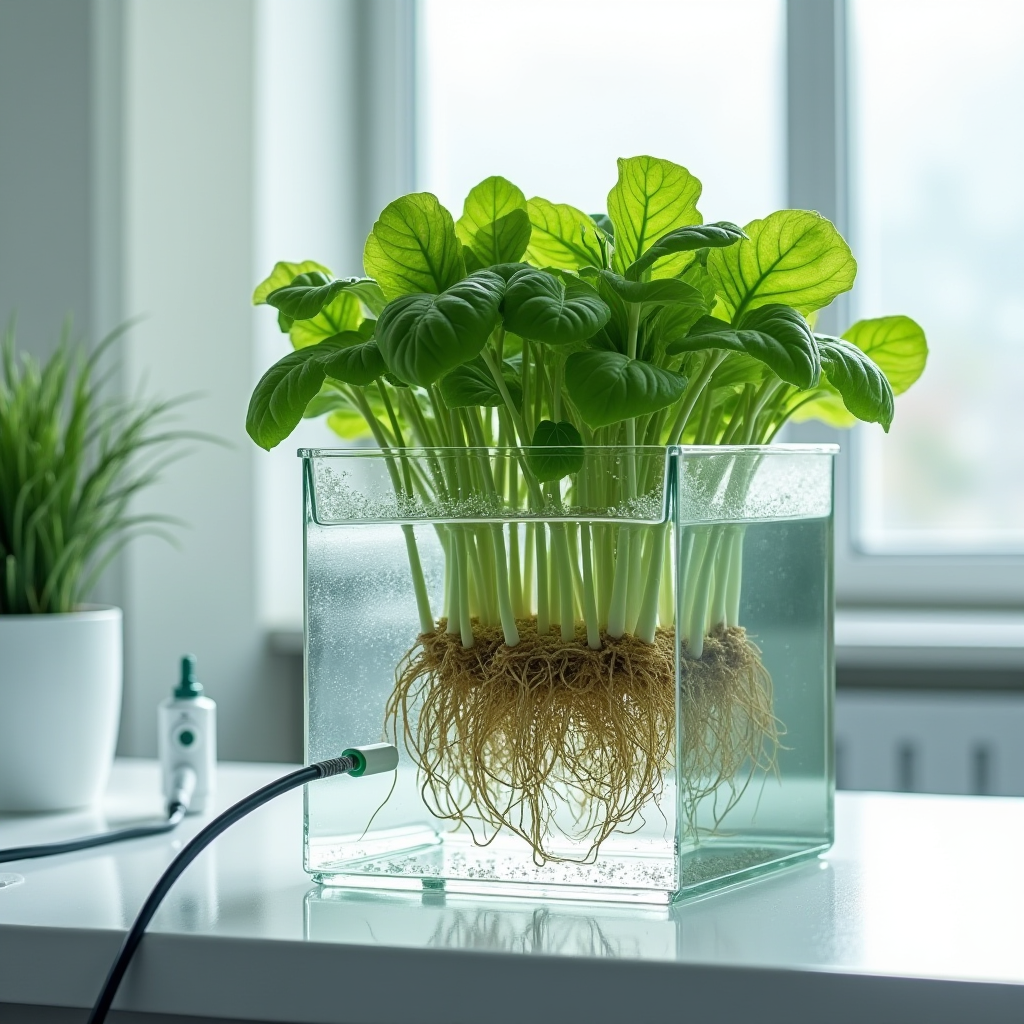
- White roots turn tan, then brown, then slimy.
- Reservoir smells “off” - earthy at best, swampy at worst.
- Lettuce tips burn or curl, basil leaves yellow from the bottom up.
On the surface, it is easy to blame nutrients, pH, or “bad genetics”. Under the lid, the real story is usually oxygen.
In Deep Water Culture, roots live full-time in water. If that water is:
- Under-aerated (weak pump, poor diffuser, bad layout),
- Too warm (above about 21 °C / 70 °F), or
- Loaded with organics and biofilm,
then dissolved oxygen crashes, pathogens like Pythium activate, and roots suffocate. Multiple DWC guides highlight root rot and hypoxia as the main failure modes of hobby systems when aeration and cleanliness are neglected, not nutrients or light intensity here and here.
Leafy greens and basil are fast drinkers with high metabolic rates. That speed is an asset only if your reservoir delivers enough oxygen to match it. When it does not, you get the classic combo: lush tops early, then a sudden crash as the root zone collapses.

The Cause: Low DO, Warm Water, Bad Bubbles
Dissolved Oxygen Targets for Leafy Greens & Basil
Most hydroponic crops are happy around 6 to 8 mg/L dissolved oxygen in the root zone. Extension resources on DWC systems and nutrient management reinforce that DO in this range supports strong root respiration and yield stability here and in DWC starter guides such as this one.
For fast, shallow-rooted crops like lettuce and basil in compact DWC, aim a bit higher when possible:
- Leafy greens, lettuce, Asian greens: 7 to 9 mg/L
- Basil and tender herbs: 7 to 10 mg/L
You will rarely hit 10 mg/L in a warm indoor environment, but designing your system for 7+ mg/L under load (mature plants, warm room) massively cuts root rot risk.
Water Temperature vs Oxygen
The hotter your reservoir, the less oxygen it can hold. As temperature rises above roughly 21 °C, DO saturation drops and pathogens become more aggressive. Practical DWC references commonly recommend keeping nutrient solution around 18 to 22 °C for root health and oxygen availability here.
- Below 18 °C: High DO potential, but growth can slow.
- 18 to 21 °C: Sweet spot for lettuce and basil in DWC.
- Above 22 °C: Oxygen drops, root rot risk climbs fast.
If your buckets are on a warm floor or near a heater, you are effectively aerating warm soup instead of cool nutrient solution.
Air Pump Size: Why “Aquarium Rated” Is Not Enough
Most DIY DWC builds are under-aerated because they rely on tiny aquarium pumps that were never sized for dense root masses.
Common hobby guidance for DWC is to size air by reservoir volume and plant density rather than tank size label. For single-bucket builds, several DWC how-to resources suggest roughly 1 to 3 L/min of air per 5 gallon (19 L) bucket as a minimum starting point here and here. For heavier plant loads, going higher is beneficial.
For leafy greens and basil, a practical working rule for indoor DWC is:
- Baseline: at least 0.5 to 1 L/min of air per gallon (0.13 to 0.26 L/min per liter) of nutrient solution.
- Dense planting, warm rooms, or long runs of tubing: push to 1+ L/min per gallon.
Examples:
- Single 5 gallon bucket (leafy greens / basil): 3 to 5 L/min air pump.
- Four 5 gallon buckets on a manifold: 15 to 20 L/min total, with valves to balance each line.
- 40 to 60 L tote with 8 to 12 heads of lettuce: 20 to 30 L/min air pump plus multiple diffusers.
Use pumps rated for continuous duty with spare capacity. Running a pump at 60 to 70% of its max output is more reliable than flogging a tiny pump at 100% 24/7.
Bad Bubble Design: Diffuser Type and Placement
Bubbles are your oxygen delivery vehicle. Their size, pattern, and position matter as much as raw pump output.
- Fine bubble diffusers (air stones, ceramic discs, micropore tubing): smaller bubbles, higher surface area, better oxygen transfer. Widely recommended in DWC best-practice guides as the default choice for deep reservoirs here.
- Coarse bubble wands: bigger bubbles, more agitation, less efficient DO transfer but good for mixing.
Poor layouts create “dead zones” under thick root mats where water sits quietly and DO drops. Warm, low-flow pockets are exactly where root rot starts.
The Solution: Dial In Air, DO, Diffusers, And Layout
1. Size Your Air Pump For The Actual Load
Use this simple starting point for leafy greens and basil in DWC:
- Minimum: 0.5 L/min per gallon of nutrient.
- Preferred: 0.75 to 1 L/min per gallon, especially for warm rooms or dense planting.
For a 20 gallon (75 L) reservoir feeding a raft or multi-net-pot lid of lettuce and basil:
- Minimum: 10 L/min pump.
- Ideal: 15 to 20 L/min pump with a manifold to multiple diffusers.
Always choose a pump with more outlets than you need. Cap unused ports or run them to a spare stone in a side bucket for extra aeration and noise reduction.
2. Aim For 7+ mg/L DO Where Roots Live
If you can, use a DO meter at least occasionally to verify your design. University and commercial sources stress the value of DO and EC/pH monitoring as the backbone of DWC system management here.
Without a DO meter, use these proxies:
- Visual: roots stay white to cream, with fresh “fuzzy” lateral roots.
- Smell: reservoir smells neutral or slightly “fresh”, never swampy.
- Behavior: plants never wilt when lights come on, even late in the cycle.
3. Use The Right Diffusers For DWC
For indoor leafy greens and basil, prioritize fine bubble coverage and even mixing:
- Small buckets (single plant): 1 medium round air stone centered on the bottom.
- 10 to 20 gallon reservoir: 2 to 4 round stones or a pair of ceramic discs spaced evenly.
- Long totes / rafts: run a line of air stones or micropore tubing along the length under the root mat, not just at one end.
Keep stones 2 to 5 cm off the absolute bottom if debris tends to collect, so bubbles are not constantly blasting sediment into the root zone.
4. Place Diffusers To Break Up Dead Zones
Layout rule: everywhere there are roots, there should be bubbles rising through them.
Practical tips:
- Center stones under each cluster of net pots instead of one big stone in a corner.
- In rafts, place stones down the middle and, for wider tubs, add a line near each side wall.
- In multi-bucket systems, give each bucket its own dedicated stone and line from a manifold. Do not daisy chain air from bucket to bucket.
5. Keep The Reservoir Cool And Shaded
To protect DO levels and stop root rot pressure climbing:
- Use opaque lids and wrap translucent totes to block light, as suggested in several DWC care guides like this one.
- Lift reservoirs off hot floors with foam or wood.
- Schedule nutrient changes in the cool part of the day and top up with cool water.
- If needed, drop a frozen water bottle in the reservoir during heat spikes as a temporary fix.
6. Run Clean To Minimize Oxygen Demand
Organic slime and biofilm consume oxygen that should be going to roots. To reduce the oxygen load:
- Use clean, mineral hydroponic nutrients rather than thick organics for DWC.
- Rinse and scrub reservoirs, tubing, and stones between cycles.
- Do full solution changes every 7 to 14 days, depending on plant size and EC drift.
This maintenance fits with standard DWC best practices outlined in many DIY and pro-level guides such as this one and this detailed DIY guide.
The Evidence: Numbers To Build Your DWC Around
To keep this practical, here is a “cheat sheet” of target ranges and rules of thumb, consolidated from DWC-focused guides and extension material on deep water culture, dissolved oxygen, and water quality monitoring here, here, and here.
Dissolved Oxygen Targets
- Leafy greens, lettuce, Asian greens: aim for 7 to 9 mg/L.
- Basil and herbs: aim for 7 to 10 mg/L if water temps are on the high side.
- Absolute minimum: avoid dropping below 5 mg/L for extended periods.
Air Pump Sizing For DWC
- Rule of thumb: 0.5 to 1 L/min of air per gallon of nutrient solution for leafy greens and basil.
- Single 5 gallon bucket: 3 to 5 L/min.
- 20 gallon multi-plant reservoir: 15 to 20 L/min is a robust target.
Reservoir Temperature
- Ideal range: 18 to 21 °C (65 to 70 °F).
- Watch zone: 22 to 24 °C (72 to 75 °F) - increase aeration and cooling strategies.
- Risk zone: above 24 °C (75 °F), especially if aeration is weak.
pH & EC Anchors (For Leafy Greens & Basil in DWC)
While this article is about aeration, your DO, pH, and EC live in the same reservoir. Poor DO often shows up alongside pH and EC drift, so it is worth locking in your baselines. Hydroponic DWC guides and extension documents commonly recommend:
- pH: 5.8 to 6.2 sweet spot (acceptable 5.5 to 6.5).
- EC (mS/cm):
- Lettuce and leafy greens: roughly 0.8 to 1.4.
- Basil: roughly 1.2 to 1.8, depending on growth stage.
These ranges are consistent with the recommendations across multiple DWC and hydroponic nutrient management resources, including hobbyist and commercial-level guides like this DWC starter guide and the Virginia Tech DWC bulletin here.
Quick Audit For Your Current DWC System
Use this checklist today on your leafy greens or basil buckets:
- Count gallons in your reservoir and compare to your pump’s L/min rating.
- Open the lid: are bubbles directly under all root zones, or just in one corner?
- Check root color and smell. White/cream and neutral smell is good; tan/brown and earthy or swampy smell means you are behind on oxygen or cleanliness.
- Measure water temperature at “lights on” peak - that is your worst-case DO moment.
If you fix air pump sizing, diffuser layout, and reservoir temperature, 80% of DWC root rot problems disappear. Nutrients and pH matter, but oxygen is the foundation. Build your system around DO first, and your winter basil and lettuce will stop tasting like stress and start tasting like something you actually want to eat.
As an Amazon Associate, I earn from qualifying purchases.