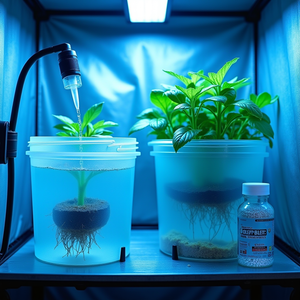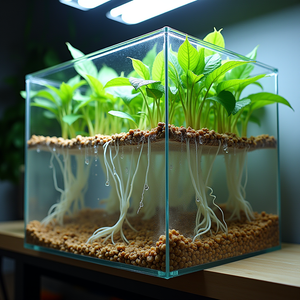
If your Kratky tote keeps brewing cloudy soup, white crust, or rusty flakes, it’s not bad luck - it’s nutrient fallout. Let’s fix it so your reservoir stays clear, stable, and high-uptake with zero pumps.
The problem
Passive reservoirs like Kratky and small-bucket DWC are magnets for precipitation and lockout. You mix clean, come back a day later to chalky rims, tan haze, or orange specks. Plants stall, tips burn, greens taste bitter, and your EC and pH drift out of range.
What’s really going wrong
- Bad mixing order - Concentrated calcium and phosphates/sulfates meet before proper dilution, forming insoluble salts that cloud and crust, especially without circulation.
- Wrong iron chelate for your pH - Fe-EDTA falls apart above about 6.5, while DTPA and EDDHA hold iron in solution much higher. Pick the wrong one and you get rusty flakes and iron deficiency.
- Alkalinity fighting you - Hard water and bicarbonates push pH up and feed white scale. In small, uncirculated reservoirs, pH rise is faster.
- Temperature and light - Warm, lit reservoirs encourage biology and reactions that cloud your solution.
The fix: stable, clear Kratky and bucket DWC in 5 moves
1) Start with the right water
- Use RO or low-alkalinity water when possible. It reduces pH drift and prevents carbonate crust. RO also makes nutrient targets repeatable, as noted in this guide.
- Target reservoir temperature 18-22 C to limit reactions and root stress, a common best practice in hydro reservoir management (source).
2) Use the no-precip mixing order
Never combine concentrates. Always add each part to a large volume of water, mix thoroughly, then add the next.
- Silica first if used. Add to full volume water, mix, wait 10-15 minutes.
- Base Part A (usually calcium nitrate) next. Mix until clear.
- Base Part B (phosphates/sulfates) after Part A is fully diluted.
- Cal-Mag only if your base is not already calcium-heavy and you use RO.
- Micros including iron chelate last.
- pH adjust at the end. Do not adjust pH between parts.
This sequence minimizes calcium-phosphate fallout and stabilizes EC/pH, as outlined in this mixing order guide.
3) Choose the right iron chelate for your expected pH
- Fe-EDTA: economical, good up to roughly pH 6.5. Above that it loses grip on iron and you see orange particulates and deficiency. See ranges discussed in this Hort Americas note and this overview.
- Fe-DTPA: more stable, commonly used in hydro; effective to around pH 7-7.5, a safer pick for hard water or near-neutral systems (source, source).
- Fe-EDDHA: the tank boss in alkaline conditions, effective into the 8-9 range. It tints solution red-purple and costs more, but it prevents iron fallout in stubbornly high pH setups (source).
Bottom line: If your pH lives 5.6-6.2, EDTA is fine. If you drift 6.3-7.2 or use hard top-offs, choose DTPA. If you routinely see 7+, go EDDHA. Using chelates is the single best defense against iron precipitation, as noted in this article.
4) Set pH to favor solubility, not just a number
- General hydro sweet spot for availability is pH 5.5-6.5 (reference).
- Kratky rule: Start slightly low (5.6-5.8). In passive bins, nitrate uptake and alkalinity tend to push pH upward, so you climb into 6.1-6.3 without daily chasing. Occasional checks recommended (guide).
- Small-bucket DWC: Start 5.7-5.9 and hold 5.6-6.2. Expect faster swings from rapid uptake and temperature shifts, so spot-check more often (overview).
- Use nitric or phosphoric acid to lower pH. Avoid citric/acetic in reservoirs - they destabilize and feed microbes.
5) Daily habits that prevent fallout
- Shield reservoirs from light to reduce algae and photodegradation.
- Keep a simple log. Check pH and EC regularly; small, consistent nudges beat big swings, as emphasized here (source).
- Top off smart: if EC rises, add pH-balanced water; if EC drops, add nutrient solution. Kratky growers can still maintain the air gap by topping smaller amounts more frequently.
Quick recipes you can trust
- Kratky lettuce tote (15-30 L): Start EC 0.8-1.2 mS/cm, pH 5.6-5.8. Iron 1-2 ppm as DTPA if your tap pushes pH above 6.2, otherwise EDTA is fine. Expect drift to 6.1-6.3 mid-grow.
- Herb bucket DWC (18-20 L): Start EC 1.2-1.6 mS/cm, pH 5.7-5.9. Keep 18-22 C. Use DTPA iron if you see persistent orange flecks or operate near pH 7.
Troubleshooting by symptom
- White crust on walls/lids: Carbonate scale from alkalinity and evaporation. Switch to RO or pre-acidify top-off water, start pH lower, and keep lids light-tight. Mixing order above helps prevent calcium phosphate crusting (guide).
- Cloudy/tan solution right after mixing: Calcium met phosphates too soon. Add parts to full volume water, A before B, micros last. Do not pH in between additions.
- Rusty flakes or rapid iron deficiency: pH too high for your chelate. Swap EDTA to DTPA or EDDHA depending on your range (source). EDDHA will tint the solution red-purple - normal (note).
- pH climbs daily: High alkalinity or heavy nitrate uptake. Cut tap with RO, start lower, and use an iron chelate that tolerates your actual pH.
Evidence snapshot
- Mixing order matters to prevent lockout and precipitation (this guide).
- Hydro-friendly pH range 5.5-6.5 maximizes availability (extension reference).
- Iron chelate stability: EDTA works acidic, DTPA to ~7-7.5, EDDHA best at high pH (Hort Americas, Hortidaily, Aqua Gardening).
- Kratky still needs occasional pH checks and steady temps (Trees.com).
Final take
In 2025, keeping Kratky and small-bucket DWC simple does not mean sloppy. Use RO or low-alkalinity water, follow the no-precip mixing order, pick your iron chelate for the pH you actually run, and set pH to favor solubility. Do that and your reservoirs stay glass-clear, your roots stay happy, and your harvest tastes like you meant it.