Stop Aeroponic Nozzle Clogs: Filtration, Pressure, and Root‑Chamber Design for Small Indoor Systems (2025 Guide)
If commercial vertical farms are bringing in humanoid robots to reduce labor, you can be absolutely sure of one thing: they are not walking those robots down the aisle every two days to unclog misting nozzles.
For home and small indoor growers, you are the robot. When a high-pressure aeroponic system goes down because of one slimy, clogged nozzle, you do not lose a work order - you lose an entire crop in hours.
This guide is about designing your way out of that failure mode. We will focus on:
- Choosing filter micron ratings that actually protect fine aeroponic nozzles
- Stabilizing pump pressure with regulators, accumulators, and anti-siphon loops
- Setting realistic mist duty cycles for leafy greens and herbs
- Managing root-chamber humidity and airflow to keep biofilm and rot in check
- Sanitizing lines and chambers without nuking your plants
The goal: a small, indoor, high-pressure or fine-mist aeroponics setup that behaves more like a fridge (quiet, boring, predictable) and less like a temperamental science project.
The Problem: Nozzles Clog, Roots Dry Out, Crops Crash
Aeroponics is brutal in one way: there is almost no buffer. In DWC you can lose a pump and still have oxygen in the water for a while. In NFT you might get a few minutes of forgiveness. In high-pressure aeroponics, a single clogged nozzle can mean roots are dry in 5 to 20 minutes, especially under warm indoor lights.
Common failure patterns in small indoor systems:
- Fine-mist nozzles clog from tiny particles, precipitated nutrients, or biofilm slime.
- Uneven mist coverage leaves some plants thriving while their neighbors crisp up.
- Biofilm and algae line your reservoir, pump, and tubing, shedding debris into the spray network.
- Roots suffocate or rot in poorly vented chambers where mist turns to stagnant soup.
- Full crop loss when a timer fails, a pressure line pops, or a single nozzle silently plugs.
High-pressure aeroponics is attractive because of its efficiency: it can use over 90% less water than soil and accelerate growth when run properly, as highlighted in this comparison of aeroponic systems. But that same efficiency comes with high complexity and low tolerance for downtime, as noted in this overview of soilless systems.
At the hobby scale, you do not have redundancy, industrial filtration trains, or automated self-flush nozzles. You need a design that keeps things simple and resilient:
- Filtration that actually matches your nozzle spec
- Pressure that does not wander all over the place as pumps cycle
- Root chambers that stay humid, not flooded or bone-dry
- Maintenance routines that you can actually stick to
Before we get there, let us anchor what is going wrong under the hood.

The Cause: Tiny Orifices, Dirty Water, Wild Pressure, and Stale Root Chambers
Let us break down why aeroponic clogging and biofilm are so common, especially indoors.
1. Nozzle Orifices Are Smaller Than Your Filter
Most true high-pressure aeroponic nozzles run orifices around 0.2 to 0.5 mm and want droplet sizes in the 30 to 80 micron range. If you feed those nozzles through a 100-micron or even 50-micron filter, you are asking for trouble.
Rule of thumb: your final filter stage should be at least 5 to 10 times finer than the nozzle orifice. For typical fine-mist nozzles in hobby systems, that means:
- 5 to 20 micron final filtration (cartridge or disc filter) on the high-pressure side, plus
- 100 to 200 micron pre-filter on the low-pressure side of the pump.
Anything bigger and you are just screening out rocks while sending silt straight into your nozzles.
2. Nutrient Chemistry & Water Quality Create Precipitates
Two big culprits in nozzle clogging:
- Hard water (high calcium and magnesium) that forms scale, especially when heated by pumps or warm grow-room temps.
- Over-concentrated nutrients or incompatible additive recipes that cause salt precipitation in lines and nozzles.
High-pressure systems are especially sensitive because droplet size and orifice size are so small. Using low-mineral input water (RO or very soft tap) and hydroponic nutrients designed to stay in solution at pH 5.5 to 6.5, as covered in this overview of aeroponic solutions, makes a noticeable difference.
3. Pressure Spikes, Sags, and Siphoning
High-pressure aeroponics is designed to run at roughly 60 to 120 psi with relatively stable pressure. In small systems, you often see:
- Direct pump-to-manifold plumbing without a pressure regulator or accumulator, so every pump cycle slams the nozzles with a pressure spike.
- No anti-siphon loop, so after the pump shuts off, gravity keeps pulling nutrient through the nozzles, dribbling and dripping instead of misting.
- Unequal line lengths, so some nozzles see 90 psi while others barely get 40 psi.
Those conditions produce inconsistent droplet size and partial atomization. That means larger droplets hitting roots (less oxygen), more wet surfaces, and more spots where mineral and organic residues can stick and accumulate.
4. Root Chambers That Are Too Wet, Too Stagnant, or Both
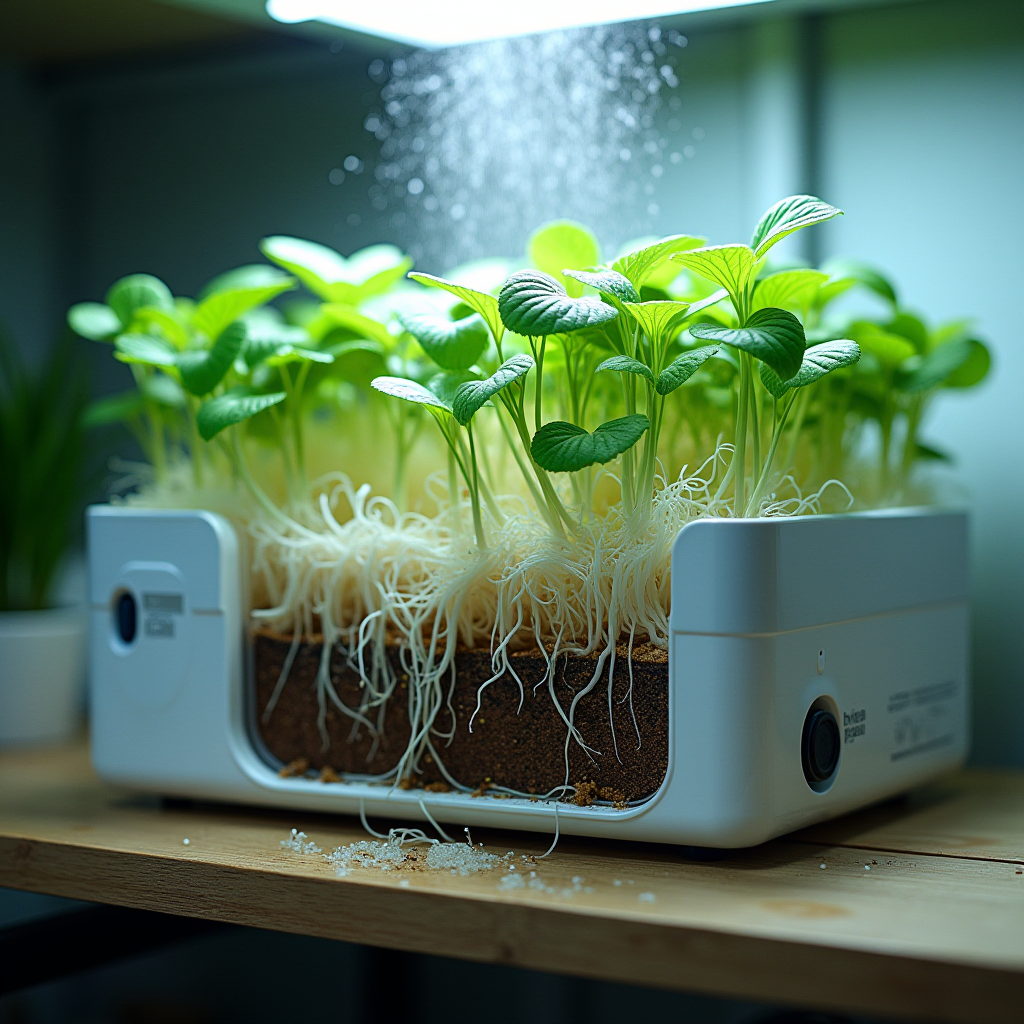
Aeroponic roots want a high-humidity environment with intermittent, fine mist, not constant drizzle. When root chambers have poor drainage or no airflow:
- Excess mist condenses into puddles and films on surfaces.
- Warm, nutrient-rich condensate grows biofilm and slime.
- That biofilm flakes off, rides back through drains, and eventually heads toward your filter and nozzles.
Indoor systems with enclosed or poorly ventilated chambers are especially prone to this. You see white, beige, or brown slimy coatings on walls, sprayers, and roots themselves.
5. Maintenance Gaps and Poor Line Hygiene
Because aeroponics can deliver faster growth - often up to 30% faster than conventional hydroponics according to this aeroponics guide - issues also snowball faster. A few reality checks:
- Most hobbyists are not flushing lines weekly.
- Few people log pH/EC daily, even though shifts signal precipitation and biofilm formation.
- Disinfection is sporadic, usually only after something goes visibly wrong.
That is how a clean system turns into a nozzle-clogged mess by mid-cycle.

The Solution: Design For Clog Resistance, Stable Pressure, and Clean Roots
Now the part we care about: how to build or retrofit a small indoor aeroponics setup that resists clogs and biofilm and is realistic to maintain.
1. Filtration That Matches High-Pressure Aeroponics
Think of filtration as a chain that must be as strong as the smallest link: your nozzle orifices.
Water source and pre-treatment
- Ideal: RO or very soft water as your base. This dramatically reduces scaling and precipitation.
- Acceptable: Low to moderate hardness tap water with consistent quality. Avoid wildly variable well water unless you know the mineral profile.
Filter stages for small high-pressure systems
For a compact indoor build (say 5 to 40 nozzles):
- Intake screen / 200–300 micron mesh on the pump suction side to keep big debris out.
- 50–100 micron sediment filter cartridge or disc filter after the pump but before the pressure regulator.
- 5–20 micron final polish stage before the manifold feeding your nozzles.
Choose clear filter housings where possible so you can visually check loading. Mount them where you can actually reach them without disassembling half your system.
Filter maintenance rhythm
- Quick rinse weekly: Pop out and rinse screens and disc filters.
- Cartridge swap: Plan on swapping 5–20 micron cartridges every 4 to 8 weeks for continuous systems.
- Flush ports: Add valves at low points in the plumbing so you can blast out settled debris.
2. Stable Pressure: Regulator, Accumulator, Anti-Siphon Loop
A good high-pressure aeroponic circuit has three key features:
- Pressure regulator tuned to your nozzle spec (commonly 60–100 psi).
- Accumulator tank to smooth pump cycles and pressure swings.
- Anti-siphon loop to stop gravity-fed dribble when the pump is off.
Setting target pressure
Check your nozzle manufacturer, but typical ranges:
- Fine mist HPA nozzles: 80–100 psi sweet spot.
- Low-pressure / fogger hybrids: 40–70 psi.
Consistent pressure improves droplet size and reduces wetting of chamber surfaces, which helps limit biofilm.
3. Dialled-In Misting Duty Cycles for Leafy Greens and Herbs
For small indoor HPA systems, most leafy greens and herbs do well with relatively short, frequent pulses while lights are on, and slightly longer intervals in the dark when transpiration slows.
Common starting points (tweak for your specific build):
- Seedlings / young transplants: 2–3 seconds ON, 2–4 minutes OFF during lights on; 2–3 seconds ON, 5–8 minutes OFF during lights off.
- Established leafy greens (lettuce, basil, chard): 3–5 seconds ON, 3–5 minutes OFF during lights on; 3–5 seconds ON, 7–12 minutes OFF during lights off.
- Heavier feeders or warmer rooms: shorten OFF times slightly; cooler rooms can tolerate longer OFF times.
The goal is to keep roots moist and white, not dripping and not drying out between cycles. If roots are turning brown or getting slimy, mist is either too frequent, droplets too large, or chamber humidity too high with no air exchange.
4. Root-Chamber Humidity, Airflow, and Drainage
Root chambers should be:
- Light-tight to prevent algae.
- Well-drained so excess mist runs back to the reservoir quickly.
- Ventilated enough that humid air moves, but not so open that roots dry out.
Practical design tips
- Add a few small passive vents high on the chamber with insect mesh. This allows warm humid air to exit while the root zone remains protected from light.
- Shape the floor of the chamber with a slight slope towards drains so puddles do not form under roots.
- Consider a low-flow air injection (a gentle airstone in a return sump or a tiny PC fan on a duct) if you are seeing stagnant, smelly chambers.
In terms of environment, target similar root zone temperatures you would aim for in DWC: around 18–22°C for most leafy greens is a solid range, as supported by typical hydroponic best practices summarized in this aeroponics comparison.
5. Sanitize Lines Without Nuking Your Plants
You want a routine that prevents biofilm buildup without forcing a full teardown every cycle.
During a grow
- Use a low-dose oxidizer that is compatible with roots and nutrients (stabilized hydrogen peroxide or similar products designed for recirculating systems). Follow label rates closely.
- Keep pH in the sweet spot of 5.5–6.2 for leafy greens and herbs. This range supports nutrient availability while keeping some scaling issues in check, as noted in many hydroponic guides such as this comparison of aeroponics and hydroponics.
- Top off with clean water and nutrients rather than dumping random additives that may precipitate at high concentration.
Between crops
- Drain system completely.
- Flush with plain water to knock out loose debris.
- Circulate a cleaning solution (for example, 3–5% hydrogen peroxide solution or a manufacturer-recommended system cleaner) for 30–60 minutes.
- Disassemble and soak nozzles in a mild acid bath (such as diluted white vinegar or citric acid) to remove mineral deposits.
- Final flush with clean water until you cannot smell cleaning agents.
Always run one full cycle of misting with plain water before putting plants back in, to ensure any residual cleaner is gone.
6. Monitoring pH, EC, and System Behavior
Even the best-designed system needs feedback. For indoor aeroponics, the critical daily checks are:
- pH: Keep in the 5.5–6.2 band for leafy greens and herbs. Sudden drifts can hint at precipitation or biofilm activity.
- EC: For typical salad greens, aim around 0.8–1.6 mS/cm depending on growth stage; many herbs are comfortable in 1.0–2.0 mS/cm. These ranges are consistent with hydroponic nutrient guidelines cited in this high-pressure aeroponics propagation resource.
- Reservoir temperature: 18–22°C to balance oxygen and growth rate.
- Visual nozzle check: Look for uneven spray patterns, dripping instead of misting, or dead spots.
A cheap camera pointed at the root chamber, triggered when the pump runs, can be a powerful diagnostic tool: you can confirm that mist is actually hitting roots every cycle without opening the system constantly.
7. Clog-Resistant Hardware Choices
- Use nozzles designed for HPA, not repurposed foggers from irrigation kits. Look for removable cores and published droplet and pressure specs.
- Use black, opaque tubing and chambers to reduce algae.
- Standardize fittings so swapping a nozzle or valve does not mean re-plumbing the system.
If you build around common, easy-to-source fittings and standard filter housings, downtime stays low and your system scales or repairs smoothly.
Design your small indoor aeroponics system with filtration, pressure control, and root-chamber hygiene in mind, and it stops being a nozzle-cleaning hobby and becomes what you wanted in the first place: a compact, high-yield, low-labor salad and herb machine.