Skip the Slow‑Cooker Seed Hack: A Safe, Temperature‑Controlled Germination SOP for Hydroponic Rockwool & Plugs
1. Common mistakes: why the slow‑cooker hack is bad hydroponic practice
“Warm is good for seeds, so hotter must be better.” That is the hidden assumption behind the viral slow‑cooker seed germination hack, and it is exactly where hydroponic growers get into trouble.
The idea is simple: use a slow cooker as a DIY heat source for seed trays. For soil growers starting warm crops in a chilly house, you might get away with it. But for hydroponic starts in rockwool and foam plugs, that same trick is one of the fastest ways to wreck germination rates and set seedlings up for problems later.
Here are the main failure points I see when growers try to adapt the slow‑cooker approach to hydroponics:
- Uncontrolled temperatures: most slow cookers are designed to hold food safe, not seeds happy. The internal temperature can sit in the 60–90 °C range. Even with a lid cracked, you can easily drive seed zone temps above 30–32 °C.
- Lettuce thermodormancy: lettuce in particular will often refuse to germinate once seed temperatures creep above roughly 25–26 °C; higher temperatures can trigger thermodormancy where seeds simply stay asleep instead of sprouting.
- Hot, wet, low‑oxygen conditions: a sealed or nearly sealed warm container quickly becomes steamy and oxygen poor. That is a perfect recipe for damping‑off diseases and weak, elongated seedlings.
- No separation between air and media temperatures: food appliances heat everything. Good hydroponic germination separates substrate temperature control from air temperature and humidity so you can keep the root zone precise and predictable.
- No real feedback or safety: there is usually no thermostat probe at seed level, no upper‑limit cutoff, and no alarm if things run away.
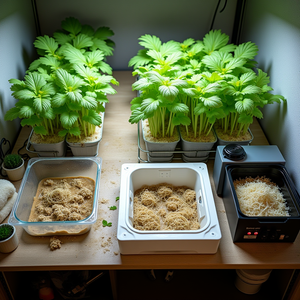
As one review of the trend noted, it can “work” only in a narrow set of conditions and is not how experienced growers manage seeds long term in this guide on the slow‑cooker seed hack. In hydroponics, where you are already managing nutrients, pH, and EC, gambling the first stage of the crop on an uncontrolled heat source is not worth it.
So instead of fighting your equipment, let’s walk through a clean, thermostat‑driven SOP that gives you precise germination temperatures, correct rockwool prep, and an easy hand‑off into Kratky, DWC, or plug‑based systems.

2. Why these mistakes happen: seeds, temperature and hydro media
Most of the slow‑cooker logic comes from a true principle that gets applied badly: seeds usually germinate faster at the warmer end of their preferred range. The problem is that different crops have different “top ends,” and hydroponic substrates like rockwool behave differently under heat than soil.
Cool vs warm crops: different ceilings
Lettuce and other cool crops have a low ceiling. Many cultivars germinate best around 18–22 °C and start to struggle above about 24–25 °C. Past the mid‑20s, a lot of lettuce shows thermodormancy: the seed senses it is too warm and shuts down rather than germinating. Once it is triggered, chilling those same seeds later does not always fix the issue.
Warm crops like basil, tomato, and peppers do prefer more heat. Basil is happy in the 24–26 °C range for germination and will tolerate a bit higher. But even warm crops have limits. Go much above the high 20s and you start trading speed for stress and low oxygen.
Rockwool and foam plugs: great when prepped, brutal when abused
Hydroponic media like rockwool cubes and foam plugs are engineered for high porosity and consistent moisture. That is exactly what we want for clean, transplant‑ready plugs, but it also means:
- If you overheat the substrate, the plug holds hot water around the seed.
- If you keep them soaked in steamy, still air, oxygen around the seed and emerging radicle drops quickly.
- If you skip rockwool pre‑soak and pH correction, the seedling starts life in an alkaline zone instead of the mildly acidic range hydro roots prefer.
Standard rockwool comes out of the package alkaline (often around pH 7.5–8). For hydroponic seed starting, you should be soaking it in mild, pH‑adjusted water (around 5.5–5.8) before sowing. If you skip that step and then cook the cubes in a slow cooker, you are hitting seeds with the wrong pH, the wrong temperature, and very low oxygen all at once.
Why sealed heat is risky
Food warmers and slow cookers are designed to trap heat and moisture. Seeds do need moisture and they benefit from warmth, but they also need oxygen and a little air movement. When you put a germination tray in a sealed, steamy box with hot water underneath:
- Temperatures tend to overshoot and oscillate.
- Condensation makes surfaces constantly wet, which favors damping‑off fungi.
- The air near the media surface can quickly go oxygen poor, especially if the water below is warm and stagnant.
The result is uneven germination, weak stems, and the classic “everything rotted at the base” syndrome.
3. How to fix it: a step‑by‑step, thermostat‑driven germination SOP
Here is a practical, repeatable workflow for hydroponic germination that beats the slow‑cooker hack on every metric: safety, consistency, and transplant performance.
Step 1: Prepare your water and rockwool / foam plugs
- Start with low‑EC water
Use tap, filtered, or RO water. For seed starting, you want a low baseline EC, at or below roughly 0.3–0.4 mS/cm. Measure if you can, but if you do not have a meter yet, avoid very hard water. - Adjust pH before you soak
Add pH‑down dropwise while stirring until you are at pH 5.5–5.8. For most greens and herbs, 5.5 is a solid target. Let the solution sit for 10–15 minutes and recheck. - Soak rockwool cubes or plugs
Submerge the cubes for 15–30 minutes so they are fully wetted. Lift them out and let them drain freely. Do not squeeze; you will collapse the pore structure and reduce oxygen around the roots. - Decide on nutrients for the soak
For germination alone, you can use either plain, pH‑adjusted water (0 EC) or a very mild nutrient solution in the 0.2–0.4 mS/cm range. Many hydro growers keep it simple: pH‑adjusted water only until cotyledons open, then introduce a weak nutrient mix once the first true leaves appear.
Step 2: Sow seeds correctly for hydroponic plugs
- Place seeds in the existing holes
Rockwool starter cubes and foam plugs usually come pre‑drilled. Drop seeds into the dimple rather than poking new deep holes. - Lettuce
Place 1–2 seeds per cube and leave them near the surface. Lettuce often germinates better with light, so either leave seeds exposed or cover with a very thin layer of vermiculite or rockwool fibers. - Basil and warm herbs
Place 2–4 seeds per cube if you want a bushier cluster in each net pot, or 1–2 for single‑plant sites. Cover lightly, but do not bury deeply. They should be sitting in moist media, not sunk into a cold, dark pocket. - Label trays clearly
Mixing cool and warm crops in the same tray is fine if you label rows and keep your temperature strategy in mind. It is easy to forget which side is lettuce and which side is basil once everything is just green specks.
Step 3: Set up proper temperature control (heat mat + thermostat)
If there is one place not to cut corners, it is seed zone temperature. A simple seedling heat mat plus plug‑in thermostat will outperform any slow cooker with less effort once it is set up.
- Cool crops (lettuce, some brassicas)
Set the thermostat to around 20 °C. Keep the high‑temperature limit below about 24–25 °C to avoid thermodormancy. - Warm crops (basil, tomatoes, peppers)
Set the thermostat to around 24–26 °C. Basil in particular is very happy in this band and will usually germinate quickly and evenly. - Mixed trays
If you must run lettuce and basil together on one mat, set the thermostat to around 22–23 °C. Place lettuce towards the edge of the mat (slightly cooler) and basil more central. - Probe placement
Always tape or clip the thermostat probe at cube level, not dangling in the air. Use a spare cube with the probe inserted or tape it to the underside of the tray where the plugs sit.
Room temperature is still relevant. If your grow room already sits at a stable 20–22 °C, you may not need bottom heat for lettuce at all. Use the mat mainly for warm crops and during cold spells.
Step 4: Manage humidity domes instead of sealing everything
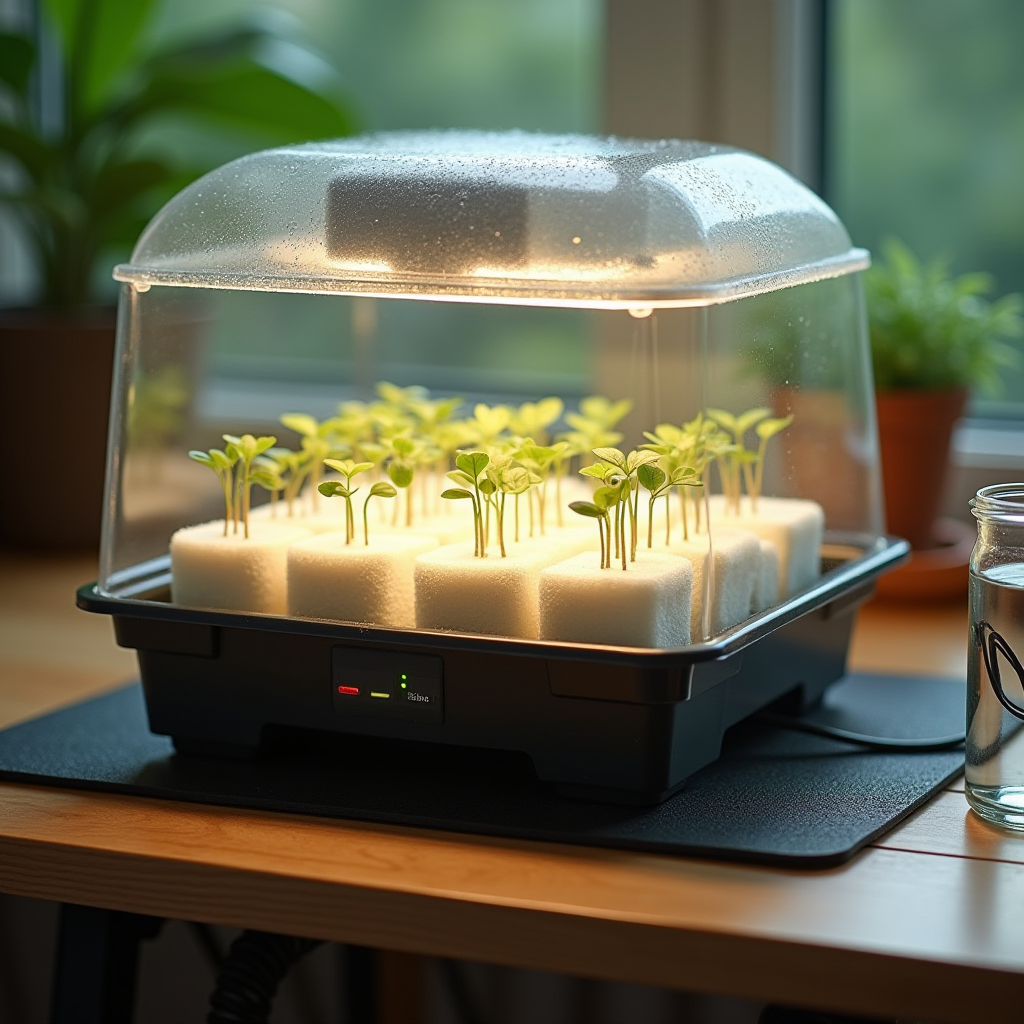
Instead of a sealed cooker, use a standard humidity dome or a clear lid over your plug tray:
- Keep the dome closed until you see the first signs of germination to maintain high humidity.
- As soon as cotyledons appear, open vents or crack the lid to introduce some fresh air and prevent damping‑off.
- By the time seedlings have their first true leaves, you should be removing the dome entirely for most of the day so plants can toughen up under normal humidity.
Step 5: Light introduction and DLI targets after radicle emergence
Seeds do not need intense light to germinate, but they do need appropriate light as soon as they emerge. Here is a practical approach:
- Before emergence
You can keep trays in low light or near the edge of your grow area. Some growers germinate under very gentle light or ambient room light. - At cotyledon stage
Move trays under your main LED, raised high enough to give low to moderate intensity. For most leafy seedlings, aim for a daily light integral (DLI) around 8–12 mol/m²/day. In practice, that often means 14–16 hours under a relatively gentle PPFD of 100–200 µmol/m²/s. - As true leaves appear
Increase light slightly or lower the fixture to build stronger, more compact seedlings. For lettuce seedlings, a DLI of roughly 12–14 mol/m²/day is a good target; basil can handle a bit more once established.
If you do not have a PAR meter, use the simple rule: seedlings should look compact with short internodes and no bleaching. If they stretch hard in the first week, you are either too dark or too warm.
Step 6: When to introduce nutrients and how strong
- Germination to cotyledon stage
Plain, pH‑adjusted water (5.5–5.8) or a very weak nutrient solution is fine. Seeds have their own stored energy. - First true leaves
Start feeding at an EC around 0.5–0.8 mS/cm with a balanced hydroponic nutrient. Keep pH near 5.8–6.0. At this stage, you are still in propagation mode, not full production. - Transplant‑ready stage
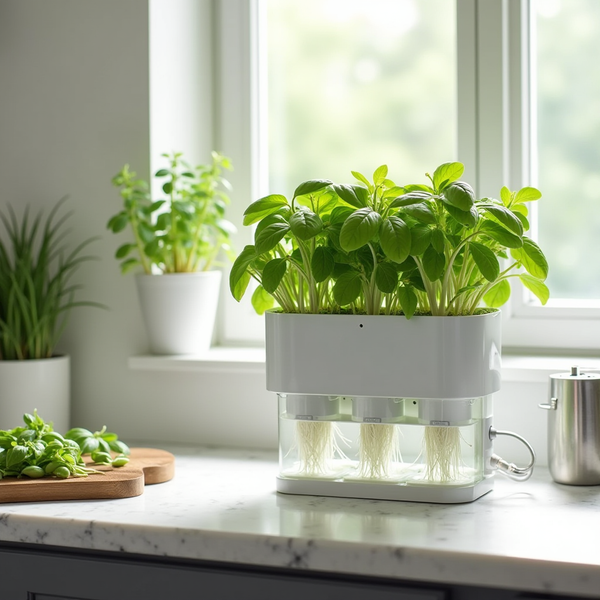
Once roots are poking out of the cube and you have 1–2 sets of true leaves, you can move seedlings into Kratky jars, DWC buckets, or your main system channels. Adjust your main reservoir to around 1.0–1.2 mS/cm for mixed lettuce and basil, with pH in the 5.8–6.2 band.
Step 7: Safe seed sanitation options
If you want to reduce pathogen load without abusing seeds, skip the cooker and use simple sanitation techniques:
- Clean trays and tools with a dilute bleach solution or hydrogen peroxide, then rinse well.
- Use fresh, high‑quality seed from reputable suppliers. Old, poorly stored seed has higher pathogen risk and lower vigor.
- Optional seed surface treatments such as a mild hydrogen peroxide soak can be used with some crops, but always follow crop‑specific recommendations from the seed supplier or breeding company.

4. What to watch long‑term: avoiding hidden failure modes
Once you have a solid germination SOP, your next job is avoiding the slow, silent problems that creep in over multiple batches.
Overheating and thermodormancy
Even with a proper thermostat, bad probe placement or changing room conditions can lead to hot spots. Get into the habit of:
- Checking substrate temperature with a separate thermometer in a test cube occasionally.
- Re‑validating settings when seasons change or when you move the mat to a new surface.
- Keeping lettuce and other cool‑loving species off the “warmest gear” by default.
If you notice lettuce germination suddenly dropping while basil still looks fine, suspect temperature first. Do not immediately blame seed quality.
Hypoxia in sealed or over‑wet setups
Hydro seedlings are especially sensitive to the balance between moisture and oxygen. Watch for:
- Stems pinching at the media surface (classic damping‑off).
- Very slow growth even though leaves look green and healthy.
- Algae on cube surfaces from constant wetness and light exposure.
Fixes are straightforward: vent domes earlier, reduce misting or bottom watering frequency, and do not sit trays in standing water. In Kratky or DWC later on, maintain a good air gap (Kratky) or strong aeration (DWC) so roots never sit in stagnant, low‑oxygen solution.
Damping‑off and sanitation drift
Even a great setup will eventually accumulate spores and biofilm if you do not clean between runs. Build simple habits:
- Rinse and disinfect trays, domes, and tools between batches.
- Avoid re‑using old, damaged rockwool or foam plugs.
- Keep nutrient spills, algae, and plant debris out of the germination area.
Transitioning into Kratky and DWC without stress
Your germination protocol feeds directly into your main system performance. To keep that hand‑off smooth:
- Match pH and EC between the seedling solution and the main reservoir as closely as possible on transplant day.
- Support the plug in the net pot so the top stays just above solution level in Kratky, or just barely touching in DWC until roots grow down.
- Protect roots from light by using opaque containers, lids, or sleeves so you do not grow algae where roots should be.
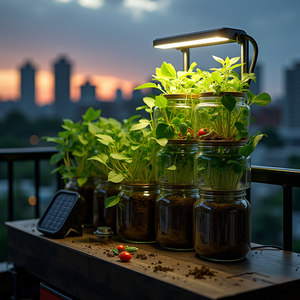
Good germination is the foundation. Once you have temperature, pH, and moisture under control in your plugs, Kratky jars, small DWC buckets, NFT channels, and balcony systems all become far easier to dial in.

Affordable alternatives to the slow‑cooker hack
If you like the concept of bottom heat but do not want to babysit a cooking appliance, here are safer, more controllable options:
- Heat mat + plug‑in thermostat
This is the gold standard for home hydro. It gives you a probe at plug level, a clear setpoint, and often an alarm or cutoff if things go wrong. Set it once, and you get repeatable germination for every batch of rockwool or foam plugs. - Sous‑vide water‑bath with an air‑gap tray
If you already own a sous‑vide circulator, you can create a very stable warm‑water bath at 20–26 °C and float or support a germination tray above the water with a clear lid. The key is maintaining an air gap so trays do not sit in water and ensuring there is still some air exchange. - Leveraging room temperature
In many homes, the ambient temperature in a grow cupboard or tent is already in the right range for cool crops. Use bottom heat only for warm‑season herbs and fruiting plants, and let lettuce germinate at room temp with solid pH‑controlled rockwool prep.
The slow‑cooker hack got attention because people are desperate for better germination. The real win is not clever appliances; it is stable temperatures, correct pH and EC, and a media workflow that slots cleanly into Kratky, DWC, and other hydro systems.
As an Amazon Associate, I earn from qualifying purchases.