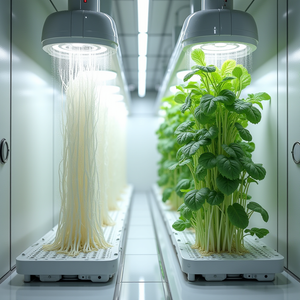
Quiet, Low-Odor Apartment Hydroponics: Design a Sleep-Friendly DWC/NFT Setup Without Sacrificing Yield
If your DWC sounds like a fish tank in a jet engine and your bedroom smells like "swamp salad," the problem is not hydroponics - it is how the system is built and tuned.
The good news: you can run productive Deep Water Culture (DWC), Nutrient Film Technique (NFT), and even hybrid setups in a small apartment or bedroom without wrecking your sleep, air quality, or sanity. You just need to treat noise, humidity, odor, and light spill as design constraints from day one - right alongside pH, EC, and yield.
Below is a practical, evidence-based guide to building a quiet hydroponic system for apartments: how to choose low-noise pumps and fans, kill vibrations, control humidity and smells, and use circadian-friendly lighting so your system supports your mood instead of keeping you up all night.
The Problem: Hydroponics That Grow Great Plants But Ruin Your Room
Most off-the-shelf home hydro systems are designed for growth first, comfort second. Move that same rig into a bedroom or tiny living room and the trade-offs hit fast:
- Constant pump hum and fan whine that bleed through walls and mask the quiet you need to wind down.
- Subtle but persistent nutrient and biofilm odors from warm reservoirs, dead roots, and splashing water.
- Humidity spikes that fog windows, feed mold, and make the room feel clammy, especially in winter.
- Harsh light spill from white/blue-heavy LEDs blowing out your night vision and messing with sleep.
- System failure risk (root rot, pythium, algae) when you try to “quiet things down” by throttling air or water without understanding what the roots actually need.
All this is ironic, because indoor plants are strongly associated with reduced stress and better emotional well-being when the environment itself is comfortable. If your brain tags your hydro system as "that loud thing that makes the room damp and smells weird," you are not getting the mental health upside you signed up for.
From a plant perspective, the problems show up as:
- Stunted or leggy growth when you move lights farther away to reduce glare instead of dialing intensity and spectrum correctly.
- Root stress and disease when you cut air pump power or flow to reduce noise, dropping dissolved oxygen (DO) in DWC below what roots need.
- Algae blooms in NFT channels and reservoirs when you try to run "open" systems to keep heat and humidity down but let light hit the nutrient solution.
- pH drift and nutrient stink from warm, under-aerated reservoirs that become a nice little bioreactor for microbes.
So you get the worst of both worlds: a system that is annoying to live with and less productive than it should be.
The fix is not to give up DWC or NFT. It is to design them like you are building a small lab inside a bedroom: quiet mechanicals, controlled airflow, sealed light paths, and clean reservoirs.

The Cause: Where The Noise, Smell, And Discomfort Really Come From
Once you understand the physics and biology behind an annoying system, the fixes become obvious and cheap. Let us break the pain points down.
1. Pump and Fan Noise: It is Mostly Vibration, Not Volume
Most apartment hydro noise is not the pump itself - it is the vibration transferring into furniture and walls. Air pumps and small circulation pumps are basically little hammers tapping your shelf 50-60 times per second.
- Air pumps resonate through hard surfaces. A strong DWC air pump sitting directly on a wooden shelf can sound twice as loud as the same pump sitting on dense foam. Tips like those in this guide on quieting air pumps show that isolation often matters more than raw decibels.
- Water pumps hum through reservoirs and tubing. Cheap pumps with poor bearings get louder as they warm up.
- Fans, especially cheap axial fans, can whine at high RPM and transmit vibration through thin metal or plastic ducts.
When all three are running in an echoey room at night, it becomes a background drone your brain cannot ignore.
2. Humidity: Transpiration + Evaporation In A Small Volume
Every plant is a tiny humidifier. In hydroponics, they sit over open water, so you also get evaporation from the reservoir or channels. In a small, shut bedroom:
- Plants can push relative humidity well above the comfortable 40-60% range considered ideal for most homes and houseplants, which helps limit mold and dust mites.
- Warm nutrient solution and splashing increases evaporation even more.
- Still air around leaves keeps a moist boundary layer, inviting powdery mildew and botrytis.
Without some form of controlled ventilation or dehumidification, your "relaxing plant corner" quickly turns into a micro-greenhouse.
3. Odor: Warm, Low-Oxygen Water Plus Organics
Pure hydro nutrient solution does not need to smell bad. The stink comes from biology getting ahead of you:
- Dead roots and biofilm in DWC buckets and NFT channels start breaking down, releasing that swampy smell.
- Low dissolved oxygen (from underpowered or throttled air pumps) encourages anaerobic bacteria, which produce sulfurous and "septic" odors.
- Warm reservoirs above about 22-23°C accelerate microbial growth. Many growers target 18-22°C solution temps for both root health and smell control.
Combine this with a sealed bedroom and you end up with persistent, low-level odor that fabric and bedding absorb over time.
4. Harsh Light Spill: Blue-Heavy LEDs And Your Circadian Rhythm
Most LED grow lights are strong in the blue spectrum, because blue and red together drive efficient photosynthesis. The problem: blue light in the evening suppresses melatonin and shifts circadian rhythm, making it harder to fall asleep and reducing sleep quality, especially if the light is in your direct line of sight.
If you are running a 16-hour photoperiod for leafy greens (a common target for fast growth, as noted in many indoor gardening guides like this one), a light that stays on into the late evening in your bedroom works directly against the "plants for mental health" goal.
5. System Choices: Pushing DWC/NFT Hard Without Giving Roots What They Need
If you simply dial pumps and airflow down to make the room quieter, you can easily drop below the oxygen and turnover rates that make DWC and NFT so powerful:
- DWC roots want consistent dissolved oxygen and a stable nutrient profile. Most leafy greens do well with EC around 1.2-1.8 mS/cm and pH 5.8-6.2, assuming the roots are well oxygenated, as summarized in hydroponic system overviews like this guide.
- NFT needs a reliable film of nutrient moving through channels. Starving the pump or using excessively long channels to "simplify" the layout can create dry spots and hot zones.
- Kratky is silent and pump-free, but if you try to scale it up without understanding the oxygen wedge (air gap) and nutrient volume, you can run plants out of solution or air at the wrong time.
Put simply: a quiet, low-odor apartment system fails when you treat noise, humidity, and smell as afterthoughts instead of core design parameters.

The Solution: Build A Sleep-Friendly DWC/NFT System That Still Hits Yield
Now we get to the fun part: designing hydro around humans and plants at the same time. Here is a systematic way to build (or retrofit) a quiet hydroponic system for apartments.
1. Start With The Right System Mix For Your Space
- Use Kratky where silence is non-negotiable (bedside herbs, microgreens). A simple opaque tote or jar with a net pot, nutrient solution, and an air gap at the top gives you totally silent growing for short-cycle crops. It is passive, low-maintenance, and ideal for greens and herbs.
- Reserve active DWC for bulk production (bigger greens, some fruiting crops) in the same room but not directly next to the bed. Use heavier totes or buckets with tight lids to provide thermal mass and sound dampening.
- Use NFT for long, narrow spaces like along a wall or window. Keep channels short (1.5-2 m or less) and level, with a modest recirculation rate so you do not need a loud pump.
For all three: make every surface that touches nutrient solution opaque to prevent algae, which also helps with smell and maintenance.
2. Choose Quiet Pumps And Kill Vibration At The Source
Good gear and mounting can drop perceived noise by more than half.
- Use overspec'd but speed-controlled pumps. A slightly larger DC or AC pump running at 50-70% load tends to be quieter and more reliable than a tiny pump screaming at 100%.
- Suspend or isolate air pumps: place them on dense foam, a yoga block, or hang them from elastic cord so they do not touch rigid furniture. Guides on silent water and air pumps, like this article, highlight how much difference vibration damping makes.
- Use soft silicone airline instead of stiff PVC where possible; it transmits less vibration.
- In DWC, use fewer but larger air stones rather than many tiny ones. You get plenty of oxygenation without as much high-pitched bubbling noise.
Test your system at night in the actual room. If you can clearly hear a mechanical hum over typical apartment background noise, keep tuning: more foam, lower pump speed, better mounting.
3. Quiet, Targeted Ventilation And Humidity Control
You do not need a grow-tent-grade exhaust fan blasting air out the window in a small apartment system. You do need steady, gentle air exchange and circulation.
- Target indoor humidity around 40-60%. A simple digital thermo-hygrometer will tell you if transpiration is getting out of hand. Many home-oriented hydro guides, like this one on small systems, recommend this range for plant and human comfort.
- Use quiet, low-RPM circulation fans focused across the canopy, not directly at your face. Aim them so leaves gently flutter, which improves transpiration and reduces disease risk.
- For sealed or small rooms, consider a compact dehumidifier on a smart plug. Run it during lights-on when transpiration is highest; many units are very quiet at low fan speed.
- Leverage existing apartment airflow: keep interior doors cracked, use bathroom or kitchen exhaust during the most humid part of the light cycle, and avoid burying the system in a dead-air corner.
If your windows are fogging regularly or you see condensation on reservoir lids, your humidity control is behind. Fix that before you blame the plants.
4. Odor Management: Keep The Root Zone Clean And Oxygenated
Odor control is 80% good root and reservoir hygiene:
- Keep nutrient solution cool: Aim for 18-22°C. In warm apartments, use insulated reservoirs or keep them off direct sun and away from radiators.
- Maintain DO with quiet aeration: Healthy, white roots in well-oxygenated solution do not smell bad. Do not let "quiet" become "stagnant."
- Regular water changes: For small DWC and NFT systems, fully change solution every 7-14 days depending on plant load, topping up with pH-adjusted water in between. This lines up with recommendations in beginner hydro guides such as this one.
- Scrub and sanitize buckets, channels, and tubing between crops to remove biofilm. Even a mild bleach or hydrogen peroxide solution followed by a good rinse goes a long way.
- Add passive odor control if needed: activated carbon room filters or carbon-infused intake filters can mop up any remaining scent without needing a roaring inline fan.
Also consider your crop choices: lettuce, spinach, bok choy, and many herbs have minimal scent compared to strongly aromatic or resinous plants. For a bedroom, low-odor crops plus clean water often mean you do not smell the system at all.
5. Circadian-Safe Lighting: Respect Your Sleep
You can absolutely run proper lighting and still sleep in the same room. Think like this:
- Shift the light schedule earlier: Instead of running 10 am - 2 am, run 6 am - 10 pm or even 5 am - 9 pm, so the light is off for at least 1-2 hours before your typical bedtime.
- Use enclosures or baffling: A simple DIY light baffle or partial enclosure (even a mini curtain or hinged panel) around the light can block direct line-of-sight while allowing air movement.
- Adjust spectrum if possible: Some LED fixtures allow reduced blue output in the evening. Lowering blue content for the last few hours of the photoperiod can be easier on your eyes while still keeping plants happy.
- Match intensity to the crop: Most leafy greens do very well at 150-300 µmol/m²/s PPFD with 14-16 hours of light. You do not need blinding-intensity fixtures run at full power in a small apartment system.
If you share a small apartment, treat your hydro light like any other screen: you should not be staring straight at it late at night. Design the space so the beam is always indirect.
6. Dial In pH, EC, And Crop Choices For Stable, Low-Maintenance Runs
A quiet setup that constantly demands your attention is not really supporting your well-being. Choose plants and nutrient targets that run stable.
- Leafy greens and herbs are ideal for apartment DWC/NFT: most like pH 5.8-6.2 and moderate EC (1.2-1.8 mS/cm), which is easy to maintain with weekly checks.
- Use buffered nutrient formulas designed for recirculating systems. They resist rapid pH swings, which means fewer late-night adjustments.
- Standardize on one or two mixes so you can learn how they behave. Once you know how your solution drifts as plants feed, you can preempt corrections instead of constantly reacting.
- Keep reservoirs appropriately sized: a slightly larger volume per plant makes parameters more stable and reduces how often you need to intervene.
The result is a system that mostly hums along (quietly), with quick weekly checks for pH, EC, and hardware rather than daily wrestling matches.
7. Putting It All Together: A Sample Sleep-Friendly Apartment Build
Here is what a practical, quiet hydroponic system for apartments might look like in a one-bedroom scenario:
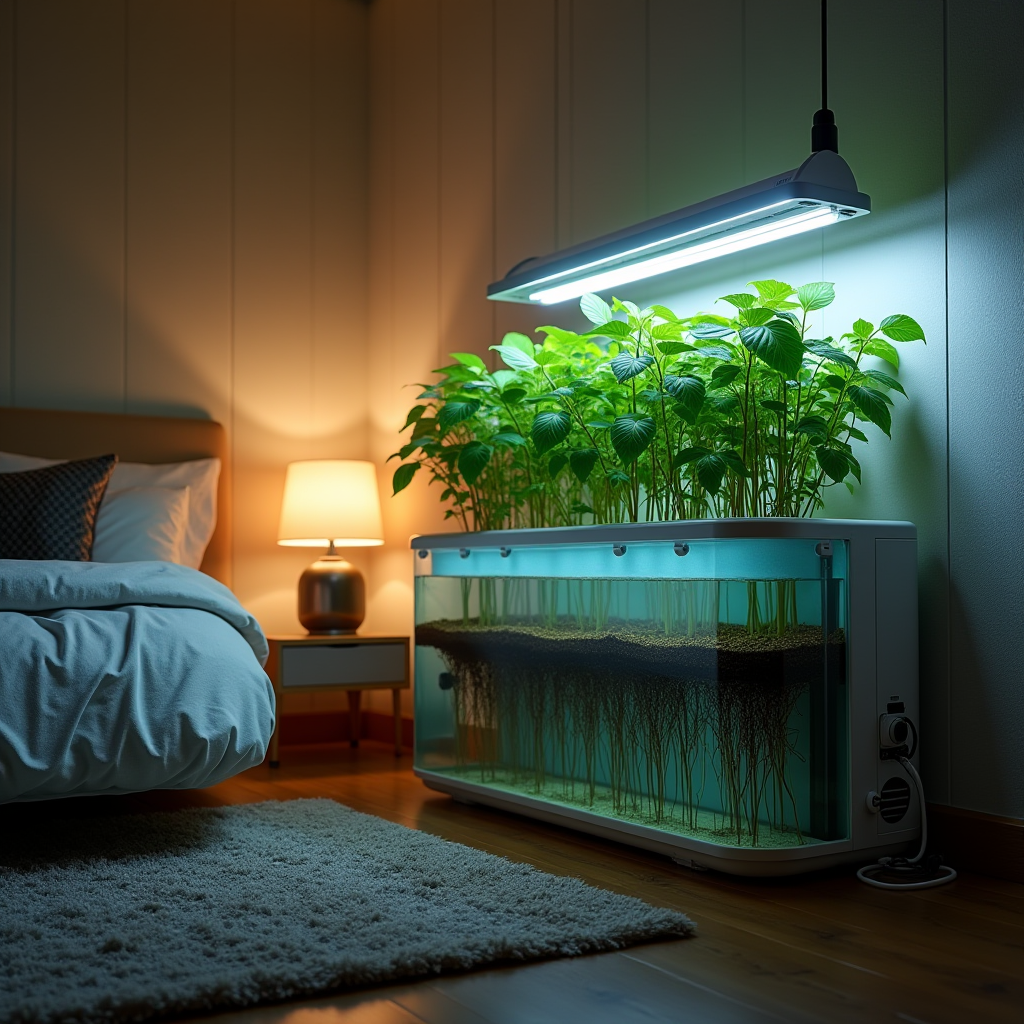
- System layout: One 40-60 L insulated DWC tote on the floor in the bedroom corner plus a short 2-channel NFT rail along a wall, plus a few Kratky jars on the windowsill.
- Pumps: A single oversized, quiet air pump feeding 2 air stones in the DWC, sitting on dense foam inside a cabinet to dampen sound; a small DC water pump for NFT on a vibration pad.
- Ventilation: One low-RPM clip fan gently sweeping the canopy, plus a compact dehumidifier set to 50-55% RH, both running on a daytime schedule.
- Lighting: A dimmable LED panel hung over the main system, run at 50-70% intensity for a 15-16 hour photoperiod ending by 9-10 pm; simple side shields to block direct view from the bed.
- Reservoir management: Weekly pH/EC checks, top-ups midweek, full changes every 10-14 days, keeping solution at 18-22°C.
This kind of system can easily provide a steady stream of leafy greens and herbs while staying quiet, low-odor, and compatible with good sleep. It feels like having a small, calm, productive biosphere in the room rather than a noisy science experiment.
Build your DWC/NFT like you are designing equipment for a shared living space, not a garage. When you give noise, humidity, odor, and light spill the same respect you give pH and EC, you end up with what hydroponics should be in an apartment: quiet, clean, productive, and genuinely good for your head.