Organic Container Crop Steering Indoors: Tensiometer Targets, SIP/Autopot Irrigation & VPD/Light Strategies For Living Soil
Most indoor crop steering advice quietly assumes you are running rockwool, coco, and sterile fertigation. In a living soil container with worms, fungi, and an Autopot tray under it, that playbook will hurt more than it helps.
The myth is simple: “Crop steering is only for high-frequency drip in inert media.” In reality, you can steer organic container crops just as effectively by using tensiometers, pot weight, smart SIP/Autopot timing, and gentle VPD and light tweaks that work with your soil biology instead of nuking it.
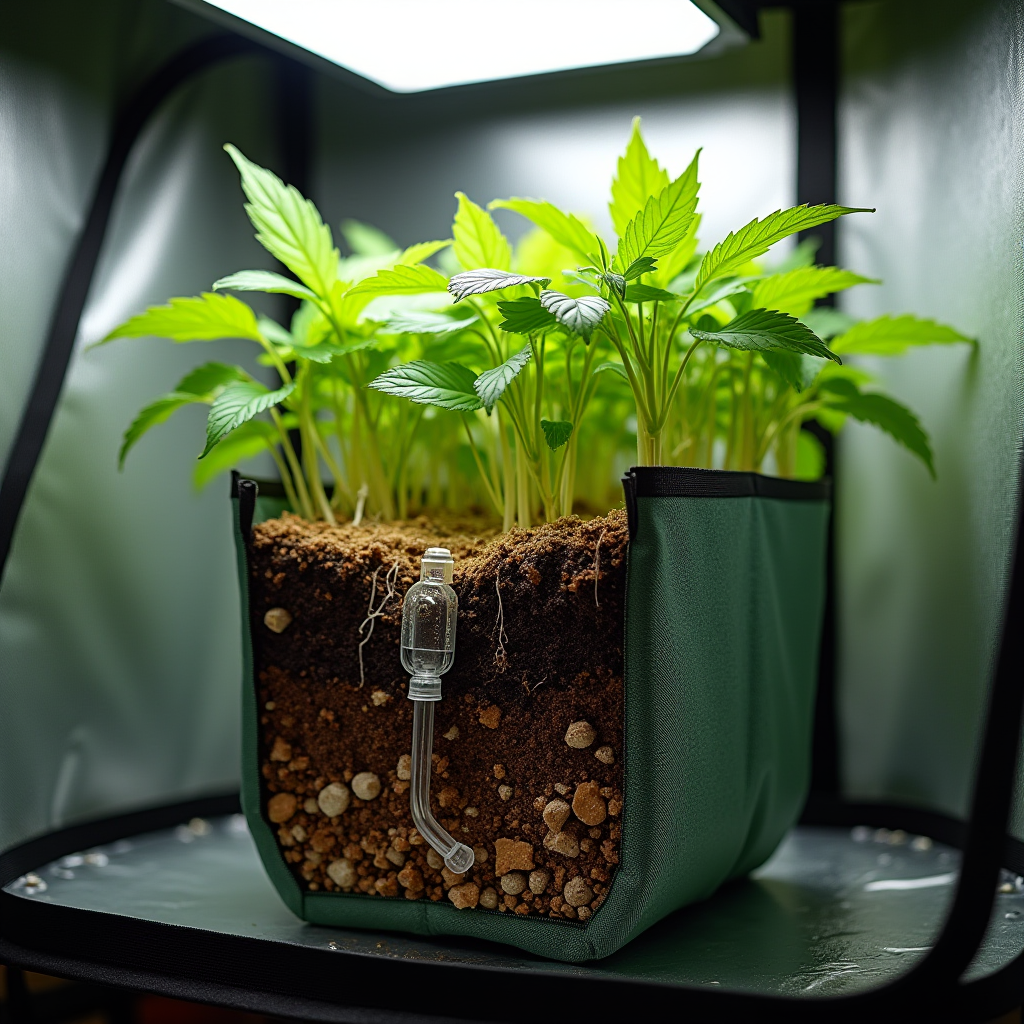
This guide stays strictly indoors and container-based: 20–50 L fabric pots, living soil or amended mixes, SIPs and Autopots, basic climate control, and LED lighting. You will see concrete kPa ranges, irrigation patterns, and day/night VPD and spectrum moves you can actually run in a tent or small room.
1. Common Mistakes In Organic Container Crop Steering Indoors
1.1 Copying coco/rockwool playbooks into living soil
In coco or rockwool, heavy generative steering means higher VPD, leaner feed, and lots of small irrigations. In a 30 L living soil pot, that same schedule is a great way to dry out the fungal network and stall your microbes.
As Garden Culture explains, soil-based steering is slower and buffered. You are steering the soil food web first, then the plant. If you change things as aggressively as you would in rockwool, you overshoot badly.
1.2 Treating SIPs and Autopots like bottom-fed coco
SIPs and Autopots are designed to hold a semi-stable moisture band in the lower third of the pot. Many growers try to “steer” by constantly raising and lowering water levels in the tray or running strong salt feeds, like they would with inert slabs. Result: saturated lower root zones, anaerobic pockets, and suffocated microbes.
1.3 Using VPD and light to punish instead of nudge
Crop steering is often sold as “push harder” – high VPD, aggressive defoliation, intense blue or red peaks. In organic containers you are running a biological engine. Sudden swings in VPD or DLI shock the plant faster than the soil community can adjust.
Garden Culture’s crop steering overview is clear: climate, irrigation, and light are tools, not weapons. In living soil, those tools must be applied in smaller, longer arcs.
1.4 Ignoring actual moisture data (no tensiometer, no pot-weight habit)
A lot of organic growers still water by “feel” alone. That works in big beds that rarely dry out deeply. In 15–30 L containers indoors, you can swing from too wet to too dry in 24–48 hours. Without a tensiometer or at least a pot-weight baseline, it is easy to create chronic stress while thinking you are steering correctly.
1.5 Static LED schedules across all stages
Running the same spectrum and intensity from rooted clone to late flower wastes steering potential. Modern dynamic LED control, like the approach highlighted by Sollum in this piece, shows how much yield and quality you gain by matching spectrum and DLI to plant phase. You do not need a SUNaaS platform at home, but you should be intentional with dimming, photoperiod, and spectrum where possible.

2. Why These Mistakes Happen (And What’s Really Going On)
2.1 Inert media steering is fast; organic steering is buffered
In rockwool and coco, irrigation and EC changes hit the root zone instantly. You can see a plant react within hours, which makes it tempting to port that same logic into soil.
In living soil, microbes and soil colloids buffer most of what you do. Moisture moves slower. Nutrient changes move slower. As Garden Culture notes, you are “steering by feel” and memory: soil remembers your last week of decisions, not just yesterday’s feed.
2.2 SIPs/Autopots are moisture stabilizers, not steering joysticks
A SIP or Autopot tray is a passive system that keeps a relatively steady moisture gradient from bottom to top. When you chase generative/vegetative swings by constantly filling and draining trays, the lower root zone never gets a consistent oxygen profile. That is why you see yellowing from the bottom up or a swampy smell long before the plant shows classic “under/overwatering” symptoms.
2.3 VPD and spectrum changes hit stomata faster than soil can respond
Raise VPD, and transpiration spikes. Shift spectrum bluer, and stomata tighten while internodes shorten. These responses happen within minutes. Your microbes and soil moisture profile cannot keep up if you change things too violently. You end up with a plant that is physiologically in “hard generative” mode while the root zone is still set up for lush vegetative growth. That mismatch is where tip burn, stalled growth, or “mystery deficiencies” start.
2.4 No common language between sensors and “gut feel”
When you first add a tensiometer or a VPD chart to an organic grow, the numbers look random. Without translation into real pot behavior, growers either ignore the data or chase it too literally. The trick is building a simple bridge: kPa value + pot weight + leaf posture. Once those three line up in your head, steering gets intuitive again.
2.5 Legacy LED habits: set it once and walk away
Early LED fixtures had limited controls, so many of us got used to one intensity and spectrum all cycle long. Dynamic systems like Sollum’s, which can alter spectrum and intensity in real time to hit target DLIs and crop recipes, show how much steering capacity light actually has in practice. Indoor container growers can borrow the same principle with basic dimmers and timers.
3. How To Fix It: Practical Organic Container Steering Indoors
3.1 Tensiometer targets and pot-weight cues for living soil
3.1.1 Baseline kPa ranges for healthy biology
Exact numbers vary with soil texture, but for indoor living soil containers the following ranges are a solid, biology-safe starting point:
- Vegetative steering (more leafy, vigorous growth): Aim for roughly 5–15 kPa in the active root zone. That is “moist but aerated” for most mixes. Do not let it sit at the very wet end for days; cycle gently between the lower and upper end of that range.
- Balanced transition (late veg/early flower flip): Allow dry-backs to around 15–25 kPa before refilling trays or top-watering. This starts the generative signal without shocking microbes.
- Moderate generative steering (bulk flower/fruit set): Let the pot climb to about 25–35 kPa before irrigation, then re-wet only down into roughly the 10–15 kPa zone. You want real, repeatable dry-backs, not bone-dry pots.
Whatever tensiometer you use, bury the ceramic tip at the depth where most feeder roots sit, usually mid-depth in the pot, not at the very bottom.
3.1.2 Pot-weight “feel” to back up sensor data
Even with a tensiometer, use your hands or a luggage scale. At the start of veg, fully saturate the pot, let it drain, then weigh or “feel” that weight. Call this 100%. When your tensiometer hits the upper end of your target band, weigh again. Maybe that is 80%. Over time, you learn that 80% weight and a 25–30 kPa reading is your perfect generative re-watering point.
3.2 SIP and Autopot irrigation that respects soil life
3.2.1 General principles
- Keep the tray as a buffer, not the main control surface. Your steering happens via how long you let the pot draw down between fills, not via big swings in reservoir strength.
- Use gentle, microbe-safe feeds. In Autopots or SIPs, stick to low-EC organic inputs: light liquid organics, compost teas, or filtered top-up water. High-salt organic blends can still crust and create osmotic shock at the bottom.
- Allow periodic “air breaks.” Every 7–10 days in veg and every 5–7 days in flower, let the tray go dry for 12–24 hours so the bottom third of the pot can re-oxygenate.
3.2.2 Example steering patterns
Vegetative-biased pattern (more growth, less stress):
- Keep Autopot valves open or SIP reservoir active most of the time.
- Top-water lightly around the root zone once a week with a mild tea if needed.
- Let tensiometer peak at around 15–20 kPa before refilling if you are manually controlling trays.
Generative-biased pattern (flower/fruit focus):
- Once roots are well established (2–3 weeks after flip), start running scheduled “tray off” windows.
- Let the pot climb to around 25–35 kPa before refilling trays. Do not top-water during this window unless the plant is wilting.
- When you refill, aim for a partial re-wet so the tensiometer returns to about 10–15 kPa, not 0–5 kPa.
This cycling maintains a healthy oxygen profile and sends a clear but gentle generative signal.
3.3 VPD settings that steer without cooking microbes
VPD is still one of your best steering tools, even in organic containers, as highlighted in this steering overview. The trick is to use narrow bands and slow changes.
3.3.1 Vegetative VPD targets (lights on)
- Day VPD: Aim for roughly 0.8–1.1 kPa. This keeps transpiration robust without forcing the pots to dry too fast.
- Night VPD: Allow it to fall slightly, in the 0.6–0.9 kPa range, by either letting temps drop a bit or raising humidity.
3.3.2 Generative VPD targets (bulk flower/fruit)
- Day VPD: Raise gradually over 7–10 days toward 1.2–1.5 kPa. Pair this with your slightly deeper dry-backs (25–35 kPa soil tension).
- Night VPD: Keep around 0.8–1.1 kPa to prevent condensation and mold while still allowing some recovery.
Do not jump VPD by more than about 0.2–0.3 kPa in a single day. Small nudges keep the soil community in step with the canopy.
3.4 Light schedules and spectrum tweaks for living soil steering
3.4.1 Photoperiod and intensity
- Vegetative steering: 18/6 or 20/4 with moderate PPFD (for many crops, roughly 300–500 µmol·m⁻²·s⁻¹). This supports root and leaf expansion without demanding extreme nutrient turnover.
- Generative steering: Standard 12/12 for photoperiod-sensitive species or a modest DLI increase for day-neutral crops. You can bump PPFD to about 600–800 µmol·m⁻²·s⁻¹ if your genetics and CO₂ support it.
3.4.2 Spectrum bias
- Vegetative push: Slightly bluer bias (if your fixture allows it) in early growth to tighten internodes and encourage compact architecture.
- Generative push: Gradually warm the spectrum with more red and far-red emphasis as you enter and progress through flower. Sollum’s work with dynamic LEDs shows how spectrum changes tied to stage can raise yield and quality compared to static output in commercial trials.
The key for living soil: avoid sudden intensity or spectrum jumps that outpace what your root zone can supply.
3.5 Where hydro logic still applies (and where it doesn’t)
Concepts from Kratky, DWC, and classic drip still help:
- Root zones love stable oxygen and moisture bands.
- EC spikes and crashes are bad news, even if soil buffers them.
- Day/night rhythm is a steering lever, not just an on/off switch.
What changes in organic containers is tempo. Think in weeks instead of days, and in ranges instead of hard setpoints.

4. What To Watch Long-Term: Benchmarks & Fine-Tuning
4.1 Canopy and leaf-level signals
- Vegetative steering success: Rapid leaf production, strong petiole angles, even color, minimal edge curl at your chosen VPD and moisture range.
- Generative steering success: Visible shift into flower or fruit set without a big stall, moderate internode shortening, consistent resin or fruit development.
- Warning signs: Chronic clawing or droop at “correct” kPa and VPD. This usually means your changes are too abrupt, or your tray regime is suffocating the lower roots.
4.2 Soil biology health checks
- Smell: Healthy soil smells earthy, not sour or rotten.
- Surface activity: Occasional fungal fuzz between irrigations is good; persistent slime or algae in SIP/Autopot trays is a red flag.
- Temperature: Avoid allowing container temps to fluctuate wildly as you chase VPD. Large swings stress microbes more than they help steering.
As Garden Culture points out, organic steering is about creating conditions that microbes like first. Plant performance follows.
4.3 pH and EC in organic containers
You are not chasing hydroponic precision, but a few guardrails help:
- pH: Aim for irrigation water and teas in the 6.2–6.8 range. Let the soil buffer the rest.
- EC/TDS of inputs: Keep most feeds modest, around what many would call 0.8–1.2 mS/cm during veg, creeping a bit higher in mid-flower if the soil is not heavily pre-charged.
- Runoff / tray readings: If your Autopot tray solution EC climbs cycle after cycle, you are overfeeding for the system’s evaporation rate. Dilute and reset rather than trying to steer harder.
4.4 Simple steering recipes you can test
Pick one steering axis at a time so you know what actually worked.
- Recipe 1 - Mild vegetative push: Keep soil in roughly the 5–15 kPa band, run day VPD around 0.9–1.0 kPa, and hold PPFD near 400–500 µmol·m⁻²·s⁻¹. Watch internode spacing and leaf size.
- Recipe 2 - Mild generative push: Allow 25–35 kPa before each tray refill, raise day VPD to about 1.3–1.4 kPa over a week, and increase PPFD to 600–700 µmol·m⁻²·s⁻¹. Track time to visible flower/fruit set and quality at harvest.
Record what you do. As with hydro crop steering, your second and third runs with the same genetics are where this really pays off.
As an Amazon Associate, I earn from qualifying purchases.