NFT Hydroponics That Actually Works Indoors: Flow Rate, Channel Slope, and EC Settings for Basil & Leafy Greens
If your NFT basil keeps dying the moment it looks harvest-ready, it is not because “NFT is too advanced.” It is because your water is doing the wrong job at the wrong speed.
Indoor NFT hydroponics is brutal in how honestly it exposes design mistakes. Get your flow, slope, and nutrient strength right and basil tastes like a high-end pizzeria. Get them wrong and you get tip burn, lanky stems, and roots that smell like a swamp.
Let’s fix that with hard numbers: channel slope, liters per hour (LPH) per channel, film depth, and pH/EC ranges that keep indoor basil and leafy greens cranking without root rot.
The Problem: Beautiful Tops, Dying Roots
Most home and small NFT setups fail in the same three ways:
- Water level too high in the channel - roots are submerged in a stream instead of a thin film, so oxygen is limited and pathogens win.
- Flow rate poorly matched to the channel length - too slow leads to hot spots, stagnation, and salt buildup; too fast blasts roots and strips oxygen.
- Wrong EC for basil and greens indoors - running outdoor or “general purpose” EC recipes in a cooler, lower-light indoor setup burns tips and stunts roots.
You see it in symptoms like:
- Tip burn on basil and lettuce even when temperatures seem fine.
- Brown, slimy roots sitting in the bottom of the channel instead of bright white, feathered roots hanging in a moist air gap.
- Algae-lined channels from slow or uneven flow, plus too much light hitting the solution.
- pH drifting hard as under- or over-fed plants play tug-of-war with the nutrient solution.
Indoors, you have tighter margins: limited light intensity, relatively stable temps, and smaller reservoirs. That means sloppy NFT design shows up fast.

The Cause: Wrong Film, Wrong Slope, Wrong Strength
NFT (nutrient film technique) is unforgiving because it depends on a very specific root environment: a shallow film of nutrients on the channel bottom with a big oxygen-rich airspace above. When you treat an NFT channel like a small DWC trough, you choke the system.
1. Film depth: keep roots in air, not in a river
For basil and leafy greens, aim for a nutrient film that is typically 1-3 mm deep along the lower part of the channel, not a full flowing stream. In practice, that means:
- Net pots should sit so that only the root tips touch the film, not the entire root mass.
- As the roots grow, most of the root system should hang in humid air with just the lower roots in the film.
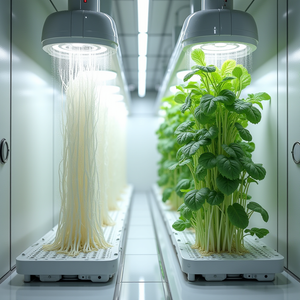
This is the core of NFT: the film is there for nutrients and water, the airspace is there for oxygen. If you cannot see exposed roots hanging in the channel, the film is probably too deep.
2. Channel slope: enough to move water, not enough to race it
Most guides converge on a channel slope of about 1-3% (1-3 cm drop per meter) for NFT systems used with leafy greens, as explained in this NFT overview and this build guide. Indoors, I like to tighten it up:
- For short hobby channels (1-2 m): 1% slope is usually enough.
- For longer runs (2-4 m): target 1.5-2% to avoid pooling at the inlet.
Too flat (under 1%): water puddles, solids settle, and you get localized root rot.
Too steep (over 3-4%): the film thins out too much toward the outlet and plants at the end of the line can starve or show deficiencies first.
3. Flow rate per channel: stop guessing, start measuring
Instead of “whatever the pump does,” tune by liters per hour (LPH) per channel. Practical ranges from hobby and commercial sources like WhyFarmIt’s NFT guide and Cropologies’ design article line up well with what works in real life:
- Target flow: roughly 1-2 L/min per channel for typical 100 mm PVC or food-grade NFT channels fully planted with leafy greens. That is 60-120 LPH per channel.
- Lightly planted or short channels can run closer to 40-60 LPH.
- Heavily planted, warmer rooms, or longer channels may need 80-120 LPH to keep nutrients refreshed.
A good starting point for indoor basil and lettuce:
- Channel length: 1.2-2 m
- Plants per channel: 6-10 sites
- Flow: 50-80 LPH per channel
Measure it: run a single channel outlet into a jug for 30 seconds, multiply by 120, and you have LPH. Adjust via a valve or by changing the pump.
4. EC too high for indoor light levels
Indoors, we rarely match the PPFD and DLI of a greenhouse. That means we cannot feed like a greenhouse. Many basil growers indoors do best at:
- EC for basil: around 1.2-1.6 mS/cm in vegetative growth, occasionally up to 1.8 mS/cm under strong LED lighting.
- EC for lettuces/greens: about 0.8-1.4 mS/cm, as supported by multiple NFT references such as this NFT guide.
Run basil at 2.0+ EC under modest LEDs and you will see tip burn and harsh flavor long before you see yield gains.
5. pH drifting out of the sweet spot
For basil and leafy greens in NFT, the proven functional range is pH 5.5-6.5, with a sweet spot around 5.8-6.0 for calcium uptake and overall nutrient availability, consistent with general hydroponic nutrient recommendations such as those summarized in this NFT system guide.
- If pH constantly rises above 6.5, your plants are often over-consuming nitrate and leaving behind alkalinity.
- If pH keeps dropping below 5.5, you may be running too strong a solution or using an imbalanced nutrient mix.
6. Oxygen starvation: warm, flat reservoirs
Even with perfect channels, a lazy reservoir can wreck roots. High recirculation plus warm indoor rooms mean dissolved oxygen drops fast if you are not adding air.
Watch out for:
- Reservoir temperature over 24 °C - pathogen risk spikes and DO drops.
- Little or no aeration - a pump alone typically does not add enough oxygen for dense roots.
- No top-off or water changes - EC creep and salt imbalance worsen stress.

The Solution: Dialed-In NFT Settings For Indoor Basil & Greens
Here is how to build or retune an indoor NFT system so it behaves more like a vertical farm and less like a plant lottery.
1. Size the channels for leafy crops, not tomatoes
For basil, lettuce, and leafy greens indoors:
- Channel internal width: around 80-100 mm (typical 100 mm PVC or purpose-built NFT channels).
- Plant spacing: 15-25 cm center-to-center for basil and most greens.
- Channel length: 1-2 m per run for small systems. Longer is possible, but easier to manage in shorter, parallel runs.
- Net pot size: 2 inches is plenty for leafy greens; it keeps root balls compact and in the oxygen zone.
2. Set slope and lock it
Use shims or adjustable stands to get a repeatable slope:
- Measure channel length with a tape measure.
- For a 2 m channel at 1.5% slope, you want a 3 cm height difference between inlet and outlet.
- Check with a level and a ruler at both ends. You should not “eyeball” NFT if you want consistency.
Once the slope is set, do not constantly move channels around. Treat slope as a fixed design choice, not a daily adjustment.
3. Tune the flow rate per channel
Practical indoor starting point for basil and greens:
- Per channel: begin at about 50-80 LPH.
- If roots look too dry near the outlet or EC is climbing fast, bump up toward 80-100 LPH.
- If channels are filling deeper than a few millimeters, reduce flow or increase slope.
How to tune without guesswork:
- Open a single channel outlet and divert into a measuring jug.
- Collect for 30 seconds, measure volume in liters.
- Multiply by 120 to get LPH.
- Adjust valves until each channel sits in your target range.
If your pump feeds multiple channels, oversize the pump slightly and throttle with individual valves on each line. This gives you per-channel control without starving the furthest run.
4. Set EC and pH for indoor basil & greens
For a mixed basil and leafy greens NFT system indoors under LED lighting:
- Basil EC: 1.2-1.6 mS/cm as your main operating range.
- Leafy greens EC: 0.8-1.4 mS/cm, depending on light intensity and variety.
- pH target: 5.8-6.0, allow it to drift gently between 5.5 and 6.3 before adjusting.
These ranges align with multiple NFT references like NoSoilSolutions’ NFT guide and broader hydroponic nutrient guidelines summarized in Ponics Life’s NFT overview.
Practical management routine:
- Check EC and pH daily in small indoor systems.
- If EC climbs more than 0.2-0.3 in a day, top off with plain water, then recheck.
- If EC keeps dropping, your plants are hungry - bump feed strength slightly at the next reservoir change.
5. Keep the reservoir cold, dark, and oxygenated
The reservoir is the lungs of your NFT system. Treat it properly:
- Temperature: aim for 18-22 °C. Above 24 °C, root disease risk rises sharply, as noted in general hydroponic DO discussions such as those referenced in this NFT maintenance guide.
- Aeration: run at least one reasonably sized air stone in the reservoir at all times.
- Light exclusion: use an opaque lid and keep plumbing light-tight to avoid algae.
- Turnover: your pump should cycle the full reservoir volume at least 4-6 times per hour.
6. Maintenance schedule that actually prevents problems
- Daily: quick check of pH, EC, water level, and pump operation; glance at roots for color and smell.
- Weekly (or every 7-10 days): full reservoir change in small systems. Clean pre-filters, inspect inlets for blockages, wipe away visible algae.
- Between crops: flush channels with a mild hydrogen peroxide or food-safe sanitizer solution, then rinse thoroughly.
Healthy NFT roots should be bright white to cream, with lots of fine hairs and a fresh, earthy smell. If they are brown, slimy, or smell sour, fix temperature and oxygen first before chasing nutrients.
7. Lighting that matches your nutrient strength
Because nutrient demand scales with light, make sure your EC choices fit your indoor lighting:
- PPFD 150-250 µmol/m²/s (basic bar or panel light): stay at the lower end of the EC ranges above.
- PPFD 250-400 µmol/m²/s (better LED, closer canopy): you can push basil toward 1.6-1.8 EC if plants look happy.
- Run lights 14-18 hours per day for leafy greens; basil usually thrives around 16 hours.
If you see stretching and weak stems even with perfect NFT tuning, you probably need more light, not more nutrients.
Putting It All Together
When you combine:
- A 1-2% channel slope
- 50-80 LPH per channel for indoor basil and greens
- A 1-3 mm nutrient film with exposed, aerated roots
- EC 0.8-1.6 depending on crop and light, and pH 5.5-6.3
- A cool, oxygenated, light-tight reservoir with consistent maintenance
your NFT system stops being finicky and starts behaving predictably. Basil leaves get thicker and more aromatic, lettuce heads fill out instead of collapsing at the base, and the “mystery failures” disappear.
NFT is not fragile. It is just precise. Get the slope, flow, and EC right once, and you can repeat basil-perfect runs indoors all year long.