LED Spectrum Recipes for Hydroponics (2026): Red:Blue, Far‑Red & UV‑A Settings for Basil, Lettuce and Tomatoes
Common Mistakes: Treating Spectrum Like an On/Off Switch
Most hydroponic growers obsess over PPFD charts and timer settings but leave spectrum on the factory default. The result is predictable: basil that smells weak, lettuce that stretches on the middle shelf, and tomato clusters that look fine yet taste flat.
The myth is simple: “As long as PPFD and photoperiod are right, the spectrum doesn’t matter much.” In 2026, with tunable LEDs, that is wasted potential.
Modern fixtures let you push specific plant responses with red, blue, far‑red, and even UV‑A. You can steer compactness, flavor, color, and flowering without adding watts, just by shifting the balance of photons your plants see.
This guide gives you concrete, spectrum‑only recipes for basil, lettuce, and tomatoes in Kratky, DWC, and rack farms. Intensity stays whatever your PPFD/VPD plan says. We only touch the color mix and schedule.
Before we get into crop‑by‑crop recipes, remember: spectrum steering works on top of solid hydroponic fundamentals. If your nutrient management, pH, and oxygenation are off, better light spectra will not rescue you, as the basics of hydroponics still apply.

Why These Spectrum Mistakes Happen
There is plenty of noise about “red lights make plants tall, blue lights make them short,” but that is only part of the story. Plant responses are controlled by several pigment systems, not just chlorophyll. As outlined in general coverage of colored light and growth responses, red and blue both fuel photosynthesis, but they also trigger different photoreceptors and hormonal cascades that change morphology and chemistry as described here.
On top of that, far‑red (around 730 nm) and UV‑A (315‑400 nm) occupy a grey zone for many growers. They sit just outside the classic PAR window, so they are easy to ignore. Yet they strongly influence shade‑avoidance responses, flowering, pigments, and defensive compounds.
At the same time, media headlines about “space‑grown tomatoes” and colored LEDs on orbital stations make spectrum sound like science fiction. For example, reports about tomato experiments on the Chinese space station highlight how controlled light spectra and conditions can support full life cycles in orbit as reported here. The message is right, but the coverage rarely translates back into “set your dimmers like this for your DWC bucket.”
Finally, most retail fixtures ship as fixed “full spectrum” bars. Without separate channels for red, blue, far‑red, or UV‑A, many growers never get to practice proper spectrum steering. They simply crank power up or down. That trains you to think that intensity is everything.
So the three big reasons spectrum gets misused:
- Simplified advice that treats red and blue as single switches.
- Confusion around “non‑PAR” bands like far‑red and UV‑A.
- Hardware that hides spectrum control behind a single power knob.
The rest of this article assumes you either have separate channels (white, red/deep‑red, far‑red, UV‑A), or you are choosing fixtures for a new rack. If your light is fixed‑spectrum, you can still use this guide to choose upgrades.
How To Fix It: Crop‑Specific LED Spectrum Recipes
Now we get to the part most growers actually need: concrete recipes. Think in terms of fractions of your total photosynthetic photon flux (PPF). We are not changing your target PPFD, only how those photons are distributed across wavelengths.
We will work with five bands:
- Blue: 400‑500 nm
- Green: 500‑580 nm
- Red: 600‑700 nm (with deep‑red around 660 nm doing most of the work)
- Far‑red: 700‑750 nm
- UV‑A: 315‑400 nm
Most “full spectrum” horticultural LEDs already deliver a white base (mix of blue, green, red) similar to daylight, as noted for plant lighting more broadly in this overview. The trick is to bias that base with extra red, far‑red, and small UV‑A doses for different crops and stages.
Basil: Best LED Spectrum for Hydroponic Basil in 2026
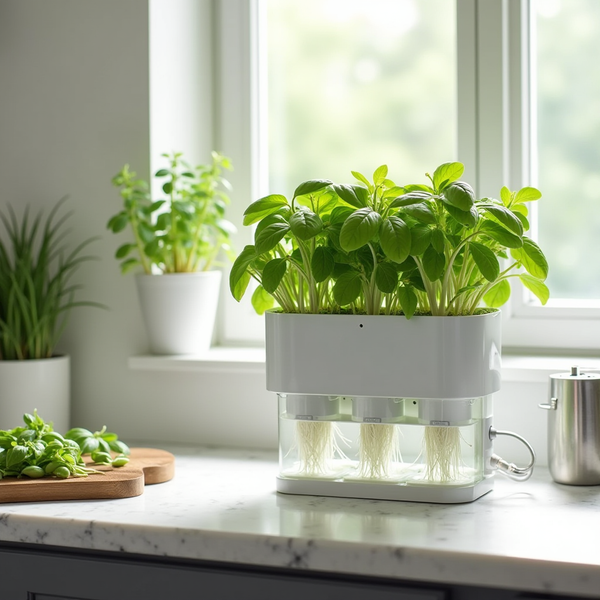
Basil in Kratky jars, DWC tubs, or NFT rails is very responsive to blue, far‑red, and UV‑A. You can push compact, aromatic plants without sacrificing yield.
Baseline basil spectrum (all stages)
- White base: 3500‑4000 K channel at 70‑80% of your driver power.
- Blue fraction: target 18‑22% of total PAR.
- Red + deep‑red: target 60‑70% of total PAR.
- Far‑red: keep at or below 8‑10% of total photon flux equivalent.
- UV‑A: off by default; used only as a micro‑dose near harvest.
Translated to a simple “slider” view:
- Seedling mode: more blue, no far‑red, no UV‑A.
- Grow mode: more red, a little far‑red, moderate blue.
- Finish mode: keep blue modest and pulse UV‑A.
Basil by stage
Seedling / establishment (days 0‑10)
- Blue: 20‑25% of PAR. Raise your blue/white channel.
- Red + deep‑red: 60‑65%.
- Green: whatever your white base provides (usually 10‑20%).
- Far‑red: 0‑3% (ideally off).
- UV‑A: off.
This keeps basil short, with thick stems and strong roots, which matters in passive systems like Kratky where you do not want leggy tops over a weak root mass.
Vegetative bulking (main biomass)
- Blue: 15‑20% of PAR.
- Red + deep‑red: 65‑75% of PAR.
- Far‑red: 5‑8%. Either run a low far‑red channel all day or use 10‑15 minute end‑of‑day pulses.
- UV‑A: off.
Lowering blue and adding modest far‑red encourages faster leaf expansion and quicker canopy closure without making basil floppy. In DWC where oxygen is abundant, you can pair this spectrum with slightly higher PPFD to take advantage of faster nutrient uptake.
Pre‑harvest aroma push (last 3‑5 days)
- Blue: bring back up to 20‑22% for firmer leaves.
- Red + deep‑red: 60‑65%.
- Far‑red: keep at 5% or less to avoid last‑minute stretch.
- UV‑A: add 1‑3% of PAR equivalent for 2‑4 hours per day, ideally in the middle of the light period.
Micro‑doses of UV‑A act like a controlled stress signal and can push secondary metabolites and terpenes, which is what you are really chasing in basil. Watch for bronzing; if leaves start to look stressed, shorten the UV‑A window rather than increasing intensity.
µmol/J efficiency and scheduling for basil
- Fixture choice: prioritize fixtures with at least 2.5‑3.0 µmol/J efficacy on the white/red channels. The small inefficiencies of UV‑A and far‑red channels are acceptable because they run at low power.
- Dimming: leave spectrum ratios fixed for each stage and dim the global output to hit your PPFD target (typically 200‑350 µmol·m⁻²·s⁻¹ for basil, depending on CO₂ and nutrients).
- Photoperiod: 16‑18 hours is typical. Spectrum steering here is about ratios, not changing daylength.
Lettuce: Red:Blue Ratios For Indoor Farming
Lettuce is where you really feel red:blue ratios in head shape and texture. Indoor farms chasing maximum grams per square meter often run too red‑heavy and end up with soft, loose heads.
Target red:blue ratios for lettuce
- Balanced commercial head (yield + structure): R:B around 3:1 to 4:1, which usually means 20‑25% blue and 60‑70% red/deep‑red, with the rest mostly green.
- Premium compact, colored heads: R:B around 2:1 to 3:1 (more blue). Good for red leaf types and dense, small heads.
- Maximum fresh weight, looser heads: R:B around 4:1 to 6:1 (less blue). Only use this if your market accepts softer texture.
Lettuce spectrum by stage
Seedling stage
- Blue: 22‑28% of PAR (R:B ~2:1‑3:1).
- Red + deep‑red: 55‑65%.
- Far‑red: off or under 3%.
- UV‑A: off.
This keeps seedlings squat and uniform, ideal for moving into NFT channels or rafts without floppy stems.
Vegetative / head building
- Blue: 18‑22% (R:B ~3:1‑4:1).
- Red + deep‑red: 60‑70%.
- Far‑red: 3‑5% for most cultivars. In tight rack canopies, you can push to 8‑10% if stretch is under control.
- UV‑A: optional; keep it very low or off unless you are chasing intense pigmentation in red lettuce.
Finishing (shape and color tuning, last 3‑7 days)
- Blue: increase slightly to 22‑25% to firm up leaves and deepen green or red tones.
- Red + deep‑red: 55‑65%.
- Far‑red: reduce to 3‑5%, or shut it off if heads are already loose.
- UV‑A: for red lettuce, consider 1‑2% of PAR equivalent for 1‑3 hours per day to push anthocyanins. Watch for any bleaching on tender leaves.
Lettuce spectrum in rack farms
Multi‑tier systems often suffer from spectrum differences between shelves, especially if fixtures are mixed. To keep production consistent:
- Standardize on one base CCT (4000‑5000 K) across the rack.
- Match the red and blue channels so you can run the same red:blue ratio per shelf.
- If far‑red bars are only on some tiers, either add them to all or avoid using them; uneven far‑red leads to uneven head size.
Good benchmarks:
- PPFD: 150‑250 µmol·m⁻²·s⁻¹ for most butterhead and leaf types.
- Fixture efficacy: target 2.5‑3.2 µmol/J for rack LEDs. Under that, spectrum steering still works, but your power bill will be higher.
- Photoperiod: 14‑18 hours, depending on cultivar and climate control.

Tomatoes in CEA: Far‑Red & UV‑A Recipes
Tomatoes in deep‑water buckets, Dutch buckets, or high‑wire systems give you the most obvious payback from spectrum steering. The goals are straightforward: predictable flowering, productive canopies, and fruit that is worth growing indoors in the first place.
Base tomato spectrum
- White base: 3000‑4000 K, leaning slightly warm to favor red wavelengths.
- Blue: 10‑18% of PAR. Enough to avoid weak, floppy plants, but not so high that you sacrifice yield.
- Red + deep‑red: 65‑75% of PAR.
- Far‑red: 5‑15% of PAR equivalent, carefully managed.
- UV‑A: micro‑doses during flowering and ripening stages only.
Tomato by phase
Vegetative build (pre‑flower)
- Blue: 15‑18%. This holds internodes in check and builds a sturdy framework.
- Red + deep‑red: 60‑70%.
- Far‑red: 5‑8%. Use either continuous low‑level FR or 10‑20 minute end‑of‑day pulses.
- UV‑A: off.
If you see internodes running longer than you want, do not just cut PPFD. First, reduce far‑red or raise blue a few percentage points while keeping overall PPFD stable. That directly targets the shade‑avoidance signal rather than starving the plant of light.
Flowering and fruit set
- Blue: 12‑15%.
- Red + deep‑red: 65‑75%.
- Far‑red: 8‑12% equivalent. Many high‑tech CEA tomato trials have shown that moderate far‑red can speed canopy closure and influence flowering time via phytochrome signals, which matches the broader understanding of red/far‑red interactions discussed in work on colored lights and plant growth like this.
- UV‑A: introduce 1‑2% equivalent for 1‑2 hours per day, preferably when ambient temperatures are stable.
Fruit sizing and ripening
- Blue: 10‑15%.
- Red + deep‑red: 65‑75%.
- Far‑red: you can keep it at 8‑10% or taper it slightly if structure is already where you want it.
- UV‑A: 2‑4% of PAR equivalent for 2‑3 hours per day, several times per week, targeted at fruiting clusters.
As with basil, UV‑A should be ramped up slowly. Look for subtle darkening or thickening of leaf tissue as a sign that plants are responding. Hard bronzing or necrotic spotting means your dose is too high or too long.
µmol/J, photoperiods, and practical timings for tomato
- PPFD targets: 350‑600 µmol·m⁻²·s⁻¹ for most compact CEA tomato cultivars, depending on CO₂ and temperature.
- Fixture efficacy: 2.7‑3.3 µmol/J on the main channels is a solid 2026 target for commercial tomatoes.
- Daylength: 16‑18 hours is common in high‑tech rooms. Use far‑red and UV‑A windows inside that daylength; do not extend the photoperiod just to squeeze in UV‑A time.
What To Watch Long‑Term: Benchmarks & Trade‑offs
Spectrum steering is not a one‑time switch; it is a dial you keep tuning as you gather data from your own system. Kratky, DWC, NFT, and tower systems all respond a bit differently because of root‑zone oxygen, nutrient availability, and canopy density, even under the same spectrum.
Key trade‑offs: yield vs quality
- More red, less blue usually means faster biomass but softer tissue and less intense flavor or color.
- More blue usually means tighter morphology, stronger pigmentation, and higher secondary metabolites, at a small cost to raw yield.
- Far‑red increases leaf expansion and canopy light use but can cause unwanted stretch if overused.
- UV‑A can upgrade flavor and nutritional quality but quickly becomes damaging if intensity or exposure time is too high.
Simple logging protocol
To actually dial in your recipe rather than guess:
- Record spectral settings by stage (blue %, red %, far‑red %, UV‑A %, along with PPFD and photoperiod).
- Log harvest metrics: fresh weight, dry matter %, leaf thickness, color, and any flavor notes.
- Note specific issues: tipburn in lettuce, bolting in basil, flower drop in tomatoes.
- Adjust one variable at a time between cycles: for example, increase blue 3‑5 percentage points while keeping PPFD and nutrients constant.
Hydroponic system considerations
While light requirements are the same across Kratky, DWC, and NFT, your system can limit how far you can push spectrum:
- Kratky: more prone to oxygen and EC swings late in the run. Do not push high PPFD plus aggressive far‑red/UV‑A if the root zone is already stressed.
- DWC: with strong aeration, plants can exploit higher PPFD and far‑red, so you will see faster responses to spectrum changes.
- NFT and towers: pay attention to shading patterns. Use small amounts of far‑red and green (via a white base) to ensure deeper penetration into lower leaves.
When to invest in tunable fixtures
If you are running a small countertop system, a quality fixed full‑spectrum light is enough. Focus on PPFD, nutrient balance, and pH stability. Spectrum steering shines when:
- You harvest weekly and want consistent morphology for packaging.
- You grow multiple crops (basil, lettuce, tomatoes) under one lighting platform.
- You care about flavor and nutritional quality, not just kilograms.
- Your power cost is high and you want more value from every photon, not more watts.
Start with the recipes in this article, then refine them as you gather data from your own room. Spectrum is finally a controllable input. Use it.
As an Amazon Associate, I earn from qualifying purchases.