If your Kratky or DWC greens look tired, it’s not the variety. It’s your nutrients, pH, and water source waving the red flag.
Yellowing leaves, tip burn, and stalled growth are classic hydroponic nutrient deficiency signals. In passive setups like Kratky and simple DWC, the reservoir is your entire world. One misstep can lock out iron or calcium and turn a smooth grow into a slow-motion crash. Here’s how to diagnose fast and fix cleanly without trashing your pH.
The problem
- Yellowing leaves: New growth paling points to iron; whole-plant pale greens and slow growth often scream nitrogen.
- Tip burn and crunchy margins: Classic calcium issues in lettuce and leafy herbs, sometimes aggravated by high EC or poor airflow.
- Stalled growth: Often a low EC or pH lockout problem, especially in non-circulating reservoirs as minerals deplete.
These show up faster in hydro than soil because plants are pulling directly from solution. Deficiencies are more common than toxicities in recirculating and static systems because uptake can strip specific ions quickly, notably potassium, iron, nitrogen, and calcium in many crops, as noted in this guide.
The cause (simple and fixable)
- pH too high or too low: Iron availability drops above roughly 6.5. Calcium uptake falters when pH swings or EC is out of balance. See pH guidance in this Kratky nutrient overview.
- Municipal water alkalinity: Hard, alkaline water buffers your reservoir upward over time, reducing iron availability and complicating calcium balance. Using RO, distilled, or low-mineral filtered water simplifies pH control, as recommended in this guide.
- EC drift in passive systems: Plants selectively pull ions. In Kratky, the solution concentrates as water drops, then depletes certain elements. Without circulation, localized gradients form and lockouts appear.
- Light and temperature stress: Warm, poorly aerated DWC drives root stress and uptake problems. Ensuring adequate aeration and sensible nutrient loads is foundational in DWC, outlined in this DWC nutrient explainer.
- UV exposure: Iron can precipitate when solutions are exposed to UV, making Fe unavailable, noted by Upstart University.
Fast diagnosis: what the leaves are telling you
- Iron (Fe) deficiency: New leaves turn yellow but veins may stay slightly green. Older leaves look fine. More likely at high pH or with hard, alkaline water. See symptom overview and pH fix in this hydro guide.
- Calcium (Ca) deficiency: Tip burn on lettuce, distorted young leaves, weak roots. Common in hydro and aggravated by low transpiration or imbalanced EC. Calcium problems are widespread in lettuce, tomatoes, and peppers, as discussed in this article.
- Magnesium (Mg) deficiency: Interveinal chlorosis on older leaves first. Often shows when EC is low or after heavy uptake of potassium. General deficiency patterns summarized in this quick primer.
- Nitrogen (N) deficiency: Uniform pale green, slower growth, smaller leaves. Common in fast-growing leafy greens when EC is undershot or solution is depleted.
The solution: targeted corrections that won’t crash your reservoir
Kratky (non-circulating) playbook
- Measure first: Check pH and EC before adding anything. Aim for roughly pH 5.5-6.5 in most hydro crops to keep iron, calcium, and magnesium available, per this guide.
- Top-off, don’t dump: Add a balanced nutrient top-off solution at 50-70 percent of label strength to restore EC without shocking pH.
- Iron chlorosis fix: Add chelated iron (DTPA for pH up to ~7, EDDHA if your source water is very alkaline). Keep the dose modest and recheck pH after 20-30 minutes. Iron availability and symptom pattern are detailed in this resource. If light is UV-heavy, cover or opacify reservoirs to prevent Fe precipitation as noted by Upstart University.
- Calcium tip burn fix: Micro-dose calcium using a cal-mag supplement or calcium nitrate. Start small, then recheck EC. Calcium nitrate is a standard correction in hydro, referenced in this troubleshooting guide.
- Magnesium support: Add a cal-mag with adequate Mg or small additions of magnesium sulfate. Keep changes incremental and verify EC.
- N boost without pH drama: Prefer nitrate-based N additions over ammonium-heavy sources to avoid rapid pH swings.
- Water source hygiene: If your tap is hard or alkaline, switch to RO/distilled or blend to reduce alkalinity. This improves pH stability and micronutrient availability, emphasized in this Kratky nutrient overview.
- Foliar as a fast band-aid: For immediate greening, apply a light foliar of chelated iron or cal-mag while you stabilize the reservoir. Keep foliar mild to prevent leaf spotting.
DWC (simple aerated buckets) playbook
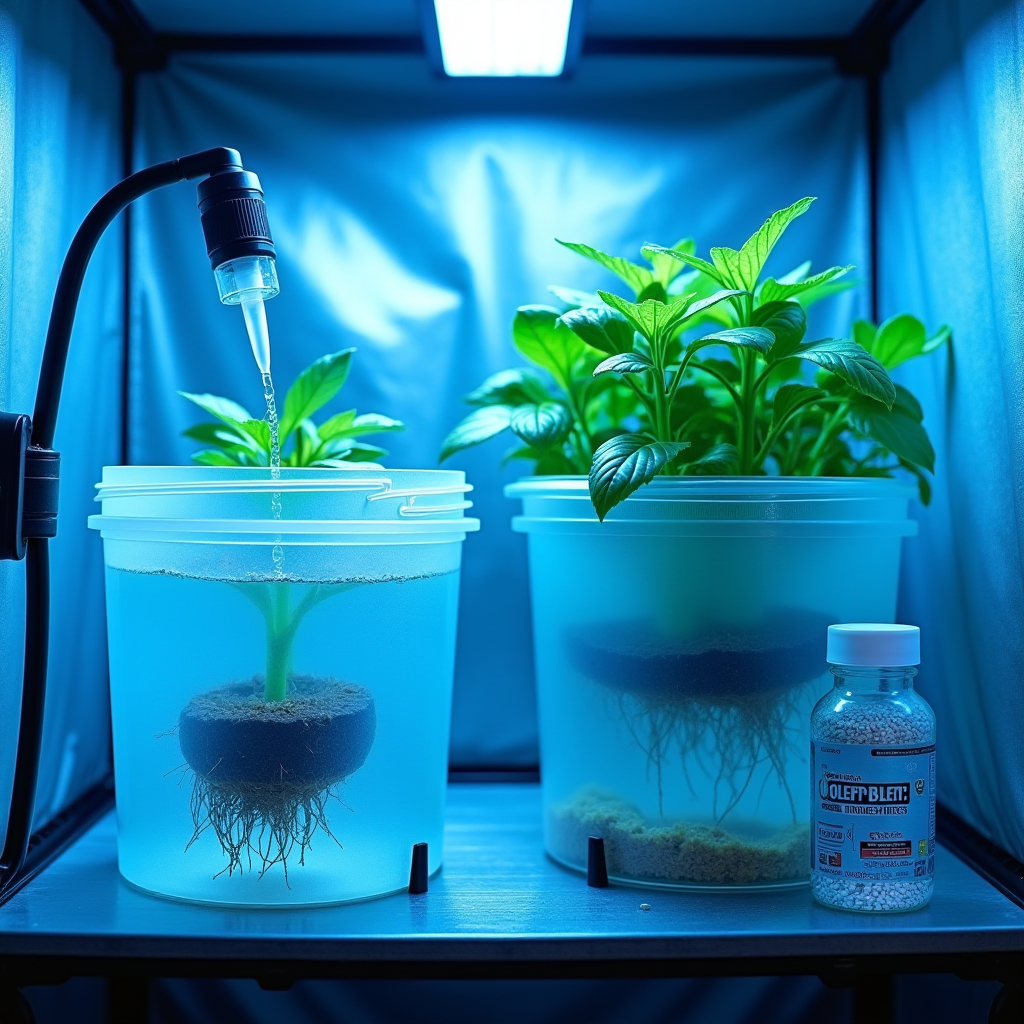
- Air and temp first: Verify strong aeration and keep nutrient temperature reasonable to protect roots and uptake. Foundational DWC nutrient and system guidance in this overview.
- pH/EC check: Keep pH roughly 5.5-6.5 and adjust slowly. If EC is low and growth is stalled, bring it up in small increments. If tip burn appears and EC is high, dilute by topping with plain, pH-adjusted RO water.
- Partial change, not a churn: If issues persist, swap 25-50 percent of the reservoir with fresh, balanced solution. This resets ratios without shocking roots.
- Iron and calcium specifics: For iron chlorosis, add chelated Fe and protect solution from UV. For calcium tip burn, add calcium nitrate or cal-mag, then recheck EC. Iron precipitation and Ca issues are covered in this article and this troubleshooting resource.
Don’t trash your pH: pro tips for clean corrections
- Pre-dissolve and pre-measure: Mix small additions in a separate container, confirm pH and EC, then add to the reservoir.
- Wait and verify: After any addition, wait 20-30 minutes, stir, and recheck pH/EC before adding more.
- Shield from light: Opaque lids and reservoirs reduce algae and prevent UV-related iron drop-out, as noted in this guide.
- Use quality water: RO/distilled or filtered low-mineral water keeps pH/EC predictable in Kratky, emphasized in this Kratky resource.
Evidence and ranges to anchor your decisions
- pH: Most hydro crops are happiest around pH 5.5-6.5, maintaining Fe, Ca, and Mg availability, as noted in this overview.
- Deficiency trends: Iron and calcium issues are frequent; nitrogen and potassium can deplete fast in active growth, summarized in this troubleshooting piece.
- Iron behavior: New-leaf chlorosis and reduced availability at high pH, and risk of UV precipitation, discussed in this guide and this article.
- Calcium correction: Calcium nitrate is a standard hydro fix for tip burn and weak growth, per this troubleshooting guide.
Quick takeaways for 2025 Kratky and DWC growers
- Start with good water. RO or distilled keeps pH/EC sane and micronutrients available.
- Keep pH near 5.8 for leafy greens, and adjust gently.
- Top-off with balanced solution before reaching for single-element fixes.
- When you do add Fe, Ca, or Mg, go small, pre-dissolve, and recheck pH/EC.
- Protect reservoirs from light. UV can drop iron out of solution.
- In DWC, strong aeration and reasonable nutrient temperatures are non-negotiable.
Dial the basics, then correct the specific deficiency. That’s how you keep your Kratky and DWC plants green, crisp, and fast-growing without playing whack-a-mole with pH.