Kitchen Counter Hydroponics in 2026: How to Turn Tiny Plug‑and‑Play Systems Into a Serious Herb and Salad Supply
Most people treat a 3 or 6 pod countertop hydro system like a novelty. The myth is simple: “It’s just a gadget, you can’t get real food out of that.” In 2026, that is flat-out wrong. The limiting factor is almost never the hardware - it’s how you plant, prune, feed, and schedule that hardware.
Right now, kits like the AeroGarden Sprout 3‑pod system are being blown out on sale, and social feeds are full of variations of the same question: “What do I actually grow in this thing, and how do I stop it from being a toy?” If that sounds familiar, this article is for you.
We are going to assume you already have, or will soon have, a small plug‑and‑play unit - AeroGarden Sprout, inbloom 10–12 pod system, iDOO, or a similar kit. We will keep the focus tight:
- Realistic weekly yield benchmarks from 3–6 pod and 10–12 pod units
- The plants that actually make sense in 2026 for a Sprout‑class garden
- How to crank up productivity with better crop choice, spacing, and pruning
- How to work around fixed hardware limits using Kratky jars and balcony add‑ons
- Simple nutrient / pH habits that separate toy results from serious output
Structure-wise, we are going to use a “mistakes and fixes” model. You will see the most common ways people underuse these systems, why they happen, how to correct them, and what to watch long-term.
1. Common Mistakes With Tiny Countertop Hydro Systems
1.1 Treating a Sprout‑class garden like a mini farm for any crop
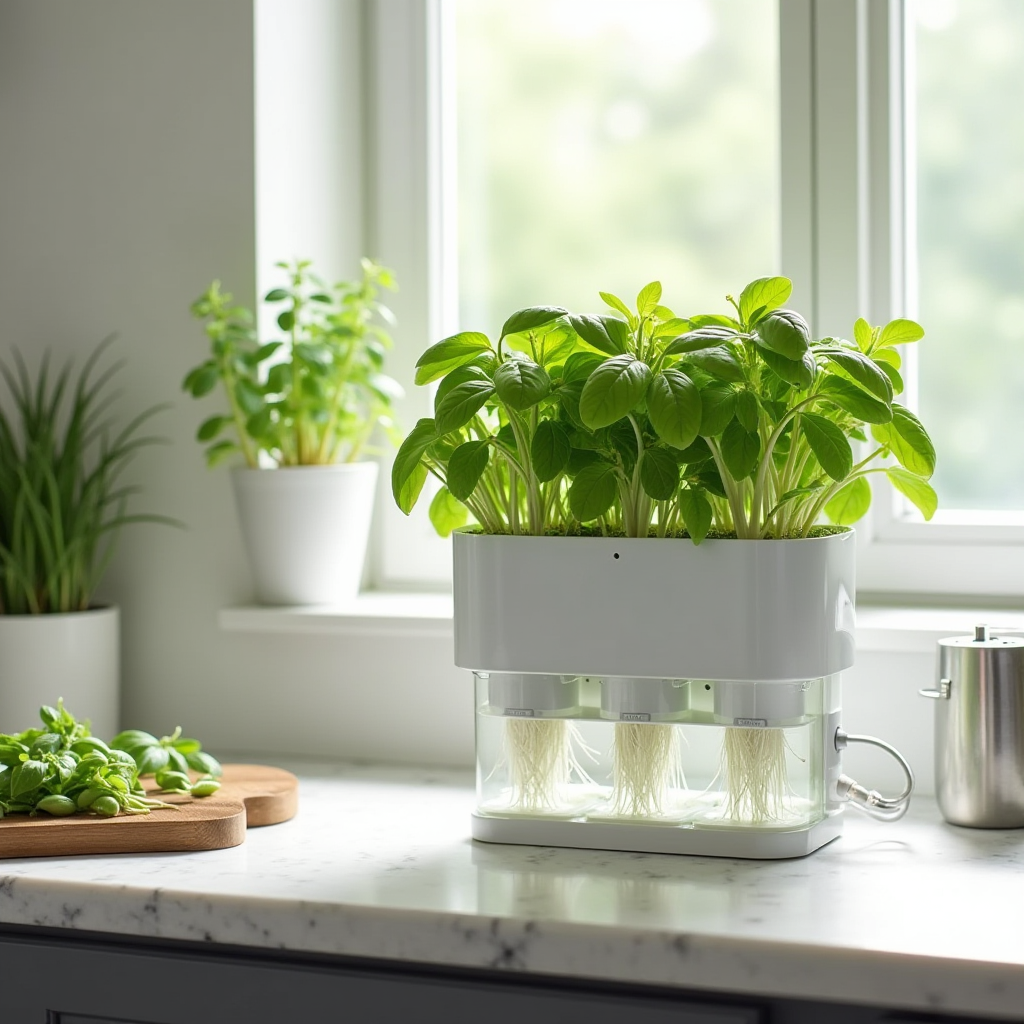
A 3‑pod AeroGarden Sprout is great hardware for what it is: a compact 3‑site DWC-style system with a small reservoir and a short, integrated LED bar, designed to grow plants up to about 10 inches tall, as confirmed in AeroGarden’s own product page and reviews.[source] The same applies to other ultra-compact units in the Sprout class.
Where people go wrong is trying to push tall, heavy-feeding crops into that format:
- Full-size tomatoes, peppers, and large kale that hit the light bar in a few weeks
- Strawberries that look pretty but barely produce, exactly what long-time AeroGarden users report when comparing herbs vs berries in small bowls[source]
- Too many “bush” plants in tiny bowls that choke each other’s root zones
The result is predictable: leggy plants, constant pruning battles, and underwhelming yield per pod.
1.2 Ignoring plant density and competition
Most kit photos show every pod planted. That part is fine. The problem is what you put in each pod.
- Three vigorous basil plants in a 3‑pod Sprout can completely shade themselves within a month.
- One fast basil in a 6‑pod system can stunt every slower herb if it sits in the middle and you don’t prune hard.
- Planting only one or two pods “to avoid crowding” wastes the built-in lighting footprint.
In other words, most growers either overcrowd with the wrong crops or under‑utilize the pod count.
1.3 Letting plants grow too tall before pruning
Reviews and user photos of AeroGarden and inbloom units tell the same story: basil stems at light height, leaves pressed against the LED bar, and a thin, weak canopy.[source] By the time many people take scissors to the plants, they are already stretching and shading neighbors.
The mistake is waiting for the plant to look “big enough to harvest” rather than using pruning to shape the canopy early.
1.4 Running whatever light schedule the default timer uses
Modern countertop systems make it easy to just hit “on” and forget it. AeroGarden, inbloom and others ship with sensible defaults, but they are still generic.
For fast-growing herbs and greens, 12–16 hours of light per day at a tight distance to the canopy tends to outperform softer schedules, which is echoed by multiple hydroponic herb guides and system tests.[source] Many people never touch the timer, or they leave the light bar too high, which wastes photons and encourages stretch.
1.5 Treating the stock nutrient bottle as a magic potion
Countertop systems often stay in “toy mode” because the nutrient side never leaves “add capful when the light blinks”. That works well enough for a single cycle, but if you want consistent, repeatable results, you need to think in terms of:
- pH range for herbs and greens
- EC (nutrient strength) targets per crop type
- Top-off vs full reservoir change frequency in small tanks
Most herbs and salad greens want pH around 5.5–6.5 and EC around 1.2–1.8 mS/cm.[source] The kits cannot manage that for you if you never measure anything.
1.6 Expecting one small unit to cover all your kitchen needs
Lastly, there is a scale issue. A Sprout or similar 3‑pod system was never meant to be a full household salad factory. Even AeroGarden’s own comparison guides position Sprout as “good for one person’s herbs”, and larger Harvest/Bounty units for salad and more variety.[source]
If you want a real weekly supply, you either:
- Move up into a 6–12 pod class unit, or
- Learn how to chain a Sprout with Kratky jars or a small DWC bucket so your total productive area grows.

2. Why These Mistakes Happen (And What Your Hardware Can Actually Do)
2.1 Marketing images vs biological reality
Promo shots show tall basil, flowers, and lettuce all sharing a tiny bowl in perfect harmony. In real conditions, those same plants start fighting for photons and root space within weeks.
Small systems behave like any other hydroponic grow:
- The light output and footprint limit how many square centimeters of leaf tissue you can support.
- The reservoir size controls how fast nutrients and pH drift.
- The maximum light height sets your effective plant height.
Independent reviews of the Sprout and similar units note that its roughly 1 liter reservoir needs topping off every 3–4 days once plants are mature, and that it excels when used for compact herbs and greens instead of large fruiting plants.[source]
2.2 Pod count is not the same as yield
It is easy to equate “3 pods vs 6 vs 12” directly with “yield x2 or x4”. The reality is more nuanced:
- Three well-managed herb pods in a Sprout can produce more usable food than six poorly pruned pods in a bigger, neglected unit.
- 12 pods crammed with basil and lettuce in an inbloom can either supply several salads a week or turn into a tangled light-blocking mess if you don’t thin and harvest regularly.
Yield depends on cultivar choice, spacing, and how aggressively you harvest, not just on pod count.
2.3 Lack of simple, crop-specific guidance
Most manuals are generic. They tell you when to add water and stock nutrients, but not:
- Best cultivars for a 25–40 cm light height
- Where to place fast vs slow plants in relation to the light bar
- Specific harvest schedules for continuous output
That gap shows up clearly in community Q&A like the Little House Living thread, where many Sprout owners ask “what should I actually plant?” rather than “how do I use the pump?”.[source]
2.4 pH/EC feels “too technical” for a kitchen
pH and EC management sounds like lab work, so many kitchen growers never go there. The irony is that herbs are very forgiving if you hit a basic band and keep it stable. Several hydroponic references converge around:
- pH 5.5–6.5 for most herbs and lettuce
- EC roughly 1.2–1.8 mS/cm as a mixed-herb sweet spot[source]
A single budget pH pen and EC meter will pay for themselves quickly if you are running your system continuously.
2.5 Underestimating the value of passive add-ons (like Kratky)
The biggest blind spot is thinking “countertop system or nothing”. In reality, the fastest way to move from gadget to serious supply is to treat your plug‑and‑play system as the core of a small network: add a few passive Kratky jars or a balcony tote and you have multiplied your plant count without buying another smart gadget.
Guides to Kratky mason jar systems show how easy it is to slot them into windowsills or shelves alongside a primary system, and they perform especially well for basil, mint, parsley, lettuce, and similar leafy crops.[source]
3. How To Fix It: Crop Choice, System Setup, and Workflow
3.1 Start with the right crops for a Sprout‑class system (3–6 pods)
For a 3‑pod AeroGarden Sprout or any low-height, low-wattage kit, think “fast, leafy, compact”. The best categories, supported by AeroGarden’s own marketing and many grow tests, are:[source][source]
- Soft herbs: Genovese basil or dwarf basil, parsley, oregano, thyme, chives, mint
- Cut‑and‑come‑again salad greens: leaf lettuce, mini romaine, arugula, baby spinach, bok choy
- Compact flowers if you want color: dwarf petunias or similar (at the cost of food yield)
Plants to avoid in Sprout‑class hardware if you care about productivity:
- Full-size tomatoes and peppers (too tall, heavy feeders)
- Large kale and Swiss chard (height and shading issues)
- Strawberries (low yield relative to herbs and lettuce in such a small bowl)[source]
Example 3‑pod planting layout for 2026:
- Pod 1 (back): Basil
- Pod 2 (front-left): Parsley or cilantro
- Pod 3 (front-right): Leaf lettuce or arugula
This mix gives you weekly herb cuttings plus a steady flow of salad leaves from a single, discounted Sprout.
3.2 Scale up smartly with inbloom and similar 10–12 pod systems
If you are debating AeroGarden vs inbloom for herbs, here is the practical angle:
- AeroGarden Sprout: 3 pods, tiny footprint, highly automated. Great for 2–3 herbs year-round in a small kitchen.[source]
- Inbloom 10–12 pod systems: more pods, larger ~4+ L reservoir, pump on 30‑min cycles, water shortage alarm, and open seed choice.[source]
For herb-heavy use, inbloom‑class systems are hard to beat for yield per dollar if:
- You are willing to source your own seeds.
- You keep up with pruning and thinning.
Example 12‑pod layout focused on herbs and salad:
- Pods 1–4: Mixed lettuces (butterhead, romaine, oakleaf, red leaf)
- Pods 5–8: Basil, mint, thyme, oregano
- Pods 9–12: Parsley, cilantro, chives, extra basil
With that layout and proper pruning, real-world tests and user reviews often report “huge lettuce and basil plants within a few months” from inbloom units.[source]
3.3 Light height and timer settings for herbs and greens
Most countertop gardens land in the 15–30 W LED range. For herbs and greens, your job is simple:
- Run 14–16 hours on / 8–10 hours off for herbs and salad greens.
- Keep the LED panel 2–4 inches above the canopy. Raise it as plants grow, but do not leave it at full height “just in case”.
Multiple guides to indoor hydro herbs recommend a similar 12–16 hour light period with close spacing to keep plants compact and productive.[source]
If your unit has “herb” and “veg” modes, pick the herb/leafy preset and then fine-tune by observing internode spacing: if stems are stretching between leaf pairs, lower the light or increase hours.
3.4 Pruning technique and harvest schedule
To turn a countertop garden into a weekly supply rather than a one-time flush, you must prune early and consistently.
- Basil, mint, oregano, thyme: start pruning once plants hit 4–6 inches. Cut just above a leaf pair to force branching. Do not remove more than one third of the plant at a time, which is a common guideline in hydro herb guides.[source]
- Parsley and cilantro: cut outer stems first, leaving the inner growth center to keep pushing new shoots.
- Lettuce and other greens: use a “cut outer leaves” approach or harvest whole heads in waves, depending on variety.
Set a weekly “harvest day”. Once a week, trim everything back to a low, even canopy. You will get more total yield over time and avoid shading problems.
3.5 Nutrient, pH and EC routine for serious output
If you want to move beyond stock bottle guessing, adopt this simple routine for herbs and salad greens, backed by multiple pH/EC charts:[source][source]
- Target pH 5.8–6.2 and EC 1.4–1.8 mS/cm as a “mixed herbs + lettuce” compromise.
- At every full change (2–4 weeks): mix fresh water, add nutrients to reach EC target, then adjust pH.
- Between changes: top up with plain water and check pH. Adjust with small amounts of pH up/down if it drifts outside 5.5–6.5.
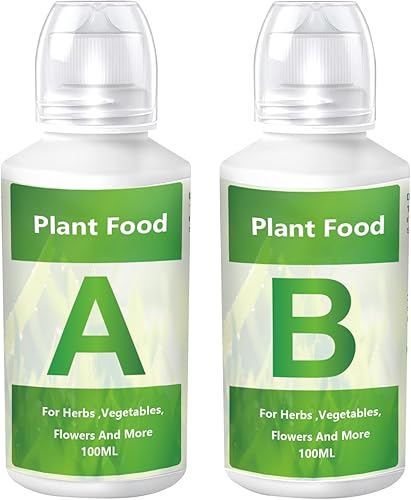
If you never want to think about EC, at least stick with a high quality A/B nutrient designed for hydroponics and follow the “light feeding” recommendations for leafy greens. That alone can be a big upgrade over stretching the stock kit bottle.
3.6 Integrate Kratky jars and balcony add-ons
Countertop unit full? Extend your system without buying another “smart” garden:
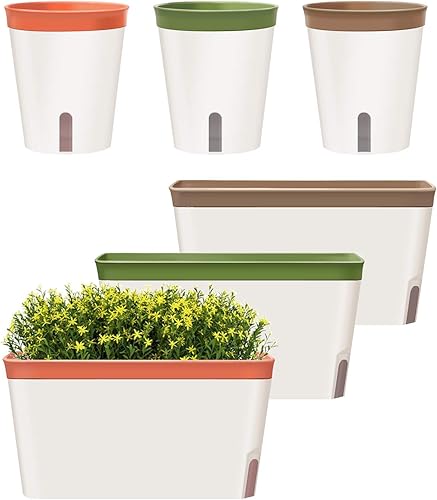
- Kratky jars: Opaque mason jars or bottles, net pots, and the same nutrient solution, set up in a simple non-circulating Kratky configuration. This works especially well for basil, mint, parsley, lettuce, and green onions.[source]
- Balcony Kratky or DWC totes: A shallow storage bin with net pots can host extra lettuce or herbs under a cheap LED strip or natural light.
Several guides show that herbs and leafy greens are ideal for the Kratky method because they grow fast, tolerate modest EC, and do not need massive root volumes.[source]
4. What To Watch Long-Term: Benchmarks, Maintenance, and Upgrade Paths
4.1 Realistic weekly yield benchmarks
Assuming good cultivar choice, tight light management, and consistent pruning, here are practical targets for kitchen-counter productivity:
- AeroGarden Sprout / 3‑pod class
- Herbs only (basil + parsley + mint/oregano): 15–30 g fresh herb tips per week once mature, enough for several meals.
- Herbs + lettuce: enough herbs for 3–5 dishes plus a couple of side salads per week, once dialed in.
- 6‑pod class (Harvest, similar)
- 4 pods of lettuce + 2 pods of herbs: 2–4 small salads per week plus herbs for daily cooking, which matches what testers of AeroGarden Harvest‑class units report.[source]
- 10–12 pod inbloom‑class
- 6–8 pods of lettuce + 4–6 pods of herbs: regular salad for 2–3 people plus heavy herb use, in line with multiple inbloom reviews describing “huge lettuce and basil plants within a few months”.[source]
Layering in 2–4 Kratky jars can easily double your total leaf output without more electronics.
4.2 Maintenance rhythm that keeps systems stable
To keep tiny systems in the “serious supply” zone instead of “toy that worked once”, lock in this basic rhythm:
- Every 2–3 days
- Top off reservoir with plain water.
- Quick visual check for algae, slime on roots, or leaf discoloration.
- Weekly
- Prune herbs and harvest lettuce back to a low, even canopy.
- Check pH and adjust if needed.
- Every 2–4 weeks
- Full nutrient change.
- Quick wipe of bowl walls and inspection of pump / air stone (if present).
This mirrors the kind of schedules recommended in hydroponic beginner guides and keeps small reservoirs from creeping into high EC or pH extremes.[source]
4.3 When to add more hardware vs more jars
If you find yourself wishing for more output, decide between:
- Adding Kratky / DWC
- Best if you have some window or balcony space and enjoy a bit of DIY.
- Use for lettuce and overflow herbs that do not need automation.
- Upgrading to a bigger countertop system
- Best if you want everything in one automated hub with reminders, timers, and integrated lighting.
- Serious Eats and other testers consistently rate mid-size AeroGarden or inbloom systems as the “sweet spot” for households that want regular salads, not just garnish.[source]
If you are already running a Sprout at high utilization (3 pods full, pruned weekly, nutrients dialed), the next logical move is either:
- Add 2–4 Kratky jars for extra greens, or
- Pick up a 6–12 pod unit to handle salads and keep the Sprout as a dedicated herb station.
4.4 How this fits into a whole‑kitchen or balcony plan
Kitchen counter hydroponics plays well with other small-space strategies. Apartment gardening guides often suggest combining a compact indoor system with a few sun‑exposed balcony containers or shelves.[source]
A simple, high‑yield 2026 plan could look like this:
- On the counter: 3–12 pod indoor hydro system for herbs and salad.
- On the windowsill: 2–4 Kratky jars of lettuce and mint.
- On the balcony (if available): one larger Kratky or DWC tote for extra greens or a small NFT rail for lettuce, both using the same nutrient stock.
This matches what vertical farming and hydroponics experts often recommend in miniature: use hydro to move crops “from rack to plate in weeks”, focusing on leafy greens and herbs where hydroponics has the biggest speed and water‑use advantage.[source]
Wrap-up: Turning “Toy” Gardens Into Reliable Supply
By 2026 standards, small countertop hydroponic gardens are extremely capable. The gap between “novelty” and “serious herb and salad supply” is not a new gadget; it is how you run the one you already have:
- Pick crops that match the light height and reservoir size (herbs and leafy greens win).
- Use all your pods, but mix fast, tall herbs with compact neighbors and prune hard from week one.
- Control light distance and run 14–16 hour days for dense, productive growth.
- Get basic pH and EC under control, even if that just means using a decent A/B nutrient and staying in the 5.5–6.5 pH window.
- Expand with Kratky jars and, if you need more, a second unit rather than overloading one bowl.
Do those things, and a discounted AeroGarden Sprout or budget inbloom system stops being a countertop curiosity and turns into exactly what you wanted in the first place: a compact, dependable engine for fresh herbs and salad greens every single week.
As an Amazon Associate, I earn from qualifying purchases.