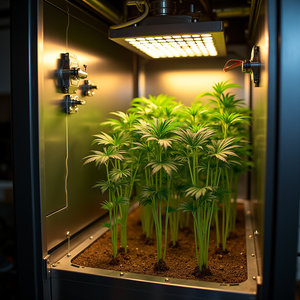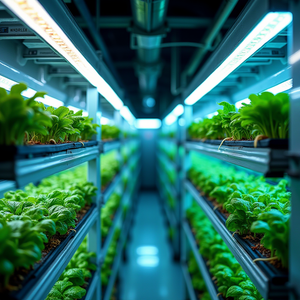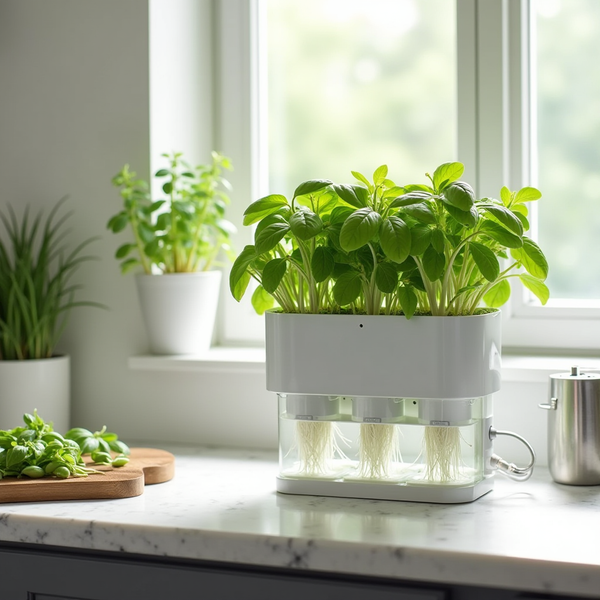
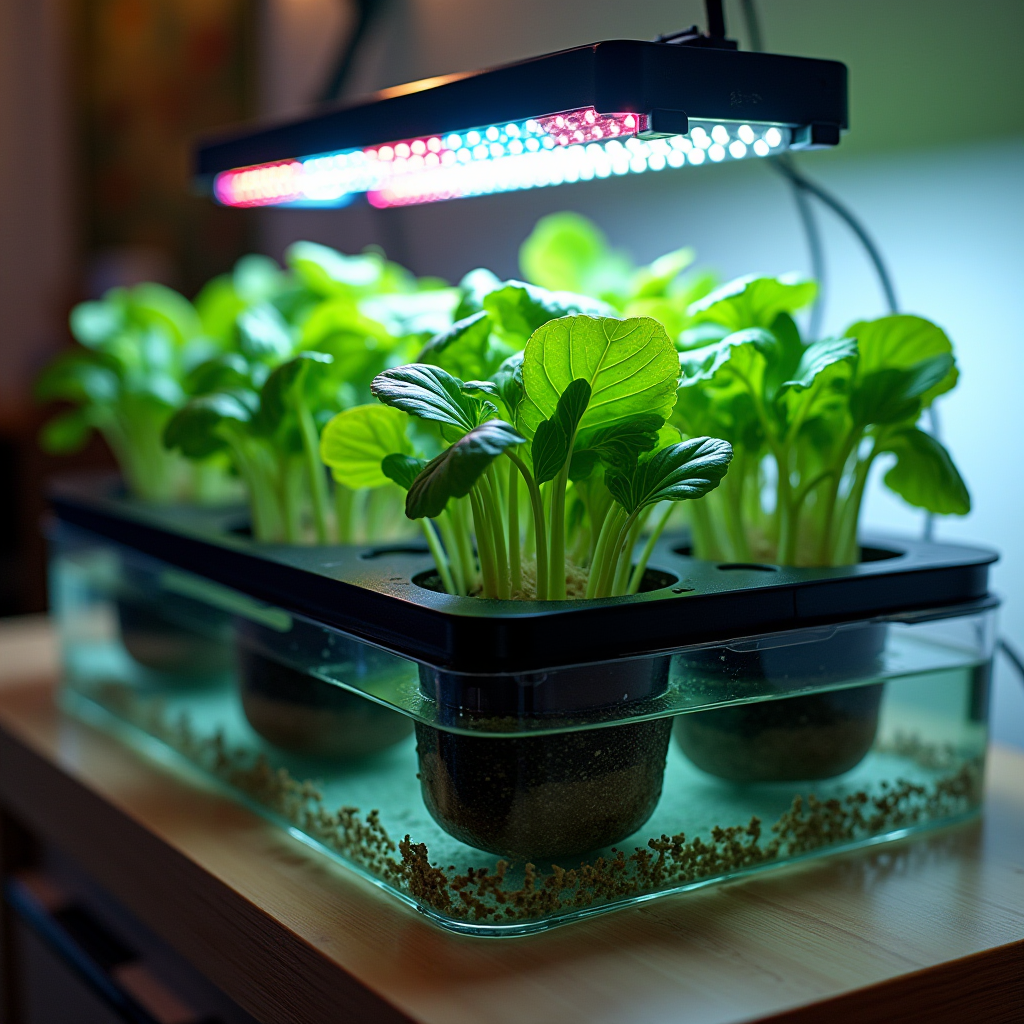
Most growers think gravity does the watering. NASA proved otherwise.
On the International Space Station, there is no gravity to pull water through media, drain trays, or clear films off roots. Yet NASA has grown compact, high-quality lettuce and leafy greens for decades using capillary wick systems and tightly tuned LED spectra in facilities like Veggie and the Advanced Plant Habitat (APH), as highlighted in this overview of ISS plant science. The result is rock-solid moisture control, oxygenated roots, and leaf structure that resists tipburn - all without a single air stone.
You can borrow the same physics and lighting logic in your racks, trays, Kratky bins, and vertical systems right now. This is not about more gadgets or cloud sensors. It is about water behavior in porous media, capillary wicks that meter that water, and spectra that keep your greens dense and resilient instead of floppy and burnt.
We will use the Mistakes Model here:
- Common mistakes with capillary and wick irrigation and LED lighting
- Why they happen (root-zone physics and plant physiology)
- How to fix them with specific designs, dimensions, and light recipes
- What to monitor long-term so your leafy greens stay stable
1. Common mistakes growers make when copying “space-style” hydroponics
Mistake 1: Treating wicks like passive drip lines instead of full root-zone controllers
Many growers toss a few cotton strings into a reservoir, sit pots above, and call it a capillary system. The result is patchy moisture: some cubes stay soaked, others dry at the edges, roots chase water, and you get uneven growth and random tipburn.
ISS systems like Veggie and APH use carefully sized, uniform wicking surfaces and porous substrates to spread water across the entire root zone, as described in NASA’s work on capillary and porous media water delivery for microgravity plant units referenced in their 25-year review. The wick is not an accessory. It is the irrigation system.
Mistake 2: Overfilling reservoirs so wicks turn the media into a swamp
Capillary systems fail fast when there is no air layer. If the reservoir level sits too high, the wick stays fully saturated, the media never drains, and oxygen availability collapses. Growers then throw in air stones to “fix” what is actually a geometry problem.
NASA solves this by setting a clear geometry between reservoir, wick, and root zone. There is always a diffusion path for oxygen, even with no bubbles. You can do the same in any tote or tray.
Mistake 3: Using heavy, low-porosity media that chokes capillary flow
Leafy greens on ISS are grown in engineered media blocks and pillows with predictable porosity and capillary rise. On Earth, many growers fill pots with coco/soil mixes or compacted coco-perlite. These can hold water, but capillary flow is slow and uneven. Roots see alternating drought and suffocation, especially in shallow trays.
Mistake 4: Running “full blast blurple” LEDs with no spectral discipline
Veggie and APH use specific LED recipes for lettuce and leafy crops, typically dominated by red and blue with white and sometimes additional wavelengths to tune morphology, as discussed in NASA’s plant growth lighting reports summarized in their ISS research highlights. On the ground, many hobby and small commercial growers use generic full-spectrum or legacy purple lights at random intensities and distances.
The result: stretched stems, thin leaves, tipburn at relatively low EC, and uneven heads. Light drives transpiration and calcium transport. If you ignore spectrum and intensity, you invite physiological issues that look like “nutrient problems.”
Mistake 5: Trying to fix tipburn only with nutrients and fans
Tipburn in lettuce and leafy greens is often blamed on low calcium or high EC. In reality, tipburn is usually a transport and balance issue: too much light and heat, too rapid growth, weak root-zone oxygenation, or uneven moisture around the root tips. ISS lettuce experiments have repeatedly linked leaf-edge injuries to air flow, humidity, and water management around the canopy, not just solution chemistry.
2. Why these failures happen: root-zone physics and plant responses
Capillary action is predictable. Most grows are not.
Capillary systems move water using surface tension in small pores or fibers. The finer and more uniform the pore, the higher and more consistently water will climb. NASA’s plant pillows and APH root modules are built around this: a controlled wick layer, a controlled porous media block, and a defined distance to free liquid.
On Earth, the same rules apply. If your wick fibers are too thick, too short, or inconsistent; if they are jammed into dense media; or if your tray has slopes and dead zones, water will not distribute evenly. That is why “just shove some rope in it” rarely works for leafy greens, which are sensitive to moisture swings.
Why overfilled reservoirs are silent root-killers
Roots need oxygen for respiration. In a well-designed wick or Kratky-type system, you deliberately leave a vertical gap between the bottom of the root mass and the solution surface. As the plant drinks, this gap grows, pulling in air and allowing the upper roots to function like a natural “airstone.”
If the reservoir stays too high, the wick saturates the entire media volume. Pores that could hold air are filled with water instead. Without airflow through the media, oxygen must diffuse through stagnant water films, which is slow. The result is the classic DWC-style root rot symptoms, but in a system that should not need forced aeration in the first place.
Media porosity controls both moisture and oxygen
ISS media is designed for controlled tensile strength and pore size to work with capillary watering in microgravity. Your substitute on Earth should be similarly porous: rockwool blocks, high-perlite mixes, or well-structured coco with added chunky perlite or growstones all give you a matrix that can hold thin water films and air at the same time.
Heavy mixes with lots of fine particles increase water-holding capacity, but the water cannot move or drain. In a wick-fed tray, that means the center stays wet and cold while the edges dry. You end up chasing problems with more wicks, more water, and more guessing.
LED spectrum, intensity, and tipburn are tightly linked
NASA’s Veggie lettuce studies used red/blue/green combinations with controlled intensity to produce compact, high-quality heads. The Advanced Plant Habitat goes further, with multi-channel LEDs and closed-loop environmental control that allows researchers to dial in transport processes like calcium movement by adjusting light spectra, air flow, and temperature together, covered in the ISS agriculture summaries within NASA’s 25-year report.
Higher blue ratios tend to keep lettuce compact, increase leaf thickness, and boost stomatal density. That can improve calcium uptake but also increases transpiration if VPD is high. Excess red coupled with high PPFD and warm air can push growth faster than calcium transport, which leads to tipburn even when your nutrient mix is perfect.
Why “nutrient-only” fixes rarely work for tipburn
Lettuce and leafy greens cannot move calcium from older tissue to new. The newest leaves at the center of the head rely on a steady flow through the xylem, driven by transpiration, to avoid necrosis at the tips. If your lighting and moisture regime creates wild swings in transpiration or uneven rooting, those inner leaves lose the race.
This is why space-grown lettuce work focuses on balancing radiation, humidity, air speed, and root moisture, not just EC. Your system needs the same balance: consistent moisture from wicks, strong but not brutal airflow, and spectra that favor compact, moderate growth rather than runaway biomass.

3. How to fix it: space-proven designs for capillary wick hydroponics and LED spectra
Designing a capillary wick tray for leafy greens (no air stones)
Take the logic of a plant pillow and stretch it into a tray you can run on a shelf.
Basic geometry
- Tray depth: 5 to 8 cm usable depth for media, above a separate reservoir or double-bottom.
- Reservoir gap: Maintain at least 2 to 3 cm of air space between the top of the nutrient solution and the tray bottom.
- Wick strips: Use 3 to 5 cm wide, highly absorbent synthetic felt or polyester wicking fabric, not cotton that rots.
- Wick spacing: Place strips every 8 to 12 cm across the tray width. For heavy-feeding lettuce, err closer to 8 cm.
Assembly steps
- Drill or cut narrow slots in the tray bottom so wick strips can pass down into the reservoir but media cannot leak.
- Thread each wick so about one-third of its width or length sits in the solution, two-thirds in contact with the tray bottom.
- Lay a continuous capillary mat or second layer of wick fabric over the strips to even out distribution.
- Add 3 to 5 cm of high-porosity media on top (rockwool croutons, 70/30 coco-perlite, or similar).
- Set the reservoir level so the lower wick is submerged but the tray bottom is still fully above the solution.
What this does: the submerged portion of the wicks pulls nutrient solution upward, the capillary mat spreads it laterally, and the porous media holds a thin, oxygenated film of water. Your roots can occupy the entire volume and still breathe, just like in ISS root modules where porous media and controlled wicks replace gravity-fed drainage.
Dialing moisture for different leafy greens
- Lettuce, bok choy, tatsoi: Aim for a media that feels like a wrung-out sponge 30 minutes after watering. If the top stays glistening wet, reduce wick width or raise the tray to increase the air gap by 0.5 to 1 cm.
- Basil and herbs: Slightly drier. Use fewer wicks or a media top layer with more perlite. If basil leaves curl down or yellow between veins, you may be slightly underwatering or running EC too high relative to moisture.
Running Kratky-style reservoirs with capillary wicks
Classic Kratky relies on a falling nutrient level to expose roots to air. You can merge that with capillary wicks by:
- Starting with the solution 1 to 2 cm below the tray bottom, wicks fully submerged.
- Letting the crop drink down 30 to 40% of reservoir volume before refilling, creating a larger air buffer.
- Refilling to the original mark rather than topping off daily, which preserves the air layer and the capillary gradient.
Suggested nutrient and pH ranges for stable leafy greens
- Lettuce and Asian greens: EC 0.9 to 1.4 mS/cm, pH 5.8 to 6.2.
- Spinach and high-demand greens: EC 1.4 to 1.8 mS/cm, pH 6.0 to 6.4.
- Use a balanced hydroponic formula with adequate calcium (often 150 to 200 ppm in solution from nitrate-based sources).
- Avoid large EC swings; adjust by no more than 0.3 to 0.4 mS/cm per correction.
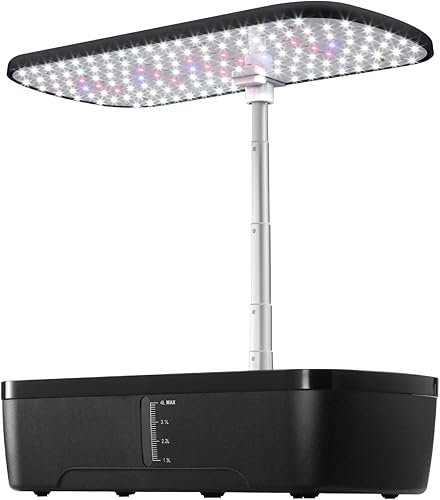
LED spectrum settings inspired by NASA Veggie and APH
You do not need a multi-channel research luminaire. You do need the right ratios and PPFD.
Target PPFD for leafy greens
- Seedlings to 7 days: 120 to 180 µmol/m²/s.
- Vegetative leafy growth: 200 to 280 µmol/m²/s for compact, dense heads.
- Maximum without aggressive climate control: 300 µmol/m²/s for most hobby/indoor setups.
Practical spectrum recipes
- “Veggie-inspired” full-spectrum recipe with a single white LED bar: Use a 4000 K to 5000 K white LED at the PPFD values above. This approximates a mixed spectrum similar to the white supplementation NASA uses alongside red and blue.
- Dual-channel red/blue fixture: Aim for roughly 10 to 20% of total power in blue (440 to 470 nm) and the rest in red (630 to 670 nm). Run the blue heavier for tighter, thicker lettuce.
- If your fixture includes green/white channels: Keep them at 20 to 40% output relative to red and blue to improve canopy penetration and visual assessment without overdriving transpiration.
Photoperiods that stabilize growth
- Use 16 hours on / 8 hours off for most leafy greens, a common photoperiod in controlled-environment research.
- Drop to 14 hours if you see rapid tipburn with good root health, as a way to reduce daily light integral without dimming.

4. What to watch long-term: benchmarks and tweaks from ISS lessons
Root-zone oxygen without air stones: what success looks like
- Root color: Cream to bright white with fine hairs. Slight beige near the wick interface is acceptable, but no brown slime.
- Smell: Neutral to earthy. Any sulfur or “swamp” odor means the media is too saturated or the solution is stagnant.
- Growth rate: For butterhead lettuce, 28 to 35 days from transplant to harvest at 220 to 260 µmol/m²/s is realistic.
If you see roots browning while EC and pH are stable, raise the tray by 0.5 to 1 cm to increase the air gap and, if needed, narrow your wicks by 25% to reduce flow.
Monitoring moisture like APH (without lab gear)
The Advanced Plant Habitat uses embedded soil moisture sensors and closed-loop control. You can approximate this with simple, repeatable checks:
- Use a consistent “finger test” or small moisture probe in multiple tray locations (center, corners, near wicks).
- Log how the media feels at set times after irrigation or after a reservoir refill (e.g., 1 hour, 12 hours, 24 hours).
- Target a state where the top 0.5 to 1 cm dries slightly between refills but the mid-zone stays moist.
If edges are consistently drier than the center, add one extra wick strip near the perimeter or extend the mat fully to the tray walls.
Tipburn prevention: integrating light, air, and moisture
To keep tipburn at bay, treat it as an integrated systems issue:
- Light: If tipburn appears on newest leaves while EC and pH are stable, reduce PPFD by 10 to 20% or shorten the photoperiod by 1 to 2 hours.
- Air movement: Use gentle, constant airflow across the canopy, not direct blasting. Aim for leaves that just barely move.
- Humidity: Keep relative humidity in the 50 to 70% range where possible. Very dry air plus high PPFD overloads transpiration.
- Moisture: Slightly drier media at the top zone (while keeping the root core moist) often improves calcium delivery to inner leaves.
Fine-tuning spectrum over multiple cycles
ISS experiments iterate spectra across many runs; you should too, even with fixed hardware.
- If heads stretch and leaves feel thin, increase blue fraction (or use a cooler white) and keep PPFD in the same range.
- If plants stay very compact but yield is low, slightly increase PPFD (no more than 10 to 15% per cycle) or extend days by 1 hour.
- If you are running white-only fixtures, experiment with fixture height to change blue:red balance at the canopy (higher mounting often softens intensity and shifts effective spectrum slightly).
EC and pH drift patterns as diagnostics
- Rising EC, dropping volume, stable pH: Plants are drinking faster than they are feeding. Slightly lower PPFD or room temperature, or reduce nutrient strength by 0.2 to 0.3 mS/cm.
- Falling EC, stable volume: Heavy feeding. Increase EC cautiously and watch leaf color; ISS-style consistent conditions usually keep this pattern very stable.
- pH creeping up daily: Typical for nitrate-based solutions. Adjust back down with acid when it passes 6.3 to 6.4 for lettuce.
Scaling to towers, NFT, and hybrid systems
The same capillary logic works in towers and NFT pipes:
- Add short wick tails or capillary strips from net cups down into flowing channels to buffer against pump outages.
- Use capillary mats in vertical towers to distribute small trickles evenly instead of relying only on gravity films.
- Design media inserts that maintain an internal air space even when flow is high, mirroring the porous blocks in ISS modules.
Bringing ISS plant science into your grow room
NASA’s quarter-century of plant research on the ISS shows that you can run hydroponic leafy greens with stable moisture, oxygenated roots, and controlled morphology without leaning on gravity or a tank full of air stones. The key lessons:
- Use wicks and capillary mats as the primary irrigation mechanism, not as an afterthought.
- Design clear geometry between reservoir, wick, and root zone so oxygen always has a path.
- Choose high-porosity media that partners with capillary flow instead of fighting it.
- Run disciplined spectra and PPFD that match what you want the plant to do, rather than what the fixture happens to output.
Start with one tray. Build a simple capillary system using these dimensions, set your LEDs to Veggie-like intensities, and log how your greens respond over a few cycles. You will spend less time chasing pH and EC “mysteries” and more time harvesting compact, consistent heads that look like they came out of a research chamber - because in a way, they did.
As an Amazon Associate, I earn from qualifying purchases.