Indoor Aquaponics Raft (DWC): Convert Your Hydroponic System - pH, Filtration, Nutrient Targets & DO
If you’ve ever tried to “just add fish” to your deep water culture rig and ended up with stressed tilapia, yellow lettuce, and brown slime coating everything, welcome to the club.
Converting an indoor salt-based DWC to an aquaponic raft is absolutely doable - but it is not just hydroponics with a fish tank bolted on. You are turning a sterile nutrient bath into a living, breathing ecosystem. That means new rules for pH, filtration, nutrients, dissolved oxygen (DO), and how hard you push the system.
This guide is for growers who already know how to run a DWC tub, but are fighting:
- Sick or gasping fish
- Yellow, slow, or “washed out” greens
- Filthy biofilm and solids building up under rafts
- pH that “won’t stay where hydroponics said it should”
- EC readings that make no sense at all
Let’s break down what’s actually going wrong - and how to redesign your indoor raft system so both fish and plants cruise.
The Problem: Hydro DWC Rules Don’t Work In An Aquaponic Raft
Most conversions fail for the same simple reason: the grower keeps treating the system like sterile DWC, while the biology is trying to run a completely different game.
Problem 1: Sick fish, high nitrite, and mystery deaths
In salt-based DWC, you crank nutrients to the plant’s liking and the only biology that matters is the roots and maybe a bit of beneficial inoculant. In aquaponics, fish are producing ammonia all day. If you do not have enough biofiltration surface area and flow, that ammonia and nitrite spike and burn the gills long before the plants get what they need.
Typical symptom chain:
- Newly stocked fish eat well for a week
- Then hang at the surface, gulping air or hiding and clamping fins
- API test kit shows ammonia or nitrite “somewhere above 0.5 ppm”
- Plants still look hungry because nitrates are low
This is a classic under-filtered, under-cycled system. Your rafts are not the biofilter, no matter how many roots you see. You need a dedicated biofilter sized to the fish load, not an afterthought sponge by the pump, as highlighted in several DWC aquaponics design guides such as this step-by-step overview.
Problem 2: Yellow lettuces and “weak” greens despite good fish load
On the plant side, you’re probably seeing pale lettuce, slow basil, interveinal chlorosis (yellowing between veins) in chard or kale, and slow head formation. In hydro DWC you might target EC around 1.2-1.8 mS/cm for leafy greens. In aquaponics your EC might read 0.5-1.0 and you panic, thinking the plants are starving.
Three things are usually going on at once:
- pH too high (7.5-8+) for optimal micronutrient availability, especially iron and manganese
- No iron supplementation, or the wrong chelate for your pH
- Over-trusting EC meters in a system where most ions are not the same mix as hydro salts
Aquaponic systems often run pH 6.8-7.2 as a compromise between fish, bacteria, and plants, as noted in this DWC aquaponics overview. Go much higher and your iron, manganese, and sometimes phosphorus availability crash. The plants are not short on “ppm”; they are short on usable forms of key nutrients.
Problem 3: Brown slime, stinky rafts, and root rot creeping in
Raft aquaponics wants clean water under the boards and high dissolved oxygen. Instead, many converted systems end up with:
- Solid fish waste settling directly in the DWC trough
- Brown anaerobic sludge collecting under rafts and in corners
- Roots browning from the bottom up, with that “swamp” smell
The root cause: no proper mechanical solids capture and mineralization step before the water hits the raft beds. In straight hydro, your nutrient solution is clear and sterile; in aquaponics, you are constantly adding solids in every gram of feed. If you do not separate, digest, and manage them, they rot where the roots live.
Problem 4: DO too low for roots or fish
Deep water culture lives and dies by oxygen. Commercial raft farms using DWC commonly maintain high aeration rates throughout their troughs, because low DO equals slow growth or root death, as summarized in this Virginia Tech DWC bulletin. In aquaponics, you also have fish pulling oxygen out of the same water, plus bacteria consuming oxygen as they process waste.
If your only air stone is in the fish tank, your rafts are living off scraps. Anything under about 5 mg/L DO in the troughs is asking for trouble with warm indoor temperatures and heavy plant load.
Put all that together and you get the standard new-aquaponics meltdown: gasping fish, weak plants, and that creeping realization that the “plug-and-play ecosystem” YouTube promised requires actual design work.

The Cause: You Now Run A Bio-Factory, Not A Bucket Of Salts
Once you accept that aquaponic DWC is biology-first, the weird behavior starts to make sense.
Biofiltration 101: Sizing for your fish, not for your ego
Fish waste comes in two forms:
- Dissolved (mainly ammonia excreted through gills and urine)
- Solid (feces and uneaten feed particles)
The dissolved load is handled by nitrifying bacteria (Nitrosomonas, Nitrobacter/Nitrospira) living on high surface-area media. This is your biofilter. In DWC aquaponics, that biofilter is usually a separate tank or barrel full of moving or fixed media that sits between your mechanical filter and the raft beds, as outlined in these DWC system notes.
Rules of thumb vary, but for small indoor systems:
- Allow roughly 20-40 liters of quality bio-media per 500 g of fish feed per day (for high surface media like K1, bio-balls, or lava rock).
- Start conservatively: low stocking density, oversized biofilter, and increase fish load only after ammonia and nitrite have stayed at 0 for weeks.
Most “converted DWC” setups have virtually no dedicated biofilter. They rely on the tank walls, a little sponge prefilter, and the raft channels. That might support a few ornamental fish and light greens, but it collapses when you push feed rates to actually drive plant growth.
Solids: Capture first, mineralize second, never let them rot in the troughs
Solid waste is a double-edged sword. Left in the system, it clogs roots and creates anaerobic pockets. Managed properly, it can be mineralized (broken down by microbes) to release extra phosphorus, potassium, and micronutrients back into solution.
For indoor raft aquaponics, a practical flow looks like this:
- Fish tank with strong aeration.
- Mechanical filter (swirl or radial flow filter, or a fine drum/sieve) to pull out most solids.
- Biofilter with high surface media for nitrification.
- Raft trough with clean, well-oxygenated water for roots.
- Return to fish tank.
Optionally, you divert settled solids from the mechanical filter into a mineralization barrel with aggressive aeration. Let them break down for days to weeks, then decant the clear, nutrient-rich supernatant back into the system in small doses.
The key: solids never accumulate in the DWC troughs themselves. If you look under a raft and see brown drifts on the bottom, or roots wrapped in sludge, your solids management is failing.
pH: Fish-safe vs plant-optimal vs bacteria-happy
Hydro DWC growers love pH 5.5-6.0. Roots are happy, iron stays available, and everything looks textbook. Put fish into that, and you will stress them and the nitrifying bacteria.
In aquaponics, you are negotiating between three needs:
- Fish generally prefer 6.8-7.5, depending on species.
- Nitrifying bacteria work well around 7.0-8.0.
- Plants want 5.5-6.5 for ideal micronutrient availability.
The practical compromise for indoor raft systems is usually:
- Target pH: 6.6-7.0 for mixed greens and common aquaponic fish.
- Allow slow drift between 6.4 and 7.2 rather than chasing a perfect number daily.
Below about 6.0, nitrifying bacteria slow down and biofiltration suffers. Above 7.2-7.4, iron and manganese availability drops sharply and your EC meter does not warn you about it, because the total ion load might still look “fine”. As described in several DWC guides like this practical raft-focused article, stable pH matters more than chasing hydroponic ideals.
Iron chelate: EDDHA vs DTPA vs “nothing”
Aquaponic systems almost always require supplemental iron. Fish feed is not enough, and the higher pH window ties a lot of iron up in unavailable forms.
Pick your chelate based on pH:
- DTPA chelate is fine if your system stays mostly below pH 7.0.
- EDDHA chelate stays available up to ~pH 9 and is the safer choice if you battle high pH, but it can tint the water red.
Dosage depends on fish load and plant demand, but many indoor systems land around 1-3 mg/L Fe added every 3-4 weeks. Always dissolve separately in system water before dosing and watch fish behavior after. Added correctly, the fish will ignore it.
Why EC meters mislead in aquaponics
Hydro EC is simple: you mix known salts, the EC lines up with known recipes, and you can almost grow by numbers alone. Aquaponics is murky:
- A large chunk of your dissolved solids are bicarbonates and non-nutritive ions.
- Organic acids, humics, and partial breakdown products can all affect conductivity.
- The NPK balance coming from fish feed is not optimized for lettuce or basil ratios.
Result: you can have “good EC” but iron-starved plants, or “low EC” with perfectly happy growth because your biology is efficient. EC becomes a trend tool, not a target-to-hit:
- Track EC over time. Rising EC without better growth can mean mineral buildup and low uptake.
- Dropping EC with happy plants usually just means they are feeding faster than the fish are supplying nutrients - adjust feed rate or plant density, not just dump more water.
Flow and DO: Raft channels are not storage drums
Indoor growers often oversize the trough volume relative to circulation, thinking “more water = more stability”. What they actually build is a long, slow-moving, oxygen-poor river. Roots at the far end get lukewarm, low-oxygen water rich in organic fines.
Better pattern:
- Design so the entire system volume turns over at least once per hour.
- Add aeration directly in the raft troughs (air stones under or between boards).
- Keep water temps in the 18-24°C range for most leafy greens; warmer water holds less oxygen and accelerates problems.
If you see DO below 5 mg/L anywhere in the loop at peak warmth and load, you either need more air, cooler temps, or less biomass (fish and/or plants).
Fish feed vs plant load: the hidden throttle
In hydro, you control nutrients with bottles. In aquaponics, your fish feed rate is your nutrient throttle.
Common backyard guidance is roughly 20-40 g of feed per square meter of raft area per day for leafy greens, but that assumes mature biofiltration and robust stocking. Indoor, it is safer to think in stages:
- Start with low fish density and under-plant rafts.
- As you see nitrates climb and plants stay deep green with no burn, slightly increase feed.
- Stop increasing when either ammonia/nitrite appear, DO dips, or solids management starts falling behind.
The classic “1 pound of fish per 5-10 gallons of water” is a very rough upper bound from larger systems, not a starting point. Indoors, limited tank volume, higher water temps, and less margin for error mean you should often run leaner than outdoor recommendations found in generic guides.
The Solution: Designing An Indoor Aquaponic Raft That Actually Works
Let’s turn the theory into a practical checklist you can apply to an existing DWC setup or a fresh build.
1. Map your flow: Fish - mechanical - biofilter - raft - return
Stop thinking “bucket with rafts” and start thinking “treatment train”. Your water should move in a clear sequence:
- Fish tank: Round or rectangular, but with good circulation so solids stay suspended and head for the outlet.
- Mechanical filter: Swirl or radial flow filter is simple and effective. Aim to remove 50-80% of settleable solids here.
- Biofilter: Barrel or tote with moving bed media, or a static media chamber with high surface area media. Ensure vigorous aeration.
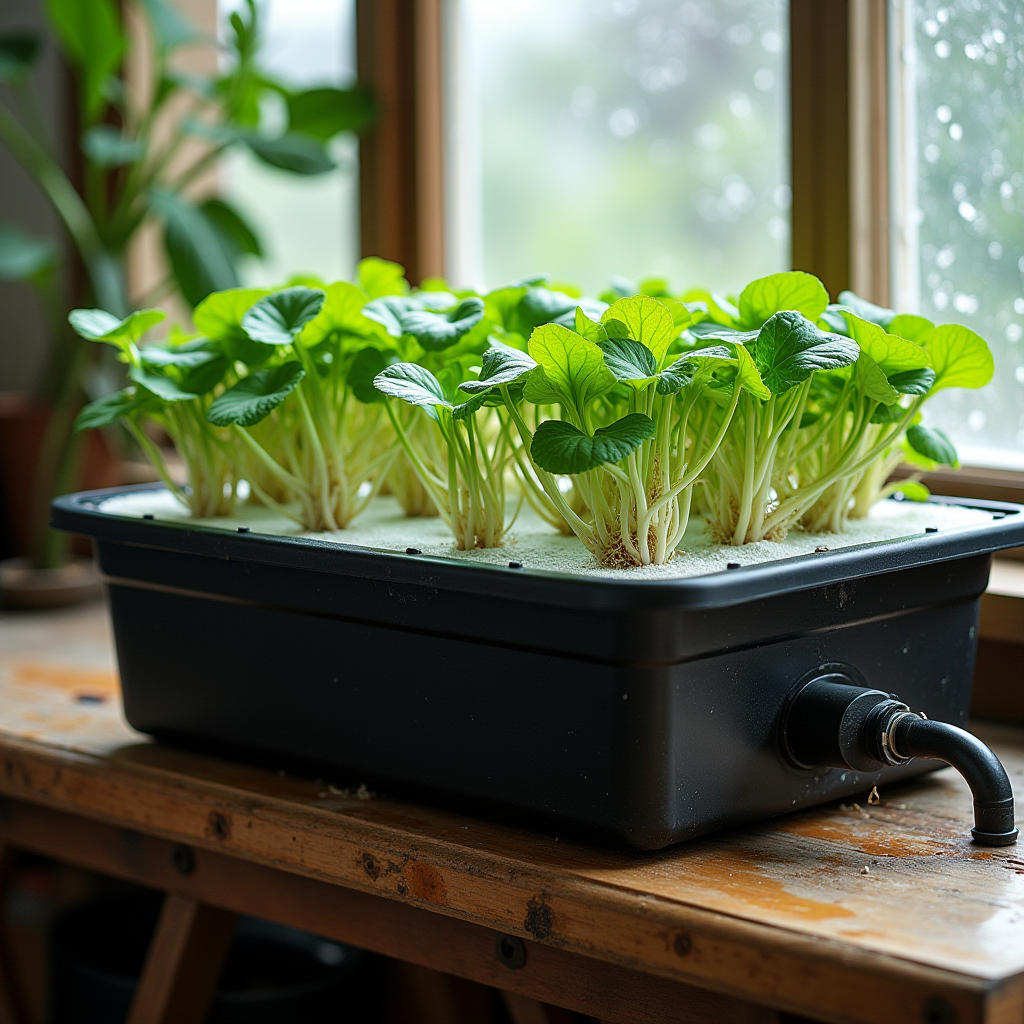
- Raft troughs: Clean, well-aerated, with minimal solids entering. Roots should look tan to white, not sludge-coated.
- Return to fish tank: Ideally with a drop or waterfall to add more oxygen.
Quick retrofit tip: if you cannot add multiple barrels, at least add:
- A settling bucket after the fish tank for solids
- A bio-media crate in a separate tank or elevated box before the DWC trough
2. Set realistic pH targets and buffer correctly
Put away the hydro pH chart. For indoor aquaponic rafts with common species (tilapia, goldfish, trout in cooler rooms, plus lettuces, basil, chard, Asian greens):
- Target pH 6.6-7.0.
- Do not adjust unless you drift outside 6.4-7.2.
To raise pH and alkalinity gradually:
- Use calcium carbonate (ag lime) or potassium bicarbonate in small, repeated doses.
- Aim to keep KH (carbonate hardness) moderate so your pH is buffered but still capable of slowly trending down as nitrification produces acid.
To lower pH:
- Use phosphoric or nitric acid in a separate dilution bucket, always adding acid to water, not water to acid.
- Adjust in small increments (no more than 0.2 pH points per day) and watch fish.
Over time, the system will naturally trend slightly acidic as nitrification proceeds. Your job is mostly topping up alkalinity so the pH declines slowly rather than crashing.
3. Pick and dose the right iron chelate
Once your pH is in the right band, fix the chronic yellowing:
- If your pH is usually below 7, use DTPA iron chelate.
- If your pH often creeps above 7, use EDDHA iron chelate.
Start with around 2 mg/L Fe every 3-4 weeks and adjust based on plant response. New growth should come in a clean, vibrant green. Old leaves may not fully recover, so judge by what grows after dosing, not before.
4. Treat EC as a compass, not a recipe
Stop chasing hydroponic EC targets:
- Log EC, pH, temperature, ammonia, nitrite, nitrate weekly (or more).
- Watch the combination of plant color, growth rate, and trends in EC:
Examples:
- Plants pale, EC low, nitrates low: lightly increase feed rate or reduce plant density.
- Plants dark but slow, EC creeping up, nitrates high: plants are overfed; reduce feed or add more plants/lighting.
- EC rising, ammonia/nitrite appear: biofiltration overloaded - not a signal to dilute nutrients, but to fix filtration and/or reduce feed.
Use EC to compare your system to itself over time, not to match a hydroponic chart.
5. Dial in DO and flow for rafts specifically
You are running DWC, not static ponds. For indoor aquaponic rafts, aim for:
- System turnover: at least 1x per hour (2x is even better on smaller volumes).
- Dissolved oxygen: 6-8 mg/L in the fish tank, >5 mg/L in raft troughs.
- Aeration: at least one air stone per 1-1.5 m of trough length, or continuous air manifold under rafts.
Cheap DO meters are not perfect but they are better than guessing. Even a basic handheld can show you the dead zones you did not know existed. If you cannot afford one yet, at minimum:
- Keep water moving briskly, not just gently stirring.
- Ensure no section of the trough sits “last in line” without aeration.
6. Balance fish feed to plant load like a grower, not a hobbyist
Start gently and only push once you have data:
- Cycle the system (fishless or with hardy fish) until ammonia and nitrite hit 0 consistently and nitrates appear.
- Add plants and watch nitrate trends. Greedy leafy greens should bring nitrates down if lighting and DO are adequate.
- Increase feed slowly until you see a nice baseline of nitrates (say 20-80 ppm), solid growth, and no ammonia/nitrite spikes.
Use your fish like variable nutrient injectors:
- More feed = more nutrients, more waste, more DO demand, more filtration required.
- Less feed = cleaner water, slower plant growth.
This is how commercial raft operations tune their systems, echoing the core principles highlighted across practical DWC references like this deep water culture system design overview and this LSU DWC aquaponics slide deck.
7. Light like it’s still hydroponics
Just because nutrients come from fish does not mean you can slack on lighting. Raft greens indoors still want:
- 14-18 hours of high-quality LED light for lettuce and leafy greens.
- PPFD in the 150-300 µmol/m²/s range at canopy for compact, non-leggy growth.
If your plants look like they are starving but your water tests fine, weak light is often the missing piece.
8. Biofilm realism: manage, do not obsess
You will never get sterile white roots in aquaponics. A thin, tan biofilm on trough walls and roots is normal and often beneficial. Problems start when:
- Biofilm traps solids and turns black or smells sulfurous.
- Roots are coated in thick brown mats instead of fine root hairs.
Mitigation:
- Keep solids out of troughs (mechanical filter first).
- Maintain strong DO.
- Periodically flush channels between crops to physically remove buildup.
Aquaponics is about controlled biology, not sterilization.
Summary: How to make your indoor aquaponic raft behave
- Give bacteria a proper home: dedicated, well-aerated biofilter sized to your feed rate.
- Pull solids out early: mechanical filtration before rafts, optional mineralization tank for extra nutrients.
- Run pH 6.6-7.0 and supplement iron with the right chelate for your actual pH.
- Use EC trends, not hydro charts, to inform adjustments.
- Oversize aeration and keep water moving; DO is life for fish, roots, and bacteria.
- Throttle nutrients using fish feed vs plant load, not bottles.
Do that, and your raft greens will finally look like hydroponic quality while your fish quietly pay the nutrient bills.