Hydroponic strawberries: it’s not the variety, it’s your root-zone steering
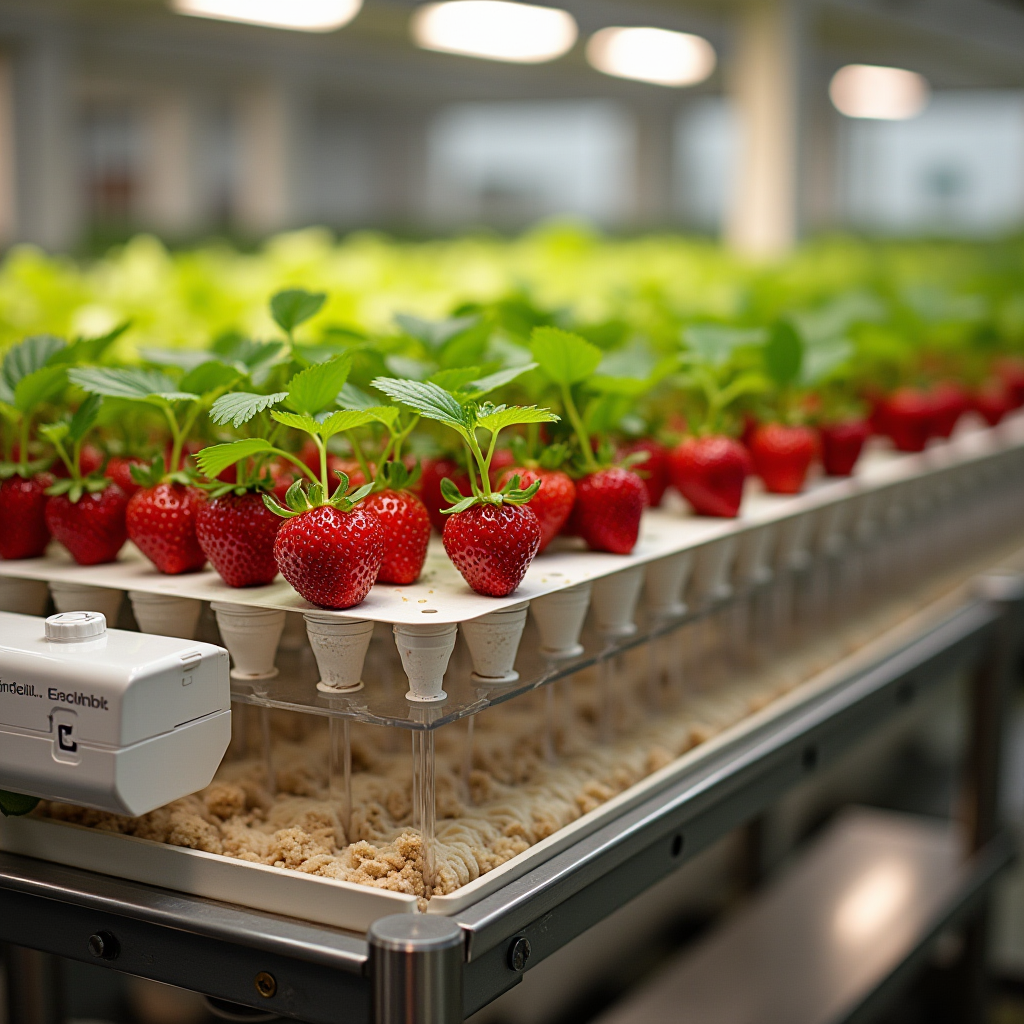
Most growers blame genetics when strawberries turn soft, bland, or misshapen. In coco and rockwool, it’s almost never the variety – it’s your EC and irrigation pattern in the slabs.
Garden Culture’s “Root‑Zone as Joystick” Part 2 nailed the principle: you steer crops by manipulating water content (WC) and EC over a 24‑hour cycle. In strawberries, that joystick is very sensitive. Push the wrong way and you get runners, hollow cores, soft fruit, and ugly tips. Push it right and you get firm, high‑brix berries with clean shape and strong pedicels.
This article is a practical mistakes‑and‑fixes playbook for day‑neutral strawberries in coco and rockwool with precision fertigation. We’ll stay focused on four levers:
- Stage‑specific root‑zone EC targets
- Drain percentage and pulse scheduling tied to light
- Ca/K balance for firmness and tip quality
- Steering away from runner‑heavy vegetative drift
1. Common mistakes in hydroponic strawberry EC and irrigation
Let’s start with the errors that quietly wreck firmness, brix, and shape in substrate strawberries.
Mistake 1: Running “tomato EC” on a salt‑sensitive crop
Strawberries are far more salt‑sensitive than tomatoes or cucumbers. Many substrate systems sit between 2.2 and 3.0 mS/cm for other vine crops; that will punish strawberries. University and extension work consistently show root‑zone EC for strawberries should stay around or below 1.0–1.2 mS/cm to avoid salt stress and yield loss [Arizona], [OSU].
Running “one recipe for the whole house” is the fastest way to get:
- Burned leaf margins on younger leaves
- Soft, watery fruit despite high EC in the slab
- Short, fibrous roots parked in the top of the substrate
Mistake 2: Irrigating like a vegetative vine crop all season
A lot of greenhouses plug strawberries into an existing tomato schedule: early start, frequent pulses, aggressive daytime drain, minimal dry‑back at night. That pattern is heavily vegetative. In strawberries, that means:
- Runner explosion after the first harvests
- Dense foliage, shaded clusters, and softer fruit
- Persistent misshapes because flower differentiation was weak
Root‑zone steering, as described in the joystick model from Garden Culture, divides the day into replenishment (P1), maintenance (P2), and overnight dry‑back (P3) periods with tuned shot size and frequency [GCM]. Ignoring that structure is a key mistake.
Mistake 3: No real handle on drain EC and WC
Growers often watch feed EC closely but treat drain EC and water content as “nice to have.” In steerable substrates like rockwool, that’s backwards. EC in the root zone is controlled by:
- Feed EC
- Shot size and timing
- Drain percentage
Without consistent drain measurements, you do not know what the roots are actually seeing. Research in steerable stone wool shows that managing WC and EC with small pulses and controlled drain is central to stable root‑zone conditions [Grodan].
Mistake 4: Treating coco and rockwool the same
Coco and rockwool respond very differently to pulses and dry‑back:
- Coco coir buffers cations, has higher natural salts, and loses structure when overdried.
- Rockwool is highly inert and steerable, with rapid WC and EC response to pulse changes.
Running identical irrigation strategies in both is a good way to get salt buildup in coco and wild EC swings in rockwool.
Mistake 5: Ignoring Ca/K steering for firmness
Soft fruit and bad tips are often blamed on “calcium deficiency” in general, when the real issue is the Ca:K (and Ca:K:Mg) balance under your light and transpiration conditions. High K for yield, without enough Ca in early generative phases, is a classic setup for:
- Soft shoulders and bruising
- Tip burn and malformed achenes
- High brix but poor shelf life

2. Why these mistakes happen in substrate strawberry systems
Most of these problems are not laziness. They’re the side‑effects of copying other crops and underestimating how tight the strawberry steering window really is.
Reason 1: Borrowed recipes from other vine crops
In many mixed or converted houses, strawberries are the new tenant. The easiest path is to run them on a diluted tomato recipe and hope for the best. But the crop’s salt sensitivity and shallow root system demand a different root‑zone strategy. Extension sources underline that strawberry root zones should stay well below typical vine‑crop ECs to avoid chronic stress and yield penalties [OSU], [Arizona].
Reason 2: Incomplete adoption of the “joystick” model
The joystick approach described by Garden Culture splits the day into three irrigation phases and uses five control dials: start delay, shot size, shot frequency, cut‑off time, and feed EC strategy [GCM]. Many strawberry operations adopt bits of this (like a simple start delay) without tying it to:
- Measured dry‑back targets by substrate type
- Stage‑specific EC goals
- Vegetative vs generative steering goals (runner control vs fruit push)
The result is a schedule that “waters” but doesn’t steer.
Reason 3: Limited sensor coverage or poor placement
Strawberries sit in relatively small volumes of substrate, often with two to four plants per slab or pot. If your only moisture/EC sensor is parked in the wettest slab near the header line, you are steering blind. Grodan and other substrate providers emphasize that uniform distribution and correct sensor placement are prerequisites for effective EC steering [Grodan].
Reason 4: Underestimating coco’s salt load and buffering
Coco often comes with significant background EC and strong cation exchange capacity. If it is not fully flushed and conditioned before planting, your plants are starting with inaccurate root‑zone EC and skewed Ca/K/Mg ratios [OSU]. Then you add a “safe” vine‑crop EC, and within a few weeks the drain EC is uneven and creeping up.
Reason 5: No deliberate Ca/K plan over the crop cycle
Many feed programs are built around a single NPK ratio that gets minor tweaks seasonally. That might work in leafy greens. It is not enough when you are trying to dial firmness, brix, and tip quality. The link between EC management, nutrient ratios, and fruit quality is well documented: excessive EC and unbalanced K can reduce firmness and overall fruit quality, while stable EC with balanced nutrients supports both brix and texture [IntechOpen].
3. How to fix EC steering and pulse scheduling for strawberries
Now for the practical framework. We’re going to plug strawberries into the joystick model but tuned for a salt‑sensitive, generative‑leaning crop with long harvest windows.
3.1 Stage‑wise EC targets for day‑neutral strawberries
These EC values are for the root zone / drain, not just the tank. Always calibrate with your own water analysis and variety response.
Stage 1: Rooting and establishment (first 2–3 weeks after transplant)
- Target drain EC: 0.8–1.0 mS/cm
- Feed EC: 0.9–1.1 mS/cm (slightly above target to overcome uptake)
- Strategy: Vegetative support but avoid saturation. You want active root exploration through the slab.
Use slightly larger shots with modest frequency to wet up the substrate in P1, then hold moderate WC in P2, allowing a controlled P3 dry‑back overnight.
Stage 2: Flower initiation and early fruit set
- Target drain EC: 1.0–1.2 mS/cm
- Feed EC: 1.1–1.3 mS/cm
- Strategy: Leaner, generative‑leaning regime to support flowering and strong pedicels without pushing runners.
This is where you use the joystick: slightly higher EC, slightly more overnight dry‑back, and tighter control of shot timing with light.
Stage 3: Peak harvest (high fruit load)
- Target drain EC: 1.0–1.3 mS/cm, stable day‑to‑day
- Feed EC: 1.2–1.4 mS/cm, depending on drain trends
- Strategy: Balanced. Prevent salt creep but keep enough generative pressure for brix and firmness.
If drain EC drifts above 1.4–1.5, increase drain percentage and/or lower feed EC until you are back in the zone. Use drain EC as your real steering feedback, as recommended for steerable substrates [Grodan].
Stage 4: Late cycle / quality finish
- Target drain EC: 1.1–1.4 mS/cm depending on plant vigor
- Feed EC: 1.2–1.5 mS/cm
- Strategy: Slightly generative, controlled dry‑back, stable Ca supply to keep fruit firm and reduce late misshapes.
Do not chase brix by spiking EC far above 1.5 mS/cm in the root zone. Research on fruit crops shows that excessive EC reduces fruit quality and can hurt firmness despite higher soluble solids [IntechOpen].
3.2 Pulse scheduling and drain goals tied to light
We’ll adapt the P1–P2–P3 framework from the joystick article specifically to strawberries in coco and rockwool.
P1: Replenishment (start of light period)
- Start delay: 45–90 minutes after lights on / sunrise, depending on climate.
- Goal: Bring the root zone back up to target WC smoothly, not in one big dump.
Run 2–4 larger pulses in P1 (for example 3–5% of substrate volume each shot) until you reach target WC. Avoid saturating coco or rockwool to the point of free water standing at the base.
P2: Maintenance (mid‑day under high light)
- Shot size: Small, frequent pulses.
- Goal: Keep WC in a narrow band, collect controlled drain, and hold EC stable.
Typical daytime drain targets for strawberries in rockwool are 10–25% of daily irrigation volume, enough to refresh EC without flushing excessively. Rockwool guidance for other crops often mentions 10–35% drain as a good steering range [CANNA]; for strawberries, stay on the lower side.
Key rules:
- Increase shot frequency with higher light / VPD.
- Use low‑flow drippers to avoid channeling and reduce EC hotspots, as highlighted in discussions of runoff EC and pore water management [FloraFlex].
- Track drain EC mid‑day and late day; trends matter more than single numbers.
P3: Overnight dry‑back
- Cutoff time: 1.5–2.5 hours before lights off / sunset.
- Goal: Controlled dry‑back to maintain generative pressure and oxygenate the root zone.
Target overnight dry‑back by substrate:
- Coco: 10–15% WC reduction (light generative push).
- Rockwool: 8–12% WC reduction.
Too little dry‑back gives you vegetative drift and runners. Too much and you start the day dehydrated, with EC spikes.
3.3 Coco vs rockwool: steering specifics
In coco coir
- Flush and condition coco thoroughly before planting to remove background salts and load Ca/Mg.
- Run slightly lower feed EC than in rockwool to account for coco’s buffering and residual salts.
- Use smaller shot sizes; avoid extreme dry‑backs that collapse structure and reduce air‑filled porosity.
- Expect slower EC response; adjust gradually over several days.
In rockwool
- Set drain targets tightly and adjust shot frequency rather than shot size when possible.
- Use the full steerability of rockwool: small changes in timing and frequency will show in WC and EC graphs within 24–48 hours [Greenhouse Canada].
- Keep sensor blocks representative (mid‑slab, not right by the dripper or drain hole).
3.4 Ca/K balance and brix steering
Within your chosen EC range, push quality with nutrient ratios:
- Ca: Prioritize during establishment and early fruit set. Maintain generous Ca in the feed to support cell wall strength and tip quality.
- K: Increase modestly at peak harvest for brix and yield, but monitor firmness and misshapes. Do not starve Ca when you push K.
- Mg: Keep Mg steady to support photosynthesis under high light but avoid overdoing it in coco, which can displace Ca.
Combine this with stable EC and well‑timed pulses and you get firm fruit with consistent internal color rather than hollow, watery berries.

4. What to watch long‑term: firmness, brix, and misshapes
Once the system is running, you can tighten quality by watching trends and responding with small, deliberate moves on the joystick.
4.1 Visual and physical crop signals
- Runner pressure: Rising runner count usually means your regime is too vegetative. Increase overnight dry‑back slightly and consider a small EC bump within your safe range.
- Leaf posture: Constantly lush, horizontal leaves with dark color suggest too much water and low generative pressure. You want leaves that are turgid but not heavy, with some daily movement as light and VPD change.
- Root distribution: In a healthy steering regime, roots explore the full depth of the slab, with active white tips near both top and bottom.
4.2 Fruit firmness and brix benchmarks
Each variety and market has its own spec, but you can use these practical targets:
- Firmness: Fruit should withstand firm thumb pressure without collapsing. Track this alongside drain EC and Ca/K adjustments.
- Brix: For premium greenhouse day‑neutral varieties, aim for brix in the low‑mid teens. If brix is low but EC is already at the top of your safe band, look at light intensity and K rather than pushing EC higher.
Remember that stable EC and consistent water potential improve both firmness and brix by keeping transport and ripening more uniform [IntechOpen].
4.3 Misshapes and tip issues
Misshapen strawberries tell you about past mistakes, mainly during flower initiation and early fruit development.
- Catfacing and double tips: Often tied to stress or imbalanced growth during early flower; review EC and dry‑back in that window.
- Tip burn and aborted achenes: Linked to Ca delivery issues and excessively vegetative canopies; improve air movement, maintain Ca supply, and rebalance Ca/K.
- Hollow core: Can be connected to erratic water availability and EC swings during sizing; tighten P2 pulses and avoid boom‑and‑bust irrigation.
4.4 Data feedback loop
To keep improving season by season, log and compare:
- Feed and drain EC, pH, and daily drain percentage
- Estimated dry‑back by substrate and zone
- Light integrals (DLI) and VPD ranges
- Quality metrics: firmness scores, brix samples, percent misshapes
This is the real value of treating the root zone as a joystick: you stop guessing and start correlating small steering changes with measurable shifts in firmness, brix, and yield, exactly the kind of $/m²/day optimization highlighted in the joystick approach [GCM].

Bringing it together
Hydroponic strawberries in coco and rockwool reward precision. If you respect their low EC tolerance, build a stage‑specific steering plan, and use pulse scheduling instead of “set and forget” irrigation, you can drive firmness, sweetness, and shape instead of chasing them.
Treat the root zone like the joystick it is: small, deliberate moves on EC, shot size, and timing, guided by drain data and fruit quality, will give you far more control than any single “miracle” nutrient bottle.
As an Amazon Associate, I earn from qualifying purchases.