Hydroponic Power Outage Survival: Backup Aeration and Thermal Protection for DWC & Aeroponics (Winter 2025)
If your DWC bucket turns into a swamp every time the power blinks, it is not bad luck - it is your outage plan (or lack of one) finally catching up with you.
Winter storms, grid hiccups, and rolling blackouts are brutal on active hydroponic systems. Aeroponics can crash in minutes. Deep Water Culture (DWC) can go from thriving roots to brown mush in a single long outage. The good news: a bit of planning, one or two well-chosen backup devices, and some no-power tricks can keep your system alive long enough for the lights to come back on.
This guide focuses on practical outage survival for home and small-scale growers running DWC and aeroponics, plus how to leverage Cyber Week deals on UPS units and portable power stations without wasting money on the wrong gear.
The Problem: When the power drops, your roots are on a timer
Hydroponic systems are brilliant at pushing growth - right up until the electricity cuts. Then the same things that make them powerful become liabilities:
- DWC: Roots are submerged in nutrient solution and rely on constant aeration from air stones or circulation pumps. When the pump stops, dissolved oxygen (DO) plummets fast. Warm, still water plus hungry roots is a recipe for suffocation and root rot.
- Aeroponics: Roots are hanging in air and depend entirely on frequent misting. Lose power to the misting pump, and you lose both water and nutrients. In a warm, dry winter-heated room, roots can start to desiccate in under an hour.
- Indoor-only lighting: If you grow in a tent, basement, or interior room, a long outage means no light at all. Plants in flower or fruiting can handle a short dark spell, but repeated or long disruptions wreck yield and can trigger stress responses.
- Temperature drift: In winter, unheated spaces can tank reservoir temperatures; in heated rooms, outage plus no air movement can make localized hot or cold zones. Rapid swings are stressful; extended cold slows nutrient uptake and opens the door to disease.
Most growers underestimate how quickly this compounds. A typical indoor DWC tote sitting at 20-22°C with a big root mass can burn through its dissolved oxygen in well under an hour once aeration stops. Aeroponic systems, especially fine-mist high-pressure setups, can stress roots in 20-40 minutes if spray cycles halt.
Meanwhile, you are usually dealing with storm chaos, not standing over your reservoir with a stopwatch.
So the core problem is simple:
- Your most critical loads (air and mist) are usually your least protected.
- You are probably backing up the wrong things first (lights instead of air pumps).
- You may not have a plan for keeping reservoirs within a safe 18-22°C when HVAC and circulation stop.

The Cause: Wrong priorities and no planned fallbacks
Most hydroponic outage damage comes down to three design mistakes, not the storm itself.
1. Backing up lights instead of life support
LED grow lights draw a lot of power for their size. A 240 W LED bar that runs 18 hours a day is a heavy load. Air pumps and small DC misting pumps, by contrast, usually sip electricity - often 3-25 W per device.
Yet many growers plug their entire tent into a basic UPS, hoping to ride out an outage with everything running. The result:
- The UPS is overloaded or drains in minutes.
- Air pumps shut down with everything else.
- Your battery money bought you 10-20 extra minutes of light and zero meaningful protection for your root zone.
Lights can go off for a few hours with minimal damage, especially in veg. Roots, especially in DWC and aeroponics, have a far shorter survival window without oxygen or moisture.
2. No staged plan for different outage lengths
Not all outages are equal. You need different tools for:
- Short flickers (0-15 minutes): voltage dips, quick blackouts.
- Medium outages (15 minutes - 4 hours): typical winter grid issues.
- Long outages (4-24+ hours): serious storms or infrastructure failure.
Running a big portable power station for a 2-minute flicker is wasteful. Trying to ride out a 12-hour outage on a tiny UPS is wishful thinking. Without a staged plan, you end up using the wrong backup for the wrong duration and draining it when you need it most.
3. Ignoring reservoir temperature until it is already a problem
In active hydroponics, temperature is not just about plant comfort. It actively controls oxygen availability and pathogen risk.
- Warmer water holds less dissolved oxygen.
- Most hydro-friendly roots are happiest around 18-22°C.
- Above ~24°C, especially without aeration, you are inviting pythium and other root diseases.
- Below ~15°C, uptake slows, and plants start looking nutrient deficient even when EC is perfect.
During an outage, you lose:
- Active cooling from chillers or air conditioning.
- Room air circulation that helps buffer temperature swings.
- Any heated reservoir support you might have had.
In winter, a cold garage might drop a reservoir from 20°C to 10-12°C overnight. In a heated room that cools slowly, DO drops as water warms and sits stagnant. Both ends of the temperature swing can do real damage, especially if power bounces on and off over a few days.
The underlying cause: most systems are built for ideal conditions, not for the worst 1 percent of days you are actually most likely to lose a crop.

The Solution: A practical outage plan for DWC & aeroponics
The goal is not to build a bunker-grade power setup. The goal is to keep roots alive and reservoirs stable long enough for the grid to come back.
Step 1: Decide what actually needs power (and what does not)
In an outage, you are no longer running a high-performance grow. You are in survival mode. That means:
- Must stay on:
- DWC air pumps (or water pumps in circulation-based systems).
- Aeroponic misting pumps and controllers (or a backup low-power pump on a simple cycle timer).
- Any small heater or circulation device needed to prevent the reservoir from freezing or plummeting below ~15°C in very cold spaces.
- Can safely go off for hours:
- LED grow lights (especially in veg, or if plants can catch ambient daylight).
- CO2 systems.
- Dehumidifiers, fans, and non-critical automation.
If your budget is limited, back up the life-support gear first. A modest 300-600 W portable power station or mid-range UPS can keep a handful of 5-10 W pumps running for many hours, whereas the same unit might only run a 240 W light bar for 1-2 hours.
Step 2: Size your UPS or portable power station for the right loads
To keep things simple, think in terms of watt-hours (Wh), not just watts. You need enough capacity for the duration you care about.
- List your survival loads:
- DWC air pump: for example 10 W.
- Aeroponic mist pump: for example 30 W, but only runs 25 percent of the time on a cycle timer, so average ~7.5 W.
- Optional: small 10-20 W circulation pump or small aquarium heater if you truly need it in a cold garage/room.
- Calculate total average watts:
- Example: 10 W (air) + 7.5 W (mister) + 10 W (circulation) = ~27.5 W.
- Choose your target runtime:
- For winter storms, 4-8 hours is a realistic minimum. Longer is better, but even 4 hours can save a crop if outages are usually brief.
- Convert to Wh:
- 27.5 W x 8 hours = 220 Wh needed.
- Factor in inverter losses and real-world capacity: multiply by 1.3-1.5. So target ~300-350 Wh minimum.
That means a 300-500 Wh portable power station or a high-quality UPS rated around 600-1000 VA can reasonably handle essential pumps for that duration. If you want to also run a small LED bar at low dimming (for example 60-100 W), jump to the 800-1500 Wh class.
Many modern power stations clearly show remaining runtime in hours at your current load, which makes it easy to adapt on the fly during a storm.
Step 3: Prioritize DC and efficient devices where possible
Every watt you save is extra runtime during an outage.
- Prefer small, efficient diaphragm air pumps over oversized aquarium pumps if you are only running a few buckets.
- For aeroponics, consider lower-pressure, lower-flow backup pumps running longer cycles rather than high-pressure misters that draw a lot of power. This is a survival mode, not full-performance mode.
- Use check valves and keep lines short to reduce strain and failure risk.
Where possible, run low-voltage DC pumps directly from DC outputs on a power station instead of going DC - AC - DC through an inverter. That can save 10-15 percent efficiency losses, which matters over long outages.
Step 4: Build no-power aeration and misting workarounds
If the backup batteries are out or you are dealing with a very long outage, you still have options to buy time without power.
No-power aeration tricks for DWC
- Manual agitation: Every 30-60 minutes, stir or pour the nutrient solution from a height back into the reservoir to entrain air. In a multi-bucket system, rotate effort to the most valuable plants.
- Emergency surface area boost: Wide, shallow reservoirs have better gas exchange than deep, narrow ones. If you know a storm is coming, slightly lower solution levels to expose more root surface to air while still keeping the main root mass moist.
- Lean on Kratky principles: The Kratky method runs without powered aeration by deliberately keeping an air gap between the net pot and solution so roots can access both water and oxygen, as described in this overview of hydroponic systems. In an outage, temporarily lowering solution levels in DWC buckets can mimic this partially and reduce suffocation risk.
No-power survival mode for aeroponics
- Convert to a drip or shallow DWC temporarily: If your aeroponic roots are in a chamber above a reservoir, you can raise the nutrient level until the root tips sit in shallow solution, creating a quick-and-dirty DWC. It is not ideal, but it beats dry roots.
- Hand misting: Use a clean pump sprayer with diluted nutrient solution and mist the root mass every 15-30 minutes. Keep spray bottles dedicated to nutrients, and sanitize them between uses.
- Slow-wicking backups: In some bucket-style aeroponics, you can run a wick from the solution to the root zone, giving at least a baseline of moisture if you cannot mist regularly.
All of these are emergency measures, but having the tools ready (clean sprayer, spare wicks, ability to safely raise reservoir level) matters.
Step 5: Keep reservoirs in the 18-22°C safe zone
You want to slow down both temperature gain and loss. A few cheap, non-electrical tricks make a big difference:
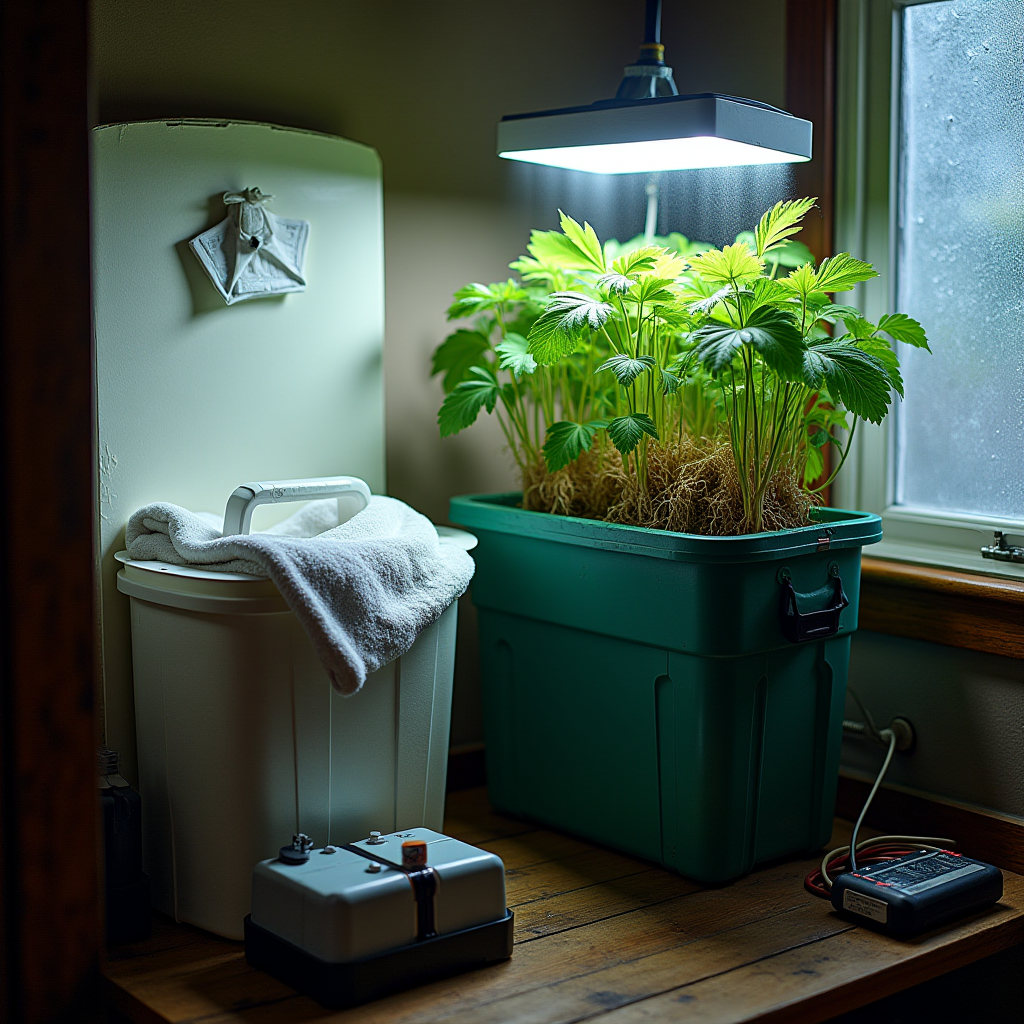
- Insulate your reservoir: Wrap DWC totes and aero reservoirs with camping mats, foam board, or even old blankets. This helps keep temperatures stable whether your space is freezing or just cooling down slowly.
- Use the thermal mass to your advantage: Larger reservoirs change temperature more slowly. If you are constantly riding the edge in small buckets, consider tying multiple units into a single larger, insulated reservoir.
- Pre-chill or pre-warm before storms: If a blizzard is forecast and your grow area tends to get cold, start your reservoir closer to 21-22°C. If the power goes out, you have more buffer before you drop below 18°C.
- Ice bottles for short, warm outages: If your outage happens during a warm spell or in a heated indoor space, frozen water bottles in the reservoir can prevent water from creeping into the high-20s°C while aeration is reduced. Do not add unsealed ice directly (it will dilute your nutrients).
Above all, avoid extreme swings. A slow slide from 22°C to 17°C over 8-10 hours is tolerable for most leafy greens and herbs. A rapid crash to very cold or a jump into warm, still water is what really triggers root problems.
Step 6: Test your setup before the storm
Do a dry run when the weather is calm:
- Plug only your critical pumps into the UPS or power station.
- Kill the mains power to your grow room or unplug your main power strip.
- Check:
- What actually stays on.
- How long your backup device claims it can run.
- Whether any devices trip surge protection or fail to restart.
This also forces you to tidy your wiring, label backup circuits, and make sure critical plugs are easy to move if you need to prioritize one system over another mid-outage.

The Evidence: What the science and experience say
Hydroponic growers and educators have been hammering home the same basic physics for years: oxygen, temperature, and moisture are the pillars of a healthy root zone, and all three go unstable during power loss.
Dissolved oxygen and DWC/aeroponics
Deep Water Culture works because roots get constant access to both nutrients and oxygen, usually via air stones or water agitation. As outlined in resources on DWC systems like this DWC guide for hobbyists, the whole point is to maintain high DO levels while roots sit in solution.
When air stops:
- Roots and microbes keep consuming oxygen.
- There is no surface agitation to replenish it.
- Warmer water accelerates respiration and decreases oxygen solubility.
That is why outages at stable 18-20°C are survivable for longer than the same outage in a cramped, warm, 25-26°C tote.
Temperature and pathogen risk
Multiple hydroponic system reviews, like this overview of high-efficiency systems, emphasize the tight relationship between reservoir temperature, oxygen, and pathogen growth. Pathogens like pythium love warm, low-oxygen water with stressed roots. That is exactly what you get when a warm DWC system loses aeration for a few hours and then comes back online with damaged root tissue.
Keeping water in the 18-22°C zone, even if you are not running at peak 20°C perfection, is essentially buying insurance against root disease after the outage, not just during it.
Why Kratky shrugs off outages
The Kratky method is often described as "set and forget" because it does not need pumps or electricity, relying instead on a fixed nutrient reservoir and an air gap that increases as plants drink water, as explained in this hydroponic systems guide. In outage-prone regions, it is not a coincidence that many growers keep at least some Kratky jars or totes running alongside their active systems.
They act as "resilient calories" - no pumps to fail, no aeration to back up. You may not push maximum yields, but you will not lose everything when the lights flicker.
Putting it together for Winter 2025
With Cyber Week deals flooding feeds with portable power stations and UPS units, the temptation is to grab the biggest thing with the fanciest screen. A better approach for a hydro grower:
- Start by listing your critical survival loads (air and mist), their wattage, and the runtime you want.
- Size a UPS or power station around that, not around your lights.
- Layer on no-power workarounds for the worst-case scenario: manual aeration, temporary DWC conversion for aeroponics, insulated reservoirs, and ice bottles or pre-warming as needed.
- Consider keeping one simple Kratky setup in the mix as a zero-power safety net for greens.
Active hydroponic systems will always be more vulnerable to outages than soil or passive systems. But with a focused, science-based plan, you can turn a power cut from a crop-killer into a minor annoyance.

As an Amazon Associate, I earn from qualifying purchases.