Hydroponic Ornamental Grasses Indoors (2026): Exact Light, EC/pH, Drip Substrates, and Year‑Round Maintenance for Poaceae & Sedges
Common mistakes with hydroponic ornamental grasses indoors
"You can treat grass like any other houseplant" is the fastest way to kill an indoor hydro grass display.
Ornamental Poaceae and Cyperaceae will put up with a lot outdoors: wind, rain flushes, huge swings in light and temperature. Indoors, in a closed hydro system, those same plants get boxed into a narrow band of light, humidity, and nutrient strength. If you miss that band, you get crispy tips, flopped clumps, and root-filled troughs that flood badly.
So let’s start with what usually goes wrong.
Mistake 1: Using soil-style care in a hydro system
- Watering “by feel” instead of targeting EC and pH.
- Running potting mix or peat in drip trays, which compacts and goes anaerobic.
- Feeding at houseplant strength (too weak) or outdoor grass strength (too hot) without measuring.
Most indoor grass articles talk about “bright light and regular watering” for decorative containers, not for recirculating hydro. That advice does not scale to a lobby trough or grass wall.
Mistake 2: Treating grasses like lettuce for light and climate
- Under-lighting clumps that evolved for open sun.
- Running very high humidity with low air movement, which encourages fungal spots on dense foliage.
- Ignoring VPD, so tips fry under strong LEDs or stay permanently soft and floppy under stagnant, humid air.
Grasses are engineered for rapid transpiration and fast nutrient flow. If the light and VPD are wrong, the nutrient recipe will never save them.
Mistake 3: Wrong substrates and poorly sized drip hardware
- Fine media (pure coco, peat) that waterlogs once roots fill the container.
- Emitters that are too small, clog easily, or only wet one side of a clump.
- Flat trays with dead corners that collect salts and algae.
Mistake 4: “Plant-and-forget” maintenance
- Letting root masses choke drains in ebb and flow tables.
- Never dividing clumps, so the center dies out while edges overgrow the hardware.
- Skipping shearing, which is essential to keep grass textures clean, compact, and pest-resistant.
Indoor plant advice often emphasizes not over-pruning and avoiding shock for typical foliage plants. Ornamental grasses are different: periodic hard cuts are part of how you keep them healthy and tidy.

Why these mistakes happen with indoor hydro grasses
Interior design leads, horticulture follows
Right now, ornamental grasses indoors are trending for texture, movement, and acoustic softening. Living walls and linear grass planters are being spec’d into offices and lobbies for biophilic design benefits like visual calm and natural motion.
The problem: most of that design work is based on soil containers, not closed-loop hydro. In hydro, you cannot hide behind “good potting mix” and occasional fertilizer; the system is exposed. Light, EC, pH, and flow all sit right at the surface.
Grasses are physiologically wired for speed
Many ornamental grasses (Poaceae) use C4 or efficient C3 photosynthesis and are built for high light, high gas exchange, and fast nutrient turnover. Plant physiology research shows that foliage crops with high transpiration demand tight coordination between light, nutrient supply, and VPD to avoid tip burn and nutrient imbalance in controlled environments.
Indoors, we compress that whole system: less light, more stable temperatures, limited air flow, and small nutrient reservoirs. If you try to run them like passive houseplants, you end up with nutrient starvation. If you run them like outdoor lawn with indoor light, you get salt burn and weak color.
Root architecture vs hydro hardware
Grasses and sedges build dense, fibrous root mats. In soil, that is fine: roots push into surrounding ground. In hydro troughs and wall panels, the root mass can physically block drains, fill emitter cups, and create standing water zones. That encourages hypoxia, algae, and fungus gnats if any organic debris is present.
So the root system and the plumbing have to be designed together: media choice, emitter size, flood height, and service access all need to handle a root mass that behaves more like a thick carpet than a lettuce head.
Maintenance expectations don’t match reality
Most interior plant contracts are set up around slow-growing tropical foliage. Grasses are different: they grow fast, respond well to cutting, and accumulate biomass and salts quickly. Without scheduled shearing and division, the system looks tired, even if the EC and pH are in range.

How to fix hydroponic ornamental grass problems: system & parameter design
1. Choose grasses and sedges that actually work indoors
Start with compact or clumping species that tolerate consistently moist roots. Good candidates include:
- Carex spp. (sedges) and Juncus spp. (rushes) for wetter systems like DWC, ebb and flow, and high-frequency drip.
- Compact ornamental grasses like Festuca glauca (blue fescue), smaller Pennisetum cultivars, and dwarf Miscanthus types where height limits allow.
- Fine-textured grasses for “soft” visual panels and sound diffusion in offices.
Skip monster species that want full outdoor sun and aggressive spread unless you have deep troughs, strong lighting, and a maintenance contract to match.
2. Run the right substrates for drip and ebb & flow
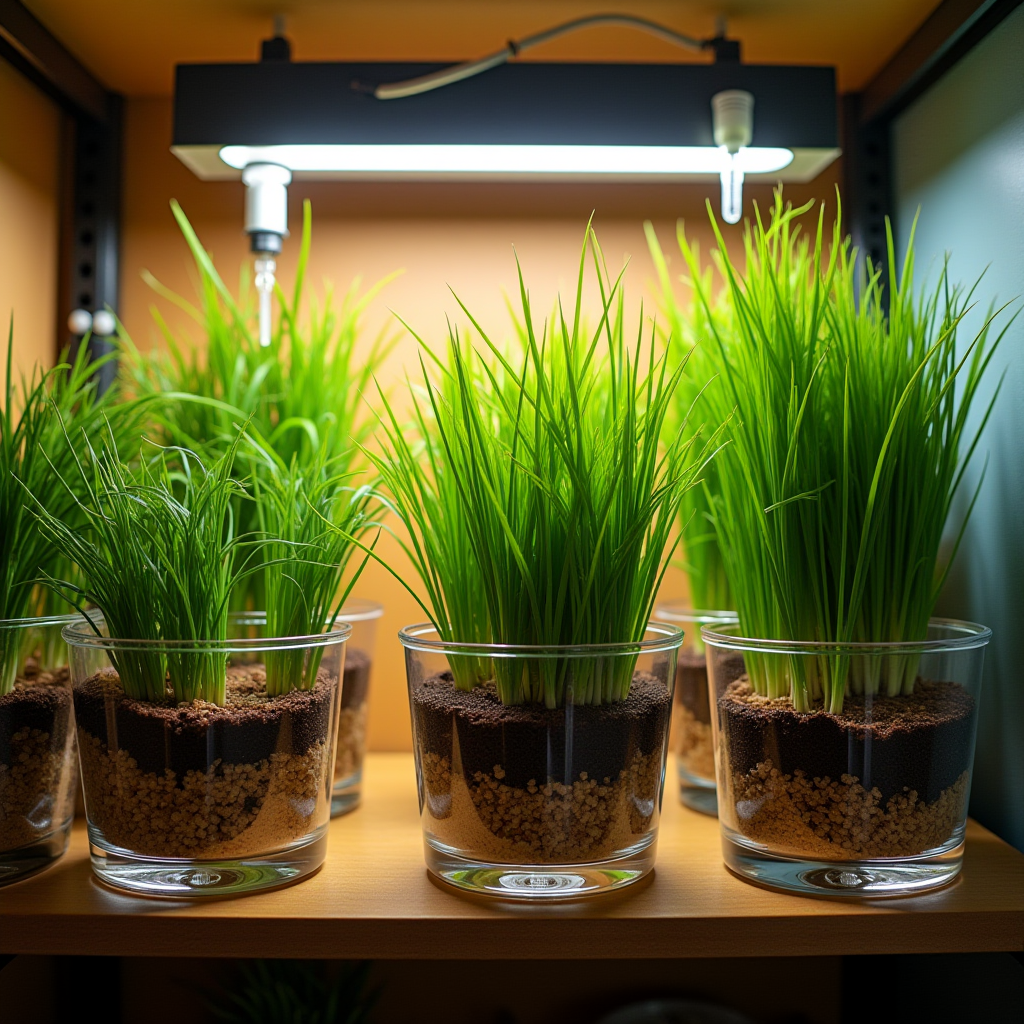
For hydroponic ornamental grasses in planters and wall modules, coco-perlite blends are the sweet spot.
- Standard mix by volume: 60–70% rinsed, buffered coco coir + 30–40% coarse perlite.
- For heavy displays: Add 10–20% LECA (expanded clay) for structure and faster drainage.
This gives you:
- Enough water-holding to buffer between irrigation cycles.
- Aeration to stop dense grass roots from suffocating.
- Low organic fines, so you keep algae and fungus gnats down compared with soil mixes.
Avoid pure soil or peat-heavy mixes. They compact, saturate, and load your trays with organic matter.
3. Dial in drip systems for ornamental grasses
For indoor troughs, linear planters, and grass strips, top-feed drip over coco-perlite is usually the most controllable option.
Emitter sizing and layout:
- Use 2–4 L/h (0.5–1 gph) pressure-compensating drippers per clump or per 15–20 cm of linear planting.
- Place at least two emitters for wider clumps so the whole root zone wets evenly.
- Run lines where they are accessible for flushing and replacement, not buried under a solid mat of foliage.
Starting irrigation schedule (coco-perlite):
- Low/medium light (PPFD 100–200 µmol/m²/s): 2–3 short irrigations per day, aiming for 10–15% runoff.
- Medium/high light (PPFD 200–350 µmol/m²/s): 3–6 irrigations per day, still targeting 10–20% runoff.
- Each event: long enough to fully saturate media without flooding the tray surface.
Check runoff EC weekly. If runoff is more than 0.3–0.4 mS/cm higher than the reservoir, increase flush volume or frequency to avoid salt crusting.
4. EC and pH targets for indoor ornamental grasses
In small indoor systems, you get better long-term results by running ornamental grasses lean and stable rather than pushing maximum growth.
- Young plants / fresh divisions: EC 0.8–1.2 mS/cm.
- Established indoor displays: EC 1.4–1.8 mS/cm as a baseline, up to ~2.0–2.2 if plants are under strong light with good airflow and show no burn.
- pH: keep solution at 5.5–6.2, allowing natural drift between 5.5 and 6.3.
Use any stable vegetative or “all-purpose” hydroponic nutrient. Grasses are foliage crops: they want steady nitrogen, adequate potassium, and full micronutrients for clean color.
Monitoring routine:
- Check EC and pH at least twice a week in offices and homes, daily in dense walls or large displays.
- Top off with plain water, then re-adjust nutrients to target EC.
- Replace reservoirs every 1–3 weeks depending on stability and plant load.
5. Light and VPD: treat grasses like fast foliage, not low-light houseplants
Most interior grasses fail because they are under-lit, especially once you remove soil buffering and put them on hydro rails.
PPFD and DLI targets at canopy:
- Shade-tolerant sedges / low-light grasses: 100–200 µmol/m²/s, 12–14 hours/day (DLI ~4–10 mol/m²/day).
- General ornamental grasses for lobbies, bright offices: 200–350 µmol/m²/s, 14–16 hours/day (DLI ~10–20).
- High-energy displays with strong LEDs: up to ~400–500 µmol/m²/s if VPD and nutrients are dialed in.
Use full-spectrum white or horticultural LEDs (around 4000–5000 K) so the plants look natural and occupants actually enjoy the space.
VPD bands:
- Vegetative comfort zone: 0.8–1.2 kPa.
- At 22–25 °C, that typically means 50–65% RH.
- New installs or stressed plants: run closer to 0.6–0.8 kPa (slightly higher humidity or lower temperature).
Combine oscillating fans with your wall or troughs so foliage moves gently. That is not just aesthetic; it keeps leaves dry, reduces fungal pressure, and supports good gas exchange.
Long-term maintenance: divisions, pruning, root management & algae control
1. Root management in drip and ebb & flow systems
Assume that grasses and sedges will eventually fill whatever container or panel you give them. Design with that in mind:
- Planters & troughs: use removable inserts or net pots in rails so you can lift clumps for division without dismantling plumbing.
- Ebb and flow tables: keep pots in trays rather than planting directly into the tray bed. That way you can manage individual clumps and prevent roots from forming a solid mat over drains.
- Grass walls: choose modular cassettes; set up a rotation schedule where a portion of modules come out each season for division and cleaning.
Division schedule:
- Compact grasses: every 12–24 months indoors, depending on vigor and pot size.
- Fast sedges and wetland grasses in DWC or high-nutrient systems: sometimes yearly or even every 9–12 months in high-light walls.
When roots start growing out of drain holes or you notice persistent slow drainage or “sour” smells, you are overdue for division.
2. Shearing and grooming for tidy displays
Hydro-fed grasses can stay evergreen indoors, which is great for aesthetics but can lead to old and new foliage mixing into a messy canopy. Build shearing into your calendar.
- Light grooming: monthly removal of brown tips and dry blades using sharp scissors; this keeps edges crisp and reduces hiding places for pests.
- Hard shear: once or twice a year, cut clumps back to 1/3–1/2 their height. Do this when systems are stable and you can give a week or two of gentle conditions (slightly lower light and VPD) to help regrowth.
After hard shearing:
- Flush system with fresh, slightly weaker nutrient solution (EC around 1.0–1.2 mS/cm) for 7–10 days.
- Keep pH tight (5.6–5.9) to maximize micronutrient availability during the regrowth flush.
3. Keeping algae and pests out of hydro grass installs
Most interior pest and algae problems on hydro grass systems start where nutrient solution meets light and organic debris.
To control algae:
- Block light from nutrient surfaces with lids, blackout film, or opaque covers.
- Use clean, low-fines media like coco-perlite and LECA rather than composted blends.
- Design trays with full drain and no stagnant pockets.
To limit pests (aphids, mites, fungus gnats):
- Keep foliage dry overnight by ending irrigation several hours before lights-off.
- Vacuum or remove dead foliage from crown areas regularly.
- Use yellow sticky cards discreetly in troughs and behind grass walls to monitor early populations.
4. System-specific notes: Kratky, DWC, drip, ebb & flow
Kratky for grasses:
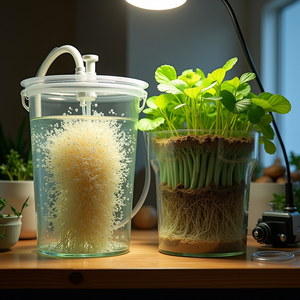
- Use only for small, decorative clumps in jars or table-top containers.
- Expect to top up solution more often than you would with herbs because grasses drink hard when established.
- Keep solution depth modest so you maintain a good air gap as roots thicken.
DWC for sedges and rushes:
- Aim for strong aeration (multiple air stones or diffuse aeration under each cluster).
- Partition large reservoirs so each clump has its own bay; this prevents one massive root mat from taking over the whole tank.
- Run EC on the lower side of the range (1.2–1.6) and scrub biofilm every 2–4 weeks.
Ebb & flow for benches and linear displays:
- Set flood height so that the top 1–2 cm of media stays drier; this reduces algae and fungus gnats.
- Flood 1–4 times per day depending on media mix, pot size, and environment.
- Test your drain time: trays should drain completely within a few minutes, not sit in shallow standing water.
Drip on coco-perlite: this is usually the lowest maintenance option for offices and homes if you keep emitters accessible and filter your nutrient solution to avoid clogs.
5. Designing hydro grass walls for biophilic spaces
For vertical grass features, aim for a system that balances aesthetics, plant health, and serviceability.
- Use modular cassettes or troughs rather than monolithic panels; you want to swap out sections for division and deep cleaning.
- Design plumbing with top-feed drip lines and bottom collection trays feeding a central reservoir.
- Consider two irrigation zones: an upper zone and a lower zone, to compensate for different evaporation rates.
- Mount LED bars or track fixtures at a shallow angle to the wall for even PPFD across the surface.
For offices, aim for a system that a facilities team can maintain with weekly checks and quarterly deeper cycles, not something that needs daily intervention by a specialist.
Benchmarks & quick reference for indoor hydro ornamental grasses
- Media: 60–70% coco + 30–40% perlite, with optional 10–20% LECA for structure.
- Systems: drip or ebb & flow for most displays; DWC for wetland sedges/rushes; Kratky only for small, decorative containers.
- EC: 0.8–1.2 mS/cm for young plants; 1.4–1.8 (up to 2.0–2.2) mS/cm for established clumps under strong light.
- pH: 5.5–6.2, checked at least weekly and adjusted in small steps.
- Light: 100–200 µmol/m²/s for tolerant sedges; 200–350 µmol/m²/s for most ornamental grasses; 12–16 hours/day.
- VPD: 0.8–1.2 kPa; typically 50–65% RH at 22–25 °C.
- Irrigation (coco-perlite drip): 2–6 events/day with 10–20% runoff, tuned by light and pot size.
- Maintenance: light grooming monthly; hard shear 1–2 times per year; divide clumps every 12–24 months.
- Algae & pests: block light from nutrient surfaces, keep crowns clean, ensure airflow and dry foliage overnight.
If you treat ornamental grasses and sedges as high-speed foliage crops instead of passive decor, hydroponic systems can carry them cleanly for years indoors. Get the PPFD, VPD, EC, pH, and substrate right, and the rest of the work becomes predictable: scheduled shears, planned divisions, and quick checks instead of messy emergencies.
As an Amazon Associate, I earn from qualifying purchases.