Hydroponic Lettuce Lighting: How to Tune Spectrum, DLI, and Photoperiod to Stop Leggy, Bitter Greens
If your Kratky lettuce tastes like sadness and bitterness, it is not the variety - it is your lighting screaming for a tune-up.
Dynamic greenhouse LEDs are in the headlines with spectrum shifting, sunrise simulations, and far-red tricks. The good news: you do not need a six-figure climate computer to fix leggy, bitter hydroponic lettuce at home. You just need to understand three things and apply them ruthlessly:
- Spectrum: blue:red balance (plus how to handle far-red)
- DLI: daily light integral - how much light your crop actually gets per day
- Photoperiod: how long the lights are on, and how you ramp them
Whether you are running budget blurple fixtures over a Kratky tote, a DIY DWC bucket, or a tidy balcony NFT rail, dialing in these three knobs is how you tighten internodes, reduce tipburn, and get lettuce that tastes like lettuce, not resentment.
The Problem: Leggy, Bitter, Tipburned Lettuce Under "Good Enough" LEDs
Most home hydro growers buy a light, hang it, set a 16-hour timer, and hope for the best. Then the plants tell the truth:
- Stretched, floppy heads that fall over when you lift the lid
- Loose, open rosettes instead of tight, crisp butterheads
- Tipburn - brown, crispy edges on the youngest leaves
- Leaves that look fine but taste aggressively bitter, especially in warm rooms
In Kratky, DWC, and small NFT systems, lighting mistakes show up fast because nutrients and water are abundant. The plants can grow quickly, but if the light is wrong, they grow poorly: tall, weak, and chemically stressed.
Common real-world patterns I see:
- Budget LED panels too far away: PPFD (light intensity) is low, so plants stretch to chase photons.
- Cheap "full spectrum" lights heavy on red, short on blue: lots of biomass but elongated internodes and floppy leaves.
- All-at-once blast of light: full intensity the moment the timer clicks on, shocking tender seedlings.
- Unlimited hours of light: 20-24 hour photoperiods trying to "make up" for weak fixtures, which just stresses plants.
The result is the lettuce version of fast food: grown quickly, looks big from a distance, but the texture and flavor are lacking, and the stress shows up as tipburn and bitterness.
The Cause: Light Quantity, Quality, and Timing Are Out of Tune
Hydroponic lettuce is basically a light-processing machine. You feed it minerals and water; light tells it what to do with them. When lettuce goes leggy or bitter under hydroponics, there are three usual lighting culprits:
1. Wrong Spectrum: Blue:Red Balance and Far-red
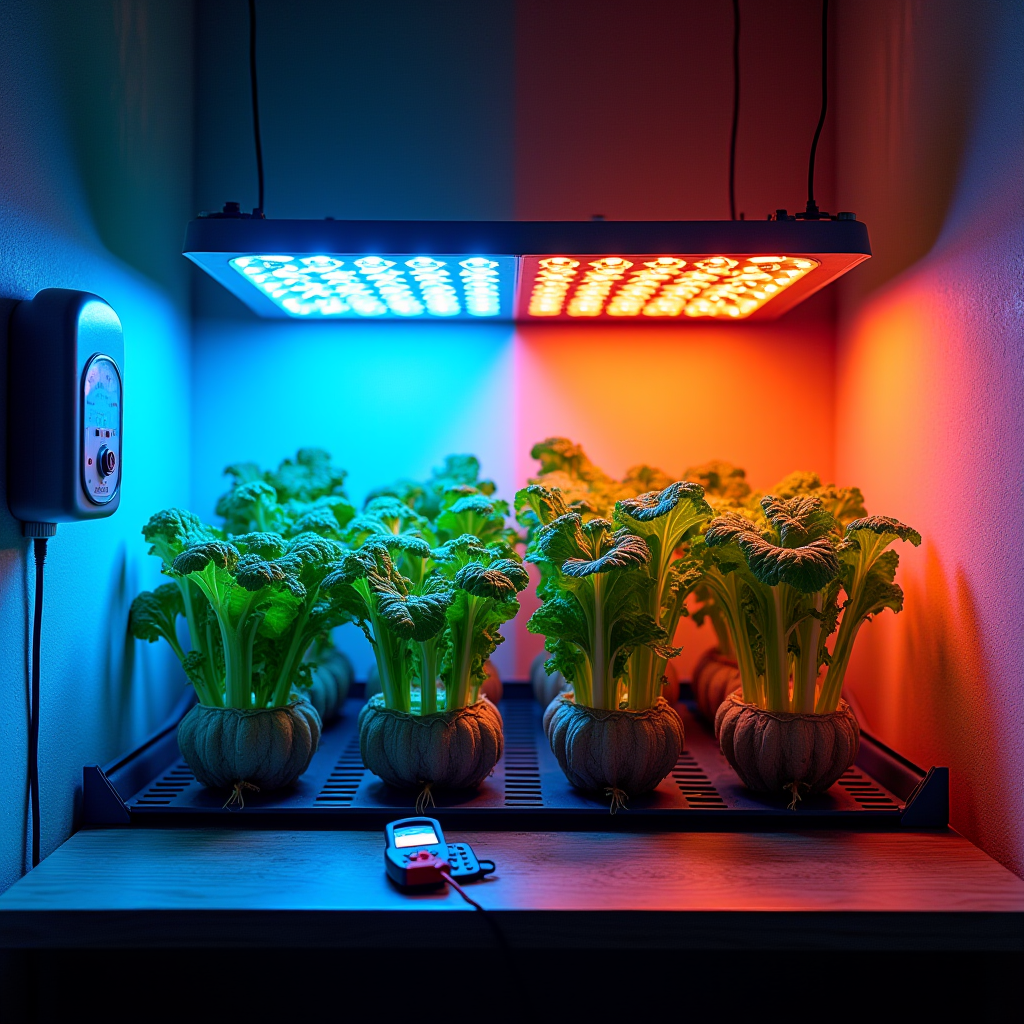
Lettuce and most leafy greens are classic veg crops. They respond strongly to blue and red light:
- Blue (around 400-500 nm): tight internodes, strong leaves, higher chlorophyll content, less stretch.
- Red (around 600-700 nm): drives photosynthesis and biomass, but too much red relative to blue can elongate stems.
Research and commercial greenhouse practice both favor a blue-enriched spectrum for compact leafy greens. Full-spectrum white LEDs that include a solid blue component and some green (for canopy penetration) are ideal, especially when balanced with modest red output as noted in this greenhouse LED guide.
Far-red (700-750 nm) is the wild card. It influences shade-avoidance responses and leaf expansion. Used carefully, far-red can help shape leaves and canopy. Overused, especially without enough blue, it tells the plant it is shaded and needs to stretch to survive. That is leggy lettuce in one sentence.
2. Wrong DLI: Not Enough (Or Way Too Much) Daily Light
Daily Light Integral (DLI) is the total number of photosynthetically active photons hitting a square meter of canopy in a day, measured in mol·m−2·day−1. It is how commercial growers size lights and timing. Home growers rarely think about it, but it is the missing link between "hours of light" and "intensity".
- Research on indoor, vertical hydroponic lettuce has found an optimal DLI around 11.5 mol·m−2·day−1 for iceberg in controlled conditions, balancing yield and energy use as shown in this study.
- Buttercrunch and similar leafy types often perform best around 14-17 mol·m−2·day−1, according to practical grower data summarized in this DLI chart.
If your DLI is too low, lettuce stretches, stays flimsy, and never really fills out. If it is too high for your temperature and nutrition, you get light stress, tipburn, and sometimes tougher, more bitter leaves.
3. Clumsy Photoperiod: Hammering Plants With Light
Photoperiod is simply how many hours per day the lights are on, but how you deliver those hours matters.
- Lettuce usually thrives in a 14-18 hour photoperiod under LEDs when intensity is reasonable, as outlined in this photoperiod and DLI overview.
- Short photoperiod + weak light = plants stretch trying to reach target DLI and never get there.
- Very long photoperiod (20-24 hours) is rarely necessary and can increase stress and respiration losses, as noted in practical lighting guides like this LED duration article.
Finally, the on/off pattern matters. Greenhouse LED systems now use sunrise/sunset dimming to ease plants into higher intensities and manage plant temperature swings. Home growers with simple on/off timers blast seedlings at full power the second the timer clicks, which can shock young leaves and exacerbate stress.

The Solution: Practical Lighting Tweaks For Kratky, DWC, And Balcony Systems
Let us turn the greenhouse tricks into home-grower steps you can implement with whatever light you already own.
Step 1: Hit A Reasonable DLI For Lettuce
You do not need to obsess over decimals, but you must be in the ballpark. For most indoor hydroponic lettuce:
- Target DLI: 12-16 mol·m−2·day−1 for leafy lettuces and herbs.
- Seedlings (first 7-10 days after emergence): start lower, around 8-10 mol·m−2·day−1 to avoid stress, then ramp up.
If you can measure PPFD with a meter or a decent app, use a DLI calculator to match your light intensity and photoperiod. If you cannot, use distance and plant feedback:
- Start lettuce with your LED higher than you think (to reduce intensity) for the first week, then bring it closer in small steps every few days.
- Watch for stretch (move light closer) and leaf curl/bleaching (raise the light or shorten hours).
Step 2: Use Spectrum To Tighten Growth
You may not have tunable channels, but you can still influence spectrum:
- If you are using old-school "blurple" with massive red and minimal blue, hang it a bit closer but shorten the photoperiod so DLI stays reasonable and stretch is limited.
- If you are buying new, favor full-spectrum white LEDs with decent blue content (often 4000-5000 K) for compact, leafy growth as suggested in practical greenhouse lighting resources like this guide.
- Avoid excessive far-red for lettuce unless you know what you are doing. If your light has a separate far-red channel, keep it modest (for example 10-15 minutes at low power at lights-off to test effects) and watch for stretch.
For mixed beds (lettuce plus basil, cilantro, or chives), a blue-leaning full spectrum strikes a nice compromise: tight lettuce, flavorful herbs.
Step 3: Fake Sunrise/Sunset Even With a Dumb Fixture
Dynamic greenhouse LEDs gently ramp intensity; you can copy the principle with simple tools:
- Use a dimmer (inline dimmer or controller) if your light supports it. Run the first and last hour of the photoperiod at lower intensity.
- No dimmer? Try a two-distance schedule: for the first 1-2 hours, hang the light higher; after that, lower it closer to the canopy.
- Alternatively, run staggered timers if you have multiple bars or fixtures: one comes on first, the second comes on 30-60 minutes later.
This softens the morning shock, reduces condensation bursts on leaves, and tends to calm tipburn in fast-growing DWC lettuce where roots are never short on nutrients.
Step 4: Pick Smart Photoperiods For Your System
Tie your lighting schedule to your hydroponic setup:
- Kratky on a windowsill or balcony: combine natural light with 6-10 hours of supplemental LED in the morning or evening to hit the DLI target without overheating. Let ambient light do some work.
- Indoor DWC or NFT in a tent: 14-18 hours on, 6-10 hours off works well. Start plants at 14 hours and increase only if they are compact but a bit slow.
- Warm rooms (above 24 °C): lean to the lower end of the photoperiod and DLI range. Excess light plus heat drives respiration and can worsen bitterness.
Step 5: Pair Lighting With Basic Climate Control
Light drives temperature and transpiration. To keep flavor and texture under control:
- Keep leaf zone temperatures around 18-22 °C for lettuce where possible.
- Use a clip fan to move air across the canopy. This helps prevent localized overheating under intense LEDs and reduces tipburn.
- If your tap water is warm, cool your nutrient solution a bit - high light plus hot roots is a recipe for stress in DWC.
The Evidence: What Research And Commercial Practice Tell Us
We do not have to guess here. Commercial plant factories and greenhouse operations have been beating on this problem for years, and the lessons translate perfectly to home Kratky and DWC tubs.
DLI Targets For Lettuce
- A recent controlled-environment study on indoor iceberg lettuce in a vertical hydroponic system identified an optimal DLI of about 11.5 mol·m−2·day−1 to maximize photon use efficiency without wasting power or stressing plants, as reported in this paper.
- Grower-focused references like this DLI guide suggest butterhead types perform best between 14 and 17 mol·m−2·day−1, which aligns with greenhouse practice.
Translated to home systems: if you are providing weak intensity for a long time or blasting high intensity for a short window, you are likely outside this sweet spot. That mismatch shows up as stretch, tipburn, or slow, compact growth.
Photoperiod and Intensity Work Together
Commercial lettuce trials make it clear that photoperiod cannot be divorced from intensity. Work summarized in this article highlights that lettuce can tolerate longer photoperiods as long as intensity is moderate and DLI is appropriate. Too intense for too many hours, and leaves hit a photosynthetic ceiling and start to suffer; not enough intensity, and even long days will not hit the target DLI.
Indoor LED guides like this practical piece also warn that very long photoperiods mainly inflate electricity costs once plants are already light-saturated for the day.
Spectrum And Plant Form
Professional greenhouse LED resources, such as this grower guide, repeatedly emphasize that blue-enriched spectra favor compact, high-quality leafy greens. Red-heavy or excessive far-red drives shade-avoidance responses: longer stems, looser heads, and changes in leaf thickness and color. These responses scale down perfectly to your 20 liter Kratky box or 4-site DWC bucket.
Combine that with the DLI and photoperiod data, and the playbook is straightforward:
- Give lettuce the right amount of light per day, not just "more".
- Use blue-rich spectra for compact, crunchy leaves and minimal stretch.
- Run moderate photoperiods instead of maxing out hours, especially in warm rooms.
- Smooth out on/off transitions to reduce stress and tipburn, even with simple timers and non-dimmable fixtures.
If your hydroponic nutrients and pH are in the standard lettuce range (pH roughly 5.8-6.2, EC roughly 1.0-1.6 mS/cm) and you are still fighting leggy, bitter plants, odds are your light tuning - not your solution - is the real bottleneck.
Start treating your lights like your nutrient mix: something to measure, tune, and adjust on purpose. When spectrum, DLI, and photoperiod are aligned with what lettuce actually wants, even a cheap fixture over a Kratky box can produce compact, sweet, salad-bar-quality heads on repeat.
As an Amazon Associate, I earn from qualifying purchases.