Hydroponic Cotton That Actually Works: Greenhouse Design, Nutrients, Pollination, and Yield Targets (2026 Europe Playbook)
"Hydroponic cotton is just a tech demo; you can't get real fiber or real yields." That belief is already outdated.
With projects like Portugal’s hydroponic cotton initiative pushing to build a full in-Europe value chain, cotton is moving from novelty crop to serious diversification play for controlled environment growers. If you already run leafy greens or vine crops under glass, you can repurpose a lot of that infrastructure for fiber production, avoid food-safety overhead, and plug into a very different set of buyers.
This playbook focuses on one thing: making hydroponic cotton commercially realistic in European-style greenhouses and indoor farms by 2026. We’ll walk through how to avoid the big mistakes around greenhouse design, nutrient and EC/pH management, irrigation strategy, trellising and pruning, pollination, humidity control for boll formation, and IPM for whitefly and thrips. You should finish with enough clarity to design a pilot block, set yield targets per square meter, and talk credibly with potential spinning or ginning partners.
1. Common mistakes when growers shift to hydroponic cotton
Most failures I see are not about cotton being a bad hydroponic crop. They’re about people treating it like a big basil plant or a short tomato and missing key fiber-crop physiology.
1.1 Treating cotton like a leafy green or tomato
Cotton is a long-cycle, determinate-ish fiber crop with a distinct vegetative, squaring, flowering, and boll fill phase. In soil, that runs 150-180 days; in hydroponics under optimized conditions, you can compress the cycle by roughly two weeks compared with soil, particularly in deep water culture (DWC) or similar systems as noted in this review.
Common missteps:
- Running “lettuce EC” (1.2-1.6 mS/cm) for a heavy-feeding fiber crop that actually wants around 1.8-2.5 mS/cm once established.
- Keeping dense canopies and high humidity that work fine in leafy systems but crush boll set and encourage disease.
- Underbuilding trellis and support, so plants flop as soon as bolls size up.
1.2 Wrong system choice or root-zone design
Hydroponic cotton will grow in most systems, but not all are equally forgiving:
- Deep Water Culture (DWC) and related deep-gutter systems: excellent vegetative vigor and good yield potential when oxygenation is solid. Studies comparing DWC and nutrient film technique (NFT) against soil show DWC significantly shortens the growth cycle while boosting biomass in greenhouse conditions here.
- NFT: viable but less tolerant of any interruption. Root mass from mature cotton is heavy; undersized channels or poor slope lead to anoxic zones.
- Kratky-style static tanks: workable for early-stage trials or educational setups, but oxygen demand and crop duration mean you are generally better off with aerated reservoirs for commercial attempts.
1.3 Missing cotton’s photoperiod and light requirements
Cotton likes long days and high light. Treating it like a 200 µmol/s/m² herb under 12-14 hours of light is a yield killer. Indoor setups that don’t deliver enough daily light integral (DLI) will still produce plants, but bolls will be fewer, lighter, and more prone to abortion.
For serious production you should be targeting at least mid-teens to low-20s mol/m²/day; in a greenhouse with solid supplemental LEDs, pushing toward 25-30 mol/m²/day is realistic and has been associated with higher productivity in hydroponic systems broadly as discussed here.
1.4 Underestimating IPM complexity (whitefly, thrips, mites)
Cotton’s anatomy and long cycle make it a magnet for common greenhouse pests. Growers coming from short-turn leafy systems often underestimate how quickly populations of whitefly and thrips can build on a crop that is sitting in the house for 5+ months. Waiting until bolls are forming to respond is usually too late.

2. Why these mistakes happen in real greenhouses
2.1 Legacy vegetable playbooks don’t translate cleanly
European CEA operators are highly optimized for food crops: rapid turns, tight irrigation steering, and food-safety-first workflows. Cotton flips some of that logic:
- Longer crop time and heavier biomass mean your root-zone volumes, trellis hardware, and transport logistics change.
- You are no longer constrained by HACCP-style food-safety rules, but you are suddenly accountable to spinners and brands on fiber quality, staple length, and color.
It is easy to assume “same house, same recipe, new crop.” That shortcut is how most hydroponic cotton trials stall at small, ornamental plants with a few bolls.
2.2 Misreading cotton’s nutritional curve
Hydroponic cotton pulls nutrients differently across its phases than leafy greens or cucumbers. Early vegetative growth appreciates moderate nitrogen and balanced K. Once squaring and flowering start, demand for potassium, calcium, and boron spikes to support boll formation and fiber development, while excessive late nitrogen pushes vegetative growth at the expense of bolls.
If you don’t track EC and drain solution composition, you will see classic issues: tip burn from Ca/B shortages, soft bolls, or outright boll drop. Hydroponics in general relies on tight control of EC, pH, and solution composition as reviewed here; cotton just makes that more obvious because fiber quality exposes any mistakes.
2.3 Incomplete environmental steering for boll set
Through squaring and flowering, cotton wants:
- Temperature: roughly 24-28 °C days, 18-22 °C nights.
- Humidity: around 55-65% RH. Higher humidity in a dense canopy drives disease and poor pollen performance; too low RH spikes VPD and stresses flowers.
- Air movement: consistent but not extreme, to dry flower surfaces and keep microclimates in check.
Most failures in boll set are not about pollen viability alone. They come from running veg-friendly humidity and low air exchange in a crop that suddenly needs more rigorous dehumidification once flowering starts.
2.4 Underestimating downstream handling needs
Even when growers manage a healthy crop, they often leave yield and quality on the table after harvest. Cotton for textiles is not “finished” at harvest. You still need:
- Defoliation or leaf removal so you are harvesting clean, trash-free bolls.
- Controlled boll opening and lint drying at stable conditions.
- Basic ginning or a partnership with a small gin or R&D spinner.
Hydroponic cotton is being positioned as a way to stabilize supply chains and improve sustainability metrics as highlighted here, but you still have to deliver lint that can be processed on standard spinning equipment.

3. How to fix it: a practical hydroponic cotton blueprint
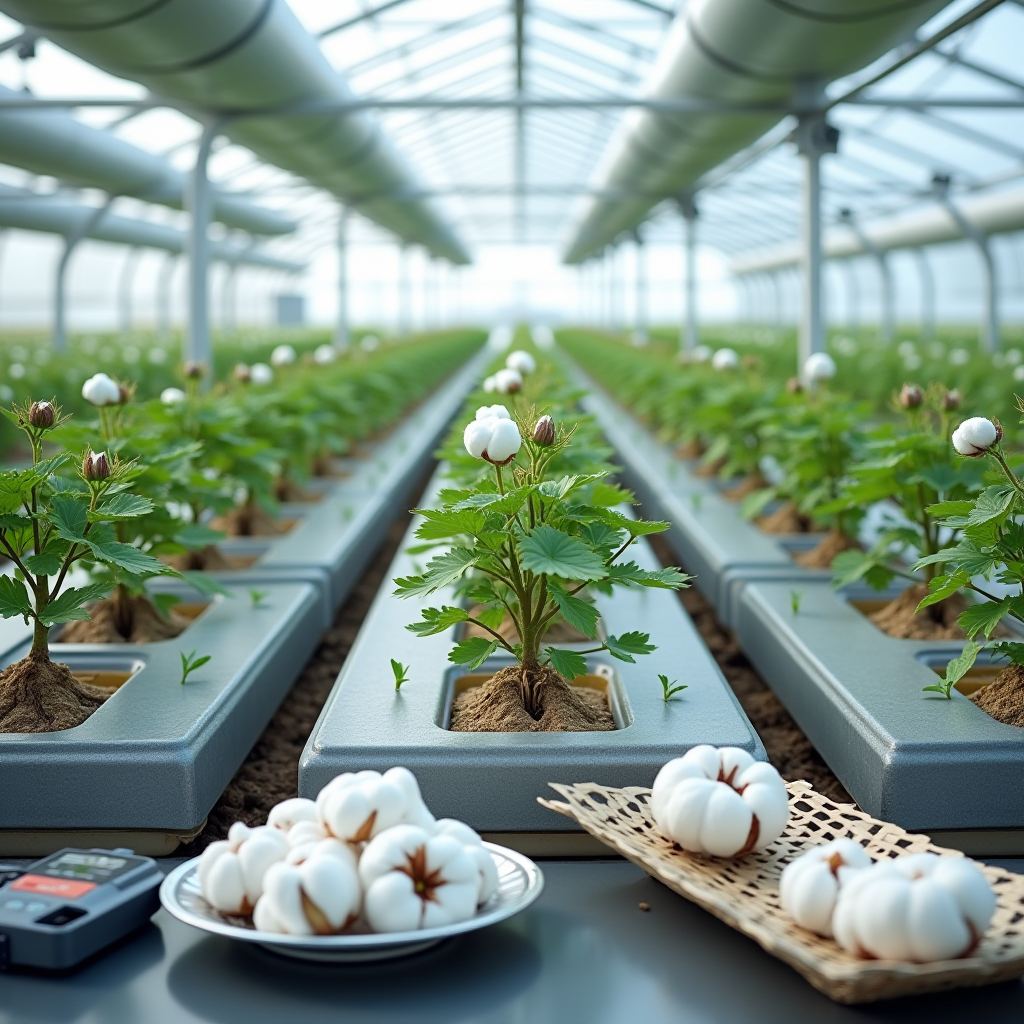
3.1 Greenhouse / indoor design for hydroponic cotton
3.1.1 Layout and spacing
- Plant density: For pilot blocks, target 4-6 plants/m² in high-wire or trellised systems, depending on cultivar vigor. Start at the low end; cotton can bush out.
- Row arrangement: 2-row gutters or benches with 80-100 cm between rows and 30-40 cm in-row spacing works for most cultivars.
- Vertical space: Aim for at least 3.5-4 m to gutter in greenhouses so you can trellis up and still maintain light uniformity.
3.1.2 Environmental setpoints by phase
Use this as a starting template and tune per cultivar and local climate:
- Vegetative (0-35 days after transplant)
- Temp: 24-27 °C day / 20-22 °C night.
- RH: 60-70% to support leaf expansion without WUE penalties.
- DLI: 18-22 mol/m²/day.
- Squaring to early flowering
- Temp: 25-28 °C day / 20-22 °C night.
- RH: steer down slowly toward 55-60% to support pollen and reduce Botrytis risk.
- DLI: 22-28 mol/m²/day.
- Boll fill and maturation
- Temp: 24-27 °C day / 18-22 °C night.
- RH: 50-55% to protect boll health and ease drying.
- DLI: 20-25 mol/m²/day.
Cotton is generally considered a day-neutral crop in modern cultivars, but a 14-16 hour photoperiod under LEDs is standard indoors to hit target DLIs. Use high-efficiency fixtures designed for dense canopies; hydroponic systems with strong lighting and tight environmental control routinely hit much higher yields per area than field systems as summarized here.
3.2 System choice and irrigation strategy
3.2.1 Recommended systems
For commercial or serious pilot work, prioritize:
- DWC or deep-gutter with strong aeration and high-volume root zone.
- Hybrid slab or bucket drip systems with inert media (coco, rockwool, or mixes) on recirculating or drain-to-waste fertigation, if you are already set up for vine crops.
NFT is feasible with deliberately oversized channels and careful root management, but it leaves less margin for error as root biomass increases.
3.2.2 Irrigation and oxygen management
- DWC: Keep dissolved oxygen above 6 mg/L. Oversize air pumps and use multiple fine-bubble diffusers per tank. Stagnant pockets in long troughs will show up as localized chlorosis and root browning.
- Drip-to-media: Run classic CEA fertigation logic: frequent, small pulses tuned to light intensity and slab weight. Keep drain EC within 10-15% of input EC to avoid salt buildup.
- Static or semi-Kratky trials: If you run passive tanks for R&D, leave a good air gap for the root zone and supplement with air stones once plants reach late vegetative stage.
3.3 Nutrient recipe, EC, and pH for hydroponic cotton
3.3.1 Core setpoints
Literature and early commercial trials converge on a nutrient solution pH of roughly 6.0-6.5 for hydroponic cotton as noted here. EC target range for most of the crop is 1.8-2.5 mS/cm, skewing lower in early veg and higher into flowering and boll fill. That fits within the broader hydroponic EC control strategies described in this review.
A practical phase-based approach:
- Vegetative
- pH: 6.0-6.2.
- EC: 1.6-1.8 mS/cm.
- N:K roughly 1:1.2 with adequate Ca and Mg.
- Squaring/early flowering
- pH: 6.0-6.3.
- EC: 1.8-2.1 mS/cm.
- Increase K and Ca, keep N moderate to avoid stretch.
- Boll fill
- pH: 6.2-6.5.
- EC: 2.1-2.5 mS/cm.
- Focus on K, Ca, Mg, and boron sufficiency; avoid late heavy N.
Micronutrients should follow a standard hydroponic profile, but cotton is particularly sensitive to boron deficiency during reproductive stages. Watch for distorted or aborted squares and address quickly via foliar or root-zone correction.
3.3.2 Monitoring and correction routines
- Log pH and EC daily. Hydroponic production depends on tight control of these metrics and the use of calibrated EC and pH meters as summarized here.
- Use phosphoric or nitric acid to adjust pH down, potassium hydroxide or a similar base to adjust pH up.
- Refresh solution at least every 10-14 days in recirculating systems, or run partial dumps plus top-ups with fresh nutrient stock to prevent salt accumulation.
- Consider UV or filtration for pathogen reduction as outlined for small and medium systems in this hydroponics technology review.
3.4 Trellising, pruning, and canopy management
3.4.1 Trellis design
Cotton branches carry weight once bolls develop, so treat it closer to indeterminate vine crops than to leafy greens:
- Install overhead wire at 3-3.5 m with vertical strings or rigid frame supports.
- Train main stems vertically and support fruiting branches with light clips or mesh to prevent lodging.
- Keep alleyways clear enough for scouting and harvest carts; cotton canopy plus hardware can get tight if you overplant.
3.4.2 Pruning strategy for compact, high-yield canopies
The goal is to balance node count with air movement and manageable plant size:
- Top or pinch once early (around 5-7 true leaves) if you want bushier plants in lower-ceiling rooms; in high-wire systems you can often skip topping and rely on natural branching.
- Remove weak, interior branches that will never see full light. Each kept branch should have a realistic path to quality bolls.
- Strip lower leaves as the canopy develops to maintain airflow and reduce disease pressure.
Good trellising and pruning directly support higher boll counts per plant and more uniform maturation, which simplifies harvest and post-harvest handling.
3.5 Pollination and humidity control for boll formation
3.5.1 Pollination options
Cotton is mostly self-pollinating but benefits from movement or pollinators to maximize boll set. In a sealed or semi-sealed greenhouse or indoor farm, you have three main options:
- Managed pollinators: bumblebees are common in European greenhouses. They can help increase boll set but require careful integration with IPM and any biocontrol releases.
- Mechanical assistance: gentle vibration of trellis wires, targeted airflow from oscillating fans, or manual brushing of flowers during peak bloom.
- Mixed approach: limited pollinator colonies plus mechanical shaking during key windows.
3.5.2 Humidity and VPD during flowering
Keep RH in the 55-65% range during flowering; this supports pollen function without encouraging fungal problems. Use VPD targets similar to those used for fruiting crops, then tune based on cultivar response.
- Increase dehumidification capacity or venting around sunrise when transpiration spikes.
- Use horizontal airflow fans to prevent dead zones where RH creeps higher.
- Monitor flower and boll health closely in the first blocks to dial in your local settings.

4. What to watch long-term: yields, IPM, and downstream handling
4.1 Yield expectations and targets for 2026 pilot blocks
Hydroponic cotton is still young as a commercial crop, but early projects and reporting suggest very high yield potential per plant. Some sources describe yield improvements of up to 60x compared with conventional field production in best-case, high-tech setups, thanks to multiple harvests from a single plant and optimized conditions as reported here. Treat those numbers as marketing ceilings, not initial targets.
For serious European greenhouses running a cotton pilot in 2026, a pragmatic planning band might be:
- First-cycle target: 0.4-0.6 kg lint/m² per cycle while you are learning the crop.
- Mid-term goal: 0.8-1.2 kg lint/m² once you have cultivar selection, nutrition, and canopy management dialed in.
- Stretch goal: higher yields are possible with multi-cycle plants and aggressive optimization, but do not build your business case on marketing extremes.
Your actual lint per plant is a function of:
- Number of bolls per plant.
- Average lint weight per boll.
- Plant density per m².
This is why disciplined trellising, pruning, and pollination are not optional; they are the levers that drive your boll count and uniformity.
4.2 IPM program for whitefly, thrips, and other greenhouse pests
Because cotton holds in the house for months, IPM needs to be designed from day one, not bolted on after you see honeydew on the leaves.
- Pre-plant: clean out old crops thoroughly, sanitize gutters and tanks, and run a dry or fallow period if possible.
- Monitoring: deploy sticky cards and do systematic leaf scouting weekly. Record presence of whitefly, thrips, mites, and any secondary pests.
- Biocontrols: introduce predators and parasitoids early and in adequate numbers. Match species to your climate and pest profile.
- Chemical tools: because cotton is not a food crop, your pesticide options may be broader, but residues still matter for worker safety and any downstream handling agreements. Coordinate with buyers on accepted chemistries.
- Canopy management: pruning and defoliation strategy should support IPM by keeping canopies open and inspectable.
4.3 Defoliation, harvest, lint drying, and ginning
Field cotton relies heavily on chemical defoliants and mechanical pickers. In CEA hydroponic systems, you can run a more targeted, quality-focused process.
- Defoliation
- Begin progressive leaf removal in the weeks before planned harvest to improve light on bolls and reduce leaf trash.
- Consider using CEA-compatible defoliant chemistries only with clear guidance from agronomists and buyers, or rely on manual defoliation in smaller pilot blocks.
- Harvest
- Harvest by hand at pilot scale, selecting fully opened bolls with dry lint.
- Track harvest dates, zone, and plant ID where possible; this data will be gold when correlating fiber quality with environmental and nutrient settings.
- Lint drying and storage
- Dry lint to stable moisture content in a clean, controlled room to prevent mold and yellowing.
- Bag and label lots clearly for downstream testing.
- Ginning and spinning partnerships
- Most greenhouses will not invest in on-site ginning at pilot stage. Partner with a small gin, textile R&D center, or spinning mill willing to run trials.
- Share detailed process data with partners so they can link processing behavior to your greenhouse parameters.
The strategic prize is clear: hydroponic cotton offers a geographically flexible, climate-resilient supply option and has already been proposed in patent literature as a way to expand extra-long staple production with lower water and input use as described here.
4.4 Data and iteration: turning pilots into a viable program
Finally, treat your first hydroponic cotton blocks like R&D, not like guaranteed cash-flow crops. Capture:
- Environmental logs: temp, RH, CO₂, DLI, photoperiod.
- Nutrient data: EC, pH, solution recipes and adjustment history.
- Plant metrics: flowering onset, nodes, boll counts, plant height, any physiological disorders.
- Yield and quality: lint per m², staple length, micronaire, color grade, and any spinner feedback.
Combine that with the sustainability benefits of hydroponic systems - including large water savings and high yield per area highlighted in hydroponic reviews like this one - and you have a compelling story for brands and investors looking to localize textile supply chains in Europe.
As an Amazon Associate, I earn from qualifying purchases.