Humanoid Robots in Hydroponic CEA: How to Retrofit Layouts, Meet Safety Codes, and Prove ROI
The Myth: “Our Greenhouse Isn’t Ready For Robots Yet”
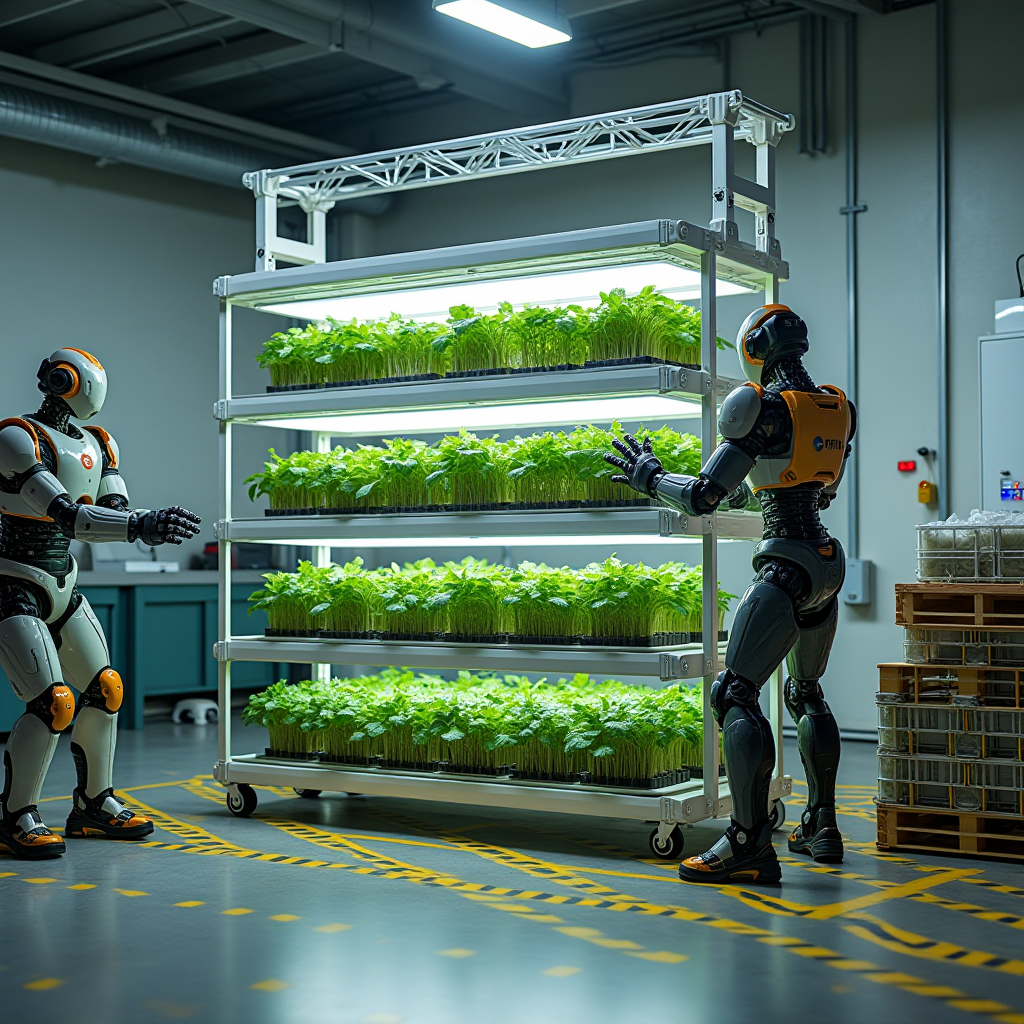
Most hydroponic growers think humanoid robots are a “next decade” problem. Layout is too tight, tasks are too fiddly, and safety rules feel like a legal minefield. So when news like Agroz launching a humanoid robotics program for controlled-environment farming hits the headlines, it feels interesting, but not actionable for this season’s transplant and harvest cycle.Agroz’s humanoid program is the signal that this mindset is now outdated. Labor pressure and repetitive-task bottlenecks are not going away. If you want to pilot humanoid robots in 2026, you need to start designing for them in 2025.
This guide is about exactly that: a practical, grower-first roadmap to retrofit hydroponic greenhouses and vertical farms so humanoid robots can transplant, trellis, harvest, and clean safely, while you can prove ROI instead of gambling CapEx.
1. Common Mistakes Growers Make When Thinking About Humanoid Robots
Mistake 1: Treating humanoids as “sci-fi” instead of near-term labor
Humanoid platforms are already moving from pilot demos to paid deployments in logistics and manufacturing, and now into CEA as groups like Agroz start structured programs in real farms.Recent coverage shows the focus is shifting to practical tasks, not research toys. If you wait until robots are “standard,” you will be retrofitting under time pressure and on vendor terms.
Mistake 2: Assuming your current layout “will work because robots are humanoid”
Yes, humanoids roughly match human size, but your facility is probably optimized for the minimum aisle width and ergonomic range your crew tolerates, not what a learning control stack and on-board sensors need. Common layout issues:
- Aisles narrower than 0.9 m between NFT tables or DWC rafts.
- Multi-tier vertical racks with mixed bench heights and awkward reach zones.
- Drainage channels, sump covers, or hose runs that are ankle traps for bipedal machines.
Mistake 3: Ignoring safety standards until a robot vendor “handles it”
Humanoid robot safety is not just a checkbox on the robot spec sheet. Standards like ISO 12100 for machinery safety and ANSI/RIA R15.06 for industrial robots expect system-level thinking: E-stop circuits, lockout/tagout, hazard zoning, and guarding that involve your layout, not just the robot.Industrial robot safety guidance applies here, even if the robot looks “friendly.”
Mistake 4: Picking the wrong tasks as your first use case
Growers often jump straight to full harvest automation. In practice, early humanoid deployments win on repetitive, structured, and ergonomically ugly tasks:
- Transplanting plugs into NFT channels or DWC rafts.
- Trellising vine crops along wires or clips.
- Leaf pruning and lower defoliation in tomato or cucumber rows.
- Sanitation: wiping contact surfaces, changing sticky cards, sweeping and mopping aisles.
High-value, delicate harvest (for example cluster tomatoes or specialty greens) is possible, but the tolerance for bruising and misses is tighter. Start where variability is low and human staff already dislike the work.
Mistake 5: No ROI model, just “we’ll save labor”
Robotics pilots that cannot show a simple, credible ROI get frozen after the first year of CapEx. If you are not tracking baseline labor hours per task, cycle times, and error/reject rates now, you will not be able to prove value when a robot joins the crew.
2. Why These Mistakes Happen: Reality Of Hydroponic Operations
Your facility was built for people, not sensors
Most hydroponic CEA sites developed in the last decade were driven by lighting, airflow, and nutrient management decisions, not robotics. As noted in recent CEA coverage on advancing soilless production, investment has gone heavily into substrate and system innovation. That means your infrastructure likely has:
- Reflective film and wet floors that confuse LiDAR and vision sensors.
- Low-mounted irrigation manifolds, hoses, and dosing lines intruding into aisles.
- Drainage slopes and trench grates that are fine for boots, risky for bipedal gaits.
Humanoid robots can navigate human environments, but they need cleaner, more predictable geometry and traction than a human does to maintain safety margins.
Safety standards are written in “robot language,” not grower language
Standards such as ISO 12100 (machinery safety) and ANSI/RIA R15.06 (industrial robots) describe risk in terms of power, force, and safeguarding performance levels, not “trellising cucumbers in a wet aisle.” New guidance on humanoid safety calls for even more context awareness and functional safety layers.Functional safety overviews highlight that the facility owner shares responsibility for risk reduction, not only the robot manufacturer.
That gap makes it easy for growers to underestimate the amount of work needed on emergency stop (E-stop) locations, lockout/tagout procedures, and hazard zoning around tasks like high-reach trellising.
Hydroponic workflows are variable and seasonal
Automation thrives on repeatability. Hydroponic operations are often structured but not always consistent:
- Different density and spacing between crops (for example baby leaf vs fruiting crops).
- Seasonal changes in crop mix or cultivar sizing.
- Manual workarounds during pH/EC issues, disease events, or equipment failures.
Without standard operating procedures (SOPs) pinned down, it is hard to pick a stable target for humanoid automation.
Robotics ROI has been fuzzy in agriculture
Many past ag-tech pitches relied on optimistic yield gains or theoretical labor savings. Now investors and growers want clear, measurable outcomes. Recent humanoid analyses stress that crossing from concept to commercial reality requires “bridges” in usability, reliability, and economics.McKinsey’s report on humanoid robots points out that pilots must be grounded in meaningful KPIs, not novelty.
3. How To Fix It: Retrofits, Safety, Navigation, And Task Selection
Step 1: Decide which hydroponic tasks are robot-viable now
Focus on tasks with clear rules, stable geometry, and a high share of repetitive labor. In hydroponic CEA, these usually include:
- Transplanting and rack loading
- Moving plugs from seedling trays into NFT channels, float rafts, or vertical towers.
- Loading/unloading DWC lids or media-less cups on vertical rails.
- Trellising and pruning
- Clipping leaders to fixed-height wires.
- Removing lower leaves up to a defined node count.
- Sanitation and recurring “checklist” tasks
- Surface wiping of bench edges and contact areas.
- Changing sticky traps and simple scouting waypoints.
- Floor cleaning in defined paths.
For Kratky or other low-tech setups, humanoids make sense in centralized prep and post-harvest spaces: washing containers, staging lids and net pots, or boxing product. For DWC and NFT, in-bay operations are more attractive because geometry is already fairly structured.
Step 2: Retrofit layout for humanoid-safe navigation
Aisle width targets
Most current humanoid platforms are roughly 0.5 – 0.7 m wide at the shoulders, with some lateral sway and arm motion. Give them room:
- Minimum working aisle: 1.2 m clear width between benches/racks.
- Comfortable target: 1.5 m, especially where arms need to reach both sides.
- Passing zones (humanoid + human or cart): 1.8 m at intervals.
Measure the actual clear width, not just bench spacing. Account for valve boxes, pipe brackets, and control panels that intrude into the aisle.
Bench height and reach zones
Humanoids need predictable reach just like your crew. For most today:
- Primary working height: 0.8 – 1.1 m for NFT, DWC lids, and tower access cups.
- Upper reach limit for frequent work: 1.8 – 2.0 m (trellis wires, upper towers).
- Keep frequent manipulations out of <0.4 m from floor (too low) and >2.0 m (too high).
If your current trellising or harvest lines sit much higher, consider lowering wires in future rehangs or using tool extensions so the robot stays in a stable reach envelope.
Floor traction, drainage, and thresholds
Bipedal robots are sensitive to low-friction surfaces and abrupt edge transitions.
- Use non-slip epoxy or textured coatings in robot routes, rated for wet areas.
- Keep drainage slopes mild (for example under 2%) along primary robot paths.
- Cover trench drains with flush, high-friction grates; avoid narrow slats where small feet or wheels can catch.
- Eliminate unnecessary floor obstacles: hose loops, stray buckets, cable protectors in primary routes.
Step 3: Design safety architecture around humanoids
Hazard zoning
Map the facility into zones:
- Green zones: robots and people mix with low risk (wide aisles, low forces, slow speeds).
- Yellow zones: robots operate with limited human presence, more constrained motion (trellising in close crop canopies, ladder-equivalent tasks).
- Red zones: no-go without lockout (maintenance, electrical rooms, confined pits).
For each zone, define robot speed limits, allowed tasks, and required PPE for humans. Align this with ISO 12100-style risk assessments and newer humanoid-specific guidance that emphasizes behavior-based safety layers.Behavior-based frameworks show how robots can automatically switch to safer behavior patterns in higher-risk contexts.
E-stop and lockout/tagout
ANSI/RIA-aligned systems expect that an emergency stop:
- Is easily reachable from all human work positions near the robot path.
- Removes power and stops hazardous motion immediately.
- Is wired in a safety-rated circuit, not just a network command.
For a hydroponic greenhouse or vertical farm, that usually means:
- E-stop buttons at bay entrances, packhouse doors, and major intersections.
- At least one E-stop on the robot itself, clearly labeled.
- Written lockout/tagout procedures that include the robot, charging docks, and any co-located conveyors or lifts.
Train staff that “pause” in the robot user interface is not an E-stop. It is just a controlled stop.
Step 4: Navigation in humid, reflective environments
Hydroponic CEA environments are hard for sensors: high humidity, condensation, reflective plastic, and changing light levels. Robust navigation often uses sensor fusion:
- UWB (Ultra-Wideband) anchors at fixed points for absolute positioning, immune to lighting and most reflections.
- LiDAR for 3D mapping and obstacle detection, tuned to avoid false returns from wet film where possible.
- Visual fiducials (AprilTags/ArUco markers) placed high on posts or racks, above splash and glare zones.
Plan installation points alongside your lighting and irrigation layout. You do not want to move UWB anchors every time you adjust a trellis wire or add an LED bar.
Step 5: Chemical compatibility and IP ratings
Hydroponic CEA robots must live with nutrient splash, disinfectants, and constant humidity. When evaluating humanoid platforms, look closely at:
- IP rating: IP54 is a minimum starting point for splash resistance in most greenhouses. Higher is better for vertical farms with high-pressure fogging.
- Seal materials: compatibility with common disinfectants (quats, peroxides) and nutrient residues.
- Corrosion resistance in fasteners and exposed structures.
Align cleaning procedures with what your robot can actually tolerate. Do not point a high-pressure washer at a humanoid unless the vendor explicitly allows it.

4. What To Watch Long-Term: ROI, Metrics, And Scaling
Build a simple ROI/TCO model before you sign
A realistic ROI model for humanoid CEA work should include:
- CapEx: robot unit cost, charging docks, navigation infrastructure (UWB anchors, fiducials), layout modifications.
- OpEx: maintenance, software fees, replacement parts, additional connectivity, and any incremental energy cost.
- Labor impacts:
- Direct hours removed from repetitive tasks (for example, transplanting, trellising).
- New roles (robot supervisor, maintenance) and training time.
- Yield and quality effects: more consistent trellising or pruning can improve light penetration and disease pressure, which can improve yield in hydroponic systems as seen in broader CEA innovation trends.Reports on soilless innovation often highlight how tighter control over operations can lift output.
Do not assume yield gains. Model scenarios: labor-only savings, labor plus modest yield lift, and a conservative “no yield change” baseline.
Pilot metrics that actually matter
For a 2026 pilot, track at least:
- Task completion rate: percentage of assigned tasks completed without human intervention.
- Mean time between assists: how long the robot operates before needing human help.
- Cycle time per unit: for example seconds per transplant, meters of trellis clipped per hour, or benches sanitized per shift.
- Safety events: near misses, E-stop activations, and any contact incidents.
- System uptime: percentage of scheduled operating time the robot is actually working.
Compare these against your human-only baselines. If you are not already timing tasks, start now with a simple sample study across a few weeks.
Integrate robotics with your hydroponic control stack
Humanoid deployment works best when robot data ties into your existing CEA systems:
- Push location-tagged observations of crop issues (tip burn, chlorosis, wilting) to your climate and fertigation system dashboards.
- Use robot patrols to spot leaks, clogged NFT channels, or low DO alarms in DWC zones.
- Feed back pH/EC readings from mobile probes into your nutrient management software for better spatial understanding.
The more robots contribute to decision-making, not just manual labor replacement, the stronger your long-term ROI.
Scaling from one robot to a small fleet
Once a single humanoid proves its worth in a few bays or one vertical room, scaling requires discipline:
- Standardize bays: same aisle widths, bench heights, trellis spacing, and sensor anchor positions across replicated zones.
- Template tasks: reusable task recipes for transplanting, trellising, and cleaning so you can drop a new robot into another bay without rewriting everything.
- Fleet coordination: charging schedules, traffic management in shared corridors, and priority rules for urgent tasks (for example leak checks).
Designing bays as “robot-ready modules” is the CEA equivalent of moving from custom one-off greenhouses to standardized production units.
Where humanoids fit next to other automation
Humanoids will not replace every specialized machine. In hydroponic CEA, you will likely see:
- Fixed automation: conveyors, seeders, nutrient dosing, HVAC, and irrigation control doing high-throughput, low-variability work.
- Task-specific robots: gantry harvesters or mobile scouting platforms for simple crops.
- Humanoids: filling the gaps where dexterity and flexibility matter most, especially in retrofitted facilities that were never designed for rigid automation.
Plan your investments so these layers complement each other rather than compete for the same task.

Bringing It Together: How To De-risk A 2026 Humanoid Pilot
If you want humanoid robots working in your hydroponic greenhouse or vertical farm by 2026, the work starts on paper and in tape on the floor this year. Summarize your plan like this:
- Tasks: pick two or three focused tasks (for example transplanting, trellising, sanitation) with clear SOPs.
- Layout: commit to aisle widths, bench heights, and traction improvements in at least one bay to create a “robot-ready” zone.
- Safety: design hazard zones, E-stop locations, and lockout/tagout updates before a robot ever arrives.
- Navigation: pre-plan UWB anchor and fiducial placement as part of your infrastructure, not as an afterthought.
- Metrics: start measuring human baselines now so you can show real ROI when the pilot runs.
Automation in CEA is no longer limited to lighting controllers and nutrient dosers. With humanoid robots moving from concept toward commercial deployment, the growers who invest in layout, safety, and metrics today will be the ones negotiating from strength tomorrow.
As an Amazon Associate, I earn from qualifying purchases.