Human‑Friendly Grow Lights for Indoor Hydroponics: Sunlike Spectrum, High CRI, and Night‑Safe Schedules for Lettuce & Basil (2025 Guide)
If your living room DWC looks great on Instagram but your lettuce tastes like bitterness and eye strain, it is not your basil’s fault. It is your lighting fighting both your plants and your circadian rhythm at the same time.
As more growers park Kratky jars, DWC buckets, and compact aeroponic towers in living rooms and studios for winter wellness, the rules change. Your lights are no longer hidden in a grow tent - they have to grow crisp greens, look good, and let you sleep.
This guide shows you how to use sunlike, high CRI LEDs, glare control, and night‑safe schedules to hit daily light integral (DLI) targets for lettuce and basil without wrecking your home ambiance.
The Problem: Great Plants, Awful Light For Humans
Classic blurple panels and harsh warehouse-white fixtures were designed for plants, not people. In a closed tent, that is fine. In a studio apartment, it quickly becomes a headache - literally.
- Leggy, floppy lettuce and thin basil stems even though the light “looks” bright to your eyes.
- Harsh glare bouncing off white walls, turning your couch into an interrogation chair.
- Blue-heavy light late at night that keeps your brain wired when you are trying to wind down.
- Plants shaded by room layout because the fixture is mounted for your furniture, not your canopy.
A lot of indoor growers try to fix this by simply cranking up intensity or running lights longer. That can leave you with:
- Lettuce that goes from sweet to bitter because it is stressed by too much light or heat.
- Basil getting light burn on top leaves while lower leaves stay pale.
- Family or housemates begging you to turn the grow off at 7 pm so they can actually relax.
The real frustration: you know your lettuce needs a solid DLI to be dense and crunchy, but you also want a living room that feels like a home, not a lab.

The Cause: Spectrum, CRI, And Schedules That Ignore Humans
Most hydroponic lighting mistakes in living spaces come down to three things:
- Spectrum that is great for chlorophyll but brutal for humans
- Low CRI fixtures that make plants hard to read
- Light schedules that clash with human circadian rhythm
1. Blue-heavy or narrow-band spectra
Older LED grow panels often lean heavily on deep blue and deep red peaks. They drive photosynthesis, but they also look nuclear-purple and can be visually stressful in a living room. Blue-heavy light late at night is particularly disruptive to human melatonin production and sleep quality.
By contrast, modern full spectrum or “sunlike” LEDs spread energy across the visible range and often extend gently into far red. They still hit the photosynthetically active region, but look like clean white light.
2. Low CRI: you cannot diagnose what you cannot see
CRI (Color Rendering Index) measures how accurately a light source reveals colors compared to natural daylight. Generic warehouse or old grow LEDs can sit around CRI 70-80, which makes greens muddy and subtle leaf problems hard to spot.
High CRI grow lights (90+ CRI) make your plants actually look like plants. That matters in the living room, and it also matters when you are trying to see:
- Early nitrogen deficiency as a gentle lime-green, not a grayish smear.
- Tip burn on butterhead lettuce before it spreads across the margin.
- Subtle bronzing or spotting on basil from light stress or micro deficiencies.
High CRI sunlike LEDs make this visual diagnosis easier while keeping the room’s color rendering pleasant for human eyes, as discussed in several modern LED grow reviews such as this guide.
3. Schedules that ignore plant DLI and human downtime
Lettuce and basil are both light-hungry compared to typical houseplants, but they are still compatible with a normal human day if you plan the schedule correctly.
- Lettuce typically thrives with roughly 14-16 hours of light per day in hydroponics, at a moderate intensity, to reach a suitable DLI for compact heads and leaves, as noted in this indoor lighting overview.
- Basil tends to like 14-18 hours of light for strong bushy growth and rich flavor development.
Run those hours at the wrong time - for example, blasting full intensity between 7 pm and midnight - and you get great greens at the cost of lousy sleep and a room that never feels dim and cozy.

The Solution: Sunlike LEDs, High CRI Fixtures, And Night‑Safe Schedules
Dialing in a human‑friendly hydroponic lighting setup is about combining spectrum, optics, layout, and timing. You do not need greenhouse-grade fixtures to do this. You just need to be deliberate.
1. Choose sunlike, high CRI LED grow lights
Look for fixtures that advertise:
- Full spectrum or sunlike output (often 3500-5000 K CCT) instead of classic blurple.
- CRI ≥ 90 for natural color rendering.
- Dimmable output or at least multiple intensity levels.
- Low-profile, fanless design for quiet operation in living spaces.
Full spectrum LEDs have become the default recommendation in most modern hydroponic lighting roundups, because they combine efficiency with plant performance and visual comfort, as summarized in this hydroponic lighting guide and this full spectrum LED overview.
2. Manage glare with distance, angle, and surfaces
In a living room or studio, how you mount the light matters as much as which light you buy.
- Height: For most lettuce and basil setups in DWC or Kratky jars, aim for 25-40 cm above the canopy with a modern LED bar or panel. Adjust based on manufacturer PPFD charts.
- Angle: Tilt fixtures slightly toward the plants and away from seating areas to keep diodes out of your direct line of sight.
- Surfaces: Matte, non-glossy backgrounds around the grow reduce harsh reflections. A simple matte board behind a row of jars can make a huge difference.
If your system is a compact tower or DWC tote in the corner, treat it like a floor lamp: position it so the beam throws toward a wall, not into the room.
3. Use night‑safe schedules that still hit DLI
For lettuce and basil, your goal is enough photons per day, not lights blasting whenever you happen to be home. Two human‑friendly strategies work well in most apartments:
Strategy A: Early bird cycle
- Lights on: 05:30 - 19:30 (14 hours).
- Most intensity in the morning and midday when you are naturally exposed to more light anyway.
- Lights off by typical evening wind‑down time.
Strategy B: Split intensity cycle
- High intensity block: 06:00 - 12:00.
- Dimmed evening block: 12:00 - 18:00 at 50-70% output.
- Same photoperiod, but room feels softer later in the day.
Either way, the plants see 14-16 hours of usable light, while you avoid a blast of blue-white at 10 pm. Use a basic outlet timer or the built‑in controller many LED grow lights now include, a feature that is widely recommended in modern lighting comparisons such as this guide.
4. Match intensity to system type (Kratky, DWC, aeroponics)
Your hydroponic system does not change the photons plants need, but it does change how fast they use them and how easy it is to keep up.
- Kratky jars on a shelf: Aim for moderate PPFD (150-250 µmol/m²/s) for lettuce and basil seedlings and young plants. As the jars are passive, going too high can push growth faster than your small reservoirs can buffer, meaning quicker swings in EC and pH.
- DWC totes or buckets: With constant oxygen and bigger reservoirs, you can comfortably run higher PPFD (250-350+ µmol/m²/s) for rapid growth. Monitor nutrients closely, because the plants will actually use what the light gives them.
- Compact aeroponic towers: These often place plants at multiple distances from the light. Set intensity for the top ring (closest to the fixture), then rotate plants or swap positions weekly so everyone gets a turn in the prime zone.

The Evidence: Light Ranges, Schedules, And Practical Targets
You do not need a quantum sensor to run a good living room grow, but it helps to anchor your decisions in numbers that are already working for other growers.
1. Photoperiod and DLI for lettuce and basil
Across multiple indoor grow guides, you will see broadly similar recommendations for leafy greens:
- Lettuce in hydroponics generally does best with 14-16 hours of light under moderate intensity, with a total DLI in the neighborhood of 12-17 mol/m²/day for compact, non-leggy growth. This aligns with the ranges mentioned in resources like this lighting guide and this hydroponic lighting article.
- Basil is more tolerant of high light and often responds well to similar or slightly higher DLI. Many indoor growers simply mirror their lettuce schedule and allow basil to take advantage of the extra photons.
If your fixture vendor provides PPFD maps, you can ballpark DLI:
- DLI ≈ PPFD (µmol/m²/s) × photoperiod (seconds) ÷ 1,000,000.
- Example: 220 µmol/m²/s for 14 hours → 220 × (14 × 3600) ÷ 1,000,000 ≈ 11.1 mol/m²/day.
That is right in range for crunchy hydroponic lettuce without needing to blast the room.
2. Why full spectrum, high CRI is the current standard
Recent buyer’s guides to hydroponic lighting increasingly treat full spectrum LED as the default, because it solves multiple problems at once:
- Plant performance: Full spectrum LEDs deliver usable light for photosynthesis while supporting natural morphology across veg and flowering stages, highlighted in reviews such as this LED overview.
- Efficiency: “Sunlike” LEDs still achieve significant energy savings versus old HID or fluorescent setups (often 50-70% less power draw for the same usable light output), as noted in this 2025 grow light guide.
- Human comfort: High CRI fixtures make your plants and your furniture look natural, which is critical in a living room or studio where grow lights double as ambient lighting.
3. Putting it together for real-world systems
Here is how that data translates into actual setups:
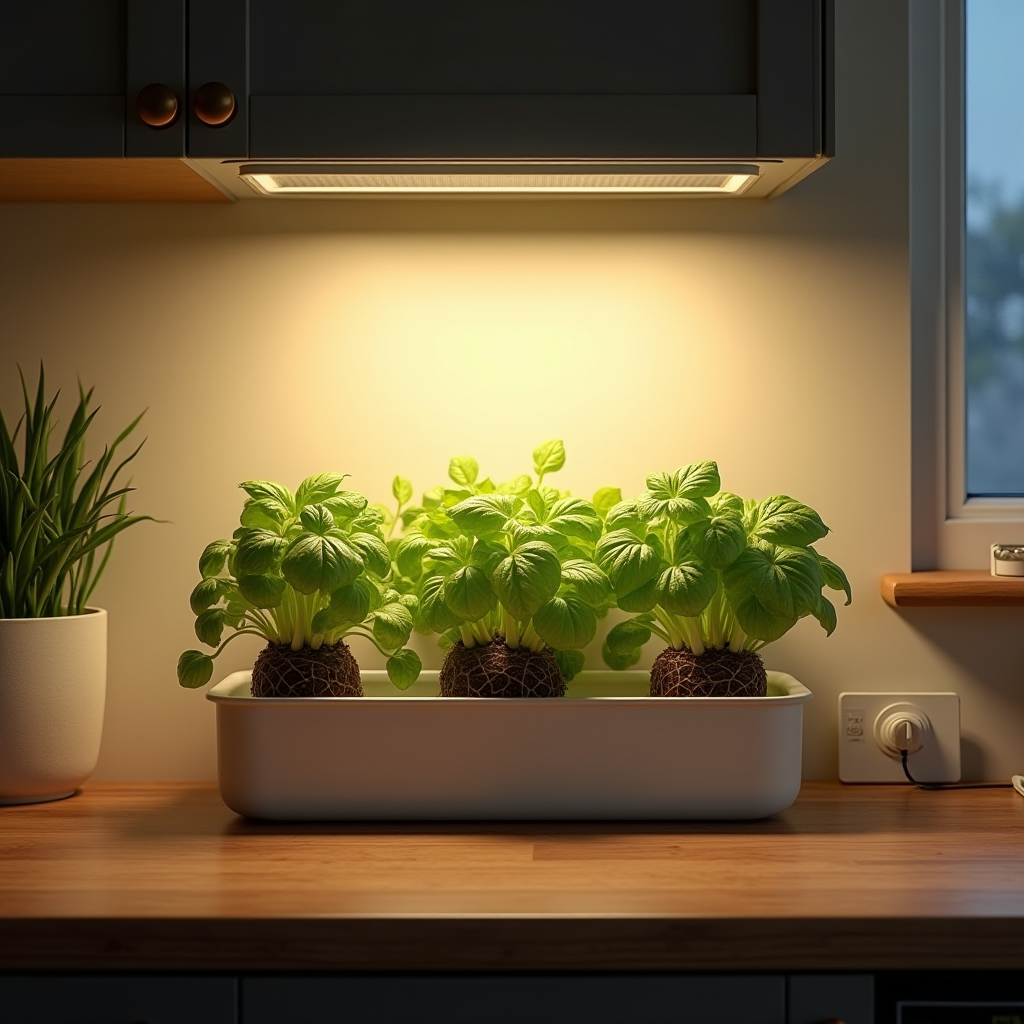
- Living room Kratky shelf: A single sunlike, high CRI LED bar or panel running 14-16 hours per day at moderate intensity, with jars arranged so every plant sees reasonably even light. Timer set to an early bird cycle so the room is dark by evening.
- DWC bucket cluster in a corner: Slightly higher intensity and similar photoperiod, with glare managed by angling the panel toward a wall and keeping the fixture high enough that diodes are never in your direct line of sight from the couch.
- Compact aeroponic tower: Full spectrum top light with integrated timer, set to a consistent 14-16 hour day. Rotate plant sites weekly so lettuce and basil take turns in the brightest upper slots.
With a sunlike, high CRI LED and a sensible schedule, you get what you actually want out of a living room hydroponic setup: dense, flavorful lettuce and basil, a calm home, and a winter garden that feels like part of your space instead of a piece of lab equipment.

As an Amazon Associate, I earn from qualifying purchases.