How Often Should You Flush LECA? An EC‑Based Semi‑Hydro/Hydroponics SOP to Prevent Salt Buildup and Root Burn
The myth: “Just flush your LECA every few weeks”
“Flush every 1–4 weeks” is the most common LECA advice online. It sounds simple. It is also the fastest way to end up with salt-crusted balls, burning root tips, and plants that stall for no obvious reason.
LECA is not soil. It does not buffer pH, it does not lock up excess salts, and it will happily hold onto whatever you pour through it. If you are not tying your flushing schedule to EC, pH, and your water source, you are guessing.
This guide turns LECA flushing into a repeatable, EC-driven SOP you can actually follow for semi-hydro houseplants and small indoor hydro systems (Kratky, passive reservoirs, and simple DWC).
1. Common LECA flushing mistakes
Mistake 1: Flushing on a calendar instead of by EC
Most people pick “every 2 weeks” or “once a month” because that is what they read in a forum. The problem: a hungry monstera in a warm, bright room might spike EC in 5 days, while a small philodendron in low light might go 3–4 weeks without any harmful buildup.
In semi-hydro, salts accumulate from three main sources:
- Concentrated nutrient solution (especially if you top up with feed instead of plain water)
- Hard, alkaline tap water that adds calcium, magnesium, and bicarbonates
- Evaporation in warm, dry rooms, which leaves dissolved minerals behind
If you ignore EC, you are blind to all three.
Mistake 2: Letting pH drift for weeks
LECA itself is fairly inert once rinsed and conditioned, but the solution in the reservoir is not. As plants feed, they selectively take up ions and excrete others. This shifts the pH. Hard water with high alkalinity will also push pH upward over time.
As noted in this guide on LECA flushing, unchecked pH drift locks out nutrients long before the plant looks obviously sick.
Mistake 3: Topping up with nutrients instead of managing concentration
A common semi-hydro routine is: water level drops, top up with more nutrient solution at the same strength. That works in recirculating systems where volume is large and monitored, but in a 300–800 ml houseplant reservoir it is a recipe for creeping EC.
Each top-up pushes concentration higher, especially as water evaporates. Eventually, roots are sitting in a strong brine while the leaves look “okay-ish” and growth quietly stalls.
Mistake 4: Ignoring dual-pot design and stagnant zones
Classic semi-hydro uses an inner pot with LECA inside an outer cache pot. If the inner pot has only a couple of side holes and no proper bottom drain, old solution can sit in the lower third of the LECA column. That pocket becomes a concentrated salt zone, even if the top layer looks fine.
Mistake 5: Treating LECA like soil when switching from tap to RO
Moving from hard tap water to RO or distilled is good for preventing salt crusts, but it is not a drop-in swap. LECA needs calcium and magnesium in solution, because the media itself does not provide them. If you move to RO and do not adjust your nutrients or add Ca/Mg, you can end up with deficiency and pH instability.
2. Why these problems happen in LECA and semi-hydro
LECA holds solution, not nutrients
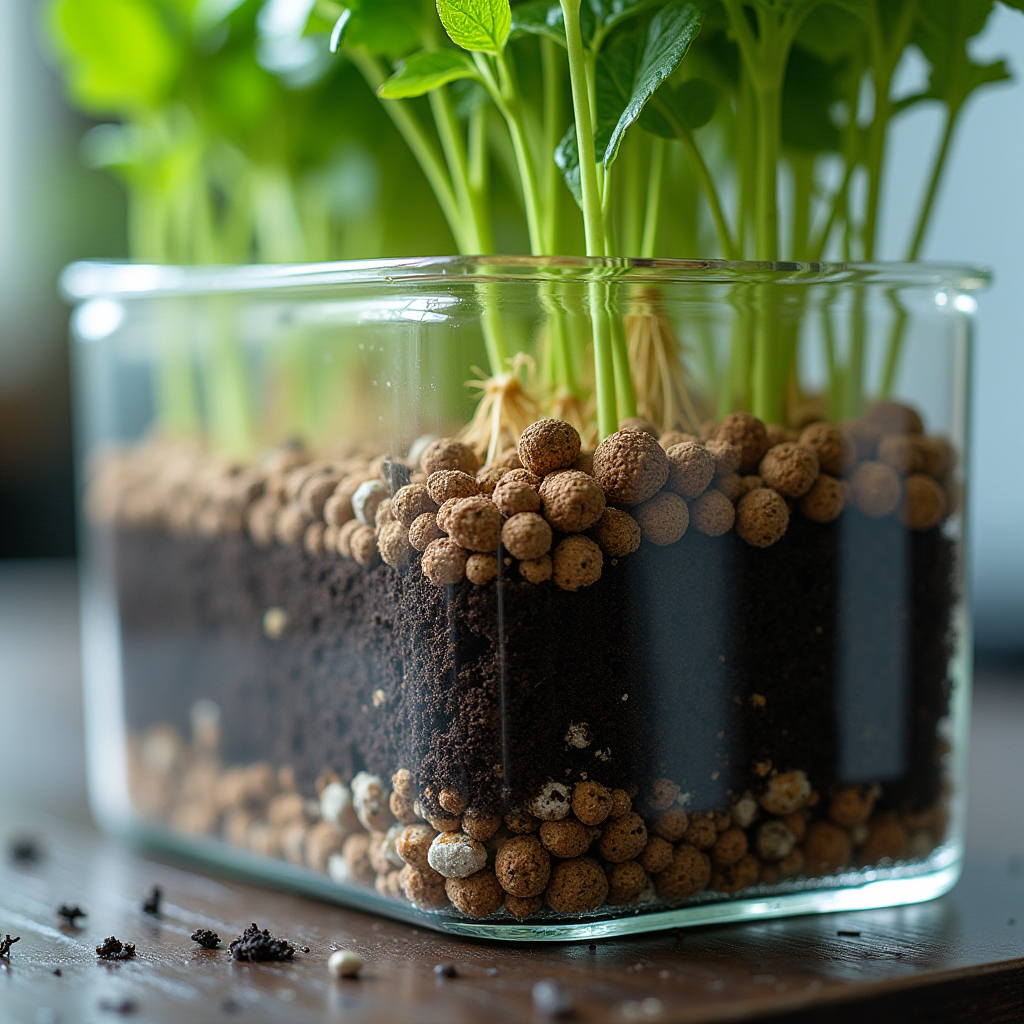
LECA is expanded clay with internal pores that hold water. It barely exchanges ions. That is good for transparency and control, but it also means:
- Whatever EC you pour in is basically what the roots experience.
- Salts do not get tied up or buffered; they accumulate until you physically remove them.
In passive semi-hydro, roots are often in contact with the same solution for weeks. Without flushing, EC slowly climbs as water is used and evaporated. That is why tying flush frequency to EC readings is more accurate than using a fixed calendar.
Water hardness and alkalinity matter more than most people think
Hard tap water can easily add 0.2–0.6 mS/cm (200–600 µS/cm) before you add a single drop of nutrients. High alkalinity (bicarbonates) acts as a slow pH-raising buffer. As described in many hydroponic nutrient management resources, including general industry references on water quality, this pushes pH up over time and increases total ionic load.
In semi-hydro, that means:
- Higher starting EC, so you hit “too strong” much sooner.
- Faster pH drift upward, especially in warm, high-light rooms where plants are feeding hard.
Environment (light and VPD) changes how fast EC drifts
Two identical LECA pots with the same feed will diverge if one is under a 12–14 hour, high-PAR LED and the other is on a dim windowsill. Higher Daily Light Integral (DLI) and a dialed-in Vapor Pressure Deficit (VPD) drive more transpiration and nutrient uptake. That makes EC and pH drift faster.
In a bright grow tent or shelf with active airflow, you might need to flush every 5–10 days at moderate feed strengths. In a low-light living room, the same plant in the same pot might be comfortable with a 3–4 week interval, provided EC and pH stay in range.
Static root zones are less forgiving than recirculating systems
In DWC, NFT, or recirculating systems, the reservoir volume is larger, and the solution is stirred and oxygenated. You usually monitor EC and pH directly in the main tank. In semi-hydro LECA pots, each pot is its own tiny system; there is no mixing between containers. Any imbalance is amplified.
This is why a semi-hydro LECA routine needs simple, container-level rules instead of “every Saturday” style maintenance.

3. The EC-based LECA flushing SOP
This is the practical part: a simple, repeatable SOP to decide when to flush LECA in semi-hydro and small hydro systems based on EC, pH, and a few system variables.
Step 0: Baseline your water
- Measure EC/TDS of your tap water. If it is above ~0.3–0.4 mS/cm or ~150–200 ppm (0.5 scale), treat it as “hard” for semi-hydro purposes.
- Measure pH and alkalinity (if you can). High alkalinity (above ~80–100 ppm as CaCO3) means pH will climb faster over time.
- If your tap is hard/alkaline and you are serious about LECA, consider RO or distilled as your base water. Then add a complete hydroponic nutrient and, if needed, separate Ca/Mg.
Step 1: Choose target EC ranges
For most indoor foliage plants in LECA (philodendron, monstera, hoya, many aroids):
- Young plants / cuttings: 0.5–0.8 mS/cm total (including base water)
- Established plants: 0.8–1.2 mS/cm total
For herbs and leafy greens in Kratky/DWC with LECA supports:
- Seedlings: 0.6–1.0 mS/cm
- Actively growing: 1.0–1.6 mS/cm (depending on species)
These are starting points; always cross-check with your nutrient manufacturer and plant type. Many commercial guidelines and practical case studies converge in these ranges for soft-tissue crops.
Step 2: Set your “flush triggers”
Instead of flushing by date, you flush when one of these happens:
- EC rises 0.3–0.5 mS/cm above your target.
- pH drifts outside 5.5–6.5 and does not correct with small pH adjustments.
- Visible salt crust appears on LECA or pot surfaces.
- Roots show burn or stall despite correct light and temperature.
For example, if you are aiming for 1.0 mS/cm for an established plant and your reservoir reads 1.5 mS/cm, it is flush time regardless of whether that took 5 days or 3 weeks.
Step 3: A default schedule (for when you cannot measure EC yet)
If you do not own a meter yet, use this as a temporary, conservative schedule for semi-hydro houseplants:
- Hard tap water + medium/strong feed: full flush every 7–10 days.
- RO/distilled + medium feed: full flush every 14–21 days.
- Low light / low feed plants: full flush every 21–28 days, watching closely for crusting or pH drift.
This lines up broadly with ranges mentioned in recent semi-hydro guidance, but we are matching it to water type and feed strength instead of a flat “every X weeks.” As soon as you can, move to EC-triggered flushing.
Step 4: How to flush LECA correctly
When your triggers are hit, here is the actual procedure:
- Remove the inner pot from the outer cache pot.
- Discard the old nutrient solution completely.
- Rinse the cache pot with warm water. If there is slime or biofilm, wash with a mild, plant-safe disinfectant or dilute hydrogen peroxide, then rinse thoroughly.
- Run plain water (preferably RO or low-EC tap) through the LECA from the top until it drains clear from all holes. Aim for at least 2–3x the reservoir volume.
- Optionally, for heavy salt crusts, soak the LECA in a bucket of low-EC water for 10–15 minutes, then drain.
- Re-mix fresh nutrient solution at your target EC and pH, and refill the cache pot to your usual waterline (generally just below the root mass for established plants).
Step 5: Adjust for environment and plant vigor
Once the basic SOP is in place, tune it by watching how fast your numbers move:
- In a high-light, warm, airy setup (good VPD): expect faster EC increase and more frequent flushes.
- In cooler rooms or low light: EC may rise slowly or even drop as the plant eats. You might flush less often, but do not let pH drift beyond 5.5–6.5.
- Fast growers (herbs, vining aroids) will usually trigger EC-based flushes sooner than slow growers (some succulents, cacti) in semi-hydro.

4. Long-term LECA maintenance, root health, and system design tweaks
Design better dual-pot drains
A small drill bit can fix a lot of LECA problems. For inner pots:
- Add several small holes around the bottom rim to prevent stagnant solution pockets.
- Ensure one or two holes are slightly higher to set the “maximum waterline” for your reservoir.
- Check that solution can drain quickly when you lift the inner pot; if it glugs and spills, you need more or larger holes.
For outer cache pots or reservoirs:
- Consider adding a small side drain near your usual waterline so you can siphon or drain solution without lifting a heavy plant.
- For small DWC or Kratky-style buckets, a simple bulkhead + valve makes routine dumps fast, so you are more likely to stick to your SOP.
Use RO water strategically
If your tap is very hard, you do not have to go 100% RO right away. Two practical options:
- Blend tap and RO to bring base EC below ~0.2–0.3 mS/cm, then mix nutrients.
- Use RO or distilled for flushing only if full RO feeding is not realistic yet. This still helps pull salts out of the LECA column more effectively.
Whichever route you choose, make sure your nutrient solution includes adequate calcium and magnesium. Some growers add a dedicated Cal-Mag product when using very soft water to stabilize pH and prevent deficiencies, as commonly recommended in hydroponic best-practice resources.
Pre-condition new LECA to reduce pH drift
Fresh LECA often carries dust and surface residues that can nudge pH upward. A simple pre-conditioning routine is:
- Rinse LECA thoroughly to remove dust.
- Soak in plain water for 24 hours, then drain.
- Soak in mild nutrient solution (around 0.5 mS/cm) adjusted to pH 5.8–6.0 for another 24 hours.
- Rinse lightly and use.
This helps LECA settle closer to your working pH before roots ever touch it, which aligns with guidance in practical LECA care articles such as this one.
Watch the roots, not just the numbers
EC and pH meters are tools, not oracles. Combine them with root inspection:
- Healthy semi-hydro roots: firm, white to cream, sometimes slightly tan from nutrients.
- Salt-stressed roots: brown tips, rough texture, sometimes “burned” appearance where they sit deepest in the reservoir.
- Rotting roots: mushy, foul-smelling, easily slough off when touched.
If roots at the bottom of the LECA column consistently look worse than those higher up, that is almost always a local EC/oxygen issue. Increase flush frequency, drop your target EC a notch, and revisit aeration (more air gaps, more frequent dry-down between fills for semi-passive pots, or active aeration in DWC).
Integrate this SOP into Kratky and small DWC systems
For Kratky jars and bins using LECA to anchor plants:
- Start with a conservative EC (0.8–1.2 mS/cm for leafy crops) and let the water level drop to create an air root zone.
- Instead of topping up endlessly, let the solution run down to 20–30% volume, then dump, flush with low-EC water, and refill with fresh nutrient solution.
- Use the same EC/pH triggers: if EC climbs 0.3–0.5 mS/cm above target before the level drops naturally, dump early.
For small DWC buckets with LECA-filled net pots:
- Monitor reservoir EC and pH every 2–3 days.
- Perform a full dump and flush when EC drifts beyond your trigger band or at least every 10–14 days, whichever comes first.
- Use an air stone to keep roots oxygenated; hypoxic roots are more sensitive to salt stress.

Putting it all together
An EC-based LECA flushing SOP takes the guesswork out of semi-hydro and small hydro systems:
- Baseline your water and choose realistic target EC ranges.
- Flush when EC or pH moves beyond your triggers, not when the calendar says so.
- Design pots and drains that actually let old solution leave the system.
- Use RO strategically and always provide balanced Ca/Mg.
- Confirm everything with root and leaf inspections.
Once you dial this in, salt crusts and random root burn stop being “mystery issues” and turn into simple numbers you can manage. LECA becomes what it should be: a clean, predictable medium that lets you see how well your system is really running.
As an Amazon Associate, I earn from qualifying purchases.