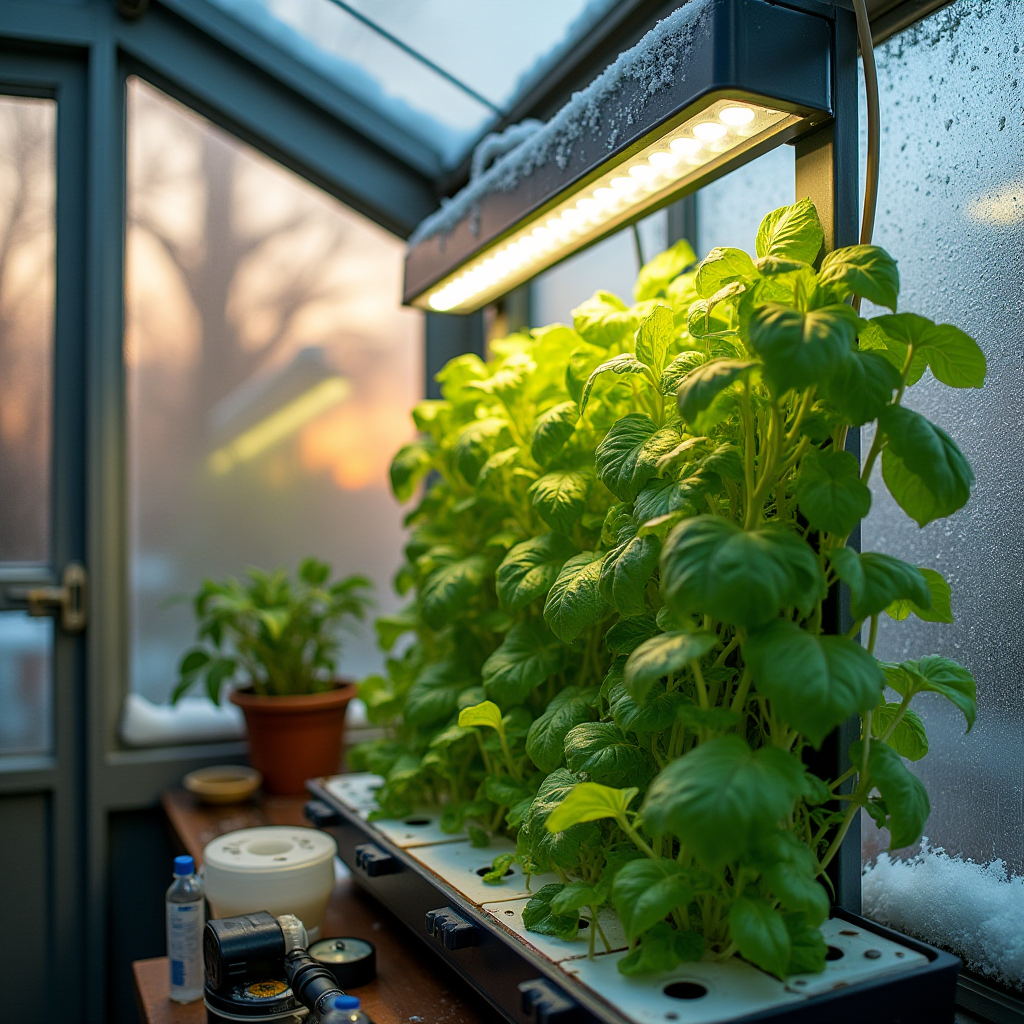
Greenhouse Hydroponics Winter Lighting: Dynamic LED Daylight Replication for Stable Lettuce & Basil Yields
If your winter lettuce looks like stretched green ribbon and your basil bolts the minute the sun comes out, it is not bad luck. It is your light and energy strategy screaming for an upgrade.
Dynamic, sunlight-mimicking LEDs are finally giving greenhouse hydroponic growers a realistic way to flatten winter light swings without torching the power bill. Paired with DLI sensors and smart control, you can keep lettuce and basil yields steady, tune spectrum around real daylight, and run lighting in sync with shade curtains, CO2, and grid tariffs.
This is not an indoor grow tent story. This is about running sunlight plus LED in a commercial-style greenhouse, where variability, tariffs, and climate control are the real enemies.
The Problem: Winter Greenhouses That Grow Stress, Not Yield
Every winter, the same greenhouse hydroponics pain points show up:
- Leggy, weak lettuce when cloudy weeks stack up.
- Basil that stretches, then bolts the moment you get a sunny warm spell.
- Uneven heads and inconsistent cut weights across gutters or rafts.
- Power bills that spike because LEDs slam on at full blast from open to close.
The pattern is simple: winter light is chaotic. One day you get 3 mol/m²/day of natural light, the next you get 15. If your supplemental LEDs are static - fixed intensity, fixed spectrum, fixed schedule - the crop rides that rollercoaster:
- Cloudy sequences: you miss the minimum Daily Light Integral (DLI) for lettuce and basil, so plants elongate and growth slows.
- Sudden bright days: plants get a DLI spike, plus heat, plus sometimes high EC or CO2. That combination easily triggers tip burn or basil bolting.
In hydroponic NFT, DWC, or raft systems, you feel this directly in harvest planning. One week your channels are packed and heavy, next week you are short on weight because clouds sat over your glass for 5 days.

The Cause: Uncontrolled DLI, Spectrum Mismatch, And Blind Energy Use
Under glass, light is not just "hours on". For hydroponic greens, three things matter:
- DLI (Daily Light Integral) - total photons per day, in mol/m²/day.
- Instantaneous PPFD - light intensity in µmol/m²/s at canopy height.
- Spectrum - how those photons are distributed across blue, green, red, and far-red.
Most winter greenhouse problems come from missing or overshooting DLI targets, then layering in temperature and CO2 swings.
1. No DLI control, only "hours of light"
Lettuce and basil are not asking for 16 hours of light. They are asking for a dose of photons:
- Modern references and dynamic LED vendors like Sollum Technologies typically target roughly 12-17 mol/m²/day for lettuce and similar or slightly higher for basil, depending on variety and climate, to maintain compact, high-yield plants in winter (Sollum dynamic lighting reports).
When you run LEDs at a fixed PPFD and fixed hours without DLI feedback, two things happen:
- Cloudy stretch: plants never see enough photons. You hit your 16 hours at low PPFD, but DLI is still short.
- Bright stretch: natural sun plus full LEDs overshoot DLI by a wide margin. Plants grow too fast, thin leaf tissue, and stress thresholds drop.
2. Spectrum that fights the sun
Static LEDs with heavily skewed red or blue spectra made sense in fully indoor grows. In a greenhouse, natural daylight is already broad-spectrum. If you layer a narrow-spectrum LED on top, you can distort the overall spectral mix hitting the crop.
Dynamic LED systems like those from Sollum are designed specifically to track daylight and complement it rather than fight it, allowing spectral shifts throughout the day and crop cycle (Sollum SUNaaS platform).
3. Lighting not integrated with shade, CO2, or tariffs
This is the big one for commercial hydroponics. When your lights run in isolation from the rest of the control stack, you get:
- Shade curtains closing while LEDs stay at 100% - wasted photons bouncing off fabric.
- CO2 not boosted while PPFD increases - plants cannot fully use the extra light.
- No demand limiting - LEDs blast at peak grid prices, smashing your margins.
Research on soilless culture highlights how the sector is leaning into integrated control to stay profitable, with the global market projected to grow at about 14% CAGR to around $19B by 2029 (DPRJ Universal soilless culture forecast). Winter lettuce and basil are right in the center of that expansion, but only if lighting and energy are under control.
The Solution: Dynamic LED + DLI Sensors + Smart Energy Control
Now to the fun part: dialing in a winter greenhouse that behaves like a stable, programmable sky over your NFT troughs or DWC rafts.
1. Set clear DLI and PPFD targets for lettuce and basil
Use crop-specific targets as the backbone of your control strategy, drawing on modern dynamic LED work and soilless culture benchmarks (Sollum dynamic LED data) and market-driven production guidelines:
- Lettuce (butterhead, looseleaf) in winter: aim for roughly 12-17 mol/m²/day.
- Basil: often run similar or slightly higher DLIs depending on cultivar, but stay conservative in winter to avoid bolt triggers, especially when temperature spikes.
Then translate those DLI targets into operational rules:
- Define a minimum PPFD under LEDs you are comfortable with for cloudy days, often in the 150-250 µmol/m²/s range for greens in greenhouse conditions.
- Define a max PPFD buffer (for example 350-450 µmol/m²/s total sun + LED at canopy) to avoid overshooting and stressing the crop.
2. Install and use PPFD/DLI sensors like a grower, not a lab tech
Dynamic LEDs are only as good as the data they get. Place quantum sensors (PAR meters) over representative areas of your lettuce rafts and basil channels:
- At least one sensor per lighting zone or per block with different shading or structure.
- Mounted at or just above canopy height and moved up as the crop grows.
Let the control system integrate those readings into a running DLI for the day. Then apply simple logic:
- If cumulative DLI by midday is behind target: allow higher LED output to catch up.
- If the day turns bright: dim LEDs dynamically to keep DLI on target instead of overshooting.
This is the core of daylight harvesting: you only buy photons from the grid that the sun did not already give you.
3. Tune LED spectrum around natural daylight
Dynamic fixtures like those from Sollum Technologies are capable of shifting spectrum throughout the day and season (SUNaaS dynamic spectrum features). For winter greens:
- Morning and heavy-cloud periods: run a balanced blue:red ratio to promote compact, dense lettuce and basil (for example, modestly blue-enriched to tighten internodes).
- Sunny mid-day with shade partially closed: lean the LEDs to fill spectrum gaps, often enhancing red and far-red modestly to keep photosynthesis efficient without pushing stretch too hard.
- Late-day: gently taper intensity instead of a hard on/off to avoid shock responses and let leaf temperatures normalize.
The main rule: because daylight is broad and variable, think of your LED spectrum as a corrective tool that rides on top of it.
4. Integrate shade curtains and CO2 with lighting
To keep lettuce from tip-burning and basil from bolting, you need light plus environment working together:
- Shade curtains: link curtain position to both PPFD and temperature. When curtains close to control heat or bright sun, allow the LED system to backfill part of the lost PPFD with cooler photons rather than roasting the crop.
- CO2 enrichment: during high PPFD periods, enriched CO2 makes each photon more productive. Dynamic systems like Sollum's integrate with climate controllers so high-light recipes line up with elevated CO2 levels (reported integration).
In practice: when PPFD rises (sun + LED), CO2 should step up in lockstep and temperature setpoints should be tight, particularly over DWC and NFT channels where root zones are stable but foliage is sensitive.
5. Run LEDs like a trader, not a tenant: daylight harvesting, demand limiting, TOU scheduling
Dynamic LEDs shine when you layer in energy strategy:
- Daylight harvesting: LEDs ramp to cover DLI deficits only. On bright winter days, many hours will run at heavily dimmed output.
- Demand limiting: set a maximum kW draw for lighting. When other loads (heating, pumps) spike, your controller temporarily trims LED intensity while still protecting minimum DLI.
- Time-of-use (TOU) scheduling: shift a slice of your light delivery into lower tariff windows when possible. For example, slightly front-load the photoperiod into off-peak morning or late-evening hours while keeping total DLI and crop morphology in check.
Suppliers like Sollum report energy savings of up to around 40% compared to HPS and nearly 17% versus static LEDs in real greenhouse deployments, thanks to these tactics (case data).
6. Protect the crop: photoperiod and stress buffers
Stable yields come from avoiding stress spikes as much as from hitting targets. For lettuce and basil in hydroponic gullies or rafts:
- Use consistent photoperiods (typically 14-18 hours for greens under mixed sun/LED) and let DLI be controlled via intensity, not wild swings in day length.
- Define a hard PPFD ceiling where the controller will cap total light, even if DLI is not technically complete, to avoid tip burn, especially in high EC or marginal cooling conditions.
- Build a ramp-up/ramp-down profile for LEDs so the crop never sees instant jumps from 0 to 300+ µmol/m²/s when curtains open.
Because your roots in DWC and NFT are sitting in near-ideal nutrient conditions, the foliage will respond aggressively to any sudden change in light and temperature. The lighting system should be the smoothest part of the environment.
7. Basic ROI checkpoints
With soilless culture growing at roughly 14% CAGR (market forecast), it is tempting to overbuild. Keep ROI grounded with a few practical checkpoints:
- kWh per kg of sellable product before vs after dynamic LEDs.
- Standard deviation of head weight / bunch weight across the house.
- Crop cycle time in days from transplant to harvest in winter.
- Downgrades and rejects from bolting, tip burn, or uneven size.
If dynamic LEDs plus DLI control cut kWh/kg, tighten your weight distribution, and shorten winter cycles even by a few days, the system is paying its way. If not, tighten your targets, check your sensors, and verify that spectrum and curtains are actually coordinated.
The Evidence: What We Know About DLI, Spectrum, And Energy In Winter Greenhouse Hydroponics
You do not need a PhD to justify dynamic LEDs, but you should understand the backbone numbers and trends.
DLI and crop performance
- Modern dynamic LED suppliers and greenhouse research point to lettuce targets in the 12-17 mol/m²/day range in winter as a sweet spot for compact heads and predictable cycles (Sollum case reports).
- Basil often runs in a similar or slightly higher band, but is more sensitive to temperature and photoperiod; stable daily photon delivery is more important than chasing maximum DLI.
Without DLI sensors, you are guessing. With them, you are steering.
Dynamic LED vs static systems
Reports from Sollum Technologies' dynamic installations show:
- Up to about 40% lower energy use than HPS for the same or better yields.
- Approximately 16-17% savings over static LEDs via spectrum/intensity modulation and daylight harvesting (SUNaaS data).
- Improved uniformity and shorter cycles reported in several greenhouse crops like tomatoes and cucumbers, with comparable gains seen in leafy greens.
Market context: why this matters now
The soilless culture sector - hydroponics, aquaponics, and related systems - is projected to grow to roughly $19B by 2029 at about 14% CAGR (DPRJ Universal forecast). In that environment:
- Buyers expect consistent winter supply of leafy greens, not "sometimes" availability.
- Energy costs and tariffs are only moving one direction long term.
- Dynamic, sensor-driven lighting is moving from "nice tech" to baseline infrastructure.
Hydroponic system compatibility
Whether you are running NFT channels, deep water culture rafts, or hybrid aquaponic lines, the principles are the same:
- Keep pH in the 5.5-6.5 zone and EC in crop-appropriate ranges, as outlined in practical hydroponics and aquaponics resources (Aquanet aquaponics basics), so plants can fully use the light you are paying for.
- Use dynamic lighting and DLI control to stabilize growth so your nutrient dosing, reservoir sizing, and harvest planning are easier to dial in.
In other words: if your environment is smart but your lights are dumb, you are leaving money and yield on the table.

Dial in DLI, spectrum, and energy now, and your winter lettuce and basil will stop riding the weather and start following your schedule.
As an Amazon Associate, I earn from qualifying purchases.