Most greenhouse growers still treat LEDs like on/off switches. That mindset is now costing real money.
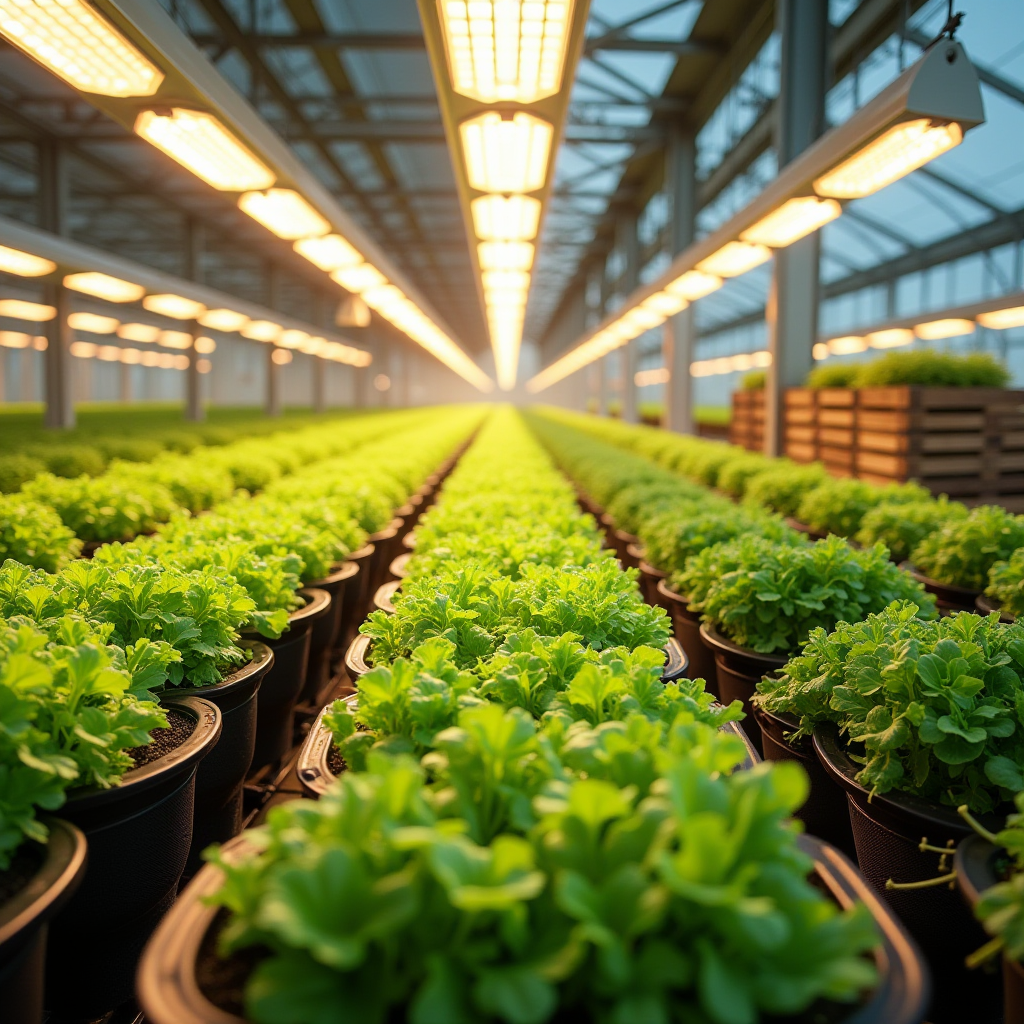
The industry is pivoting. Roelands Plant Farms just lit up a new 12-acre dynamic LED expansion that runs on sensors, not guesses, and modulates both intensity and spectrum in real time as reported here. That kind of deployment is the line in the sand: static supplemental lighting is officially old tech.
If you are running hydroponic cucumbers in gutters, tomatoes in high-wire, or dense leafy greens over DWC, the question in 2026 is not “Should I add LEDs?” It is “How do I design a sensor-driven, DLI-based lighting strategy that actually pays back?”
This post is about the nuts and bolts: how to control LEDs by DLI instead of clock time, where to mount PAR sensors so your feedback loop is accurate, when spectrum tuning is worth paying for, and how to model kWh and ROI before you sign a fixture quote.
1. Common mistakes with dynamic LED and DLI control in hydroponic greenhouses
1.1 Running LEDs on fixed hours instead of DLI targets
The classic approach is simple: “Lights on from 4 am to 10 am in winter.” It feels controlled, but it ignores the actual light your crop receives.
Daily Light Integral (DLI) is what the plant experiences: the total PAR photons per square meter per day (mol·m⁻²·day⁻¹). Sun varies by hour, day, and season. A static schedule can leave you with 12 mol one cloudy day and 25 mol the next for the same energy spend. That means:
- In gloomy stretches, you under-light, losing yield and uniformity.
- When the sun spikes, you over-light, dumping kWh into a crop that is already light-saturated.
Research on dynamic greenhouse lighting is clear: DLI-based control improves light-use efficiency and yield stability compared to fixed photoperiod schedules, especially in variable climates as shown in recent work.
1.2 Putting PAR sensors in the wrong place
A DLI control loop lives and dies on the PAR sensors. If they do not see what the crop sees, your controller is flying blind.
Common mistakes:
- Roof-mounted sensors that read sky, not canopy.
- Sensors stuck on edge benches with different shading than the main crop.
- Sensors shaded by trusses, cable trays, or even hanging ducts part of the day.
- Never cleaning the domes, so readings slide 5 to 15% over time.
The result: your controller thinks DLI is low when sections of canopy are already saturated, so it ramps LEDs and wastes kWh. Or it thinks DLI is fine when the mid-bay canopy is actually starving for photons.
1.3 Buying spectrum-tunable fixtures and never steering the crop
Dynamic spectrum is powerful, but only if you use it deliberately. Too many growers pay for multi-channel fixtures, then run them at a fixed “white” all year.
Typical missed opportunities:
- No shift to higher blue ratios in vegetative phases for more compact, robust plants.
- No red + far-red bias in generative phases to drive flowering, fruit set, or elongation where needed.
- No end-of-day (EOD) spectrum plays, even when photoperiod-sensitive crops would benefit.
Modern tunable LEDs can adjust red, blue, far-red, and sometimes green independently. If you are paying for that, it should be tied to crop stage and steering goals, not left as a static setting.
1.4 Ignoring how light level changes nutrient demand and EC behavior
Dynamic LEDs do not change just light; they change plant metabolism. If you raise DLI 20 to 40% in a DWC, NFT, or slab system and keep the same fertigation schedule, you are setting yourself up for trouble:
- Faster uptake of N, K, Ca, and Mg can outpace your dosing strategy.
- Under high DLI, pH and EC drift faster because roots are working harder.
- Tip burn, blossom-end rot, or pale new growth appear even with “normal” EC.
Dynamic light with static nutrition is half a system. If your light output is variable by design, your fertigation logic must be designed to track it.

2. Why these mistakes happen when you move from static to dynamic LEDs
2.1 Legacy thinking: treating LEDs like HPS on a timer
Most greenhouse teams grew up on HPS: one channel, on/off, tied to a cheap time clock or a basic solar integrator. When you swap in LEDs, it feels natural to reuse the same control logic.
The problem is that dynamic LEDs can do far more. Modern fixtures are dimmable in 1 to 10% steps, some in 1% steps, and spectrum-tunable models can independently modulate red, blue, and far-red. If your controller only knows “on” and “off,” you are paying for hardware your software cannot use.
Facilities like Roelands are shifting specifically because dynamic LED plus DLI control closes that gap between capability and practice. They are integrating light sensors, weather data, and crop recipes into real-time control, not just plugging LEDs into an HPS-style schedule as highlighted here.
2.2 Underestimating how sensitive DLI is to sensor errors
PAR sensors look simple, so growers treat placement casually. But DLI is essentially “PPFD integrated over time.” A 10% error in PPFD is a 10% error in DLI for the whole day.
If your sensor sits under a partially shaded zone, your controller may run LEDs harder all day across the house. That turns into a 10 to 20% energy penalty with no benefit, or sometimes even light stress in the best-lit zones.
On the other hand, a sensor sitting in a high-light pocket may cause the system to back off LEDs too early, leaving the rest of the crop under the target DLI. You see that as uneven growth and harvest timing between bays.
2.3 Spectrum as a “set and forget” feature instead of a steering tool
The physics of photons is straightforward: at the same power draw, you get more red photons than blue photons, because red carries less energy per photon. So many operations set a spectrum that favors red for efficiency and never move it.
That is a missed chance to steer the crop. Studies in controlled environments have repeatedly shown that blue-rich spectra compact canopies and change leaf thickness and pigment, while red-plus-far-red can speed stem elongation and flowering timing. Recent work on dynamic spectra under greenhouse conditions suggests that timing those shifts with crop stage matters more than any single static recipe as discussed here.
2.4 No link between lighting control and fertigation logic
Most greenhouse controllers still treat lighting and fertigation as separate modules. Light recipes live in one screen; nutrient recipes and EC setpoints live somewhere else. When you introduce dynamic lighting, this separation becomes a liability.
If your DLI algorithm decides to push LEDs to 80% for three cloudy days, but your fertigation schedule does not scale shot volume or frequency, your root zones fall behind. In DWC and NFT systems, that can show up fast as diluted EC, accelerated pH drift, and visible deficiencies even while the controller reports “in-range” averages.
On the flip side, if your TOU (time-of-use) power strategy drops LED output for several days and your nutrient strategy keeps assuming high DLI, you may be running EC higher than needed, pushing vegetative crops toward tip burn or overly generative behavior in fruiting crops.

3. How to fix it: practical design for DLI-based dynamic LED control
3.1 Build a simple, robust DLI control loop
You do not need a research lab. You need a clean feedback loop with good sensors and sane setpoints.
Step 1: Define realistic DLI targets by crop and stage
- Leafy greens (lettuce, spinach, many herbs): 12 to 17 mol·m⁻²·day⁻¹ is a solid commercial range in hydroponic systems, with some cultivars handling 18 to 20 if CO₂ and climate are dialed.
- Tomato, cucumber, pepper: 20 to 30 mol·m⁻²·day⁻¹ is typical for high-wire hydroponics, with many growers targeting around 25 in winter conditions.
- Strawberry: often 15 to 20 mol·m⁻²·day⁻¹ for protected cultivation, depending on cultivar and desired fruit quality.
Start conservative if you are new to dynamic supplementation, then push targets up as you confirm that climate, CO₂, and fertigation can keep up.
Step 2: Place and configure PAR sensors correctly
- Mount at or just above typical canopy height for each zone.
- Avoid edges, aisle gaps, and under obvious shadow objects.
- In large houses, use multiple sensors per climate/light zone and average them in software.
- Set a maintenance routine: wipe sensor domes weekly and check calibration yearly.
Step 3: Use cumulative DLI, not just instantaneous PPFD
Your controller should integrate PPFD over time to calculate a running DLI from midnight (or lights on) to current time.
- Early in the day, allow higher LED output to build DLI margin.
- As you approach the target DLI, taper intensity rather than hard-off.
- Define a maximum photoperiod (for example, 18 hours for many vegetative crops) so the system does not extend day length endlessly to chase DLI in bad weather.
Step 4: Tie DLI control to TOU power pricing
If your utility has time-of-use rates, your algorithm should bias supplemental light toward cheaper blocks while still hitting the DLI target by the end of photoperiod. That might look like:
- Pre-loading DLI in off-peak hours with slightly higher PPFD from LEDs.
- Allowing DLI to drift toward the low end of the target range in expensive peak hours.
- Using forecast or yesterday’s weather pattern to avoid big overcorrections.
3.2 Practical spectrum strategies for crop steering
If you invest in spectrum-tunable LEDs, set up simple, stage-based recipes instead of chasing perfect “secret” spectra.
Example baseline channels (actual percentages will depend on your fixture):
- Propagation / early vegetative: Higher blue fraction (20 to 25% of total PAR), moderate red, minimal far-red. Goal: compact, sturdy seedlings or young plants with strong root systems.
- Mid vegetative: Moderate blue (15 to 20%), strong red, still low far-red. Goal: balanced canopy expansion without excessive stretch.
- Generative / flowering and fruiting: Blue 10 to 15%, strong red, add controlled far-red (for example, 5 to 10% of PAR or as a separate EOD pulse). Goal: initiate and support flowering, elongation where needed, and fruit fill.
End-of-day (EOD) plays
- Short pulses of red + far-red at day’s end can influence phytochrome and, in some crops, affect flowering timing or internode length.
- Keep EOD treatments short (for example, 10 to 30 minutes) and consistent while you evaluate response.
Always test on a small block first. Different cultivars respond differently to spectrum shifts. Run side-by-side trials for at least one full cycle before locking in house-wide recipes.
3.3 Integrate lighting with hydroponic fertigation logic
Dynamic light should be paired with dynamic fertigation. At a minimum:
- Link your climate/light controller and fertigation controller so that daily effective DLI is a data point the nutrient system can see.
- Create “light level bands” (low, medium, high DLI days) and associate each band with specific fertigation behaviors.
For example:
- On high DLI days, allow slightly more irrigation events, or modestly higher nutrient concentration where crop and strategy support it.
- On low DLI days, cap total irrigation events or run a “lighter” recipe to avoid pushing soft, watery growth in leafy crops.
In DWC systems, the lever is not irrigation frequency but solution concentration and refresh rate. If your lights run hotter than usual for a week, plan for earlier reservoir changes and tighter pH and EC monitoring, because uptake and drift will spike.
3.4 Where Kratky, DWC, and NFT fit into high-DLI, dynamic houses
In a dynamic LED greenhouse, system choice defines how hard you can push light.
- Kratky: Works well at modest DLI for short-cycle leafy crops. As DLI rises, the fixed volume of static solution becomes the limitation; oxygen and nutrients can be depleted before harvest. Use Kratky in zones where you are not pushing maximum DLI, or accept shorter growth cycles and tighter starting solution design.
- DWC: Well-suited to high and variable DLI because dissolved oxygen is maintained by aeration. With dynamic LEDs, DWC can support very aggressive growth and short cycles, but EC and pH control must be sharp.
- NFT / high-frequency drip: The most flexible under dynamic DLI, because you can adjust irrigation frequency and volume almost in real time as light and transpiration change.

4. What to watch long-term: ROI, benchmarks, and integration
4.1 Modeling kWh, photons, and yield before you sign
Before you buy fixtures, build a simple DLI-based ROI model. You do not need a full-blown simulator; a structured spreadsheet is enough.
Step 1: Establish baseline DLI by season
- Use historical solar data or your own PAR logs to estimate monthly average DLI at canopy without supplemental light.
- Plot those values against your crop’s target DLI per month.
Step 2: Calculate required supplemental DLI
- For each month, Supplemental DLI = Target DLI − Baseline DLI (clip at zero; no negative values).
- Convert that to mol·m⁻²·day⁻¹ that your LEDs need to provide.
Step 3: Convert photons to kWh using fixture efficacy
Fixture efficacy (for example, 3.2 µmol·J⁻¹) tells you how many photons you get per joule. Rearranged:
- Required energy (kWh/m²/day) ≈ (Supplemental DLI × 10⁶ µmol/mol) / (Efficacy µmol/J) / (3.6 × 10⁶ J/kWh).
Multiply by total m² of lit area and days per month to get monthly kWh. Apply your TOU tariff to estimate cost.
Step 4: Estimate yield uplift per extra mol of DLI
- Use published light-response curves for your crop or internal trial data.
- A common ballpark is 0.5 to 1.0% yield increase per additional mol·m⁻²·day⁻¹ within the responsive range, but this varies heavily by crop and environment.
- Translate additional yield into revenue using realistic market prices.
Step 5: Compare annualized capex + opex to added gross margin
- Annualize LED capex over fixture lifetime (for example, 8 to 12 years, or to L90/L80 hours).
- Add estimated maintenance and cleaning costs.
- Compare to the added gross margin from yield uplift and quality premiums.
If you cannot reach a reasonable payback (for example, under 6 to 8 years) using conservative assumptions, rethink fixture density, efficacy, or target DLI.
4.2 Fixture selection: dynamic vs static, what actually matters
Dynamic (dimmable and spectrum-tunable) fixtures are not always the right choice. Base your decision on three questions:
- Do you intend to run true DLI-based dimming? If yes, you need at least reliable dimming, ideally with smooth control.
- Will you actively steer crops with spectrum by phase? If you cannot commit to recipe development and trials, pay for efficient fixed-spectrum fixtures instead of tunable units.
- What does your control infrastructure support? If your climate computer cannot handle multi-channel spectra or fine-grained dimming, you may not be able to exploit a fully dynamic fixture.
For many operations, a good compromise is:
- High-efficacy dimmable LEDs with a “balanced” white/red spectrum for main production.
- More advanced, spectrum-tunable fixtures in trial bays or high-value specialty crops where steering can earn a real premium.
4.3 PAR sensor placement rules that actually work
To keep your DLI control loop accurate over years, adopt simple sensor standards:
- Mount sensors on dedicated brackets at canopy height, adjustable as crop height changes.
- Use at least one sensor per light/climate zone; more in heterogeneous houses.
- Log sensor data and periodically compare against a handheld reference sensor at multiple points in the canopy.
- Replace or recalibrate sensors on a defined cycle instead of waiting until numbers “look wrong.”
4.4 Long-term integration with greenhouse climate control
The end game is not “smart lights.” It is a greenhouse where light, temperature, humidity, CO₂, and fertigation are all talking to each other.
As you move toward that:
- Feed DLI status into your climate computer so it can coordinate venting, screens, and CO₂ dosing around light level.
- Use light level and DLI forecast to adjust CO₂ setpoints (for example, higher CO₂ when PPFD is high and vents are closed).
- Let the fertigation system track DLI so recipes and shot strategies match actual plant demand.
This is where operations like Roelands are headed: dynamic LEDs as one component in a fully integrated, sensor-driven greenhouse that is designed around the crop’s DLI, not the clock.
Bottom line: design around DLI, not hardware
Dynamic LEDs are just hardware. The real advantage comes from a control philosophy built around DLI and crop steering:
- Set clear, crop-specific DLI and spectrum targets by stage.
- Place and maintain PAR sensors so your controller sees what the crop sees.
- Use dimming and spectrum tuning to hit those targets efficiently, not just to light up the house.
- Integrate lighting decisions with hydroponic fertigation, pH, EC, and climate control.
- Model kWh and yield before you buy, so the system pays for itself instead of just adding complexity.
Get those fundamentals right and dynamic LEDs stop being a science project. They become another precise, reliable lever for pushing yield, quality, and consistency in your hydroponic greenhouse.
As an Amazon Associate, I earn from qualifying purchases.