DWC Aquaponics for Home Growers: Biofilter & Solids Design for Stable, Healthy Greens
If your raft roots look like brown noodles and your pH chart swings harder than a nightclub door, it is not that “aquaponics is finicky”. It is your biofiltration and solids management begging for a redesign.
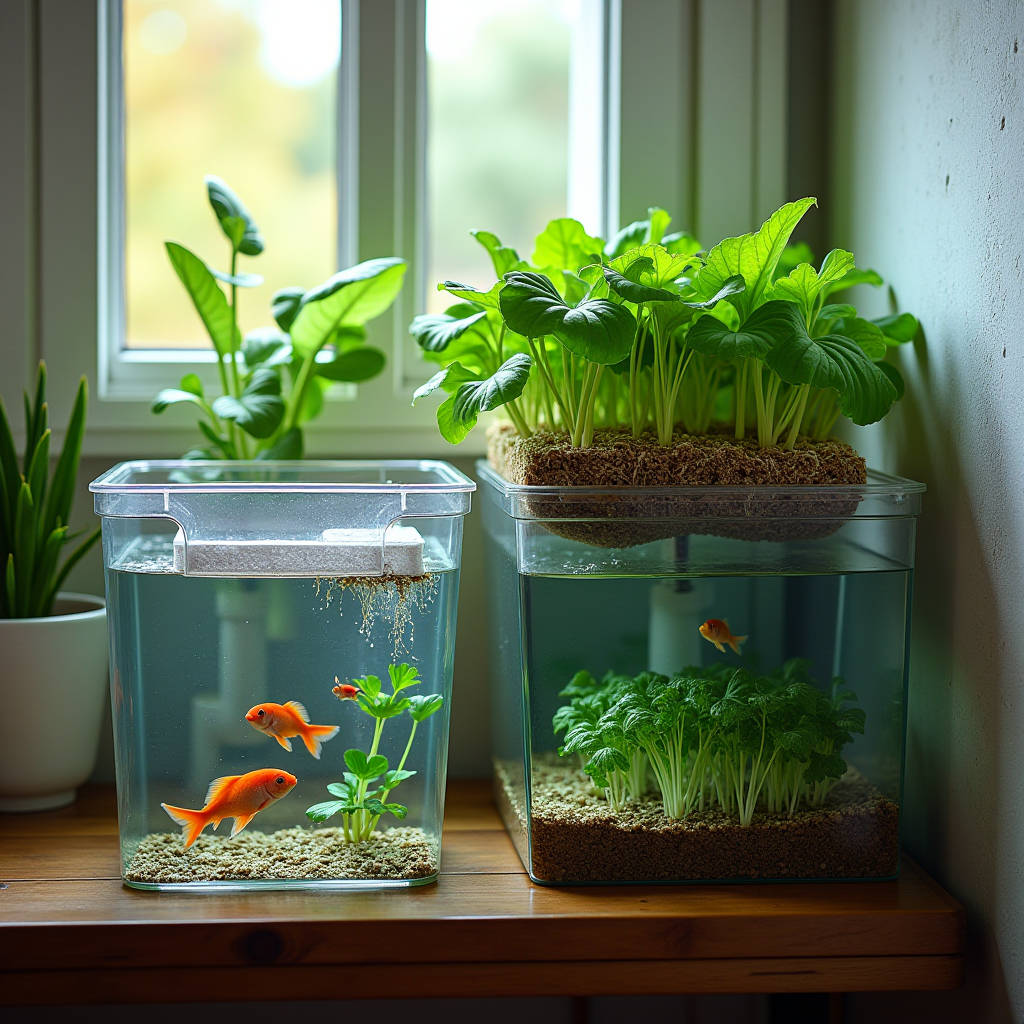
Indoor DWC aquaponics can be brutally simple and ridiculously productive - if you respect the biology. When you bolt fish onto a deep water culture or raft setup without planning for nitrifying bacteria and solids capture, you are asking for slime, stunting, and stress.
This guide keeps it tight and practical: when you can safely let the raft be the biofilter, when you absolutely need dedicated media, and how to handle solids so your lettuce stays crisp and your fish stay alive.
The Problem: Slime, Swings, And Sulking Greens
Most home DWC aquaponics failures look the same:
- Nice clear system for 2-4 weeks, then boom: cloudy water, brown slime on roots, and yellowing leaves.
- pH starts around 7.5 from tap or buffers, then slowly slides down, then suddenly crashes.
- Fish stop eating well, plants stall, and the whole setup smells more like a dirty aquarium than a salad bar.
Common red flags:
- Root slime and discoloration - often an overload of fine solids and heterotrophic bacteria smothering roots, not just "root rot".
- pH instability - nitrification naturally acidifies water over time, but without proper biofilter surface area and alkalinity management, the drop is wild and unpredictable, as noted in this FAO DWC aquaponics guide.
- Ammonia or nitrite spikes - fish survive a while, then you add more fish or feed heavier and suddenly see stress, gasping, or losses.
- Slow, pale greens - the system never really matures into steady nitrates; you are stuck in a cycle of mini-crashes.
The pattern is simple: too much fish waste, not enough functioning biofilter, and nowhere for solids to go except into the root zone.
In a classic hydro DWC, you run sterile or near-sterile: clean solution, salt-based nutrients, no fish, very little organic load. In DWC aquaponics, you are running a living wastewater plant plus garden in the same plumbing. If you do not intentionally give bacteria and solids a place to live that is not the raft tank, the raft tank becomes the biofilter and solids trap by default. That is when the trouble starts.

The Cause: Under-Biofiltered, Over-Loaded DWC
To fix DWC aquaponics, you need to understand three things that are invisibly running the show:
- Where nitrifying bacteria live.
- Where solids are allowed to settle or accumulate.
- How much fish load your system can actually support.
1. Nitrification: Your Invisible Engine
Fish excrete ammonia (NH3/NH4+). Nitrifying bacteria convert that into nitrate (NO3-), which plants use. That nitrification happens in two stages driven by different bacteria, as outlined in this overview of DWC aquaponics biology:
- Nitrosomonas: ammonia to nitrite (NO2-).
- Nitrobacter/Nitrospira: nitrite to nitrate.
These bacteria need:
- High oxygen (> 5 mg/L dissolved oxygen is a solid target).
- Stable temperature (18-28 °C; they slow outside this band).
- Plenty of surface area to colonize.
- Moderate pH (roughly 6.8-7.2 is a good compromise for fish, plants, and nitrifiers, as highlighted in this DWC aquaponics guide).
In a bare DWC tank with smooth plastic and raft bottoms, you simply do not have much surface area. Roots and tank walls will grow biofilm, but once you start pushing fish feed, that is usually not enough. The bacteria lose the race against heterotrophic microbes chewing through solids, so you get oxygen crash zones and slime.
2. When You Can Skip a Separate Biofilter
There are cases where your DWC/raft tank can act as its own biofilter without a separate media tank. It is reasonable to run biofilter-free if:
- Fish density is kept very low - think display-tank level, not production-level: roughly 0.25-0.5 kg of fish per 100 L of system water, with light feeding.
- Plant-to-fish ratio is high - lots of hungry greens relative to fish waste production.
- Solids are pre-filtered with a simple mechanical stage (sponge prefilter, small swirl filter, or settling bucket) so only fine dissolved nutrients reach the rafts.
- Water is heavily aerated - air stones under each raft bay, vigorous circulation, and good gas exchange.
If you are running a small indoor setup with a single DWC trough, a light stocking of ornamental fish, and good aeration, you can often let the tank walls, plumbing, and root surfaces host enough bacteria. But once you push stocking density or scale beyond that, a dedicated biofilter becomes the difference between "cute experiment" and "reliable food production".
3. When You Need Dedicated Media Biofiltration
For most home growers aiming to actually harvest consistent greens and keep fish healthy, a separate biofilter is the smart move. A typical approach for raft aquaponics, consistent with design examples in this home DWC aquaponics guide, is:
- Media type: high-surface-area media like expanded clay (LECA), plastic bio-balls, K1/K3 moving-bed media, or coarse lava rock.
- Rule-of-thumb sizing (home scale, leafy greens):
- About 20-40 liters of quality media per 100 L of fish tank for light to moderate stocking (0.5-1 kg fish per 100 L).
- If you want to push harder stocking, go towards the higher end or use a moving-bed biofilter that adds even more effective surface area.
- Flow rate: aim to circulate the entire fish tank volume through the biofilter at least once per hour.
- Oxygen: either air stones in the biofilter or a strong waterfall-style return to keep DO high for nitrifiers.
This media volume gives nitrifiers a stable home that is separate from your raft roots. That separation is what keeps roots clean and white instead of smothered in biofilm.
4. Solids: The Silent Root Killers
In raft aquaponics, solids are your main enemy for root health. Sources include:
- Uneaten feed.
- Fish feces.
- Biofilm flocs and plant debris.
If these solids go straight to the raft tank, they:
- Coat roots and reduce oxygen transfer.
- Create anaerobic pockets that produce hydrogen sulfide and other toxins.
- Increase oxygen demand in the water, starving both roots and fish.
Commercial DWC aquaponics and raft systems almost always use mechanical pre-filtration and dedicated biofiltration before water hits the rafts, exactly to keep roots in clean, low-solids water, as seen in designs summarized by FAO and other technical guides.

The Solution: Practical DWC Aquaponics Design For Stable Greens
Let us turn the mess into a stable, predictable system. We will cover:
- Smart decisions about when to run "biofilter-free" vs "biofilter-heavy".
- How to design biofiltration that plays nice with rafts.
- Simple, effective solids removal that actually fits indoors.
- Circulation, aeration, and pH management that keep everything steady.
1. Decide Your Target: Display Tank vs Production Tank
Before you buy anything else, decide:
- Display/low-load system (few fish, small harvests, main goal is enjoyment and learning).
- Production-oriented system (regular lettuce and herb harvests, modest but real fish biomass).
For display/low-load DWC aquaponics:
- Fish tank volume similar to raft water volume (for example 80-120 L each).
- Stock at about 0.25-0.5 kg fish per 100 L, feed lightly.
- Use a small mechanical prefilter (sponge on pump inlet or small in-line filter) to catch large solids.
- Use the tank walls, plumbing, and roots as your biofilter (monitor ammonia and nitrite regularly at first).
For production-oriented DWC aquaponics:
- Plan for a dedicated biofilter between the fish tank and raft trough.
- Size the biofilter as mentioned earlier: 20-40 L of high-surface media per 100 L of fish tank water for moderate loads.
- Add mechanical solids removal before the biofilter to protect it from clogging.
2. Raft-Friendly Biofilter Layout
A clean, proven flow layout for home DWC aquaponics looks like this:
- Fish tank (aerated) →
- Mechanical solids removal (settling bucket or swirl filter) →
- Media biofilter (static or moving bed) →
- DWC/raft trough (heavily aerated) →
- Return to fish tank.
Key design notes:
- Media container: tote, barrel, or box that is easy to access and clean.
- Flow direction: upflow or crossflow through media so solids settle and bacteria see fresh water.
- Bypass or valve: give yourself the option to adjust flow through the biofilter without choking the raft circulation.
This separation means:
- Most nitrification happens in media, not on roots.
- Most solids get captured before they can coat root systems.
3. Simple, Effective Solids Capture
For small indoor raft/DWC systems, you do not need a big drum filter. You just need a place where water slows down and solids can settle out.
Three easy options:
- Swirl or radial flow settler:
- A round bucket or barrel where water enters tangentially and exits from the center-top or via a standpipe.
- Solids spiral and settle to the bottom, where you can drain them out every few days.
- Upflow settling bucket:
- Water enters at the bottom, rises slowly, and exits near the top.
- As velocity drops, heavier solids settle to the bottom.
- Inline sponge or brush filter:
- Water passes through coarse foam or plastic brushes.
- Great for fines, but needs frequent rinsing to avoid clogging and anaerobic pockets.
Placement rule: solids filter first, then biofilter, then rafts. You want most of the "chunky" organics out before they hit media or roots.
4. Circulation, Aeration, And Turnover
Circulation and oxygen are what tie this whole design together:
- Turnover: aim to circulate at least the fish tank volume through the loop every 45-60 minutes.
- Aeration:
- Fish tank: 1-2 air stones or a diffuser, keep DO above ~5 mg/L.
- Biofilter: either air stones or a splashy return.
- DWC trough: several stones spaced under rafts to keep roots bathed in oxygenated water, which is standard practice in DWC aquaponics as described in this raft aquaponics overview.
- Flow to rafts: feed the raft from one end and drain from the other so solids cannot accumulate in dead corners.
5. pH Management And Stability
Nitrification will naturally drive pH down over time. That is normal. The trick is to manage it rather than fight it.
For stable DWC aquaponics pH:
- Run in the 6.8-7.2 range as a compromise for fish, bacteria, and nutrient availability, consistent with technical guidance such as FAO and other DWC references.
- Use a carbonate buffer source in your system (crushed coral, calcium carbonate, or potassium bicarbonate in a small media bag in your sump) to provide alkalinity.
- When pH drifts below ~6.6, adjust slowly using calcium carbonate/hydroxide or potassium carbonate/hydroxide, alternating to provide both Ca and K.
- Avoid chasing pH daily. Adjust in small increments, then let the system respond.
Unlike pure hydro where you dial in EC, aquaponics EC is usually much lower and less directly controlled, with nutrients coming primarily from feed, as discussed in several aquaponics DWC guides. Focus on:
- Stable pH.
- Ammonia and nitrite near zero once the system is cycled.
- Nitrate consistently present (often 20-80 ppm for leafy greens).
6. Quick Checklist: Turning Root Slime Into White, Fuzzy Roots
To transform your DWC aquaponics from unstable to dialed-in:
- Add a dedicated mechanical solids filter after the fish tank.
- Install a media biofilter sized at roughly 20-40 L per 100 L of fish tank for moderate loads.
- Increase aeration in both fish tank and raft trough.
- Ensure water flows fish → solids removal → biofilter → rafts → return.
- Keep stocking and feeding moderate until the biofilter is fully cycled (4-8 weeks of consistent nitrification).
- Monitor ammonia, nitrite, nitrate, and pH weekly; adjust stocking and feeding based on what your tests tell you.
Do that, and your greens will stop sulking, your roots will stay bright and well oxygenated, and your pH will slide gently instead of cliff-diving. You are not just running “fish plus rafts”; you are running a small wastewater treatment plant tuned for salad production. Treat the biology with respect and it will feed you for years.