Closed-Loop Rooftop Geodesic Farms: Code-Compliant Water, Energy, and CO2 Integration for Urban Hydroponics (2025–2026 Guide)
Most teams still think a rooftop greenhouse is “closed-loop” once the condensate hose is plumbed back into the tank and a CO2 tank is in the corner. In practice, that half-finished approach is exactly how you end up with soaked insulation, mystery leaks into offices below, and CO2 alarms going off in the stairwell.
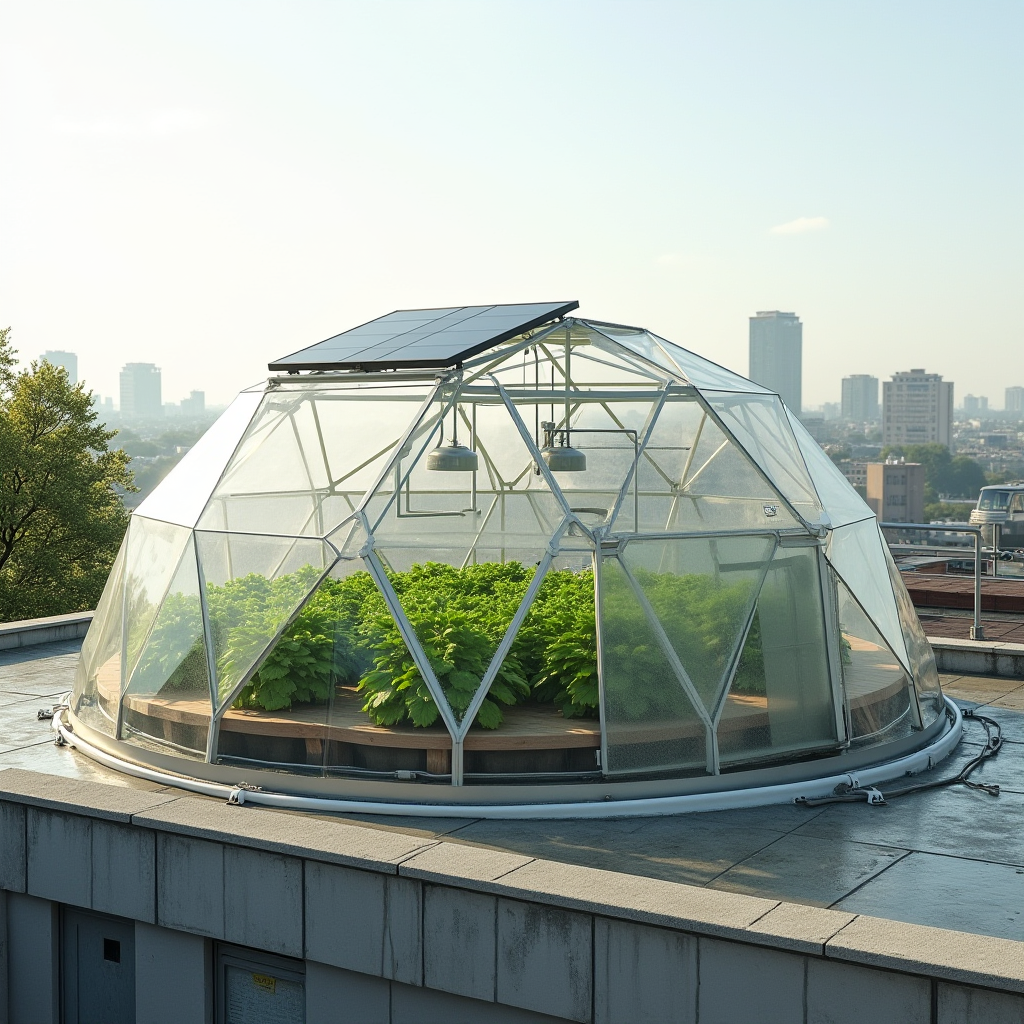
Expo 2025’s geodesic farm concepts are showing where this is heading: integrated, sensor-heavy domes that reclaim water, manage latent heat, and couple safely to the host building’s mechanical systems, not just sit on top of them as covered here. At the same time, schools are rolling out plug-and-play hydro systems in common spaces like Northfield Mount Hermon’s installation, and industry shows are leaning harder into food safety and code compliance as Indoor Ag-Con’s programming shows. Put together, the message is clear: if you want a rooftop geodesic farm to survive inspections and actually turn a profit, you need more than a strong frame and a signed structural letter.
This guide focuses on the operational guts of a closed-loop rooftop geodesic greenhouse in 2025–2026: water recovery and nutrient loops, humidity and energy management, safe CO2 integration, and clean tie-ins to building MEP systems. We will keep it practical and directly usable whether you are running Kratky beds, DWC, NFT, or a mixed system.
1. Common mistakes in “closed-loop” rooftop greenhouse design
1.1 Treating condensate as “free water” without a spec
One of the fastest ways to get sideways with both plant health and plumbing code is to pipe every bit of HVAC and glazing condensate straight into your nutrient reservoir with no treatment, no backup path, and no tracking.
Growers often:
- Mix untreated condensate directly into recirculating tanks, driving down alkalinity and destabilizing pH.
- Send condensate lines through weak points in the roof envelope, creating hidden leaks into insulation and ceiling cavities.
- Forget that most jurisdictions treat condensate as an “indirect waste” that must drain through an air gap to a code-compliant receptor.
1.2 Oversizing CO2 and undersizing safety
Urban domes love CO2 because the volume is compact and insulated. The mistake is speccing enrichment like a ground-level hoop house and forgetting the occupied building below:
- No hard-wired CO2 sensors at worker breathing height and no zoning between plant area and access corridors.
- CO2 generators or tanks with no interlock to the ventilation/HVAC system.
- No defined low-occupancy and no-access modes for nights, weekends, or school holidays.
1.3 Letting humidity drive your energy bill instead of your design
Closed domes with DWC, NFT, or dense Kratky beds throw off a lot of moisture. Common mistakes include:
- No explicit latent load calculation for crops, tanks, and irrigation, so dehumidifiers get sized by guesswork.
- Relying only on vent windows, which dump conditioned air and CO2 every time humidity creeps up.
- Skipping heat recovery ventilators (HRV) or energy recovery ventilators (ERV) and treating dehumidification as a simple “add another portable unit” problem.
1.4 Ignoring nutrient loop hygiene in a highly visible building
Schools and offices like clean, quiet, and low-risk. Yet rooftop farms often:
- Run a single big reservoir feeding everything (DWC, NFT, and any Kratky top-ups) with no isolation or pathogen control.
- Use opaque operational practices: hand mixing nutrients, no logs, and no documented corrective actions when EC and pH drift.
- Skip secondary containment, so a cracked bulkhead fitting can drip into a classroom ceiling instead of a catch pan.
1.5 Treating the roof like a backyard, not a building system
Rooftop geodesic farms live inside the building code, energy code, fire code, and often health department rules if you are selling or serving produce. Typical missteps:
- No formal interface with the base building drawings and MEP engineer for drains, waterproofing, and penetrations.
- Non-rated materials or open-flame heaters inside a structure that may be classed similarly to an assembly or educational occupancy.
- No plan for emergency power to keep aeration running in DWC or protect temperature-sensitive crops during outages.
2. Why these mistakes happen (and what the building is doing in the background)
2.1 “Closed-loop” is defined differently by growers and inspectors
Growers think in terms of mass balance: minimal waste, tight nutrient cycles, and condensate reuse. Inspectors and facility managers think in terms of risk: known pathways for leaks, off-gassing, and electrical faults.
On a rooftop dome, those worlds collide. Recirculating nutrient and condensate loops are attractive because hydroponics can cut water use by up to 90% compared to soil systems as noted here, but they also concentrate any mistake you make with plumbing, sanitation, or dosing.
2.2 Geodesic domes amplify microclimate errors
Geodesic domes are excellent for light distribution and structural efficiency as discussed in this overview. The tradeoff is that they are very “tight” volumes. CO2 and humidity accumulate faster than in a leaky hoop house, especially when you run high-density DWC rafts or NFT gullies with continuous flow.
In a sealed shell, a mis-sized HRV, weak dehumidifier, or poorly positioned exhaust point does not just cause a few wet corners. It can push humidity into the 80–90% range, reduce transpiration, and force you to dump air (and CO2) just to stay ahead of condensation.
2.3 Educational and office settings prioritize visibility and comfort
Projects like the hydroponic system showcased at Northfield Mount Hermon’s Alumni Hall demonstrate how public-facing these farms now are. Admins want a clean, quiet showpiece that fits into school operations without staff babysitting it every hour.
That often leads to:
- Plug-and-play units being scaled up without upgrading safety controls.
- CO2 and humidity controls being simplified to the point of guesswork.
- No written SOPs for nutrient management, spill response, or after-hours operation.
2.4 Code is catching up to controlled environment agriculture
Food safety and indoor agriculture tracks at events like Indoor Ag-Con are sending a clear signal: regulators are now paying attention to how CEA spaces integrate with buildings. Inspectors expect to see:
- Documented air changes and fresh air introduction.
- Safe, listed equipment for CO2 delivery and heating.
- Defined waste, effluent, and chemical handling routes.
Hydroponic domes perched on roofs are no longer invisible to those discussions. If your system is truly closed-loop, the documentation has to show how that loop stays stable and safe over time.
3. How to fix them: a practical blueprint for closed-loop rooftop geodesic farms
3.1 Build a condensate and nutrient strategy, not just a pipe run
Start by separating your thought process into three loops: potable makeup water, recirculating nutrient solution, and condensate.
- Potable makeup water: Treat this like any indoor hydroponic facility. Tie into a code-approved cold-water line, run through a backflow preventer, then through your filtration (sediment, carbon, softening if needed) and reverse osmosis if you need very low EC source water. Meter it.
- Nutrient loop: Keep this fully within the greenhouse footprint and above a continuous waterproof membrane or secondary containment. For DWC and NFT, use distributed reservoirs instead of one giant tank so you can isolate a crop if disease hits.
- Condensate loop:
- Collect from AHUs, fan coils, minisplits, and glazing gutters into a dedicated condensate header.
- Route that header to a small, vented day tank with an air gap to satisfy indirect waste requirements in most plumbing codes.
- Treat condensate with at least filtration down to 5 microns and UV or other disinfection before blending into your RO tank or directly into low-EC crop reservoirs.
Track volumes on all three and log them weekly. You want to know what percentage of your hydroponic make-up is condensate so you can adjust nutrient strength and buffers accordingly.
3.2 Design humidity and latent load like you design lighting
Geodesic domes get sold as “passive” structures, but once you pack them with plants you are running a climate battery whether you planned to or not. Quantify it.
- Estimate transpiration rates for your crops and systems. A dense DWC lettuce bay can easily transpire several liters per square meter per day.
- Calculate your target vapor pressure deficit (VPD) range for each crop stage and back into the required dehumidification capacity.
- Size a mix of equipment: primary dehumidification (dedicated units or DOAS with reheat), HRV/ERV to reclaim sensible (and sometimes latent) energy from exhaust, and controlled natural ventilation only as a peak or emergency tool.
For rooftop domes, HRV/ERV units are your best friend. They let you exhaust humid air while capturing much of the heat, reducing the penalty of keeping CO2 and temperature in range as noted in rooftop greenhouse design research.
Integrate your dehumidification strategy with your water loop by reclaiming condensate from coils and dehumidifiers. That condensate is usually low in dissolved solids and an excellent source for make-up water if you treat it properly.
3.3 Implement CO2 enrichment with industrial-style safety
CO2 enrichment is not hard technically, but on a rooftop dome, you have to assume someone will be up there alone at some point during a malfunction. Design like an industrial gas room, not a hobby tent.
- Source: Prefer piped CO2 cylinders or tanks with external fill stations. Combustion generators add moisture and require flue management, which complicates humidity and fire code issues.
- Distribution: Run rigid lines or reinforced hose, color-coded and labeled, with shut-off valves at zone branches. Keep lines away from sharp edges and hot surfaces.
- Sensing:
- Install at least two fixed CO2 sensors per dome zone: one near worker breathing height (about 1.2–1.5 m) and one below, since CO2 is heavier than air.
- Choose sensors with 4–20 mA or Modbus outputs so they can interlock with your BAS or CO2 controller.
- Interlocks and thresholds:
- Set a soft alarm below your target upper limit (for example, 1200 ppm if your target is 1000 ppm) to adjust injection.
- Set a hard alarm (for example, 5000 ppm or local code threshold) that immediately cuts CO2, opens exhaust, and notifies staff.
- Have a manual emergency stop near the entry door.
- Operational modes: Program “occupied”, “unoccupied”, and “emergency purge” modes in your control system so the dome is never enriching when people are not expected to be present, unless your risk assessment supports it with extra safeguards.
3.4 Make nutrient management auditable and boring
A closed-loop rooftop hydroponic greenhouse lives or dies by stable pH, EC, and sanitation. The goal is to turn nutrient management into a predictable routine.
- Standardize nutrient chemistry: Use a clear A/B nutrient line appropriate for your main crops and system types (DWC, NFT, and any semi-static Kratky beds). Keep concentrated stock tanks labeled and segregated.
- Automate what matters:
- Install inline pH and EC probes on each major loop or bay.
- Use peristaltic pumps tied to a controller to dose acid/base and nutrient A/B, within defined limits.
- Set alarms for drift outside your crop-specific bands.
- Define setpoints by system:
- Kratky leafy greens: EC roughly 0.8–1.4 mS/cm, pH 5.8–6.3.
- DWC/NFT leafy greens: EC roughly 1.2–1.8 mS/cm, pH 5.8–6.2.
- Fruiting crops: EC often 2.0–3.0 mS/cm depending on cultivar and stage, with pH still in the 5.8–6.3 range.
- Cycle your solution: In a genuine closed-loop system, you need periodic partial dumps and top-ups to avoid ion imbalance. Write a schedule (for example, 10–20% bleed and refill weekly, full changeover by crop cycle or sooner if sodium and chlorides creep up).
- Sanitize between cycles: Flush lines with a sanitizer compatible with your materials, especially NFT channels and DWC plumbing. UV treatment or ozone at low, controlled levels can help keep biofilm in check in recirculating systems, as described in technical reviews of hydroponic greenhouse operation like this one.
3.5 Respect the building: drainage, waterproofing, and containment
On a rooftop, water does not just spill “outside.” It goes somewhere. Treat every liter of nutrient solution as if it wants to find the weakest point in your waterproofing.
- Continuous liner under wet zones: Under all reservoirs, DWC beds, and drain manifolds, install a continuous waterproof liner that slopes toward a dedicated floor drain or sump. That liner should tie into the roof membrane at terminations agreed with the building envelope consultant.
- Secondary containment: Place bulk nutrient storage, mixing tanks, and large reservoirs inside bunded areas sized for at least 110% of the largest vessel.
- Indirect waste with air gaps: Route all drains (including emergency overflow from tanks) through air gaps into code-compliant floor sinks or trench drains. No hard connections from nutrient loops into the building sanitary or storm drains.
- Leak detection: Add leak detection cables or spot sensors in critical areas (around riser penetrations, above finished ceilings below) tied to alarms. It is cheap insurance compared to repairing water-damaged offices.
4. What to watch long-term: daily cycles, KPIs, and code alignment
4.1 Run your dome on cycles, not vibes
A closed-loop rooftop greenhouse has daily and seasonal rhythms. You need operating modes that reflect those patterns.
- Morning ramp:
- Bring lights and CO2 up together, not independently.
- Start dehumidification before peak transpiration, not after humidity spikes.
- Check pH and EC trends from the night to plan any manual corrections.
- Midday stabilization:
- Hold VPD in target range using HRV/ERV airflow tweaks, minimal venting, and modest dehumidification.
- Watch for CO2 dead zones in complex geodesic geometry and correct with mixing fans or diffuser adjustments.
- Evening and night:
- Reduce CO2 setpoints or disable enrichment once lights are off, unless specific crops demand otherwise.
- Keep dehumidification active to avoid condensation, but adjust setpoints to save energy while staying within safe bands.
- Trigger automated nutrient top-ups or tank equalization during low-occupancy periods.
4.2 Track metrics that matter for closed-loop health
In a rooftop closed-loop setting, the key performance indicators are slightly different than in a simple indoor grow.
- Water balance: Liters of potable water used, condensate recovered, and nutrient solution discharged per week.
- Energy per kilogram harvested: Especially for dehumidification and CO2. Compare seasonal performance, not just monthly energy bills.
- CO2 use and leakage: CO2 delivered vs CO2 consumed (estimated by crop mass and enrichment levels). Spikes in use without yield gains point to leaks or poor control.
- Nutrient stability: Standard deviation of pH and EC in each loop over time, plus occasional lab tests for ion accumulation.
These metrics help you prove to administrators, investors, or city partners that your dome is not just architecturally clever but resource-efficient and safe, aligning with emerging literature on rooftop agriculture’s role in sustainable cities like this review.
4.3 Keep your code story current
Codes, standards, and guidance for controlled environment agriculture are moving targets. Indoor Ag-Con and similar events are already expanding content around food safety, biosecurity, and building integration as recent agendas show.
Build a simple compliance file and keep it updated:
- As-built MEP drawings showing drains, penetrations, and containment.
- Control schematics for CO2, dehumidification, and emergency modes.
- SOPs for spills, sensor calibration, nutrient mixing, and biological controls.
- Annual checklists for leak tests, HRV/ERV maintenance, and safety device testing.
That file is your first line of defense during inspections and your roadmap if something does go wrong.
4.4 Plan for staff turnover and student cycles
Schools and offices will see staff change. Students graduate. If the only person who understands how the Kratky beds tie into the RO/condensate loop is one facilities tech, your closed-loop design is fragile.
- Write concise, one-page “quick starts” for key tasks: starting a crop, mixing nutrients, responding to a CO2 alarm, and resetting a tripped pump.
- Run at least one training session per semester or quarter for anyone who will set foot in the dome.
- Log all alarms and near-misses. Review them with the team so fixes become institutional knowledge, not tribal memory.
As an Amazon Associate, I earn from qualifying purchases.