1. The Scenario: When Heatwaves and Monsoons Hit Your Hydroponic Greenhouse Back‑to‑Back
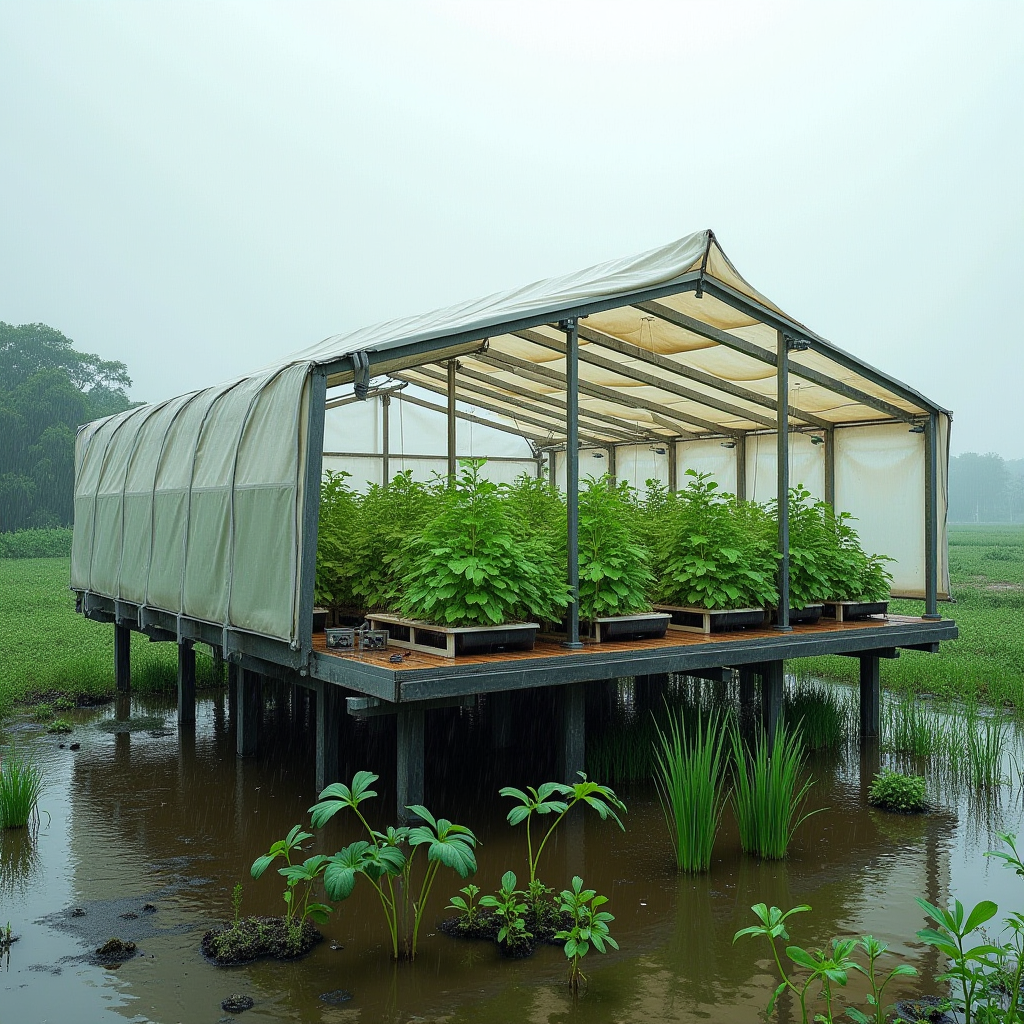
“Greenhouse” used to mean protection. In much of India today, a badly designed greenhouse can be the most hostile place on your farm between April and September.
Daytime canopy temperatures regularly cross 40 °C in many states. Nighttime humidity during the monsoon sits near 90%. Power cuts hit right when grids are stressed. If you are trying to keep Deep Water Culture (DWC), NFT, or high‑density leafy greens on target VPD and solution temperature in those conditions, a simple fan‑and‑fog setup will not save you.
That is exactly the failure mode the new Unnati Model Farm, a climate‑proof, tech‑enabled hydroponic project by Brio Hydroponics and IIT Guwahati, is designed to avoid. The initiative focuses on climate resilience and scalable technology for Indian growers, showing how to stabilise microclimate, automation, and resource use even under extreme weather, as reported in this coverage of the Unnati Model Farm.
This article uses that same “climate‑proof” framing and turns it into concrete design and operating specs you can actually build around: glazing and shade choices that keep solar gain under control, hybrid cooling for both dry heat and monsoon air, airflow targets around the canopy, nutrient solution temperature management, and blackout‑aware power planning that fits India and South Asia’s grid realities.
We will keep this practical. Think in terms of numbers, not wishful thinking.

2. The Breakdown: What “Climate‑Proof” Actually Means in Hot‑Humid India
2.1 Target outcomes, not just “cooling”
For a productive hydroponic greenhouse, your design should be built around these core targets for leafy greens and herbs in most Indian plains and hill‑edge climates:
- Canopy temperature: 22 - 28 °C for lettuce, basil, many leafy greens. Warm‑season crops (tomato, capsicum) can run slightly higher but yields still drop above 32 °C.
- Root‑zone / nutrient solution temperature: 18 - 24 °C for DWC, NFT, recirculating systems. Above ~26 °C, dissolved oxygen drops sharply and Pythium risk spikes, as widely noted in hydroponic research compilations such as this overview on hydroponics.
- Relative humidity (RH): 55 - 75% at canopy level for most leafy crops.
- VPD (leaf‑air vapour pressure deficit): 0.6 - 1.2 kPa for leafy greens in vegetative growth, 0.8 - 1.4 kPa for fruiting crops. This keeps transpiration and calcium transport in a stable range.
- DLI (Daily Light Integral): 12 - 17 mol/m²/day for lettuce and leafy greens, 18 - 25 mol/m²/day for fruiting crops, combining Sun and any supplemental LEDs. Guidance here aligns with ranges reported in controlled‑environment horticulture studies summarised in this agronomy review.
“Climate‑proof” means your greenhouse can stay close to those numbers in:
- Peak pre‑monsoon heat: 40 - 46 °C ambient, RH often 15 - 35% in interior regions.
- Monsoon: 26 - 32 °C ambient, RH 80 - 95%, with sudden solar swings on partly cloudy days.
- Frequent power dips: 15 - 60 minute cuts several times per week, and longer shutdowns during storms or local faults.
2.2 The four pillars of climate‑proof design
Drawing on the resilience framing of the Unnati Model Farm initiative and best practices from controlled‑environment agriculture in hot regions, we can break the design into four pillars:
- 1) Solar control: limit heat entering the structure with glazing, shade, and orientation.
- 2) Hybrid cooling: evaporative pad‑and‑fan for dry heat plus refrigerant or chilled‑water coils and dehumidification for monsoon.
- 3) Air movement and distribution: keep canopy air mixed and avoid dead pockets.
- 4) Nutrient and power resilience: keep solution cool and oxygenated, and critical loads alive through blackouts.
The rest of this guide walks those pillars as a complete scenario: from shell and cooling to root‑zone management and blackout SOPs.
3. The Action Plan: From Structure to SOPs
3.1 Shell design: glazing, shade, and orientation for Indian heat
Choose glazing for thermal performance, not just price.
- Material: For most serious hydroponic greenhouses, 8 - 10 mm twinwall or triplewall polycarbonate is a better starting point than single‑skin film. It reduces solar heat gain and buffers temperature swings compared to film, while still letting plenty of PAR in.
- Solar Heat Gain Coefficient (SHGC): Aim for SHGC ~0.5 - 0.6 in hot plains. Look for polycarbonate sheets with light‑diffusing, UV‑stabilised coatings and moderate shading. Diffuse light reduces leaf burn and improves uniformity, as shown in protected cultivation studies summarised in this review of greenhouse covers.
- Roof pitch and orientation: In much of India, a north‑south orientation with a 22 - 30° roof pitch helps distribute light more evenly over the year. Avoid large east and west transparent walls; use insulated or shaded facades on those sides where possible.
Use shade as a controllable “valve”.
- External shade nets: 35 - 50% shade, retractable or at least sectional, on the roof is key. External shading keeps the heat out rather than trapping it inside.
- Internal thermal screens: A second internal screen can be used in two modes: day mode to limit direct radiation on the canopy, and night mode to reduce longwave heat loss if you are at a cooler site.
- Setpoints: For leafy greens, start closing external shade when outside solar radiation exceeds ~700 W/m² or internal canopy temperature approaches 28 - 29 °C even with fans running.
For Kratky or low‑tech systems under polyhouse films (common with smaller growers), at least use:
- 150 - 200 micron UV‑stabilised film with diffusing additives.
- 50% external green or white shade net during pre‑monsoon and summer.
- White paint or lime coating on the upper third of sidewalls to reduce low‑angle heat.
3.2 Hybrid cooling: pad‑and‑fan plus mechanical dehumidification
India’s climate swings between very dry and very wet. Your cooling strategy must be able to operate in both regimes. The Unnati Model Farm’s technology‑enabled approach, as described in the project announcement, explicitly focuses on designs and automation that can adapt across seasons instead of a single fixed mode.
3.2.1 Pad‑and‑fan sizing for dry heat
In many interior regions (Rajasthan, Telangana interiors, Vidarbha, parts of Karnataka) during pre‑monsoon, outside air might be 40 - 44 °C and 20 - 30% RH. Evaporative cooling works very well here.
Design numbers:
- Air changes per minute (ACM): For hot climates, design for 1.0 - 1.5 ACM. That means the entire greenhouse air volume is exchanged 60 - 90 times per hour.
- Example calculation: A 500 m² greenhouse with an average height of 4 m has a volume of 2000 m³. At 1.25 ACM, you need 2000 × 1.25 = 2500 m³/min, or 150,000 m³/hr of airflow through the pads.
- Pad area: With typical pad velocities of 1 - 1.5 m/s, you need around 2 - 2.5 m² of pad area per 10,000 m³/hr of airflow. For 150,000 m³/hr, that is roughly 30 - 37.5 m² pad area.
- Water circulation: Design for 4 - 6 L/min per m² of pad area with a recirculation tank and filter.
If outside is 42 °C / 25% RH, well‑designed pads can drop supply air temperature to 28 - 31 °C while increasing RH. VPD remains workable if you maintain good air speed over the canopy.
3.2.2 DX or chilled‑water coils plus dehumidification for monsoon
During monsoon in coastal and northeastern regions, ambient might be 27 - 30 °C at 85 - 95% RH. Evaporative cooling here only adds moisture and destroys VPD. You need sensible cooling with active moisture removal.
Two practical options:
- Packaged DX (direct expansion) units with dehumidification mode: Essentially inverter split or ducted units sized for greenhouse load, distributing air through ducts or fabric socks above the canopy.
- Chilled water coils: Central chiller or heat pump feeding multiple air handlers. More CAPEX but better for larger farms with multiple bays.
Rule‑of‑thumb sizing for monsoon loads:
- For a well‑designed greenhouse with shading and low‑conductivity glazing, a starting point for cooling capacity is 160 - 250 W/m² of floor area in monsoon conditions, depending on crop density and light levels. So a 500 m² hydroponic unit might need around 80 - 125 kW of cooling capacity if fully mechanically conditioned.
- Use ducted distribution that delivers 0.3 - 0.6 m/s air speed in the crop zone. Avoid dumping cold air in one corner and expecting it to mix.
- Use thermostats and humidistats to drive cooling and reheat strategies so you do not run at 95% RH just to hit a temperature setpoint.
Hybrid strategy:
- Use pad‑and‑fan whenever outside RH is below ~60% and temperature is high.
- When outside RH rises, shift to DX or chilled‑water mode, closing the pad and tightening up the envelope to reduce wet air ingress.
- Use staged control: e.g., Stage 1: fans only, Stage 2: pads + fans, Stage 3: mechanical cooling + dehumidification. This is exactly the kind of automation stack tech‑enabled farms like Unnati are built around.
3.3 Airflow: canopy‑level targets and layout
Cooling capacity is wasted if it does not reach the crop uniformly.
- Target canopy airspeed: 0.3 - 0.8 m/s measured at plant height. Lower end for tender leafy crops, higher end for dense canopies and fruiting crops.
- Horizontal air flow (HAF) fans: Use small, efficient fans in racetrack patterns to ensure complete mixing. A rule of thumb is one HAF fan (0.3 - 0.5 kW) per 80 - 120 m², depending on layout.
- No dead corners: Watch for zones where leaves do not move. These are where powdery mildew, botrytis, and tip burn will concentrate during monsoon.
- Vertical mixing: In tall structures, use duct socks or perforated tubes to distribute conditioned air along the length of the greenhouse, not just from one end.
For NFT and DWC, good airflow around the canopy also stabilises nutrient uptake and reduces condensation on leaves, which in turn stabilises EC and pH trends by preventing erratic transpiration.
3.4 Reservoir and root‑zone management: keeping solution cool
In hot climates, you can do everything else right and still lose crops because nutrient solution runs at 28 - 32 °C all day. DWC especially becomes a pathogen incubator at those temperatures.
Design for 18 - 24 °C solution temperature, even when air is 30 - 32 °C.
- Insulate all nutrient tanks: Use 25 - 50 mm of closed‑cell foam or equivalent around sidewalls. Paint externals white or silver to reflect heat.
- Oversize your reservoirs: Larger volumes heat up more slowly. Design for at least 3 - 5 L of solution per plant site in DWC and 1.5 - 3 L per site in NFT to buffer fluctuations.
- Bury or semi‑bury tanks where possible: Earth is a free thermal mass. Even partially sinking tanks can drop peak solution temperatures by 2 - 4 °C.
- Run chiller coils or heat‑exchange loops: For serious operations, dedicate 40 - 80 W of chilling per 100 L of solution, depending on your max ambient. Many commercial systems use glycol loops coupled to chillers that also serve air handlers.
- High DO levels: Target 6 - 8 mg/L dissolved oxygen in DWC and raft systems. Use oversized air pumps, multiple stones, and redundancy. In hot water, more airflow is your only quick buffer if temperature rises.
- Light‑proof everything: No translucent tanks or pipes. Algae blooms spike pH, consume oxygen, and complicate EC readings.
Kratky in heat: In simple Kratky setups for balconies or small greenhouses, use reflective lids (white or silver), deep containers, and position them in the coolest area with maximum air movement. Top up with cool, shaded water and nutrients in the evening instead of during peak heat.
3.5 Water source, rain harvesting, and RO integration
Unnati’s climate‑proof framing also includes resource efficiency and smart water management. In many Indian locations, EC of borewell water is 0.8 - 1.5 mS/cm or higher, with bicarbonates that fight pH control. During monsoon, however, you may have large amounts of soft rainwater landing on your roof for free.
Practical integration strategy:
- Gutter your greenhouse roof: Capture rainwater into a dedicated raw water tank sized for at least 20 - 30% of your monthly irrigation demand.
- Pre‑filtration: Use leaf screens and a simple 100 - 200 micron sediment filter before storage.
- Blend and polish:
- Use rainwater as a low‑EC base when available, blended with borewell water as needed.
- Run the blended water through RO if your source EC or hardness is too high for stable nutrient management. Many controlled environment hydroponic operations in India already run RO to ensure consistent pH/EC behaviour.
- Nutrient preparation SOP: Always measure source water EC before adding nutrients. Subtract that from your target EC band, typically:
- 1.0 - 1.4 mS/cm for lettuce and leafy greens.
- 1.8 - 2.4 mS/cm for fruiting crops.
- pH management: Maintain pH 5.5 - 6.5. High bicarbonate water needs more acid and drifts quickly; RO or rainwater dramatically stabilises pH in recirculating systems.

3.6 Blackout‑ready power planning
A beautiful hydroponic greenhouse is worthless if your pumps and controls die during every storm. The South Asian reality is frequent grid instability, and the “climate‑proof” tag only means something if your farm can ride through it.
3.6.1 Categorise loads
Split your loads into three classes:
- Tier 1 (critical, must never stop):
- Nutrient circulation pumps for NFT and DWC.
- Air pumps for DWC and raft systems.
- Core control and monitoring (PLC, controllers, data loggers, network where needed).
- Tier 2 (important but can be cycled):
- Cooling systems: fans, pads, DX or chilled‑water pumps.
- Dehumidifiers and air handlers.
- Essential lighting (for seedlings or critical photoperiod).
- Tier 3 (non‑essential during an outage):
- Supplemental LEDs where natural light is adequate.
- Non‑critical plug loads, charging, etc.
3.6.2 Backup architecture
Minimum viable setup for a small to mid‑scale hydroponic greenhouse:
- UPS for Tier 1: Sizing for at least 30 - 60 minutes of runtime so pumps and controls do not stop during short cuts. Calculate your Tier 1 total wattage and multiply by outage duration to size the UPS (in Wh).
- Generator or hybrid inverter for Tier 1 + Tier 2: For a 500 m² climate‑controlled greenhouse, Tier 1 might be 2 - 5 kW, Tier 2 another 10 - 40 kW depending on cooling type. Use an automatic transfer switch (ATS) so the changeover is fast and predictable.
- Battery‑solar hybrid where feasible: In many parts of India, solar plus batteries can cover a decent portion of daytime load, especially circulation pumps and some fans. Cooling loads are heavy, but offsetting the base load reduces generator runtime and fuel costs.
Operational SOP during outages:
- Program your control system to shed Tier 3 and non‑critical Tier 2 loads automatically when on backup power.
- During long outages in extreme heat, prioritise root‑zone survival: keep pumps and aeration running even if you cannot fully cool the air.
- Accept a temporary VPD drift but keep EC and DO stable. Plants can recover from a few hours of heat stress; they will not recover from oxygen‑depleted roots.

4. Benchmarks & Metrics: Keeping VPD and DLI on Target Without Wasting Energy
4.1 Daily and weekly monitoring checklist
Climate‑proof design is only half of the story. The other half is predictable operation. Here is a practical monitoring checklist tailored for Indian heatwave and monsoon conditions.
Every day
- Canopy temperature and RH: Log at least morning, mid‑day, and late evening at several points in the greenhouse.
- VPD: Use an app or controller to calculate VPD from temperature and RH. Keep most readings in the 0.6 - 1.2 kPa band for leafy greens.
- Nutrient solution:
- Measure EC and pH of each system.
- Measure solution temperature at least once mid‑day.
- Cooling system behaviour: Note when pads, fans, and DX/chilled units stage on and off. Watch for any periods where temperature or RH drifts outside targets for more than 30 - 60 minutes.
- Power events: Record outages and how your backup system behaved. Did any pumps stop? Did any alarms trigger?
Every week
- DLI measurement: If you have a quantum sensor, record daily light integral. If not, use a PAR app or at least estimate based on average PPFD and photoperiod.
- Crop performance:
- Yield per m² per cycle.
- Root health inspection on sample plants (colour, smell, mucous films).
- Any heat or humidity stress symptoms (tip burn, leaf edge necrosis, oedema, botrytis, downy mildew).
- Energy and water use:
- Cooling kWh per kg of produce.
- Water consumption per kg of produce, including top‑ups to reservoirs.
4.2 Practical benchmark ranges for hot‑humid hydroponic greenhouses
For a well‑designed, Unnati‑style climate‑conscious system in Indian conditions, realistic mid‑term targets might look like this:
- Leafy greens yield: 3.5 - 6.0 kg/m² per month depending on crop and density.
- Average VPD: 0.7 - 1.1 kPa for at least 80% of occupied hours.
- Nutrient solution temperature: 18 - 24 °C for at least 90% of occupied hours, never above 26 °C for more than 60 minutes.
- DLI: 12 - 17 mol/m²/day for leafy greens, combining sun with any supplemental LEDs.
- Cooling energy intensity: Actual values will depend heavily on location and system type, but if you track kWh/kg and see it rising season after season, you know you are losing efficiency somewhere (dirty pads, poor insulation, uncontrolled air leaks).
- Water use: Expect at least 70 - 90% savings compared with open‑field production if you are capturing and recirculating nutrient solution and integrating rainwater harvesting, a trend supported by multiple studies summarised in this FAO report on water‑efficient agriculture.
4.3 How to iterate your design like a serious grower
Unnati’s model farm concept is about providing a living lab for technology and process refinement. You can copy that mindset on your site:
- Instrument first, optimise second: If you are guessing VPD or solution temperature, that is your first upgrade. Basic sensors are cheap compared with lost crops.
- Change one variable at a time: When you adjust pad area, fan speed, or dark‑cloth timing, track the impact on canopy temperature, VPD, and yield over at least two full crop cycles.
- Document SOPs: For heatwaves, monsoon onset, and blackout events, write down step‑by‑step actions for your staff. Practice them before you are under pressure.
- Design with failure in mind: Ask, “If the grid dies for 2 hours at 3 pm in May, what stays alive?” Build backwards from that answer.
If you treat climate‑proofing as a one‑time equipment purchase, it will disappoint you. If you treat it the way Brio Hydroponics and IIT Guwahati have framed Unnati - as a continuous, tech‑assisted process of stabilising your environment against heatwaves and monsoons - you will get crops that stay on schedule while others around you are shutting down.
As an Amazon Associate, I earn from qualifying purchases.