If your aquarium looks great but your basil looks miserable, your aquaponics design is the problem - not your green thumb.
Indoor growers and aquarists are quietly discovering one of the most satisfying winter projects you can build: a compact aquarium aquaponics system that turns fish waste into herbs, greens, and fresh lettuce all year. When it works, it is absurdly efficient. When it does not, you get yellow leaves, sick fish, and bio-gunk everywhere.
This guide is for people starting with an existing aquarium (20-150 L range is perfect) and wanting to bolt on a reliable plant system. We will focus on:
- Choosing between a media bed vs DWC raft over your tank
- Dialling in a safe fish-to-plant ratio using actual water tests, not guesswork
- Setting realistic pump turnover and flood/drain timing for small indoor systems
- Target pH and dissolved oxygen (DO) ranges that keep roots and fish happy
We will stay practical, numbers-based, and indoor-focused. No backyard ponds. No tilapia farm fantasies. Just small, dialled-in aquarium aquaponics you can actually maintain.
The Problem: Beautiful fish, sad plants, and unstable water
Most aquarium aquaponics failures cluster around a few very predictable pain points:
- Oversized fish loads that slam your biofilter and leave you with chronic ammonia or nitrite.
- Undersized or poorly designed plant beds where roots are either drowning (no oxygen) or starving (no nutrients).
- Sluggish plant growth because nitrates never really build, or pH is out of the plant comfort zone.
- Pump and flood cycles that are either too aggressive (stressing fish, temperature swings) or too weak (dead zones, sludge pockets).
- "Hydroponic" expectations in an aquaponic system: chasing high EC, hammering pH corrections, and forgetting there are animals in the loop.
Here is what that looks like in the real world with a typical 60 L indoor aquarium:
- You have a dozen fish, feed heavily, and run a single small planter over the tank.
- Ammonia and nitrite spike whenever you add fish or increase food.
- Plants stay pale, slow, or algae-covered, while you do water changes to save the fish.
- pH drifts unpredictably, and top-ups with tap water cause mini shock events.
All of this is fixable, but only if you treat your aquarium aquaponics as a designed system, not an afterthought bolted to the hood.
The Cause: Unbalanced loads, weak biofiltration, and mismatched layouts
1. Media bed vs DWC on an aquarium: choose the right workhorse
For small indoor systems, your grow area is not just a plant holder - it is your primary biofilter. That is why the layout choice matters more than most beginners realize.
Media bed over an aquarium
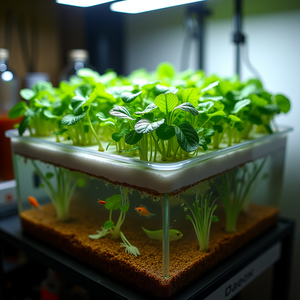
A media bed is a shallow tray (commonly 10-20 cm deep) filled with expanded clay, lava rock, or similar. Water from the tank floods the bed, bacteria convert ammonia to nitrate, solids get trapped, and plants root directly in the media.
Key advantages for aquarium aquaponics:
- Built-in biofilter: tons of surface area for nitrifying bacteria, as described in this basics of aquaponics guide.
- Mechanical filtration: captures fish solids so they can mineralize instead of circling the tank.
- Flood-and-drain friendly: every drain cycle pulls in fresh oxygen to the root zone.
- Forgiving for beginners: can handle minor overfeeding and stocking mistakes better than bare-root systems.
Drawbacks:
- Media adds weight, so you must support it properly above the tank.
- Neglected systems can clog with sludge and need occasional cleaning.
DWC raft over an aquarium
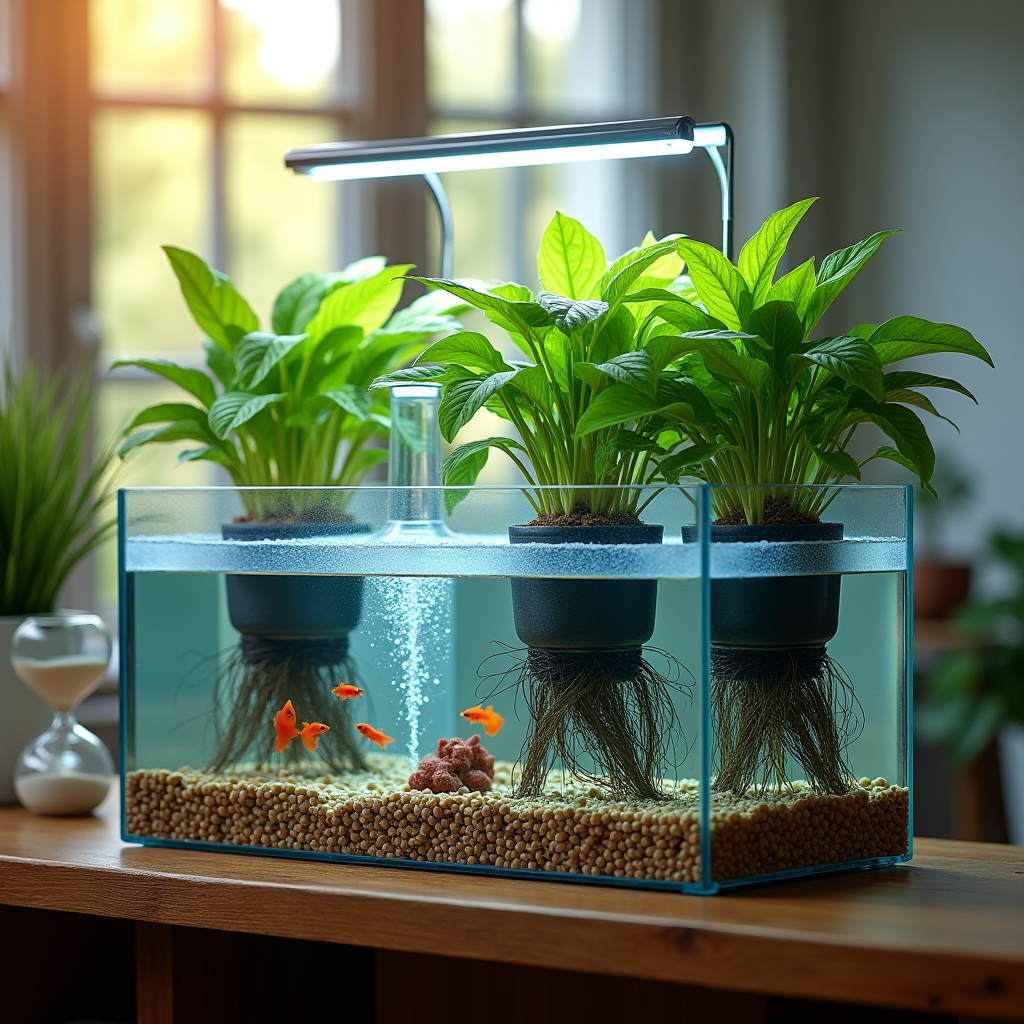
Deep Water Culture (DWC) in aquaponics is simply a raft or lid with net pots floating on a reservoir of aquarium water. Roots hang directly into the water, similar to hydro DWC, but nutrients come from fish waste instead of bottled salts.
Advantages:
- Very light and compact - great for small tanks and shelves.
- Easy plant handling - rafts lift off for inspection and harvest.
- Excellent for leafy greens and herbs if DO is high enough.
Drawbacks for small indoor tanks:
- No real solids filtration: you still need a sponge, canister, or pre-filter, as noted in Purdue's aquaponics overview.
- Heavily reliant on aeration to avoid root rot and oxygen stress.
- Less biological buffering than a media bed, so swings show up faster.
A practical compromise for aquarium growers: run a small media bed as the first stage (solids and biofilter) and a mini DWC raft after it if you want more plant sites. But if you are just starting, a single media bed over the tank is usually the better first build.
2. Fish-to-plant ratio: stop guessing, start testing
Most "rules" about fish density are aimed at commercial setups or big IBC systems. For a living room 40-80 L aquarium, use water tests as your main guide.
General safe starting point for an indoor display tank:
- Fish load: roughly 0.25-0.5 kg of fish per 100 L of water in aquaponics-style systems, lower than pure aquaculture recommendations for margin of error.
- Plant area: aim for about 0.05-0.1 m² of well-lit grow bed per 40-60 L aquarium for leafy greens (around 6-12 medium plant sites).
Better than generic ratios is this simple test-driven approach, supported by guidance from practical aquaponics resources like this beginner system guide:
- Cycle the tank and bed fully before adding many fish.
- Add a modest fish load and feed lightly.
- Track ammonia, nitrite, and nitrate at least twice a week for the first month.
Then interpret:
- Ammonia & nitrite should read 0 ppm in a mature, balanced system.
- Nitrates should typically sit between 20-80 ppm for actively growing greens.
- If ammonia or nitrite are regularly above 0.25 ppm, your fish load or feeding is too high for your biofilter.
- If nitrates are constantly at 0-5 ppm and plants are pale, you either have too few fish, you are underfeeding, or plant mass is oversized relative to fish.
3. pH and DO targets that keep both sides happy
Aquaponics is a compromise between fish, bacteria, and plants. Most aquarium species are fine in pH 6.5-7.5. Nitrifying bacteria work best around pH 7-8, while plants prefer around 5.8-6.5 like typical hydroponics. Indoor aquarium aquaponics settles in the middle.
For a small indoor system, aim for:
- pH: 6.6-7.2. This keeps plants reasonably happy without stressing common aquarium fish, a middle ground also highlighted in Clemson's aquaponics introduction.
- DO (dissolved oxygen): keep it above 5 mg/L for fish health, and ideally closer to 6-8 mg/L in DWC or heavy plant load situations.
- Temperature: 20-26°C works for most aquarium species and cool-season greens like lettuce and herbs.
If you do not own a DO meter, treat surface agitation + an air stone as non-negotiable, especially for DWC rafts. Roots and fish are pulling from the same oxygen budget.
The Solution: A compact, balanced aquarium aquaponics design you can copy
Let us put numbers to this and walk through a practical, repeatable layout for winter indoor growing.
Step 1: Pick your layout - media bed, DWC, or hybrid
Baseline recommendation: single media bed over the tank
For a 60 L aquarium, a good starting spec looks like this:
- Tank: 60 L with small, hardy fish (e.g., guppies, white cloud minnows, or similar community fish).
- Media bed: 40 x 30 cm tray, 12-15 cm deep, filled with rinsed expanded clay.
- Flow pattern: pump from tank up to media bed, drain back via standpipe and bell siphon or simple overflow.
This gives you biofiltration, solids capture, and plant support in one unit. Run this alone for the first month or two, then add a small DWC raft later if you want extra sites.
When to prefer DWC over media
Choose a DWC-first design only if:
- You already have a strong aquarium filter handling solids and biofiltration.
- You want very low weight over the tank (e.g., fragile stands, wall shelves).
- Your focus is fast-turnover greens and you can commit to strong aeration.
In that case, use a shallow DWC tray or raft beside or above the aquarium, fed from the filter outflow, and return water to the tank with a slight drop to add oxygen.
Step 2: Dial in pump turnover and flood/drain timing
Pump sizing and timing is where indoor aquaponics often gets sloppy. Too many people just plug in a pump and hope. Instead, calculate backwards from tank volume.
For aquarium-scale systems, a solid rule of thumb from home aquaponics practice and guides like this DIY aquaponics resource is:
- Turnover: move roughly the full tank volume through the grow bed 1-2 times per hour.
- For a 60 L tank, target 60-120 L/h of real flow after head-height losses.
Media bed: ebb and flow timing
With a bell siphon or timed flood-and-drain, aim for:
- Flood time: 10-20 minutes to reach max height in the media bed.
- Drain time: 3-10 minutes to fully empty back into the tank.
- Cycle frequency: 2-4 complete flood/drain cycles per hour is great for indoor media beds.
On a timer-based flood-and-drain (no siphon), a simple starting program is:
- 15 minutes ON, 45 minutes OFF, 24/7.
That usually gives you enough exchanges to keep roots oxygenated and nutrients moving without overheating pumps or super-chilling the tank with constant flow.
DWC: continuous flow and aeration
DWC does not need ebb and flow. Instead, focus on:
- Constant gentle flow through the raft channel or tray.
- Strong aeration via air stones directly underneath root zones.
For a small raft fed from an aquarium, aim for:
- Turnover of the DWC volume at least once per hour.
- Air pump sized for at least 0.5-1 L/min per plant site for dense rafts.
Step 3: Stocking and feeding based on test results, not charts
Once your system is built and cycled, use this staged approach:
- Week 0-4: Run the tank with media bed and no or very few fish. Seed bacteria with a small amount of flake food or bottled nitrifying bacteria.
- Week 4-8: Add a light fish load (for 60 L, perhaps 4-6 small community fish). Feed once per day, only what they clear in 30-60 seconds.
- Plant the bed with fast greens (lettuce, basil, mint, pak choi, chives).
- Measure ammonia, nitrite, nitrate, and pH weekly.
Only add more fish if:
- Ammonia and nitrite are consistently at 0 ppm.
- Nitrates sit above 10-20 ppm with healthy plant growth.
Never chase nitrate numbers at the expense of fish comfort. Aquaponics is slower to respond than bottled hydro nutrients. Patience pays off in stability.
Step 4: Lighting and plant choice for real productivity
Aquarium lights rarely cut it for dense herb production. For winter indoor growing, treat the grow bed as a proper indoor garden:
- Light duration: 12-16 hours per day for leafy greens and herbs.
- Distance: keep LEDs 20-35 cm above the canopy for most compact fixtures.
- Plants: lettuce, basil, mint, oregano, pak choi, chard, coriander, and small Asian greens perform best in aquarium aquaponics.
Stay away from heavy feeders (tomatoes, cucumbers, big peppers) unless you have a larger fish load, more water volume, and better filtration. For a 60 L aquarium, think salad bar, not salsa factory.
Step 5: Ongoing water management and pH nudging
Because aquaponic systems naturally acidify over time as biofiltration and plant uptake progress, expect pH to drift downward slowly. Instead of aggressive chemical swings:
- Top up evaporated water with dechlorinated or RO water.
- Use buffering media (e.g., a small bag of crushed coral in the filter) if your system tends to crash below pH 6.4.
- If you must adjust, use small, diluted doses of aquaponics-safe pH up/down, checking fish behavior after changes.
Unlike pure hydroponics, you generally do not chase specific EC values in aquaponics. EC is still useful to watch trends, but nutrient concentration comes from feed rates and fish metabolism, not your bottle.
Putting it all together
A balanced aquarium aquaponics system for indoor growers looks something like this:
- 60 L aquarium with moderate stocking, strong aeration, and stable temperature.
- Single media bed over the tank, sized ~40 x 30 x 15 cm, filled with expanded clay, run on 15 min ON / 45 min OFF flood cycles.
- pH stable in the 6.6-7.2 range, DO high thanks to air stones and drain return splash.
- Water tests guiding fish additions and feeding, not guesswork.
- Dedicated grow light over the bed running 12-16 hours daily.
From there, you can add a small DWC raft, extra media modules, or even a vertical tier, but the backbone is the same: correct fish load, robust biofiltration, and predictable flood/drain timing.

As an Amazon Associate, I earn from qualifying purchases.