Aquaponics Ammonia Control: Stop Betting On Plants To Fix A Biofilter Problem
“Plants will take care of the ammonia.” That line has crashed more aquaponics systems than bad pumps ever will.
Yes, plants can help with ammonia. No, they cannot save fish from a weak biofilter, high pH, and an overloaded tank. If you design your system assuming plant beds will “soak up” ammonia directly, you are gambling with fish health, biofilter maturity, and plant roots.
This guide strips the topic down to what actually matters: how ammonia behaves in aquaponics, what plants really remove, how to size your biofilter for TAN, and how to monitor free ammonia (NH3) so you act before toxicity spikes. We’ll stay practical and numbers-based, so you can tune your system instead of guessing.
1. Common Mistakes In Aquaponics Ammonia Control
1.1 Treating plants as the primary ammonia filter
A wave of articles and videos say plants “lower ammonia levels” in water. That is only half true. As discussed in this guide, plants are very good at removing ammonium (NH4+) and nitrate (NO3−), but the really dangerous form in aquaponics is free ammonia (NH3), which is far more toxic to fish.
In a real system, the sequence is:
- Fish excrete total ammonia nitrogen (TAN), a mix of NH3 and NH4+.
- Nitrifying bacteria in the biofilter oxidize TAN to nitrite (NO2−) and nitrate (NO3−).
- Plants take up NO3− and NH4+ as nitrogen sources.
Plants are the cleanup crew, not the emergency brake. If your TAN and NH3 are climbing, you have a biofilter and loading problem, not a plant density problem.
1.2 Ignoring the difference between TAN and free ammonia (NH3)
Most test kits give you TAN. That number alone does not tell you how dangerous your water is. Toxicity is driven by the fraction of TAN that exists as free ammonia (NH3), which depends on pH and temperature. As pH and temperature rise, more TAN becomes NH3 and fish stress ramps up fast, even if the TAN reading has not changed.
Two growers can both measure 1.0 mg/L TAN:
- Grower A: pH 6.6, 22 °C - mostly safe NH4+, tiny NH3 fraction.
- Grower B: pH 8.2, 28 °C - a much higher fraction as NH3, potentially in the danger zone.
Ignoring this split is how “numbers looked fine” turns into a sudden fish kill.
1.3 Undersizing the biofilter and oversizing the fish load
Another classic mistake: packing in more fish because the plants “look hungry” or the nitrates look low. The system might survive for a while, but the biofilter is already behind. Then you add a hot day, a leftover feed dump, or a clogged line. TAN spikes, NH3 spikes harder, and the biofilter cannot keep up.
Despite many hobby rules floating around, reliable design should start from feed rate and TAN production, not just tank volume. If you do not match your biofilter media area to the expected TAN load, you are permanently on thin ice.
1.4 Running pH high “for the bacteria”
Nitrification does like neutral to slightly alkaline conditions, but pushing pH up into the 7.5–8.0 range in a warm system can turn a safe TAN level into a dangerous NH3 level very quickly. As noted in this article, the NH3 fraction climbs sharply with pH. Running “high pH for bacteria” without watching NH3 is an easy way to stress fish and burn roots.
1.5 Relying on plants that do not pull nitrogen fast enough
If your plant beds are packed with slow, woody crops or stressed plants, they are not consuming much nitrate or ammonium. That leaves more inorganic nitrogen circulating and ramps up the pressure on the biofilter. Many systems look “planted” but are not actually running serious nitrogen uptake because the crop choice and plant health are wrong.

2. Why These Ammonia Problems Happen
2.1 The chemistry: TAN vs NH3 vs NH4+
Total ammonia nitrogen (TAN) is the sum of two forms:
- NH3 (unionized ammonia) - highly toxic, can damage gills and kill fish at very low levels.
- NH4+ (ammonium) - far less toxic, plant-available nitrogen.
The balance between NH3 and NH4+ is controlled by pH and temperature. At lower pH (around 6–7), most TAN is in the safer NH4+ form. As pH and temperature climb, the percentage present as NH3 rises. This is why a small pH increase can turn a stable system into a crisis, even if the TAN number on your test kit barely moves.
Research summarized in this guide and aquaculture manuals agrees on one point: long-term safe NH3 levels are very low, often quoted around 0.02–0.05 mg/L for many warmwater fish. That leaves very little room for sloppy management.
2.2 What plants actually do with nitrogen
Plants in aquaponics consume nitrogen mostly as:
- Nitrate (NO3−) - the main, stable form.
- Ammonium (NH4+) - can be taken up readily but can cause toxicity if it dominates.
They do not convert toxic NH3 into something safe. They simply draw down the pool of NO3− and NH4+, which indirectly reduces TAN and total inorganic nitrogen in the system.
In practice, this means:
- Plants are excellent at controlling long-term nitrogen accumulation (especially nitrate).
- They are not fast enough or reliable enough to protect fish from a sudden ammonia surge when a biofilter fails or is undersized.
2.3 Biofilter limitations: surface area, DO, and maturity
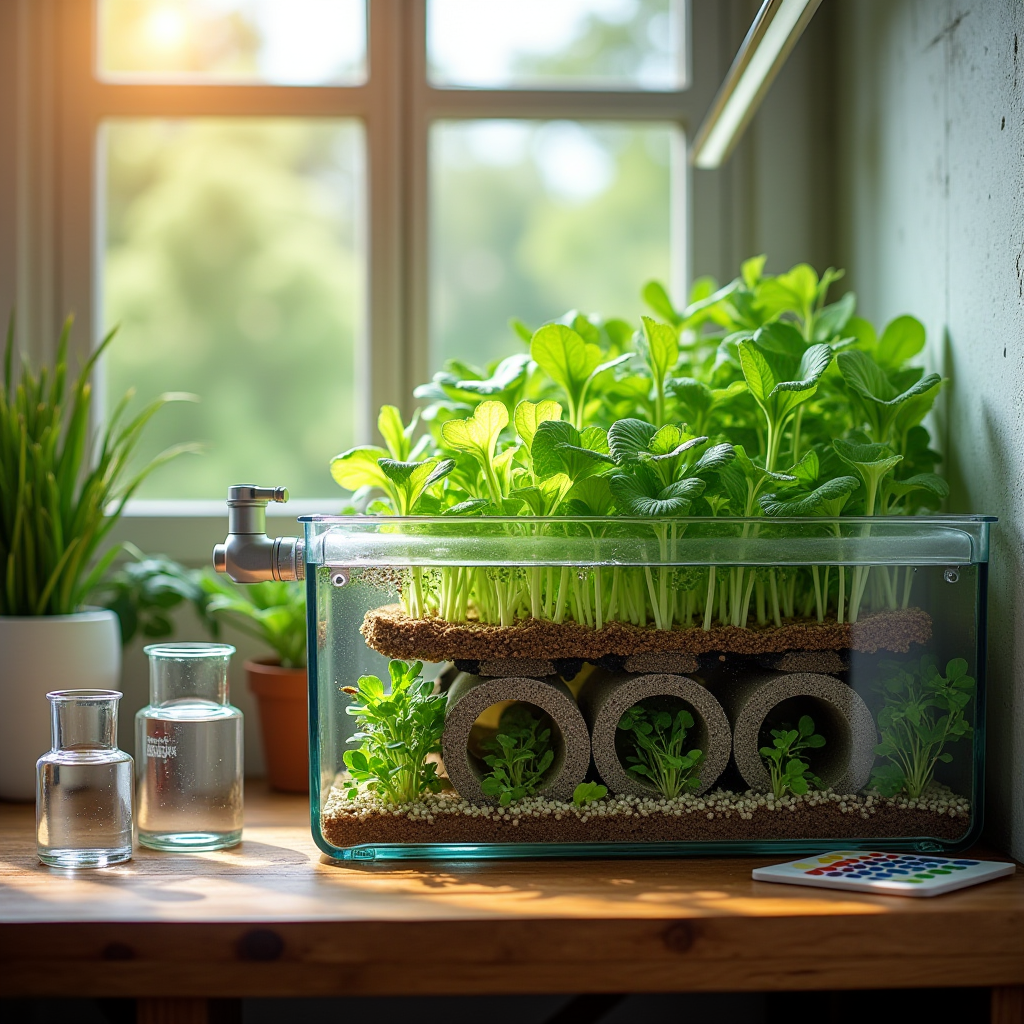
Nitrifying bacteria live on surfaces - media, tank walls, pipe interiors - but your main engine is the biofilter media. For a given feed rate, there is a minimum surface area and oxygen supply needed to oxidize the daily TAN load. If you do not provide that, TAN creeps up and nitrite often follows.
Key constraints:
- Insufficient surface area - not enough media volume or low specific surface area media.
- Poor dissolved oxygen - nitrifiers slow down when DO drops, especially in clogged or stagnant media.
- Young biofilter - newly set up systems simply do not have mature bacterial populations yet.
This is why stable aquaponics systems obsess over aeration, media choice, and cycling time.
2.4 System loading: fish, feed, and plant mismatch
Ammonia input is roughly proportional to feed input. The more protein you push through the fish, the more TAN you get. Problems appear when:
- Daily feed rate rises but biofilter size and aeration stay the same.
- Plant area and health do not keep up, so nitrate and ammonium accumulate.
- Water temperature climbs, which both increases NH3 fraction and speeds fish metabolism.
Even a perfectly designed system on paper can glitch if the actual feed load drifts higher than planned.
3. How To Fix Ammonia Control In Aquaponics
3.1 Step 1 - Start with clear targets
Set simple, fish-safe water targets for a cycled system:
- TAN: ideally < 0.5–1.0 mg/L.
- Free NH3: well below your species’ limit, often < 0.02–0.05 mg/L.
- Nitrite (NO2−): < 0.5 mg/L, preferably close to zero.
- Nitrate (NO3−): variable; many systems run 40–150 mg/L without fish stress.
- pH: 6.4–7.0 as a working band.
- DO: > 5 mg/L in fish tank and biofilter.
These are starting points. Always check species-specific guidance for your fish.
3.2 Step 2 - Size the biofilter based on TAN production
Do not guess biofilter size. Work from feed and TAN. A practical method:
- Estimate daily feed at your planned stocking: for example, 500 g/day.
- Estimate TAN from feed. A common guide is that roughly 25–35% of feed nitrogen is excreted as TAN; many designers convert this to a rule of thumb like “X grams TAN per 100 g feed” for a given feed and species.
- Use manufacturer or literature data for your media to get a nitrification rate: grams TAN per m² surface area per day under good conditions.
- Calculate required media area so that (media area × nitrification rate) ≥ daily TAN load.
- Add a safety factor (1.5–3×) to cover real-world issues like cooler temps, lower DO, and partial clogging.
For moving-bed media with high specific surface area (SSA), you may only need a relatively small volume for a hobby system. For low-SSA options like gravel, you need much more volume to process the same TAN.
3.3 Step 3 - Maintain DO and flow for the biofilter
A beautifully sized biofilter is useless if the water through it is slow, low in oxygen, or partially stagnant. Focus on:
- Strong aeration in the fish tank and biofilter chamber.
- Even flow distribution across all media, avoiding dead zones.
- Regular inspection for clogging with solids or biofilm sludge.
As pointed out in recent coverage, nitrifying bacteria are oxygen-hungry; if DO drops, they slow down before fish show visible distress.
3.4 Step 4 - Dial in pH to control NH3 fraction
Your pH target is where fish, bacteria, and plants all “accept” the compromise. A practical band is 6.4–7.0:
- Below ~6.2, nitrification rate drops, and you can see TAN creep up.
- Above ~7.2, the NH3 fraction climbs and makes any TAN spike more dangerous.
Actionable approach:
- Check pH daily in new systems, then at least several times a week.
- Use calcium carbonate, potassium carbonate, or bicarbonate mixes to gently raise pH and alkalinity when it drifts down.
- Avoid big jumps; adjust in small doses and observe.
3.5 Step 5 - Use a free ammonia (NH3) calculator, not guesswork
To estimate NH3 you need three numbers:
- TAN (mg/L)
- pH
- Water temperature (°C)
Online “free ammonia NH3 calculator aquaponics” tools and many aquaculture references use the same equilibrium formula to calculate the NH3 fraction from TAN. You can also set this up in a spreadsheet so you can type in TAN, pH, temperature and get NH3 instantly.
Once you see NH3 plotted over time, the link between pH, temperature, and toxicity becomes very obvious, and it gets much easier to justify tight pH control.

3.6 Step 6 - Choose plants that actually move nitrogen
Fast-growing plants are your allies. For strong ammonium and nitrate uptake in aquaponics, focus on:
- Leafy greens: lettuce, pak choi, kale, Asian greens.
- Herbs: basil, mint, cilantro (coriander) in cool conditions.
- Aquatic/semiaquatic species (in side-stream polishing beds): watercress, kangkong (water spinach), duckweed.
These species have high nitrogen demand and can tolerate a portion of their nitrogen as NH4+. But they still depend on the biofilter to keep NH3 low enough that roots and microbes are not being burned.
3.7 Step 7 - Control EC as a supporting metric
EC (electrical conductivity) does not tell you anything directly about TAN or NH3, but it is a good “background noise” indicator for nutrient levels. In aquaponics, typical EC is lower than in salt-heavy hydroponic recipes, yet plenty for leafy greens.
Use EC to support your nitrogen management:
- Rising EC with rising nitrate suggests the system is accumulating nutrients faster than plants can use them.
- Falling EC and pale plants may mean your plant load is high relative to fish load, or you are underfeeding.
Because aquaponics nutrients come from feed, do not “chase” a hydroponic-style EC target. Instead, look at EC trends alongside TAN, nitrate, and plant symptoms.

4. What To Watch Long-Term: A Simple Ammonia SOP
4.1 Daily and weekly monitoring routine
Build a simple, repeatable monitoring SOP so you never “forget” about ammonia until it is too late:
- Daily (especially in new or heavily stocked systems):
- Check fish behavior, feed response, and any gasping at the surface.
- Measure pH and water temperature.
- Glance at DO if you have a meter, or at least confirm all aeration is running.
- 2–3 times per week (mature systems):
- Measure TAN and nitrite (NO2−).
- Log values so you see trends instead of isolated numbers.
- Weekly:
- Measure nitrate (NO3−) and EC.
- Do an NH3 calculation for at least one set of TAN/pH/temperature readings.
4.2 Response plan when TAN creeps up
When you see TAN rising above your normal baseline, act in layers:
- Reduce feed by 25–50% temporarily.
- Check pH and temperature. If pH is high, plan to nudge it down into the mid-6 range using compatible acids or by letting nitrification pull it down while buffering carefully.
- Boost aeration immediately to support both fish and nitrifiers.
- Inspect biofilter for clogs, low flow, or dead zones.
- Consider partial water change if NH3 is approaching species limits and you need fast relief.
Once TAN returns to normal, do not immediately jump back to the old feed rate. Increase feed in small steps while watching TAN and NH3.
4.3 Response plan for nitrite spikes
Nitrite spikes usually show up when the first-stage nitrifiers (ammonia oxidizers) outpace the second-stage nitrifiers (nitrite oxidizers), or after a disturbance. In that case:
- Follow the same initial steps as for TAN: reduce feed, increase aeration.
- Add chloride (Cl−) via non-iodized salt at appropriate rates for your species; this can protect fish by reducing nitrite uptake at the gills (check species-specific guidance).
- Stay patient: let the nitrite-oxidizing bacteria catch up.
4.4 Long-term plant strategy for nitrogen balance
Over months, your plant plan matters:
- Keep a solid core of fast-growing leafy crops to maintain strong nitrogen uptake.
- Add slower, fruiting plants only if your fish load and feed rate can support the extra demand.
- If nitrate stays pegged high even with full beds, consider increasing plant density or adding a secondary polishing bed (e.g., with watercress or duckweed in a side loop).
This keeps nitrate from creeping into “swamp” territory and reduces pressure on the system if anything temporarily slows the biofilter.
4.5 System upgrades that make ammonia control easier
Once you have basic control, a few upgrades make life easier:
- Dedicated moving bed biofilter with high-SSA media and strong aeration.
- DO meter so you can see oxygen trends, not just “bubbles look okay.”
- Simple spreadsheet or app to log TAN, pH, temperature, and auto-calc NH3.
- Backup air pump or generator to prevent crashes during power cuts.
None of this has to be expensive. It is about putting measurement and buffer capacity ahead of crisis response.

Closing Thoughts: Put The Biofilter First, Let Plants Do The Polishing
In a stable aquaponics system, plants absolutely help control nitrogen. Fast-growing greens and herbs can pull a lot of nitrate and some ammonium from the water. But they are not your primary ammonia removal technology. That job belongs to a well-sized, well-aerated biofilter backed by disciplined pH, temperature, and feed management.
Translate the “do plants remove ammonia in aquaponics” question into a clearer plan:
- Design around TAN load, not wishful thinking.
- Use a free ammonia (NH3) calculator so toxicity is never a mystery.
- Keep pH in a tight band where NH3 stays low and nitrification stays strong.
- Grow vigorous plants that actually move nitrogen, but never treat them as a safety net for biofilter shortcuts.
Do that, and your fish stay alive, your plants stay lush, and your system stops feeling like a gamble.
As an Amazon Associate, I earn from qualifying purchases.