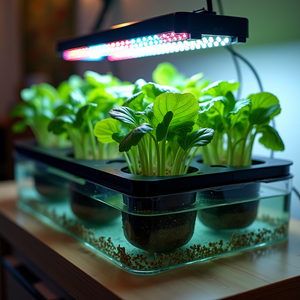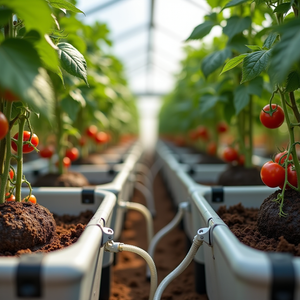
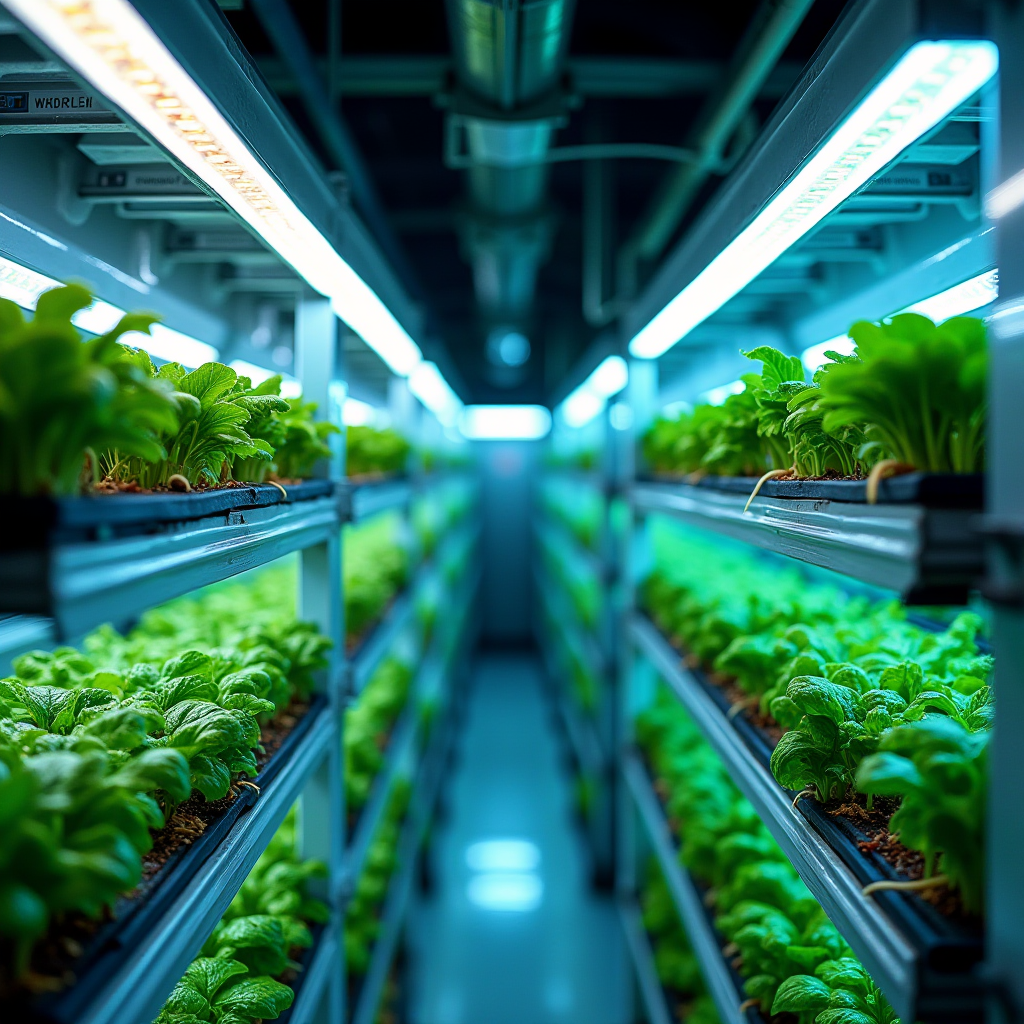
“Running LEDs at 100% all day is not a lighting strategy. It’s a donation to your utility.”
Most hydroponic greenhouses and vertical farms are still lighting like it’s 2015: fixed spectra, flat schedules, and a power bill that climbs every time you push for more yield. The myth is that any reduction in light automatically means less production.
In 2026, that’s no longer true. With AI-controlled, spectrum-tunable LEDs, you can hit the same PPFD and DLI targets, ride demand-response signals, and even enhance flavor and morphology while cutting kWh per kilogram.
This isn’t about shiny dashboards. It is about using dynamic dimming and spectra like real control variables: shifting load away from price spikes, matching photons to plant stage, and protecting margins as energy costs and market volatility keep rising. Recent market work on AI in agriculture points in the same direction: AI/IoT-led optimization is moving from pilot to standard practice in commercial production, with the AI in agriculture market projected to reach around $1.7 billion by 2031 at a 9.5% CAGR, driven by exactly these efficiency gains in controlled systems as noted here.
Let’s walk through a realistic scenario and convert it into a concrete action plan for your hydroponic greenhouse or vertical farm.
1. The Scenario: Same Yield, Lower kWh/kg
Picture a 2,000 m² leafy-green greenhouse running DWC gutters, plus a 150 m² R&D vertical rack area for herbs and compact vine crops.
- Utility tariffs are time-of-use with brutal late-afternoon peaks.
- You signed up for a demand-response program: when the grid is stressed, you get a text and a price spike.
- Lighting is your dominant electrical load, well ahead of pumps and nutrient dosing.
Your goals for the next 12 months:
- Cut lighting kWh/kg by at least 15%.
- Hold or slightly improve yield and crop time.
- Use existing spectrum-tunable LEDs (or your next fixture upgrade) and an AI/IoT control layer instead of adding more hardware complexity.
This is the exact problem dynamic “sun-like” systems such as those from Sollum Technologies are targeting. Their greenhouse deployments use fully programmable spectra and intensity to mimic natural daylight or execute custom, cloud-controlled recipes throughout the day, with growers reporting more precise control over energy use and quality traits as highlighted here.
Now we break this scenario down into simple, controllable pieces: light quantity, spectrum, timing, and how that interacts with your hydroponic system.
2. The Breakdown: PPFD, DLI, Spectrum, and the Power Bill
2.1 PPFD and DLI: Your Primary Control Targets
You do not need constant high intensity to hit crop light requirements. You need the right daily total.
- PPFD (µmol·m²·s) is your instantaneous light at canopy.
- DLI (mol·m²·day) is total PAR over the day and is what plants actually integrate.
They are linked by:
DLI (mol·m²·day) = PPFD (µmol·m²·s) × photoperiod (seconds) ÷ 1,000,000
Example for lettuce:
- DLI target: 17 mol·m²·day.
- Options:
- 240 µmol·m²·s for 20 hours, or
- 340 µmol·m²·s for 14 hours, or
- A dynamic mix, as long as the integrated total stays near 17 mol.
AI lighting control is about shaping that PPFD curve around energy prices, natural light, and plant needs while keeping the DLI stable.
2.2 Dynamic Spectrum: Why It Matters For kWh/kg
Modern greenhouse and vertical-farm LEDs typically expose at least three independent channels (blue, red/deep red, and sometimes a broad white or far-red). Systems like Sollum’s expand this into many channels to emulate full sunlight and adjust spectra in real time.
Spectrum affects:
- Canopy architecture (compact vs stretched).
- Leaf thickness, color, and nutritional compounds like anthocyanins.
- Photosynthetic efficiency at a given PPFD.
Blue is powerful but more energy-expensive per effective photon. Red is highly efficient but can drive softer, more elongated growth if overused. Far-red can influence flowering and extension but must be used sparingly.
The energy play is simple: maintain the minimum blue you need for morphology and quality, then lean harder on high-efficacy red/deep-red when you are pushing biomass. AI scheduling does that automatically per growth stage, per zone.
2.3 Energy & Market Context
This isn’t hypothetical. Industry reports show AI, IoT, and data platforms are becoming central in agricultural technology growth strategies, particularly in energy- and input-intensive segments like CEA as discussed in this AgTech report. On the infrastructure side, modular commercial greenhouse projects are leaning on advanced controls and strategic tech partnerships to stay viable under rising power prices and climate volatility as noted here.
For hydroponic operators, that translates into one clear mandate: treat lighting schedules as a financial instrument, not a fixed asset.
3. The Action Plan: AI Lighting Schedules That Actually Save Money
3.1 Step 1: Lock In Agronomic Targets
Start with the biology, not the tariff sheet. For each crop/zone, define:
- DLI range by stage (e.g., lettuce 12–18 mol·m²·day, basil 15–20).
- PPFD comfort band at canopy (for most leafy greens: 200–350 µmol·m²·s in greenhouse, 220–380 in vertical racks).
- Acceptable photoperiod window (for example, 14–20 hours) to keep circadian cues coherent.
Your AI or control layer needs these as hard constraints. You can run “lean” within the band on expensive days and push toward the high end on cheaper ones, but you do not cross the lower limit without a very good reason.
3.2 Step 2: Integrate Energy Prices and DR Signals
Next, feed your lighting controller real-time or day-ahead pricing and DR signals. At minimum, you want:
- Day-ahead price curve or fixed peak/off-peak periods.
- Real-time alerts for DR events (usually 1–4 hour windows).
A practical control rule set looks like this:
- Off-peak: run PPFD in the mid to high end of the crop’s band.
- Peak: dim down to your minimum PPFD that still allows you to reach DLI by end-of-day, or temporarily accept a small DLI reduction within a weekly band.
- DR event: apply a deeper dim (for example, 30–50% reduction) on compliant zones first, then compensate with slightly higher PPFD before or after the event to recover DLI.
In a greenhouse, the AI also accounts for forecast solar DLI. On a bright day, it will automatically reduce supplemental PPFD even during off-peak periods.
3.3 Step 3: Build Dynamic Spectral Schedules
Once timing and PPFD are handled, layer in spectra.
Base recipe examples for leafy greens:
- Propagation (days 0–10): 20–25% blue, 60–70% red, 5–10% green/white, minimal far-red.
- Vegetative push: 12–18% blue, 65–75% red, 5–15% green/white, optional 2–5% far-red late in “day” if you want a softer canopy.
AI scheduling adjusts within these bands:
- More blue during early photoperiod to keep internodes tight.
- More red during high-PPFD periods (especially when power is cheapest) for better photon efficiency.
- Short far-red or spectrum shifts at “sunset” to trigger desired morphology or color changes.
Nasa’s long-running work on space-based plant growth has shown that carefully tuned spectra and time-of-day lighting can control morphology and resource efficiency in closed systems, informing many current CEA strategies as summarized here. Commercial platforms are essentially industrializing this idea.
3.4 Step 4: Tie Lighting Directly to kWh/kg
None of this matters unless you track it. For each crop, log per batch:
- Total kWh for lighting in that zone.
- Harvested kilograms of marketable product.
- Resulting kWh/kg.
Run A/B blocks:
- Block A: your current “static” lighting schedule.
- Block B: AI-optimized schedule with dynamic dimming and spectrum.
Compare:
- kWh/kg.
- Days to harvest.
- Leaf color, thickness, taste (basic sensory panel is enough at first).
If you are not seeing at least a 10–15% improvement in kWh/kg with equal or improved quality, tighten your constraints or revisit your DLI assumptions. It usually means you are still over-lighting somewhere.
4. Benchmarks & Metrics: How To Know You’re Really Optimized
4.1 Lighting KPIs That Matter
Track these by zone and by crop:
- DLI delivered vs DLI target: daily and averaged weekly.
- PPFD variance across the canopy: uniformity matters more as you dim.
- kWh/m²/day and kWh/kg: your core efficiency metrics.
- Peak demand: your maximum kW draw during tariff peak windows.
A solid target for a well-run leafy-green vertical rack with decent fixture efficacy and AI scheduling is often in the 3.5–6.0 kWh/kg range, depending on product and market. Greenhouses with strong solar contribution should come in lower.
4.2 Hydroponic System Benchmarks Under Dynamic Lighting
When you move to dynamic lighting, your hydro system has to keep up.
DWC or NFT benches
- Solution temp: 18–22 °C, daily swing < 3 °C.
- pH: 5.6–6.2 most of the time; minimal oscillation with dosing.
- EC drift: < 0.2–0.3 mS/cm per day between corrections under stable plant load.
When you push higher DLI or run long photoperiods, transpiration spikes. You’ll see faster water drawdown and faster EC climbs if you top up late. An AI controller that ties light intensity to predicted water and nutrient use can slow PPFD if the reservoir is nearing critical limits, protecting roots while you fix the underlying issue.
Kratky and low-tech systems
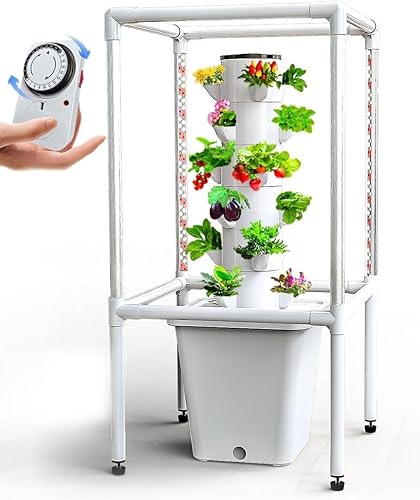
Kratky and other passive setups on balconies or small rooms will not be running advanced AI, but the logic still applies at a smaller scale. If you upgrade to a programmable LED bar over a Kratky shelf, you can manually mimic AI strategies:
- Run higher intensity during your cheapest hours (often overnight with domestic tariffs).
- Trim intensity and keep to the lower end of your DLI band when household demand is high.
- Watch EC closely; high light with small reservoirs means concentration rises fast.
4.3 Quality Traits and “Bonus” Gains
AI spectrum scheduling lets you do more than defend yield. You can deliberately tweak traits such as:
- Leaf color in red or purple basil by increasing blue and a bit of far-red late in the cycle.
- Texture and thickness by tuning blue/green ratios and DLI.
- Flavor volatiles by applying short, high-blue intervals in the final days before harvest.
Log any spectrum or DLI changes alongside taste tests and visual grading so your AI or control logic can start learning which “recipes” pay back in the market.
4.4 Practical Implementation Path
Finally, keep the rollout simple. A realistic roadmap:
- Phase 1: Instrumentation
- Install at least one PAR sensor per zone at canopy level.
- Log kWh per lighting circuit, EC, pH, and solution temperature.
- Phase 2: Rule-based dimming
- Implement time-of-use dimming and DLI tracking without full AI.
- Manually adjust spectrum by stage and time-of-day.
- Phase 3: AI optimization
- Integrate weather forecasts, price signals, and historical crop responses.
- Allow the system to propose new schedules, then approve and test them on limited zones.
- Phase 4: Continuous improvement
- Evaluate each season’s kWh/kg, yield, and quality data.
- Lock in the best-performing “recipes” as your new baselines.
All of this slots cleanly into the broader wave of AI and IoT adoption across agriculture, where data-driven control is becoming a primary lever for profitability rather than an afterthought as that AgTech forecast emphasizes.
Dial in your PPFD, DLI, and spectra with purpose, let AI handle the micro-adjustments around prices and weather, and treat your lighting schedule as a crop input you can optimize, not a fixed cost you endure.

As an Amazon Associate, I earn from qualifying purchases.