Africa Hydroponics Backward Integration: Local Nutrients, Media, and QA to Cut Costs and Supply Risk (2025–2026 Playbook)
Common Mistakes: Treating Inputs Like Fixed Imports Instead of Controllable Variables
"Imported is safer" sounds true until your nutrient shipment is stuck at port, the naira has slid 20%, and your lettuce in DWC is three days from running dry. The myth that you must rely on foreign salts, media, and consumables is one of the biggest brakes on African hydroponics right now.
Across West and Southern Africa, growers are facing the same pattern:
- Imported nutrient kits priced in dollars blow up operating costs whenever currencies swing.
- Shipment delays leave NFT and Kratky lines half-fed or force emergency formula changes mid-crop.
- Local substitutes are used without proper testing, leading to sodium, chloride, or heavy metal issues that only show up at harvest.
Meanwhile, policy and market signals are pointing in a different direction. Nigeria’s Manufacturers Association is urging members to build local raw material chains to cut import dependence, as reported in this MAN AGM coverage. In South Africa, commercial hydroponic lettuce outfits like Eldorado Fresh are scaling production and proving that controlled environment systems can work at serious volumes, as described in this hydroponic farming feature. Put those together and you get a clear message: the bottleneck is not demand or technology, it is how we design the input supply chain.
The mistake is assuming you have only two options: pay whatever it costs for imported “hydroponic-grade” inputs, or gamble on untested local materials. That is false. You can engineer a local, tested, and stable input chain if you treat nutrients, media, and QA as a production system, not shopping list items.
Why These Mistakes Happen: Price Shocks, Patchy Data, and Unstructured Local Sourcing
Most African hydroponic operations were built in an era where imported kits, premixed nutrients, and branded media were the default. As long as foreign exchange and logistics cooperated, this was tolerable. That is no longer the case.
1. Currency and logistics risk baked into every crop cycle
Indoor farms and greenhouse lettuce lines running in naira, rand, or cedi are buying their key inputs in dollars or euros. Every currency swing or shipping delay shows up as:
- Late sowings because nutrients or rockwool did not arrive on time.
- Forced formula changes midway through a Kratky crop because the usual A/B is unavailable.
- Emergency purchases of whatever “hydroponic” salt a local dealer has on the shelf, usually with no certificate of analysis.
When your DWC reservoir is 1 000 L and you turn it over several times per crop, those swings compound fast.
2. Confusing fertilizer-grade with food-grade
Local fertilizer markets are geared to field crops. That means volume and price trump purity. For hydroponics this is a problem, because any impurity in the salt goes straight into the root zone. Heavy metals, chloride, or sodium do not have soil to buffer them.
Many growers assume that if a bag is labeled calcium nitrate or mono ammonium phosphate, it is automatically fine for lettuce in NFT. In reality, fertilizer-grade material can be loaded with byproducts that are irrelevant in a maize field but can stress or contaminate hydroponic crops. As noted in many nutrient management guides, heavy metals, sodium, and chloride accumulation can cause leaf burn, reduced growth, or unsafe residue levels if not managed.
3. Unstructured use of local media
Across Nigeria, Ghana, and other markets, growers are experimenting with coco coir, rice hulls, and local pumice instead of imported rockwool. The problem is not the idea, it is the lack of process. Instead of standardizing washing, buffering, and testing, many farms treat each batch as a one-off. So each crop becomes a new experiment in EC, cation exchange, and moisture behavior.
4. No defined QA thresholds or vendor agreements
Most vendor relationships in this space are transactional: buy a pallet, hope for the best. There are no written limits for heavy metals, sodium, or chloride, no requirement for batch COAs, and no plan for what to do when a batch fails.
The result is predictable: one crop is perfect, the next has stunted growth and hidden contamination, and the grower blames "hydroponics" instead of the missing QA system.

How To Fix It: A Backward Integration Blueprint For African Hydroponic Inputs (2025–2026)
Backward integration for hydroponics means bringing more of the critical input chain under your control in-region. Nigeria’s Manufacturers Association is pushing exactly this logic for industry at large: local raw materials, reduced import dependence, and stronger value chains, as summarized in this report. For hydroponics, that translates into four workstreams:
- Locally formulated nutrients from fertilizer salts.
- Locally processed and validated media.
- Defined QA and testing thresholds for every input.
- Vendor agreements and labeling that lock in consistency.
This section is your action playbook.
1. Formulate nutrients from local fertilizer salts
Start by mapping exactly what you need to feed your crops in your systems (Kratky, DWC, NFT, or drip to coco). The goal is to rebuild your standard nutrient recipes using locally available single-salt fertilizers.
1.1 Core salts to source locally
For leafy greens and herbs, most workable base formulas rely on these salts:
- Calcium nitrate [Ca(NO3)2]
- Potassium nitrate [KNO3] or potassium sulfate [K2SO4]
- Mono potassium phosphate (MKP) [KH2PO4] or mono ammonium phosphate [NH4H2PO4]
- Magnesium sulfate (Epsom salt) [MgSO4·7H2O]
- Micronutrient mix: usually a chelated trace mix or individual salts for Fe, Mn, Zn, Cu, B, Mo
These are widely available from fertilizer blenders and agro-dealers across Nigeria, Ghana, and South Africa. Your job is to stop buying random “hydroponic nutrient” labels and start specifying the exact salts and purity grades you want per bag.
1.2 Build a standard recipe library
Work with a consultant or experienced grower to translate your crop targets into salt weights per 1 000 L, using common leaf crop targets such as:
- N: 150 to 180 ppm for lettuce and leafy greens.
- P: 40 to 60 ppm.
- K: 180 to 220 ppm.
- Ca: 160 to 200 ppm.
- Mg: 40 to 50 ppm.
For each crop (lettuce, basil, coriander, baby spinach), create a simple sheet that lists salt weights per 1 000 L, pH target, and EC target. Keep it system specific: Kratky and low-aeration systems often benefit from slightly lower EC than high-oxygen DWC or NFT.
1.3 Deal with impurity risk up front
When you switch to fertilizer-grade salts, you must manage impurities by design. Build three simple controls into your sourcing:
- COA requirement: every batch of each salt must come with a certificate of analysis listing heavy metals (Pb, Cd, As, Hg), sodium (Na), and chloride (Cl) at a minimum.
- Baseline lab test: send one sample from each new supplier for an independent heavy metal and impurity panel. This is a once-off supplier qualification cost, not a monthly expense.
- Spec sheet: define your own upper limits (for example, Cd below 3 mg/kg, Pb below 10 mg/kg, Na below 0.5% on a weight basis). You can align these with food safety guidance and local regulations.
Once those are set, you can safely use fertilizer-grade salts that meet your spec instead of overpaying for branded food-grade salts every time.
1.4 Practical pH and EC management with local salts
Local salts may shift your solution pH compared with imported mixes. Do not guess. For each new bulk blend you create:
- Mix a 100 L test batch at your standard strength.
- Measure EC and pH after full dissolution and 2 hours of circulation.
- Adjust with local nitric or phosphoric acid, or potassium hydroxide, to hit 5.5 to 6.2 for most leafy crops.
- Log the acid or base volume needed per 100 L so you can scale predictably.
Once you have this dialed in for Kratky and DWC variants, you can scale up with confidence.
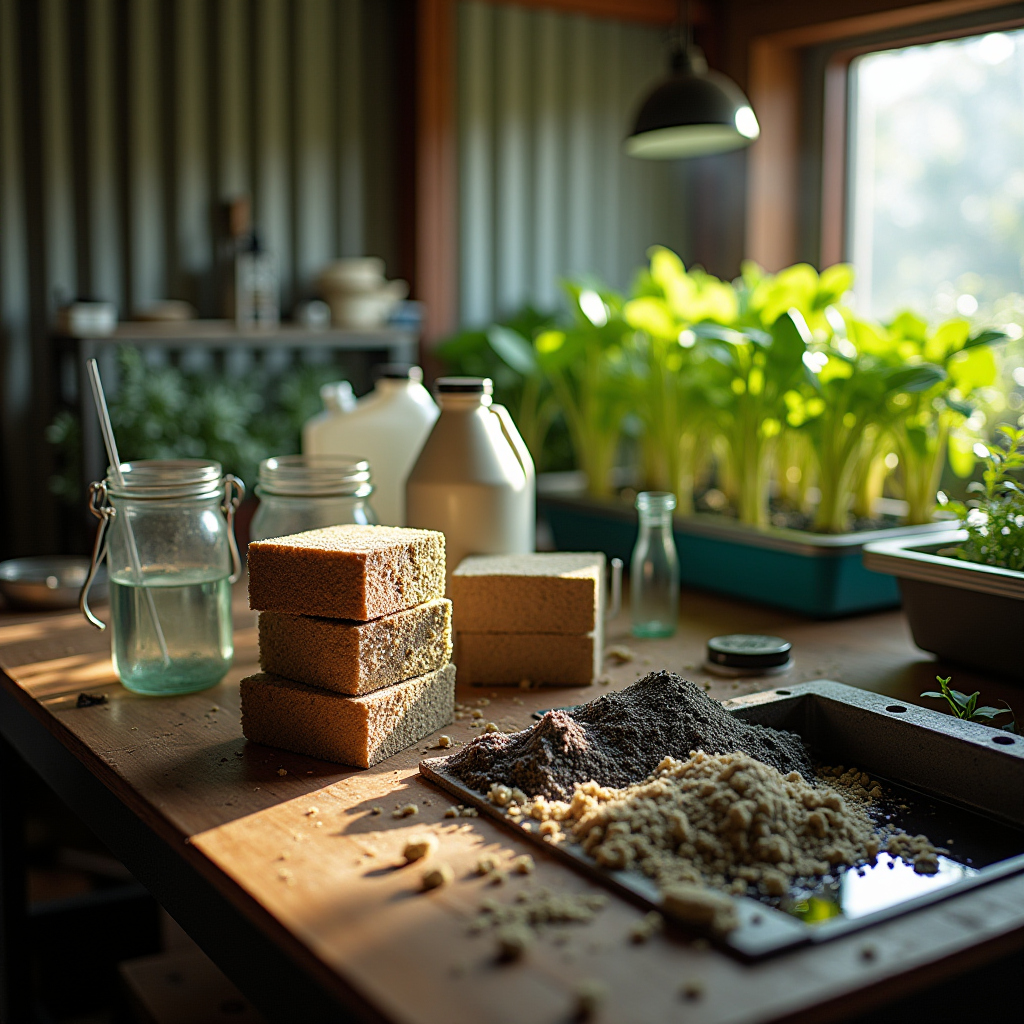
2. Process and validate local media (coir, rice hulls, pumice/perlite)
Rockwool and imported perlite are convenient but create the same forex and supply risk problems. Africa has ample alternatives: coir in coastal regions, rice hulls in rice belts, and pumice or expanded aggregates in volcanic zones.
2.1 Coco coir as a rockwool replacement
Coco coir is already used by many greenhouse tomato and leafy operations globally and is increasingly available in West Africa via coconut processors. For hydroponics, you need more than just "bag of coir":
- Leaching and buffering: raw coir often carries high potassium, sodium, and chloride. Require suppliers to wash to a runoff EC below 0.8 mS/cm and pre-buffer with calcium nitrate to stabilize the cation exchange complex.
- Particle size control: specify a blend of chips and pith suited to your system. NFT starter plugs need finer material; DWC rafts and drip bags can handle coarser mixes for more aeration.
- Microbial load: require a basic microbial test to screen for fungal pathogens. Pasteurization or steam treatment is ideal if the volume justifies it.
Set up a simple intake test: soak a 1 L sample of each new batch, measure runoff EC and pH, and visually check structure. Reject or blend down any batch that falls outside your set range.
2.2 Rice hulls for aeration and as a standalone media
Rice hulls are abundant in parts of Nigeria and Ghana, and they are a useful amendment or standalone media in systems where you need high aeration. To use them safely:
- Carbonization or parboiling reduces microbial load and improves stability.
- Blend strategy: mix hulls with coir (for example 30:70 hull:coir) to improve drainage in seedling trays and Kratky net pots.
- Sinking behavior: test how hulls behave in your actual system configuration. In DWC, you want a mix that stays in the net pot and does not float out into the reservoir.
Again, standardize. Do not let each harvest depend on whatever the mill sent you that month. Lock in a processing spec with one or two mills.
2.3 Local perlite alternatives (pumice, expanded aggregates)
Some regions in East and Southern Africa have pumice and other volcanic aggregates that can stand in for perlite. Requirements are straightforward:
- Crush and screen to the right particle size range (typically 1 to 4 mm for seedling trays and net pots).
- Wash to remove dust and fines, which otherwise clog NFT channels and reduce oxygen in DWC.
- Test for pH (aim near neutral) and soluble salts.
Used correctly, these aggregates can reduce dependence on imported perlite and give you a stable, reusable media option.
3. Set QA thresholds and contamination testing
Once you are sourcing locally, quality assurance is non negotiable. The aim is not perfection, it is predictability. You want every batch of nutrient salts and media to behave within known limits.
3.1 Define target and red-line values
For each input type, define:
- Nutrient salts: max heavy metals, max Na and Cl, minimum purity percentage.
- Media: maximum runoff EC and Na/Cl, pH window (for example 5.5 to 6.8), maximum moisture content for storage.
- Water: baseline EC, hardness, Na, Cl, and iron levels.
Use these values to decide when to accept, blend, or reject a batch. The exact numbers will depend on your local water and crops, but the key is to write them down and enforce them.
3.2 Build a testing model that fits your scale
You do not need a full lab in-house. Instead:
- Use simple handheld meters for daily pH and EC checks.
- Send quarterly samples of your main salts and media to a regional lab for heavy metals and impurities.
- Test your irrigation water at least annually or whenever you change source wells.
Agritech and lab services are expanding in the region, as noted in this overview of agri-tech in emerging markets. Partner with one of these outfits or with a university lab instead of trying to invent the wheel.
3.3 QA for DWC, NFT, and Kratky specifically
Each system exposes problems differently:
- DWC: impurity and Na/Cl issues show up fast as root browning and leaf edge burn because the roots are submerged continuously.
- NFT: particle contamination and biofilm clog channels; small shifts in EC or pH can quickly affect a whole lane.
- Kratky: static solutions make initial purity and pH range critical; there is no constant dilution or correction from a recirculating tank.
For each system type, define tolerance bands for pH drift and EC change per day. If a new batch of salts or media causes drift outside those bands, you know to investigate the inputs first.
4. Structure vendor agreements and labeling
Once you know what you want and how you will test it, lock it into your commercial relationships. This converts random local sourcing into repeatable backward integration.
4.1 Vendor technical specifications
For each vendor (fertilizer, coir processor, rice mill, aggregate supplier), create a 1 to 2 page spec that covers:
- Chemical specs (purity, heavy metal limits, Na/Cl limits).
- Physical specs (particle size distribution, moisture, packaging).
- Documentation (COA per batch, date of manufacture, batch code).
- Sampling method and dispute process when a batch is out of spec.
Make acceptance of these specs a condition of doing business. This protects both sides and gives vendors a clear target.
4.2 Labeling and repackaging rules
If you repackage salts or media for internal use or resale, you are stepping into a light manufacturing role. That means:
- Follow local labeling regulations for fertilizers or agricultural inputs (company name, composition, net weight, batch number, and safe handling instructions).
- Do not claim "food-grade" or "hydroponic-grade" unless your inputs and QA actually meet that standard.
- Keep traceability: every repack should be linked to the original supplier batch so you can trace issues back upstream.
This matters for brand trust and for food safety, especially when selling into supermarkets or export chains.
4.3 Pricing and risk-sharing
Design your vendor contracts to reflect the new reality:
- Agree on price adjustment formulas tied to local costs, not only dollar benchmarks.
- Include a mechanism for credit or replacement if a batch fails agreed specs.
- Offer volume commitments in exchange for better QA and processing investments from the vendor.
This is how you move from buying commodities to co-developing an input chain.

What To Watch Long-Term: Cost Curves, Variability, And Scale
Once you start backward integrating, the work shifts from "can we source locally" to "how consistent and cost-effective can we make this at scale". The region is already moving in this direction. Urban authorities and farmer recognition initiatives, like those highlighted by the Kumasi Metropolitan Assembly in this report on local farmers, signal growing institutional interest in modern, productivity-focused systems. Hydroponics will be part of that mix, but only if we keep standards high while reducing dependence on imports.
1. Cost model vs imports
Build a simple per-kg and per-m2 cost model comparing imported and local inputs.
- For nutrients, track total cost per 1 000 L of working solution at your target EC, including additives.
- For media, track cost per crop cycle per plant, factoring in reuse if possible.
- Include logistics, customs, and storage losses in your import costs. That is where local sourcing wins hardest.
Update this model each quarter so you see whether local suppliers are actually delivering the savings you expect.
2. Monitoring batch variability
The reality of local sourcing is that raw materials will vary. Your job is not to eliminate variability, but to detect and correct for it before it hits your plants.
- Track EC and pH behavior of each new nutrient batch in a test reservoir.
- Log plant response (growth rate, leaf color, root structure) against batch numbers.
- Use simple visual scoring: for example, root color and density in DWC, leaf size and uniformity in NFT.
Over time, you will spot patterns that link certain suppliers or treatment methods to better performance. Use that data to steer your contracts.
3. System-level risk controls
As you scale, do not let a single bad batch of salt or media take down the whole farm.
- Split sourcing: for critical salts, qualify at least two suppliers and split orders between them.
- Staggered mixing: never switch all reservoirs to a new batch on the same day. Start with one zone, watch performance, then roll out.
- Buffer stocks: keep at least one crop cycle of tested inputs in reserve so you have time to reject bad batches without shutting down.
4. Regulatory, food safety, and customer communication
Backward integration increases your responsibility for what goes into your crops, but it also gives you a stronger story for retailers and regulators.
- Align your heavy metal and contaminant limits with national food safety standards and, if you export, with buyer standards.
- Document your nutrient recipes, QA tests, and media processing steps. This is your proof of due diligence.
- Use this to support certifications or retailer audits. Many supermarket chains will value a local, transparent input chain as much as they value “imported” labels.
Agri-tech startups in Africa are already building services around traceability and input management, as discussed in this analysis of emerging agri-tech models. Plug into those tools where it makes sense.
5. Continuous improvement: from pilot to platform
Your first year of backward integration is essentially a pilot. Treat it as such. Set clear targets:
- Reduce nutrient cost per 1 000 L by 20 to 40% vs imported mixes.
- Localize at least 60% of your media volume without yield loss.
- Document zero food safety incidents linked to inputs.
Review outcomes annually, adjust specs, and deepen relationships with suppliers that hit the mark. Over time, that network of local salt producers, media processors, labs, and growers becomes an asset of its own. It is the backbone that lets West and Southern African hydroponic farms ride out currency swings, shipping chaos, and policy shifts while still delivering consistent, high-quality crops.
That is the real promise of backward integration for hydroponics in Africa: not just lower cost, but control.

As an Amazon Associate, I earn from qualifying purchases.