Aeroponics vs NFT on Vertical Racks: Which One Actually Lets You Ignore It For a Week?
If your “set-and-forget” herb rack needs babysitting twice a day, it is not automated - it is a fussy pet with LEDs. As vertical farms experiment with humanoid robots and high-end control systems, small growers need something more realistic: vertical racks that run clean, stable, and productive with very little touching.
This article strips the debate down to what matters for compact indoor racks growing herbs:
- How to size NFT flow rates correctly so channels do not stagnate or flood
- How to choose aeroponic nozzles and droplet sizes that grow roots instead of biofilm
- How to lay out manifolds on a rack so clogging and airlocks do not cripple a whole tier
- How to run simple, low-touch clean-in-place (CIP) routines so you are not scrubbing slime every weekend
- Where to put sensors so your automation actually sees problems before your basil collapses
We will stay focused on indoor herbs (basil, mint, coriander, parsley) on 2-3 tier racks in apartments, garages, and micro-farms - not warehouse megafarms.
The Problem: Pretty Racks, Ugly Roots
Most home and micro vertical setups fail in the same few ways:
- Leggy herbs and weak flavor because channels are too deep or roots are constantly waterlogged.
- Root rot and slime from warm, slow-moving nutrient films or aeroponic chambers that run more like fog machines than oxygen systems.
- Clogged misters and uneven flow that turn half your rack into a drought zone and the other half into a swamp.
- pH and EC swings because reservoirs are small and hidden, so you check them “when you remember”.
- Maintenance burnout: hand-scrubbing channels, pulling nozzles, and bleaching everything every crop cycle.
On NFT racks, the typical failure pattern is:
- The pump is oversized, so you throttle it with a ball valve.
- Some channels get plenty of flow while the top tier barely trickles.
- Film depth varies wildly, creating wet anaerobic root mats near the inlet and dry roots near the outlet.
On aeroponic racks, the problems are different but just as predictable:
- Nozzles are chosen by price, not droplet size, so you get coarse streams that drench roots and metal fittings that corrode or clog.
- The manifold is a dead-end ladder of tees, so pressure and spray pattern are totally different from top to bottom.
- The system is almost impossible to sanitize without full teardown.
The result: inconsistent yields, constant tweaking, and a system that you do not trust to run while you are away for a long weekend.

The Cause: Hydraulics, Droplets, and Dirty Plumbing
NFT on Racks: The Film Is Not a Film
In theory, Nutrient Film Technique runs a thin, oxygen-rich sheet of nutrient over bare roots. In practice on small racks, most growers run more like shallow Deep Water Culture in a tube.
Research and extension guides on NFT suggest target flow rates around 0.5-2.0 L/min per channel for leafy crops, depending on channel length and plant load, to maintain a thin film without flooding roots [Cropologies NFT design guide], [Virginia Tech NFT production guide].
On compact indoor racks, the common causes of failure are:
- Oversized pumps feeding multiple channels from one line with no proper flow balancing.
- Insufficient slope (less than 1 percent) so water pools, warms up, and goes anaerobic, promoting Pythium and other root pathogens.
- Long runs (over 4-5 m equivalent) with many elbows that stack back-pressure and create uneven distribution across tiers.
Aeroponics: Great Oxygen, Bad Implementation
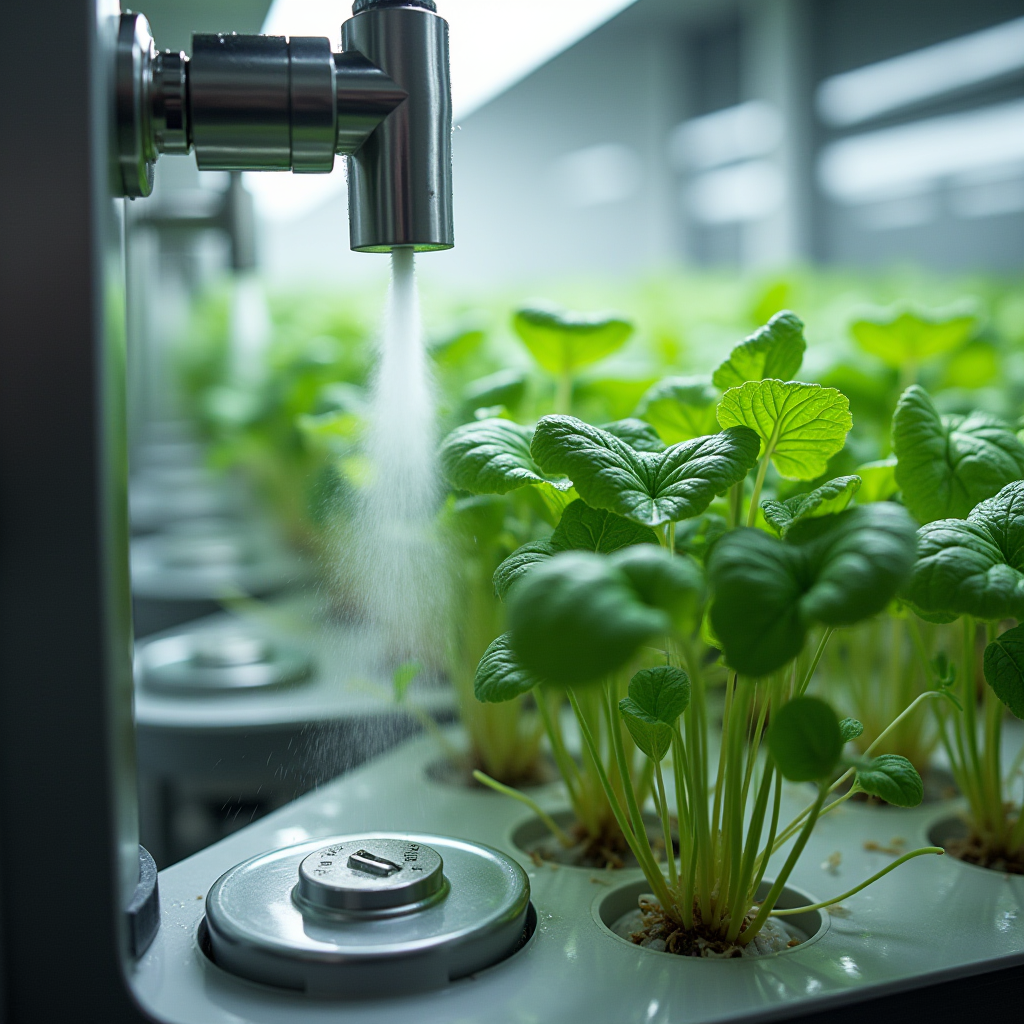
Aeroponics can deliver very high oxygenation and fast growth if droplet size, spray interval, and chamber design are tuned. Studies on aeroponic systems highlight that fine droplets in the tens of microns, combined with intermittent cycles, support rapid root growth and nutrient uptake [smart aeroponic system study], [aeroponic design review].
Small rack systems usually get three things wrong:
- Droplet size is uncontrolled. Cheap micro-sprinklers produce 100+ micron droplets or jets that soak roots. That kills the oxygen advantage and increases disease risk.
- Nozzle count vs pump pressure is mismatched. Add a few extra nozzles and suddenly pressure drops, coverage suffers, and some plants only get a mist when another nozzle shuts off.
- Dead legs and blind manifolds keep pockets of nutrient sitting still. Those become biofilm factories and are hard to sanitize without dismantling the rack.
Sanitizing: Biofilm Always Wins If You Ignore the Plumbing
Both NFT and aeroponic racks silently grow biofilms in:
- Undersides of channel lids
- Low-flow corners in manifolds
- Nozzle bodies and small barb fittings
- Return lines with poor slope or standing water
Once those biofilms are established, they drive pH drift, clog emitters, and host pathogens. As noted in hydroponic design references, designing for easy flushing and sanitation is as important as yield-focused design [Open Source Ecology hydroponic design notes], [InHydro system selection guide].

The Solution: Dialed-In Design For Low-Touch Racks
1. Decide: Aeroponics or NFT For Indoor Herbs?
For compact multi-tier racks with herbs, choose based on how much complexity you want to manage:
- NFT - Fewer moving parts, easier to troubleshoot, tolerant of minor design mistakes. Best for growers who want “set-and-check” rather than “tune every parameter”.
- Aeroponics - Higher potential growth rates and better root oxygenation, but demands better filtration, nozzles, manifolds, and housekeeping. Best if you like engineering and want maximum yield per square meter.
For most first-time vertical rack herb growers, start with a cleanly designed NFT and add aeroponic tiers later.
2. NFT Channel Flow Rate and Layout
Use these practical rules for racks up to 3 tiers, with herbs in 60-100 mm wide channels.
- Channel slope: 1-3 percent (1-3 cm drop per meter) to keep a moving film and prevent pooling.
- Flow per channel: Aim for 0.75-1.5 L/min for 1-2 m long herb channels with 8-12 plants, within the commonly recommended 0.5-2 L/min per channel range [Cropologies NFT design guide], [Frontiers NFT review].
- Header pipe: Run a main 19-25 mm line up the side of the rack, then tee off with short drops and valves to each channel. This beats daisy-chaining channels and gives per-channel tuning.
- Return lines: Oversize them (at least as big as the supply header) and keep a steady downward slope back to the reservoir to avoid standing water.
To set the pump:
- Count your channels (say 6 channels).
- Pick a target of 1.0 L/min per channel. That is 6 L/min total.
- Add 30-40 percent overhead for head height and valves, so size for roughly 8-9 L/min at your rack height.
- Use a pump with a performance curve, then test actual flow with a jug and timer, trimming with valves until each channel hits target.
3. Aeroponic Droplet Size and Nozzle Selection
For vertical rack herbs, you are not chasing ultra-high-pressure, laboratory-grade aeroponics, but you still want droplets small enough to keep roots oxygenated rather than waterlogged. The research on aeroponic systems shows that fine droplets in the approximate 30-80 micron range are a sensible target for productive systems, balancing mist quality and clog resistance [smart aeroponic system study], [aeroponic design review].
Practical guidelines:
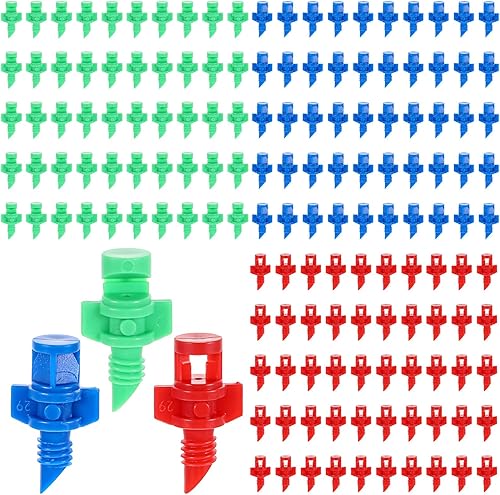
- Nozzles: Choose misters rated for fine droplets and designed for cleanable orifice inserts. Avoid coarse micro-sprinklers that shoot visible jets or heavy streams.
- Pressure: Most low-pressure aeroponic misters work around 20-40 psi. Check the manufacturer droplet specs at your operating pressure.
- Filtration: Place a 100-200 micron filter before the manifold to keep grit and precipitates out of nozzles.
- Cycle timing: For herbs, start with 5-10 seconds on, 2-4 minutes off. Short bursts keep roots moist without building up water films.
4. Manifold Layout for Even Coverage
Think plumbing, not just hoses. Goals: even pressure, no dead ends, and easy flushing.
NFT headers
- Run a vertical main riser alongside the rack.
- At each tier, tee off horizontally to a short header feeding that tier’s channels.
- Include a flush valve at the bottom of the riser so you can blast cleaning solution through all lines in one go.
Aeroponic manifolds
- Aim for loop manifolds instead of dead-end ladders. Connect both ends of the manifold back to the feed so pressure equalizes.
- Limit each circuit to a reasonable number of nozzles based on pump capacity, then add additional circuits instead of endlessly branching one line.
- Add quick-disconnects and unions so manifolds can be removed for periodic deep cleaning without cutting tubing.
5. Low-Touch CIP (Clean-In-Place) Routines
You want your CIP to look like this:
- Drain nutrient.
- Fill with sanitizing solution.
- Run on a timed loop to hit every surface.
- Drain, rinse, refill with clean nutrient.
Concrete protocol for herbs on racks:
- Between crops: Remove plants and media, then run a 1-2 percent hydrogen peroxide or food-safe peracetic acid solution through the system for 20-30 minutes. For aeroponics, cycle misters as normal so chambers and nozzles are fully contacted.
- Mid-crop maintenance (every 3-4 weeks): After a drain, run a weaker solution (for example 0.3-0.5 percent hydrogen peroxide) for 10-15 minutes, then rinse and refill. This helps keep biofilm under control without full teardown.
- Design detail: Slight extra slope on channels and return lines plus low points with drain or flush valves make these CIP cycles quick and thorough.
Always check compatibility of sanitizers with your plastics, pumps, and seals. Many commercial vertical farms use similar oxidizing agents in automated CIP loops, because they are effective on biofilms and relatively residue-free when flushed properly [vertical farming system design overview].
6. Sensor Placement That Actually Helps Automation
All the automation in the world is useless if sensors are in the wrong place. For compact herb racks:
- Reservoir: Put pH and EC probes in the main reservoir, ideally in a small recirculation loop where solution is always moving. Maintain typical herb ranges of pH 5.5-6.5 and EC 1.2-1.8 mS/cm, consistent with general hydroponic nutrient recommendations [InHydro system selection guide].
- Temperature: Place one probe in the nutrient solution and one in the grow zone air. For most herbs, keep nutrient around 18-22°C and air around 20-24°C to balance growth and disease suppression.
- Flow and level: Add a float switch or ultrasonic level sensor in the reservoir, and optional simple flow switches on the main feed to detect pump failures or clogged filters.
- Light and humidity: A simple PAR or lux sensor at canopy height and a humidity sensor on the rack (away from direct mist) let you adjust LED height and ventilation to avoid leggy growth and fungal pressure.
Tie these into simple alerts: low level, no flow, or out-of-range pH/EC should notify you long before plants show stress.
Evidence: What The Data Says (So You Are Not Guessing)
To keep this practical, here are the key evidence-based anchors for your design decisions.
NFT flow and film behavior
- Academic and technical sources for NFT systems consistently recommend 0.5-2.0 L/min per channel, with slope around 1-3 percent, to maintain a thin flowing film that supplies both nutrients and oxygen [Cropologies NFT design guide], [Virginia Tech NFT guide], [Frontiers NFT review].
- Design work on NFT for urban and small-scale systems confirms that keeping solution depth shallow and flowing reduces root disease and improves oxygenation compared with deep channels or stagnant pockets.
Aeroponics, droplet size, and root performance
- Studies on smart aeroponic systems and root imaging show that fine droplets and intermittent cycles lead to highly branched, oxygenated root systems with fast nutrient uptake [smart aeroponic system study], [aeroponic design review].
- These same studies highlight practical limitations: nozzle clogging, uneven spray due to poor manifold design, and maintenance burden if CIP is not built in from the start.
Nutrient, pH, and EC targets for herbs
- General hydroponic system guides recommend pH 5.5-6.5 and moderate EC levels around 1.2-1.8 mS/cm for leafy greens and herbs, giving good nutrient availability without salt stress [InHydro system selection guide].
- Vertical farming design resources emphasize that actively monitored and controlled pH/EC, along with appropriate nutrient temperature, reduces disease pressure and stabilizes yields [Open Source Ecology design notes], [vertical farming system design overview].
Automation and CIP in vertical systems
- Vertical system design literature notes that integrating sensors (pH, EC, temp, flow) and automated dosing reduces labor and human error and allows higher planting densities [vertical farming system design overview].
- Smart aeroponic prototypes combine high-frequency monitoring with automated misting intervals and demonstrate stable yields with reduced water and nutrient consumption when properly maintained [smart aeroponic system study].
Translated into action for small racks: if you control flow, droplet size, and cleaning, you are 90 percent of the way to “robot-grade” stability without the robot.
Putting It All Together
If you want a vertical rack that can survive a winter of heavy indoor production without eating your weekends:
- Pick NFT if you want simple and stable; pick aeroponics only if you are ready to manage nozzles and manifolds.
- Size NFT flows in the 0.75-1.5 L/min per channel range, with 1-3 percent slope and balanced headers, not daisy chains.
- For aeroponics, choose fine-droplet misters, filter upstream, and build loop manifolds you can flush.
- Design CIP from day one with drain points and oxidizing sanitizers you can circulate on a timer.
- Put your sensors where the water and air actually mix, not where it is convenient to mount them.
Vertical farms may bring in robots to tweak valves and swap trays. You do not need one. You just need sound hydraulics, clean plumbing, and a bit of automation so your herbs taste like basil and not like regret.

As an Amazon Associate, I earn from qualifying purchases.