Aeroponics vs NFT for Vertical Basil & Greens: Clean Roots, Low Maintenance, and Robot‑Friendly Design
If your basil roots look like a plate of overcooked spaghetti wrapped in brown slime, it is not “just hydroponics” - it is your system design telling you it is not future-ready.
As humanoid robots and semi-autonomous carts start creeping into vertical farms, the boring details - pipe diameter, nozzle type, channel slope, sensor access - suddenly matter a lot. The good news: the same design moves that keep robots happy also give home and small-scale growers what we really want for basil and leafy greens:
- Clean, white roots with high oxygen
- Minimal biofilm and clog risk
- Predictable, low-maintenance workflows
- A layout that can be serviced by humans today and robots tomorrow
In this article, we will stay focused on one decision: aeroponics vs NFT for vertical farming hydroponics, specifically for basil and leafy greens in indoor racks.
The Problem: Slimy Roots, High Touch Systems, Unhappy Racks
Most small vertical growers start with the same story:
- Vertical PVC NFT rails slapped onto a rack
- Or a DIY “aeroponic” tower that is really just a leaky sprinkler column
And then the pain starts:
- Root rot and biofilm in the lower channels or at the bottom of towers
- Clogged emitters that silently starve a whole row overnight
- Constant cleaning of slime-coated pipes, pumps, and returns
- pH and EC drift as reservoirs run warm and gunky
- Leggy basil and lettuce that stretches under weak or uneven lighting
With vertical stacking, every failure multiplies. A blocked line on level three can stress four levels below it. For humanoid robot workflows, this is a nightmare: there is no simple “go wipe the gunk” command if your plumbing is inconsistent, opaque, or buried behind improvised fittings.
Real-world headaches that show up in both hobby and pilot-scale racks:
- Dead corners in NFT channels where water slows and biofilm thrives, especially if the slope is shallow or uneven, as noted in this NFT guide.
- Misting nozzles choking on fine root hairs or tiny bits of media in budget “aeroponic” systems, leading to dry roots and wilted crops.
- Overheated solution in small indoor reservoirs, pushing root-zone temperatures above 22 °C and inviting Pythium and other root pathogens, a common risk highlighted in NFT/DWC comparisons like this breakdown.
- Manual checks everywhere - you need eyes and hands on every level to confirm flow, spray pattern, and root condition.
On paper, both aeroponics and NFT are fantastic for basil and leafy greens. In practice, bad implementation turns them into “biofilm generators.” For automation, that is a non-starter.

The Cause: Root Environment, Flow Geometry, And Service Access
When you strip away brand names and marketing, aeroponics vs NFT is really a question about how you expose roots to three things:
- Water and nutrients
- Oxygen
- Mechanical stress and contamination
Aeroponics: Mist Quality, Nozzles, And Failure Modes
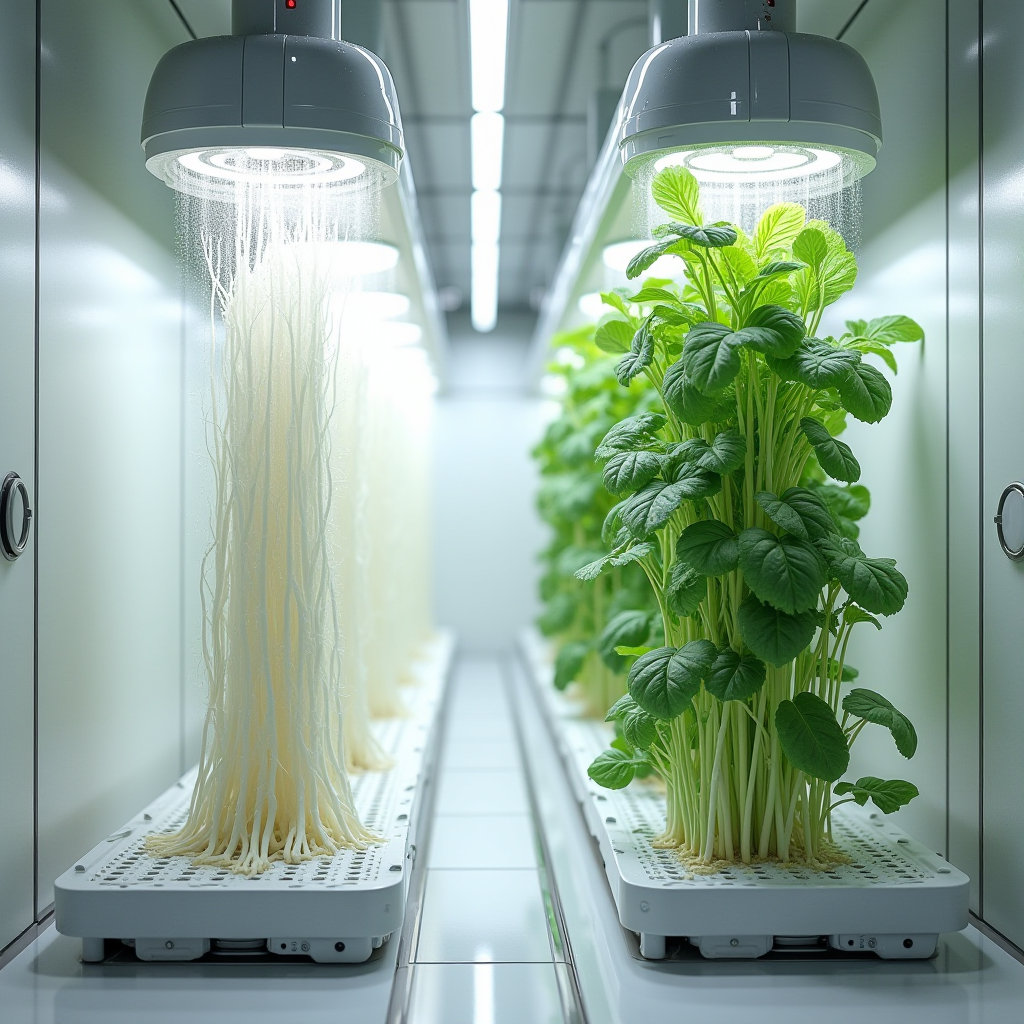
In true aeroponics, roots hang in air and see a fine mist of nutrient solution. This gives them maximum oxygen and very fast growth when tuned correctly, as outlined in comparisons like this Eden Green explainer.
The catch: the entire system rides on nozzle performance and mist interval timing.
- Fine-orifice nozzles (good for real fog-like mist) clog easily with any biofilm, precipitated salts, or micro-debris.
- Cheap “sprinkler” heads give coarse droplets, wetting roots heavily and turning the lower chamber into “NFT in a bucket,” losing the aeroponic advantage.
- High pressure creates beautiful mist but punishes any design sloppiness: tiny particles, scaling, or poor filters mean frequent manual intervention.
- Pump/nozzle failure is unforgiving: roots can dry out and stress within 15-30 minutes under warm indoor conditions.
For humanoid robots, this is a maintenance trap: reading a flow sensor is easy, diagnosing a partially clogged nozzle hidden inside an opaque chamber is not.
NFT: Channel Hydraulics, Oxygen, And Biofilm
In NFT, roots sit in a channel with a shallow stream of nutrient solution flowing past them. It is simpler, lower pressure, and extremely well suited to basil and leafy greens, as highlighted in thorough NFT guides like this one.
The hidden problems usually come from basic geometry and material choices:
- Undersized channels that choke with root mass halfway through a crop cycle.
- Wrong slope (too flat or uneven) that creates pooling, low oxygen, and warm pockets where pathogens thrive.
- Opaque vs translucent plastics - translucent pipe lets in light, driving algae growth that coats everything and feeds biofilm.
- Poorly designed returns that splash and aerate poorly, or trap air and cause gurgling and intermittent flow.
Unlike aeroponics, NFT is graceful under partial failure. If flow slows, roots still stay wet long enough to survive while you fix it. That is exactly the kind of fault tolerance you want for semi-autonomous racks.
Environmental Control: pH, EC, And Temperature
Whether you go aeroponics or NFT, three numbers dictate your basil and leafy greens performance:
- pH: keep it around 5.5-6.5 for basil and most leafy greens, which matches typical recommendations for hydroponic systems in guides like this comparison.
- EC: 1.2-2.0 mS/cm is a safe working range for basil, lettuce, and similar greens, trending toward 1.2-1.6 for young plants and 1.6-2.0 for mature heads. This aligns well with many vertical farm nutrient benchmarks collected in recent hydroponics reviews such as this overview of hydroponics in sustainable crop production.
- Solution temperature: 18-22 °C is the sweet spot; above 24 °C, oxygen solubility drops and root pathogens gain ground.
Aeroponics has a slight edge on oxygen due to the air-exposed roots, but it is also more sensitive to temperature swings and mist timing. NFT buffers those swings with the thermal mass of circulating solution.
Serviceability And Robot Compatibility
From a design-for-robots lens, NFT has a structural advantage:
- Channels and manifolds can be made visually inspectable with removable lids or clear inspection windows, while still blocking light with covers.
- Flow sensors, level sensors, and valves are standard industrial parts that integrate cleanly into PLCs or robotic control systems.
- Cleaning is predictable: flush channels, sanitize, inspect, repeat. A humanoid robot can be tasked with opening end caps, aiming a sprayer, and re-seating seals.
- Aeroponic chambers, in contrast, bury critical components (nozzles, manifolds) inside opaque housings that are hard for both humans and robots to access without disassembly.
So the real “cause” of most headaches is not that aeroponics or NFT are inherently bad. It is that aeroponics amplifies small design flaws, while NFT exposes poor hydraulics and light management. Both issues scale badly in tall racks.

The Solution: NFT‑First Racks, “Soft” Aeroponics, And Robot‑Ready Details
For basil and leafy greens in vertical farming hydroponics, the most practical path is:
- Standardize on NFT as your backbone for main production.
- Use low-pressure “soft aeroponics” only where it really adds value (nursery / propagation, or specific high-oxygen-demand stages).
- Design every rack, pipe, and channel so a human or humanoid robot can see, reach, and replace the critical parts.
1. NFT‑First Design For Basil & Greens
If you are building or upgrading an indoor hydroponics system for basil and leafy greens, start with a clean NFT base:
- Channel size: for basil and lettuce, aim for channels 70-100 mm wide with enough depth for roots to spread without fully blocking flow.
- Slope: 1-3% (1-3 cm drop per meter) to keep a consistent thin film without pooling. Verify with an actual level, not your eyeballs.
- Opaque, smooth interiors: food-grade PVC or similar, no internal ribs. Keep light out to starve algae.
- Modular lengths: 1-2 m sections with quick-connect couplings and accessible end caps, so a single channel can be removed by hand or by a robot with a simple gripper.
- Dedicated nursery stage: do not drop tiny seedlings straight into long production channels. Use net pots or plugs in a short, high-flow nursery rail or a DWC/Kratky nursery, then transplant once roots are strong.
For basil specifically:
- pH: 5.8-6.2
- EC: 1.4-1.8 mS/cm for vegetative growth; avoid pushing higher unless you are dialed in.
- Light: 14-18 hours/day under consistent PPFD in the 200-350 µmol/m²/s range for leafy production; bump slightly higher if you are aiming for dense, aromatic basil with strong essential oil content.
2. “Soft Aeroponics” Where It Helps, Not Everywhere
Pure high-pressure aeroponics is touchy and maintenance-heavy. For a robot-friendly, low-maintenance rack, a smarter play is soft aeroponics in a controlled zone:
- Use low-pressure, larger-orifice sprayers in a nursery chamber or a short vertical section where seedlings establish roots.
- Keep the system fully drainable, so you can run a cleaning cycle (acid rinse, sanitizing flush) that a robot can trigger and monitor with sensors.
- Pair every spray manifold with inline filtration and a pressure gauge. If pressure drops, a robot can flag “maintenance required” before seedlings dehydrate.
- Move plants from soft-aero nursery to NFT production once root mass is resilient and more tolerant of minor flow variations.
This hybrid strategy keeps the high-touch complexity contained in a small, accessible zone instead of spread across every tier.
3. Plumbing & Layout That Stay Clean
Regardless of system type, make the following non-negotiable for indoor hydroponics system design:
- Single main reservoir per rack module, not one random tote per level. Fewer reservoirs = easier nutrient control and automation.
- Straight runs, gentle bends: Tidy manifolds and minimal fittings lower dead spots where biofilm can anchor.
- Quick-disconnect unions at logical break points so robots (or you) can isolate and swap pieces without cutting pipe.
- Service corridors at the back or side of racks for pumps, sensors, and drains, all at a comfortable height.
- Standardized components across racks: same pumps, channel profiles, net cups, and hose diameters, to reduce inventory and simplify robotic tooling.
4. Nutrient, pH, And EC Management That Scales
To keep roots clean for the long haul, treat nutrient management like a process line, not a hobby bucket:
- Use a two-part or three-part hydroponic nutrient formulated for leafy greens, and mix to target EC using a reliable meter.
- Keep a tight pH window: adjust daily or automate adjustments so pH stays within 5.7-6.2 for most basil and salad mixes, as recommended in hydroponics comparisons like this aeroponics vs hydroponics guide.
- Log EC and pH over time. Even simple data helps you predict top-off volumes and nutrient additions for each rack size.
- Run regular sterilization cycles between crops: drain, rinse, sanitize (e.g., peracetic acid at appropriate dilution), flush, refill.
These practices keep biofilm in check and make your racks predictable enough for a robot to manage with simple rules.
5. Lighting & Vertical Geometry For Basil And Leafy Greens
Finally, do not sabotage perfect root zones with bad lighting. For multi-level basil and greens:
- Use full-spectrum LED bars or panels mounted per tier, sized so every plant sees uniform coverage.
- Design vertical spacing so your tallest crop sits 20-35 cm below the light at maturity.
- Standardize on runtimes: 14-18 hours/day for leafy greens, synced across racks so timers and future robotic schedules are predictable.
Uniform lighting makes the whole system easier to model, automate, and scale.
Bottom Line: Which Should You Choose?
For basil and leafy greens in vertical racks:
- Choose NFT as your primary production system if you care about low maintenance, fault tolerance, and easy integration with humanoid or semi-autonomous workflows.
- Add soft aeroponics in the nursery if you want faster starts and ultra-clean early root development, but keep it simple and accessible.
- Whatever you build, design it so a robot could service it: clear access, standard parts, easy sensor placement, and predictable cleaning routines.
Get the hydraulics and layout right, keep your pH and EC steady, and your roots will stay white, your basil will stay bushy, and your racks will be ready for the day the robot shows up with a wrench.